Your ghost town road trip to Golden, Utah requires serious preparation and a spirit for adventure. You’ll need a high-clearance 4WD vehicle loaded with extra supplies, as the journey winds south from Wendover on Alternate Highway 93 before threading eastward on increasingly narrow gravel roads through Deep Creek Valley. Plan your visit during spring or fall to avoid scorching summers and winter road closures that seal Granite Creek Canyon from December through May. Once there, you’ll discover crumbling mining structures, weathered foundations, and a windswept cemetery alongside modern mobile homes that keep this settlement hovering between abandonment and survival—and there’s much more waiting beyond Golden’s dusty paths.
Key Takeaways
- Visit during spring (March-May) or fall (September-November) to avoid scorching summer heat and winter road closures from December through May.
- A high-clearance 4WD vehicle is required to navigate rocky washes, rutted passages, and unpaved roads throughout Deep Creek Valley.
- Begin in Wendover, travel south on Alternate Highway 93, then head eastward on narrowing gravel roads through the 4-mile-wide Deep Creek Valley.
- Extend your trip to nearby Clifton (4.5 miles south of Gold Hill) and Terrace to explore additional authentic mining ruins and structures.
- Pack extra supplies, verify vehicle maintenance, inflate spare tires, and bring survival gear since cell signals fade in this remote location.
Discovering the Mining Legacy of Golden, Utah
Tucked into a remote canyon along the San Rafael River, Golden emerged in the 1890s when prospectors discovered gold deposits glinting in the sun-scorched hills of Emery County. You’ll find remnants of their dreams scattered across the landscape—crumbling stone foundations and rusted equipment marking where mining operations once thundered through the desert silence.
The abandoned mills stand as skeletal monuments to boom-and-bust ambition, their weathered timbers still defiant against relentless winds. When you explore these sites, you’re walking the same dusty paths those fortune-seekers carved into unforgiving terrain. They chased liberation through gold, staking claims in a wilderness that promised wealth to those brave enough to extract it from solid rock.
How to Reach Golden in the Deep Creek Mountains
Reaching Golden demands commitment to isolation, as the ghost town sits deep within a valley where cell signals fade and pavement becomes memory. You’ll launch from Wendover, pushing south on Alternate Highway 93 before threading eastward on gravel arteries that narrow with each mile.
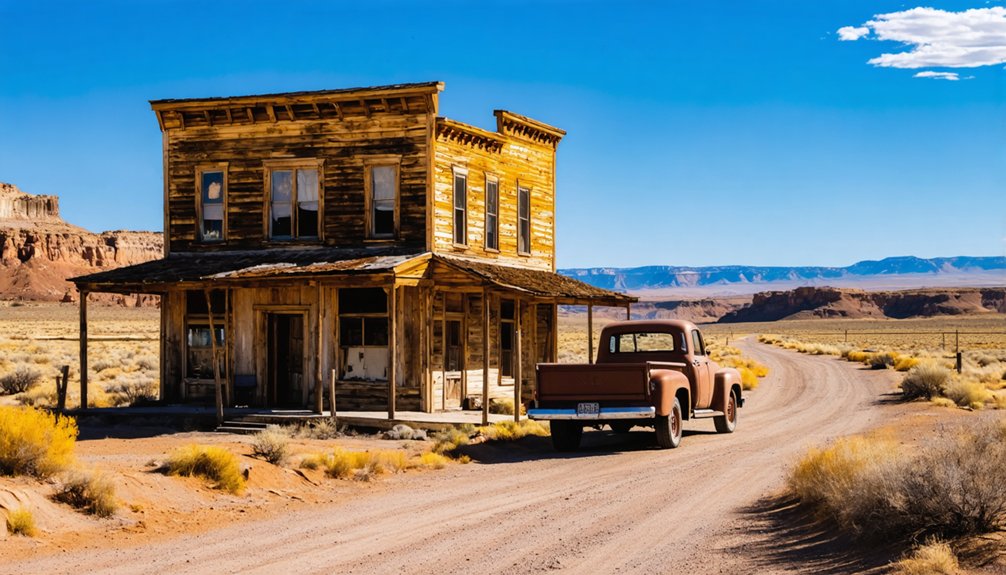
The 4-mile-wide Deep Creek Valley channels you through a labyrinth of dirt tracks—past Gold Hill’s weathered structures, beyond the Pony Express trail, into Snake Valley’s emptiness. High clearance vehicle requirements aren’t suggestions here; rocky washes and rutted passages punish street cars mercilessly.
Seasonal road closures seal Granite Creek Canyon from December through May, transforming winter journeys into snowbound impossibilities. This isn’t recreational driving—it’s calculated exploration where preparation determines whether you’ll witness Golden’s remnants or simply turn back defeated.
Must-See Historic Sites and Abandoned Buildings
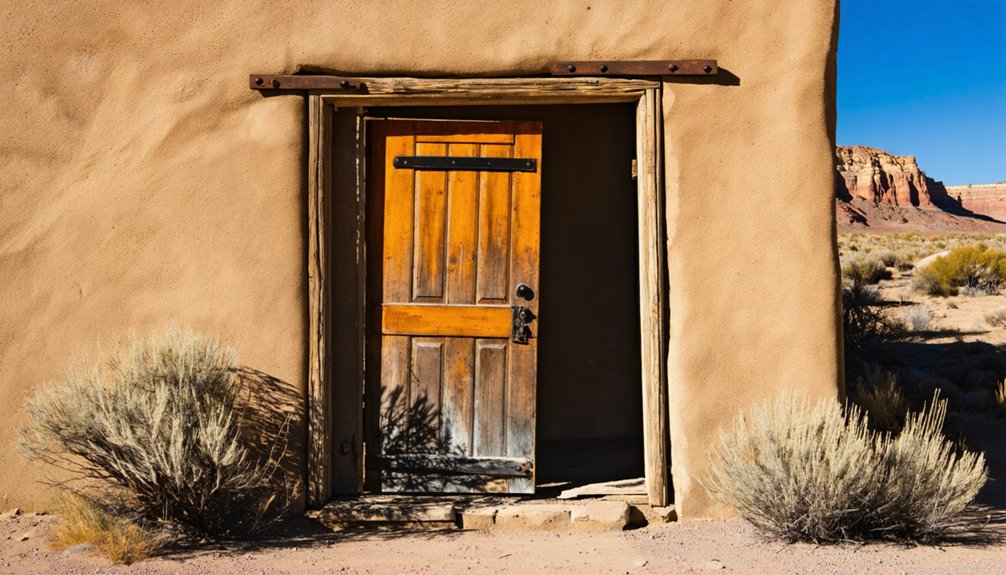
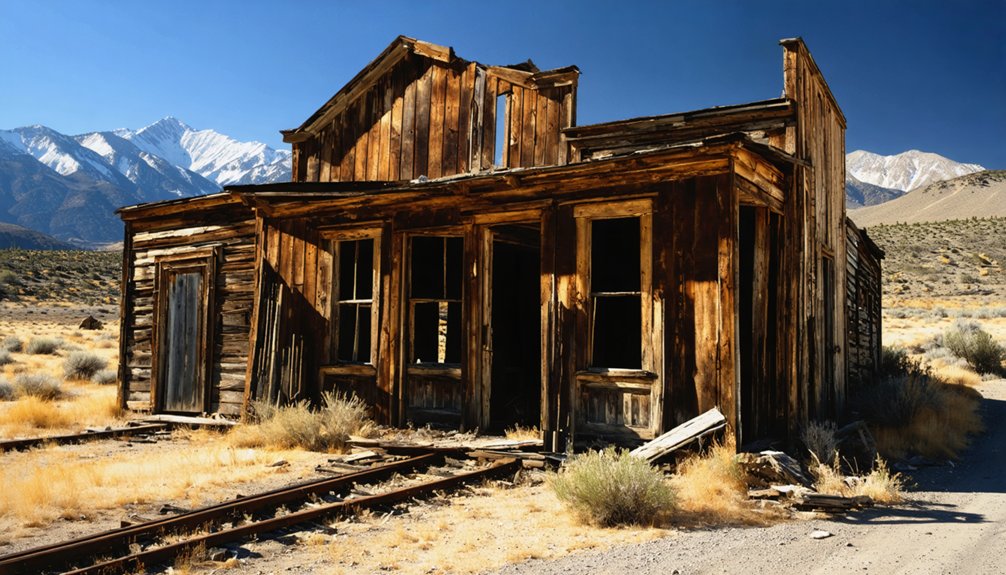
Golden’s skeletal remains tell their story through absence—walls that surrender to gravity, foundations where fortunes dissolved, timber frames bleaching under relentless sun. You’ll wander past crumbling stone structures where miners once slept, their dreams of riches now dust scattered across sagebrush flats.
The cemetery sits windswept on a hillside, headstones marking lives cut short by harsh frontier reality.
While Golden itself offers raw abandonment, nearby Promontory Summit delivers context through historic railroading displays. There, you’ll witness where transcontinental railroad construction culminated in 1869—the golden spike ceremony that connected a nation. Full-scale locomotive replicas demonstrate the iron horses that conquered these mountains.
The contrast strikes deep: Golden’s silent decay versus Promontory’s preserved triumph, both testifying to ambition’s double-edged sword.
What Makes Golden a Semi-Ghost Town Today
You’ll notice Golden hasn’t surrendered to complete abandonment—a handful of determined residents still call this weathered settlement home, their presence keeping it from slipping into full ghost town status.
Modern mobile homes now stand where original structures once lined the dusty roads, replacing the town’s historic architecture with utilitarian shelter. The surrounding hills hold untapped mineral deposits that occasionally spark whispers of revival, though whether Golden will rise again or continue its slow fade remains uncertain.
Persistent Population Despite Decline
The semi-ghost town classification fits Golden like a weathered work glove—snug around the edges but showing plenty of holes. You’ll find a handful of residents clinging to this forgotten outpost, their persistence rooted in family lineage that predates the mining collapse.
While Millard County grows at 6.1% and neighboring towns boom, Golden’s population hovers stubbornly near zero growth, sustained by ranchers and agricultural diehards who’ve mastered survival on scraps.
What keeps them here? Regional resilience bred from generations of making do. Low living costs matter when you’re willing to trade convenience for elbow room.
The community maintains skeletal infrastructure—enough to prevent total abandonment but not enough to attract newcomers. They’re not waiting for revival; they’re living on their own terms.
Mobile Homes Replace Originals
Why does Golden feel more like a trailer park dropped onto history’s bones than a preserved mining camp? You’ll discover the answer when you see twelve mobile homes occupying lots where saloons and boarding houses once stood. The demographic changes began in 1952, when the first trailers replaced forty log cabins—a practical solution for housing remaining miners without restoration costs.
Untapped Resources Fuel Hope
Despite housing barely forty year-round residents, Golden hasn’t surrendered to complete abandonment because whispered promises of mineral wealth keep trickling through its dusty streets. You’ll sense the cautious optimism when locals mention unexplored veins running beneath these weathered hills. Old-timers speak of geological surveys suggesting untapped deposits, their eyes gleaming with the same fever that built this town generations ago.
The conversation’s shifting now—sustainable development options replace the old boom-or-bust mentality. You’ll hear talk of responsible extraction methods, heritage tourism possibilities, and mining jobs potential that wouldn’t sacrifice Golden’s character for profit. It’s a delicate balance between preserving what remains and embracing opportunity. This tension between ghost town romance and economic revival keeps Golden suspended between past and future, neither fully abandoned nor thriving.
Exploring Nearby Ghost Towns: Clifton, Eureka, and Beyond
While Golden serves as your base camp for desert exploration, the surrounding landscape harbors a constellation of forgotten settlements that tell the broader story of Utah’s mining frontier. Just 4.5 miles south of Gold Hill, Clifton beckons with authentic remnants untouched by historic preservation efforts—Oliver Young’s log cabin stands sentinel over collapsed structures and an overgrown cemetery where William R. Sheldon rests.
Your exploration reveals:
- Storage dugout carved into hillsides behind Young’s cabin
- Cemetery containing personal narratives from former residents through weathered headstones
- Mine shafts scattered across Deep Creek Mountains
- Foundation ruins marking where hotels and saloons once thrived
The accessible dirt roads let you wander freely through boom-and-bust cycles frozen in time, experiencing Utah’s mining legacy without barriers or entrance fees.
Best Routes and Itineraries for Ghost Town Enthusiasts

Three distinct routes transform Golden into a strategic waypoint on Utah’s ghost town circuit, each offering progressively ambitious expeditions through the state’s mining heritage.
Your weekend warrior loop connects Grafton’s photogenic structures with Silver Reef’s preserved sandstone buildings, covering approximately 200 miles of mostly paved roads.
The five-day prospector’s trail weaves through Eureka’s intact downtown before pushing into remote territories where road condition challenges demand high-clearance vehicles.
For the ultimate two-week odyssey, you’ll navigate toward Cisco’s railroad remnants and Frisco’s beehive kilns, though seasonal accessibility factors restrict spring travel when snowmelt renders backcountry passages impassable.
Each route rewards your wanderlust differently—choose based on your vehicle’s capabilities and appetite for solitude among Nevada’s abandoned outposts.
Essential Tips for Your Western Utah Adventure
You’ll want to time your visit for late spring or early fall when temperatures hover between 60-80°F, avoiding summer’s scorching heat and winter’s treacherous snow that can close mountain routes.
A high-clearance 4WD vehicle loaded with extra water, navigation tools, and emergency supplies isn’t optional—it’s survival equipment for traversing the unpaved roads west of Park Valley into these remote Raft River foothills.
Before or after exploring Golden’s skeletal remains, you can anchor your journey in nearby Park Valley for supplies or venture to the equally haunting ruins of Terrace, creating a multi-site ghost town expedition through Box Elder County’s forgotten mining frontier.
Best Season to Visit
Timing your ghost town adventure to Golden can mean the difference between a sun-scorched slog through dusty ruins and a perfectly comfortable exploration of Utah’s abandoned past. Western Utah’s seasonal weather patterns favor spring and fall, when temperatures hover in the comfortable 60s-70s°F range.
Summer’s brutal 90°F+ desert heat will drain your energy, while winter’s quiet solitude comes with biting cold.
Optimal visiting windows:
- March-May: Mild 40-70s°F weather with wildflowers painting the landscape
- September-November: Pleasant conditions with minimal crowds and lower prices
- Weekdays year-round: Escape traffic congestion plaguing southern Utah
- Winter months: Off peak visitation rates (9-17% annually) for absolute solitude
You’ll find freedom in choosing shoulder seasons—fewer tourists blocking your shots, open roads beckoning exploration, and temperatures that won’t compromise your adventure.
Required Vehicle and Supplies
Before departing civilization, tackle maintenance considerations: verify oil levels, fluids, tire pressure, and tread depth. Inflate that spare fully—sharp desert rocks show no mercy.
Pack three days’ worth of water, food, and survival gear, even if you’re confident in your route. Download offline maps. Bring recovery tools and basic maintenance kits.
Remember: driver skill trumps modifications. Overconfidence strands capable rigs faster than mechanical failures.
Nearby Towns to Explore
While Golden itself offers haunting solitude, the surrounding desert harbors a constellation of ghost towns that’ll transform your expedition into a multi-day adventure through Utah’s mining heritage.
Priority Destinations Worth Your Time:
- Gold Hill (23 miles north of Callao) – Utah’s largest preserved ghost town features the iconic Goodwin Mercantile Company and structures from successive boom-bust cycles since 1892
- Silver Reef (north of St. George) – Restored mining communities showcase Wells Fargo Building and visitor-friendly facilities documenting the unique sandstone silver discovery
- Clifton (Deep Creek Mountains) – Remote late-1850s settlement accessible through extreme western Utah’s unpaved routes
- Frisco (15 miles west of Milford) – Stone kilns and cemetery remain from 1870s operations, demonstrating environmental reclamation efforts
Each site reveals distinct chapters of frontier settlement patterns.
Frequently Asked Questions
Are There Any Accommodations or Lodging Options Available in Golden, Utah?
Golden doesn’t offer lodging within the ghost town itself, but you’ll find budget friendly hotels and vacation rental options in nearby Panguitch. The Golden Spur Hotel’s cowboy-themed rooms perfectly complement your ghost town adventure, just minutes away.
What Safety Precautions Should Visitors Take When Exploring Abandoned Buildings?
Like a Victorian explorer with a smartphone, you’ll need to wear protective gear and avoid unstable structures. Don’t trespass—crumbling floors and hidden dangers lurk everywhere. Respect boundaries, stay alert, and never venture into legally off-limits buildings alone.
Is It Legal to Take Artifacts or Souvenirs From the Ghost Town?
No, you can’t legally take artifacts from Golden. Federal and state laws protect these treasures through artifact preservation regulations. Removing items violates cultural heritage conservation rules, risking fines and imprisonment while stealing irreplaceable pieces of Utah’s frontier story.
What Is the Best Time of Year to Visit Golden?
Fall offers you Golden’s sweet spot—seasonal weather patterns deliver perfect mid-60s temperatures while tourist crowd levels drop dramatically. You’ll explore abandoned buildings in comfortable conditions, capturing that authentic solitude every adventurer craves without summer’s scorching heat.
Are There Any Guided Tours Available for Golden and Nearby Ghost Towns?
You’ll find small group tours exploring multiple ghost towns near Golden, with groups capped at twelve adventurers. However, self-guided tours offer ultimate freedom—you’ll discover ghost town museums and historic sites at your own pace using detailed route guides.