Your ghost town adventure to Granby begins on US Route 2 in Lancaster, New Hampshire, leading to an 8-mile mountain bike trek through Vermont’s Northeast Kingdom. You’ll climb 1,700 feet to discover stone cellar holes and crumbling foundations where copper miners once lived during the 1880s boom. Gates block vehicle access, so pack offline maps, three light sources, respiratory protection, and sturdy boots for traversing this remote backcountry route. The journey demands serious preparation, but exploring these ruins and documenting their architectural secrets offers rewards that extend far beyond the physical challenge.
Key Takeaways
- Access Granby via US Route 2 in Lancaster, NH, then Granby Road to VT Route 102 and Radar Road.
- Bring a mountain bike for the 8-mile round trip with 1,700-foot elevation gain; gates block vehicle access.
- Pack offline maps, three light sources, respiratory masks, sturdy boots, and first aid supplies for remote terrain.
- Check seasonal conditions: winter closures, spring frost heaves, summer construction delays, and fall tourist congestion affect Route 2.
- Explore stone cellar holes, crumbling foundations, memorial church, and cemetery documenting Granby’s 1880s-1920s copper mining heritage.
The Rise and Fall of Granby: From Copper Boom to Abandonment
When German metallurgists arrived from Hanover in 1705, they found themselves standing at what would become America’s first successful European copper mining operation—a deposit at Copper Hill in East Granby that glimmered with promise beneath Vermont’s rocky soil. Sixty-four residents formed the colonies’ first chartered copper mining company, extracting wealth that funded schools and eliminated town expenses.
Mining era innovations transformed the landscape during the 1880s-1920s peak, when open-pit techniques and water-jacketed cupola furnaces pulled nearly 150 million pounds of copper from these hills. But shifting market dynamics proved merciless. Western mines offered richer deposits, prices plummeted, and sulfurous fumes choked the land for miles.
What Remains: Exploring the Ruins and Landmarks of Granby
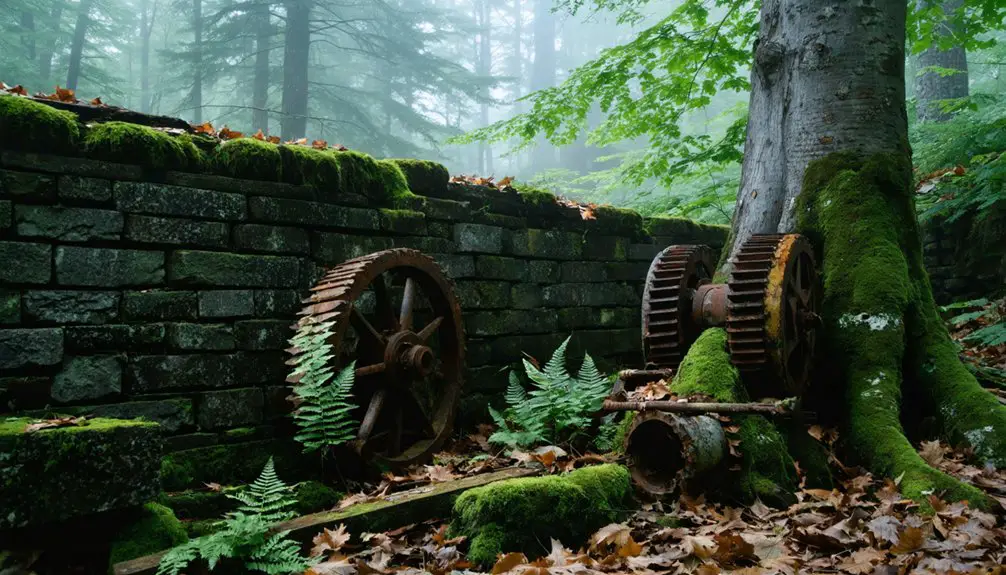
Though forest canopy now swallows nearly every trace of human ambition, Granby’s skeletal remains still whisper through the wilderness. You’ll discover stone cellar holes beneath woodland cover, marking where families once carved out their existence.
Beneath the reclaiming forest, stone foundations mark where ambitious settlers once wrestled existence from unforgiving wilderness.
Overgrown roads lead to crumbling foundations—silent monuments to the logging and copper industries that birthed this settlement.
Trail systems guide you past a memorial church preserving spiritual heritage, while cemetery stones document residents who’ve long returned to earth. State parks maintain reference maps showing former boundaries, though historic preservation efforts remain minimal here. Nature’s reclaiming the natural landscape with ruthless efficiency.
Dense forest dominates what human hands once tamed. You’ll need determination to find these ruins, but that’s precisely their appeal—ghost towns don’t surrender their secrets easily.
Getting There: Routes and Road Conditions to Granby Ghost Town
You’ll find your journey to Granby beginning on US Route 2 through Lancaster, New Hampshire, where Granby Road branches toward Vermont Route 102 before connecting to Radar Road—your gateway into this forgotten settlement.
The 8-mile round-trip demands a mountain bike rather than a car, as gates block vehicular access beyond a certain point, and the 1,700-foot elevation gain tests your endurance across rugged terrain.
Cell service vanishes as you pedal deeper into the Northeast Kingdom’s forest, so download offline maps and check seasonal conditions with the Kingdom Trails association before attempting this remote backcountry route.
Primary Access Routes
While modern GPS will guide you toward Granby’s coordinates, the journey to this ghost town demands old-school navigation through Vermont’s remote Northeast Kingdom. You’ll follow US Route 2 east through Lancaster, New Hampshire, then branch onto Vermont Route 102 toward Granby.
The final stretch requires connecting to Granby Road before reaching Radar Road—your gateway to East Mountain’s abandoned installations.
Here’s where locked gate logistics become indispensable: standard vehicles can’t proceed beyond the checkpoint. You’ll face an eight-mile round-trip covering 1,700 feet of elevation gain, making mountain bikes essential equipment. Road maintenance challenges plague these backroads, where Essex County’s sparse 39.1-square-mile wilderness prioritizes isolation over infrastructure.
The Kingdom Trails association monitors access, ensuring you’re balancing adventure with responsible exploration through Vermont’s most remote terrain.
Seasonal Road Conditions
Vermont’s Northeast Kingdom transforms dramatically with each season, and your Granby expedition hinges on understanding these shifts. Winter delivers the harshest conditions—Route 302 near Topsham demands chains or four-wheel drive, while DOT maintenance schedules reduce coverage December through March. Emergency response times stretch to 45 minutes during severe weather.
Your seasonal navigation checklist:
- Winter (Dec-Mar): Monitor snow plow operations on I-91; expect frequent closures
- Spring (Apr-May): Watch for frost heaves and weight restrictions during thaw periods
- Summer (Jun-Aug): Plan around Route 2/7 construction delays extending through 2027
- Fall (Sep-Oct): Navigate leaf-peeper congestion on scenic routes
Access New England 511 and WeatherBug cameras for real-time conditions. Local roads won’t appear on state systems—contact town offices directly.
Standard GPS systems will fail you on the approach to Granby—the town’s coordinates (44.5047° N, 71.6842° W) lead to unmarked logging roads that fork without warning through dense spruce forests. You’ll need offline maps downloaded before losing cell service near Victory Basin. Mark waypoints at every intersection; the old settlement lies three miles past where maintained roads end.
Trail accessibility changes seasonally—spring washouts erase familiar paths, while autumn leaf-drop reveals forgotten foundations. Veteran explorers recommend paper topographic maps as backup navigation coordinates stored digitally prove worthless when batteries die in Vermont’s backcountry. The forest service gate eight miles south serves as your last reliable landmark. Beyond that point, you’re traversing by instinct and the scattered stone walls that mark Granby’s ghostly boundaries.
Best Time to Visit and Weather Considerations for Your Trip
You’ll find Granby’s abandoned homesteads most accessible from June through September, when summer’s mild temperatures keep forest trails clear and unpaved roads navigable without the challenge of spring mud or winter snow.
The Northeast Kingdom’s dramatic weather shifts demand layers in your pack—morning frost can give way to afternoon warmth even in peak summer, while fall foliage season in late September brings both stunning visibility through thinning leaves and the risk of early snowfall closing mountain routes.
Plan your exploration between these seasonal extremes, remembering that April’s mud season transforms those same peaceful logging roads into impassable quagmires that’ll strand your vehicle miles from the nearest help.
Seasonal Weather Patterns
Planning your ghost town road trip to Granby means understanding Vermont’s dramatic seasonal shifts, where a humid continental climate delivers four distinct experiences throughout the year. You’ll encounter temperatures ranging from summer’s comfortable mid-60s to winter’s bitter single digits, with precipitation levels averaging 43.3 inches of rain annually and average snowpack reaching 89.25 inches.
Each season offers unique exploration conditions:
- Summer (June-August): Warm, wet conditions with July bringing 4.72 inches of precipitation
- Fall (September-November): Perfect hiking weather amid brilliant foliage
- Winter (December-February): Deep snow transforms the ghost town into a winter wonderland
- Spring (March-May): Unpredictable mud season with rapidly changing conditions
Choose your adventure based on what type of atmosphere you’re seeking in this abandoned landscape.
Trail Accessibility Considerations
When exploring Granby’s abandoned remnants, accessibility challenges become immediately apparent—the ghost town’s trails bear little resemblance to the hardened, multi-layer surfaces and 36-inch minimum widths that define truly accessible pathways. You’ll encounter primitive dirt roads leading to locked gates, with eight-mile round-trips from certain access points offering zero disability accommodations.
East Mountain’s routes lack benches, rest areas, or informational signage that’d help you plan your adventure confidently.
The terrain demands serious preparation if you’re using mobility devices. Without volunteer trail maintenance or developed infrastructure, you’re traversing on your own terms through rugged conditions. Before venturing out, research current gate locations and surface conditions thoroughly—what limited information exists changes frequently, and there’s no one maintaining these forgotten paths to recognized accessibility standards.
Essential Gear and Safety Tips for Ghost Town Exploration
Exploring Granby’s abandoned structures demands more than curiosity—it requires deliberate preparation that could mean the difference between a memorable adventure and a dangerous mishap. Your reconnaissance missions planning should include daytime site visits to assess structural integrity and identify escape routes.
Abandoned buildings safety hinges on carrying proper equipment and understanding the specific hazards you’ll face in Vermont’s decaying ghost town.
Essential gear for your exploration:
- Three independent light sources with backup batteries
- FFP3 respiratory mask for mold and asbestos protection
- Sturdy boots with ankle support and cut-resistant gloves
- First aid kit and offline navigation tools
Share your route plan with someone outside your group, including expected return time. Move deliberately through deteriorating structures, constantly checking floor stability and ceiling conditions before advancing into unfamiliar spaces.
Nearby Attractions and Other Vermont Ghost Towns Worth Visiting
Your Granby exploration opens the door to a darker chapter of Vermont’s abandoned places—one where mystery eclipses mere economic decline. Head south to Glastenbury, where supernatural folklore accounts have accumulated since the 1940s. This ghost town reached 241 residents during its 1880 logging peak before vanishing into legend.
The surrounding Bennington Triangle harbors documented disappearances—Middie Rivers in 1945, Paula Welden in 1946—that inspired Shirley Jackson’s haunting fiction. You’ll find abandoned railroad beds and crumbling boarding houses threading through Green Mountain National Forest.
The Abenaki called Glastenbury Mountain where “Four Winds meet,” and cultural preservation efforts now maintain these indigenous warnings alongside colonial accounts of unexplained lights. Unlike Granby’s straightforward abandonment, Glastenbury demands respect for its unsolved mysteries.
Capturing Your Journey: Photography Tips and Historical Documentation
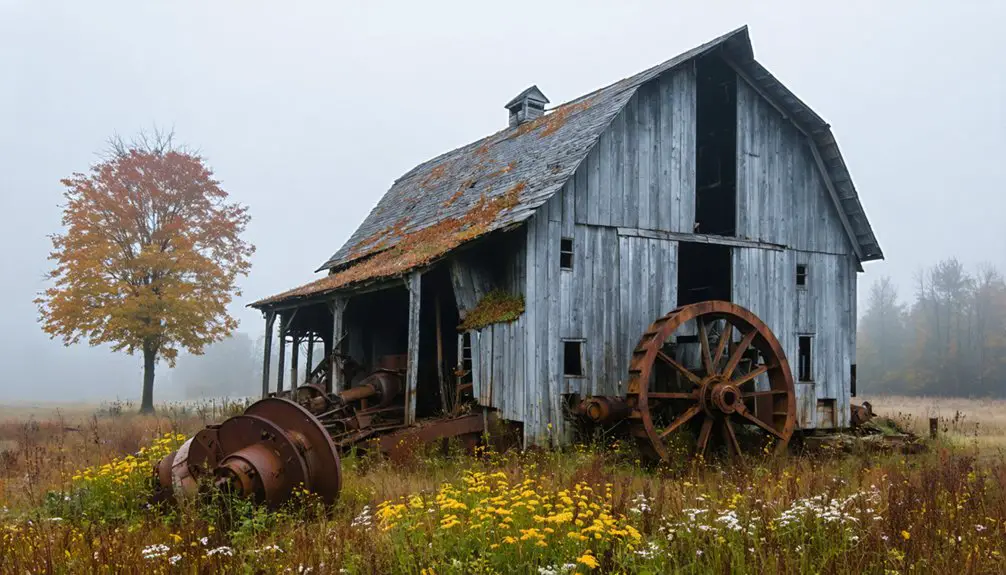
Before you venture into Granby’s skeletal remains, pack wide-angle lenses to capture the collapsed timber frames against Vermont’s mountain backdrop—early morning fog transforms abandoned homesteads into ethereal compositions. Your documentation serves dual purposes: personal memories and historical preservation.
Every photograph you capture in Granby becomes part of Vermont’s permanent record—your lens preserves what time threatens to erase forever.
Essential Documentation Practices:
- Photograph structural details before weathering erases them completely—rotted sills, hand-hewn beams, and foundation stones tell construction stories
- Record GPS coordinates of significant ruins for historical documentation databases
- Sketch floor plans where walls once stood, creating architectural records for future researchers
- Note dates on gravestones and building materials for film archiving projects
You’re not just taking pictures—you’re preserving fragments of Vermont’s vanished communities. Shoot in RAW format for maximum detail retention, and maintain backup copies of everything you document.
Frequently Asked Questions
Are There Any Documented Disappearances or Paranormal Incidents in Granby?
No documented disappearances or paranormal incidents exist in Granby specifically. You’ll find no records of occult rituals performed or unexplained lights sightings here—those mysteries belong to Glastenbury Mountain’s Bennington Triangle, located in southern Vermont instead.
Can I Camp Overnight Near the Granby Ghost Town Ruins?
Camping near Granby’s ruins requires landowner permission since it’s private property. You’ll find designated campgrounds nearby in Green Mountain National Forest, where hiking trails accessibility connects you to Vermont’s backcountry. Always camp 200 feet from trails.
Do I Need Permits to Explore Abandoned Buildings in Granby?
Yes, you’ll need permission from Granby Town Hall before exploring. Abandoned property laws and trespassing concerns apply even to ghost towns—turns out “freedom” doesn’t include risking structural collapse or legal trouble in century-old buildings.
Are the Ruins on Private Property or Publicly Accessible Land?
I can’t confirm Granby’s specific property boundaries without reliable data. You’ll need researching protected land status and trespassing considerations before exploring. Always respect private property—freedom means responsible adventure, not legal trouble that’ll end your ghost town journey.
What Indigenous Legends Exist About the Granby Area?
Specific Granby legends aren’t well-documented, but you’ll find the region holds spiritual beliefs of local tribes throughout Vermont. The Abenaki considered these mountains sacred, with ancient burial grounds scattered across the landscape, their stories passed down through oral tradition.