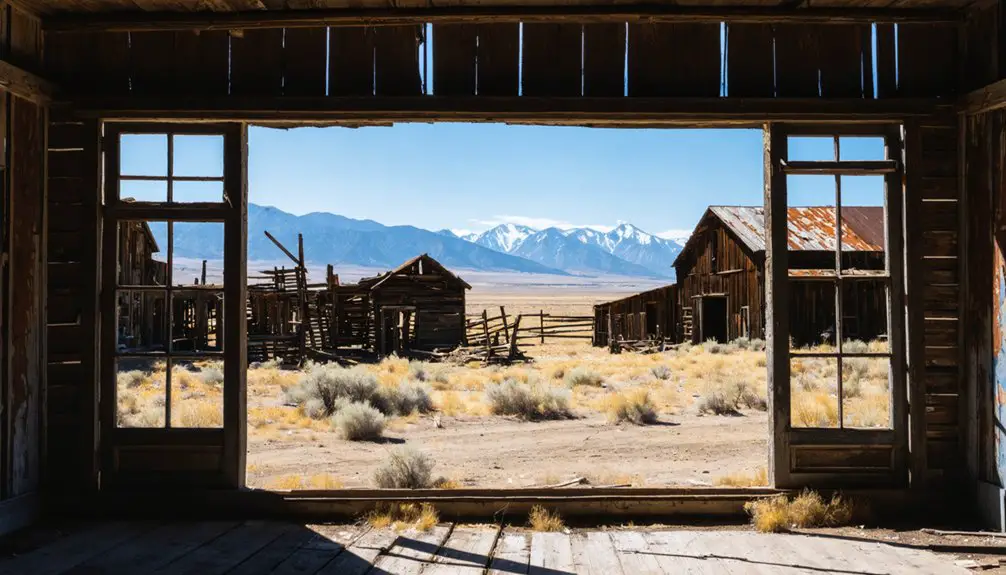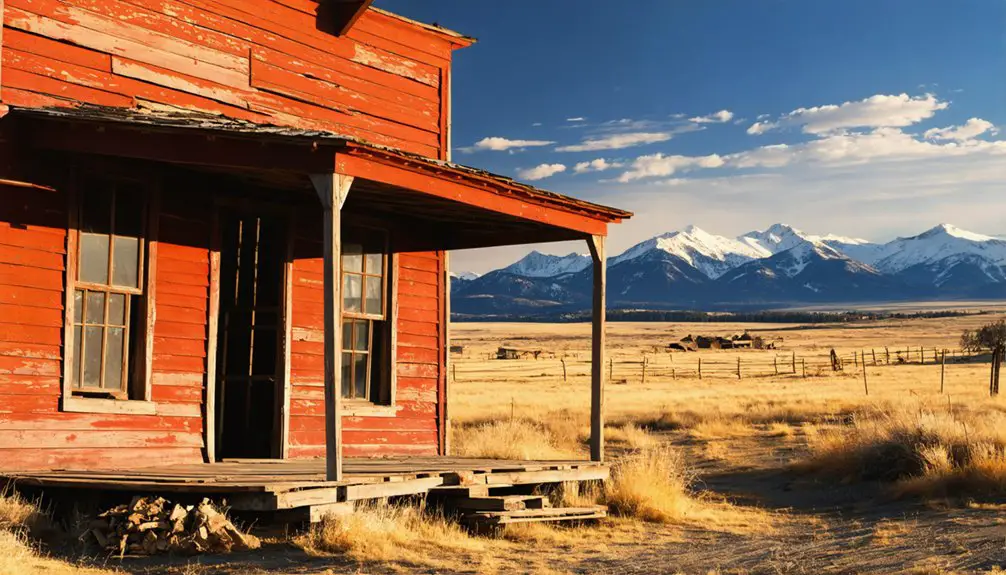
You’ll navigate a serpentine gravel road climbing 1,280 feet through Montana’s backcountry to reach Granite Ghost Town at 6,930 feet, where 3,000 souls once thrived during the 1880s silver boom. The park opens Memorial Day through September, revealing skeletal stamp mills, the three-story Miners Union Hall ruins, and remnants of eighteen saloons scattered across precipitous slopes. Plan three miles of exploration through this National Register site, where $4 million in silver once flowed annually before economic catastrophe struck. The weathered foundations and mountain vistas tell stories that statistics alone cannot capture.
Key Takeaways
- Granite Ghost Town State Park sits at 6,930 feet elevation, accessible Memorial Day through September via a well-maintained three-mile gravel road.
- The serpentine road climbs 1,280 feet through southwestern Montana backcountry but remains suitable for standard vehicles.
- Explore ruins of the three-story Miners Union Hall, listed on the National Register since 1974, featuring Montana’s finest maple dance floor.
- View skeletal stamp mill remains, elaborate tramway systems, and Douglas Creek tunnel from Granite’s $4 million annual production peak in 1890.
- Discover remnants of ethnic neighborhoods, eighteen saloons, four churches, and housing foundations from the 3,000-person boomtown’s diverse community.
From Silver Boom to Abandoned: The Story of Granite’s Rise and Fall
The glint of silver in a rocky outcrop changed everything for this remote Montana mountainside. When Charles McLure discovered ruby silver assaying at 2,000 ounces per ton in 1880, St. Louis investors poured ten million dollars into the Granite Mountain Mining Company.
Economic cycles turned favorably as the mine hit the legendary Bonanza Chute in 1882, producing nearly $300,000 yearly—equivalent to $10 million today.
Getting to Granite Ghost Town State Park
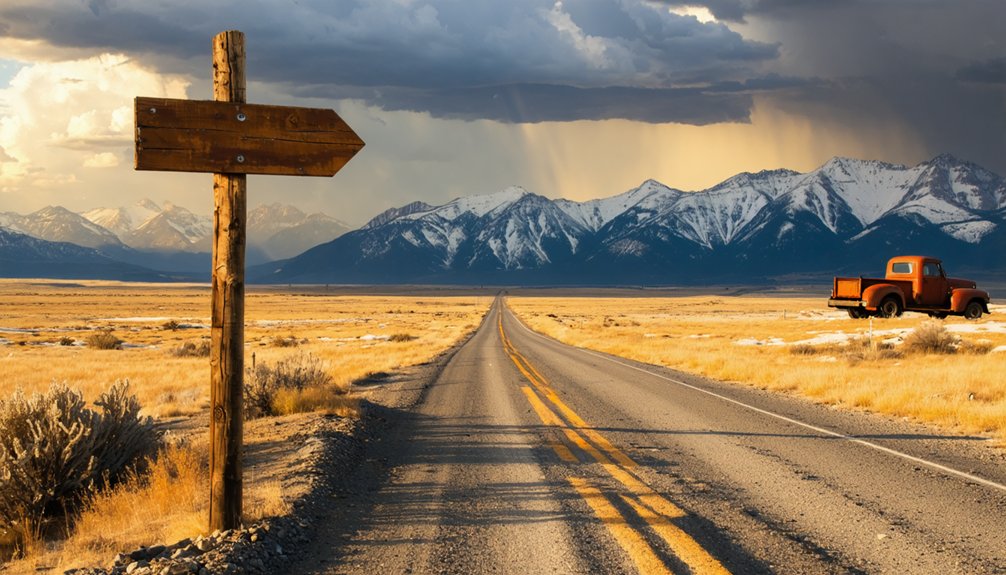
Today’s adventurers seeking Granite’s silver-streaked ruins must navigate a journey as dramatic as the mining camp’s own rise to glory. You’ll leave Philipsburg behind and climb a serpentine gravel road that gains 1,280 feet through southwestern Montana’s untamed backcountry.
A serpentine ascent through Montana’s backcountry delivers modern explorers to silver-streaked ruins as dramatic as Granite’s own legendary rise.
The narrow road conditions demand respect—pull aside when vehicles approach—but your reward unfolds with every switchback.
What awaits on your ascent:
- Panoramic mountain vistas that’ll steal your breath at 6,930 feet
- Three miles of freedom from civilization’s grip
- A ghost town suspended in time, accessible Memorial Day through September
Standard vehicles handle the well-maintained gravel admirably. Contact 406-287-3541 before departing. Park manager Cheryl Morris guarantees this 1975-established sanctuary remains open to those brave enough to chase forgotten silver dreams into Montana’s wild high country.
What to See: Best-Preserved Buildings and Historic Sites
You’ll find Granite’s most haunting remnants along the Ghost Town Walk trail, where the skeletal Miners Union Hall still dominates the hillside—its three-story frame a shadow of the grand 1890 building that once pulsed with dancing boots and union debates before vandals torched it in 1966.
Stone foundations trace the town’s lost grid like archaeological excavations, marking where families slept and merchants sold provisions during the silver boom. The crumbling 100-stamp mill ruins scatter across the mountainside above, their exposed iron innards stamped “Western Iron Works, Montana,” still clinging to the rocks where they once thundered through $40 million worth of ore.
Miners Union Hall Ruins
Standing sentinel among the pines of Deerlodge National Forest, the Miners Union Hall ruins command attention as Granite’s most magnificent remnant of boom-town grandeur. This three-story marvel, completed in 1890 for $23,000, hosted the town’s final celebration on December 31st before the Silver Panic struck. You’ll find three walls still defying gravity, though the structure’s unstable—tread carefully.
The Northwest’s finest all-maple spring dance floor where miners waltzed away their dangerous workdays
A specialty stage that brought vaudeville dreams to Montana’s wilderness
Secret lodge rooms where fraternal orders conducted mysterious rituals
Despite historic preservation efforts, the dance floor’s in disrepair, reduced to rubble. Listed on the National Register since 1974, these ruins whisper stories of 3,000 souls who vanished overnight.
Historic Building Foundations Trail
While most of Granite crumbled into Montana’s wilderness, a handful of skeletal structures pierce through the pine forest like tombstones marking civilization’s retreat. You’ll discover the architectural significance of Mills A and B foundations below the ghost town—massive stone footprints that once anchored silver processing operations.
Trail accessibility winds you past the Methodist Church’s barely-there foundation, marked only by a state parks sign among scattered trees. The Catholic Church’s stone base huddles behind other ruins, its Irish congregants long departed. State park markers guide your exploration, but you’re free to wander off-trail where foundations hide in shadow.
Each crumbling wall tells stories the wilderness tried silencing—you just need to listen beyond the wind’s whisper.
Exploring the Mining Operations and Infrastructure
You’ll find yourself standing among the skeletal remains of what was once one of Montana’s most profitable silver operations, where massive stamp mills once thundered day and night processing ore that made millionaires of St. Louis investors.
The rusted cables and crumbling foundations trace the path of an elaborate tramway system that hauled fortune after fortune down the mountainside, while the dark mouth of the Douglas Creek tunnel still yawns open—a record, evidence, or proof of the ambition that drove men to bore through solid rock chasing veins of ruby silver.
Walking these grounds, you can almost hear the ghost echoes of 200 stamps crushing two hundred tons of ore daily, when Granite Mountain’s production reached a staggering $4 million annually.
Peak Production and Riches
The Bonanza Chute transformed Granite from a struggling prospect into one of Montana’s most lucrative silver operations. After punching through 115 feet of barren rock in 1882, miners struck ore assaying 1,700 ounces per ton—pure fortune locked in stone. You’d witness wealth pouring from the mountain as processing technology evolved, with ore continuously dumped into furnaces where combusting gases worked their alchemy.
The mine’s peak years delivered staggering returns:
- $4 million in precious metals flowed from Granite Mountain in 1890 alone
- 1,400 tons from the Bonanza Chute yielded $274,000 in a single season
- Annual bullion production reached $1 million during the 1898-1901 revival
Mine expansion added 50 stamps in 1891, pushing daily capacity to 200 tons. That massive 4,307-pound silver bar showcased at the 1893 World’s Fair? Pure Montana independence cast in metal.
Mill and Tram Systems
Moving all that wealth down the mountain required engineering as ambitious as the mining itself. You’ll marvel at how the two-mile Blaine shaft tramway conquered gravity—massive iron buckets hauling 500 pounds of ore downhill while returning with fuel.
This continuous ore transport fed the Bi-Metallic Mill’s thundering 200 stamps, where the industrial chloridization process transformed rock into fortune.
Douglas Creek Tunnel Project
Beyond the thundering stamp mills, Granite’s mining empire pushed deeper into the mountain through an intricate network of tunnels and shafts that would eventually stretch for miles. The Douglas Creek tunnel carved through solid rock, channeling water to power the Flint Creek Hydroelectric Project‘s Pelton turbines. You’ll find these engineering marvels transformed the landscape permanently:
- Transmission lines snaked across ridges in 1900, bringing electricity where none existed
- Irrigation reservoir rehabilitation now struggles with barriers created by century-old infrastructure
- Environmental remediation impacts continue as 43 miles of contaminated waterways require cleanup
Today’s environmental remediation impacts reveal mining’s true cost—heavy metals poisoning Douglas Creek’s tributaries, blocking cutthroat trout migration. The basin’s closed to new water permits, a legacy to freedom’s limits when resources run dry.
Life in a Boomtown: Neighborhoods and Daily Living
At its peak, over 3,000 souls carved out lives on Granite’s precipitous slopes, where the mountain’s rocky spine forced the entire town to cling to steeply angled ground near the ridge top. You’ll discover ethnic diversity woven through every gulley—Irish families clustered northwest of Main Street in Donal, Cornish miners lined Broadway, while Chinese immigrants built their community in the gully opposite the main road.
Despite company structured housing that rented lots for $2.50 monthly, miners exercised autonomy by constructing their own cabins on granite foundations still visible today. They built eighteen saloons, four churches, a school, hospital, and library. The three-story Miners Union Hall anchored social life, while fraternal lodges gathered neighbors.
Winter brought sledding parties down the four-mile run to Philipsburg—freedom found even in a company town.
Planning Your Visit: Trail Information and Park Details
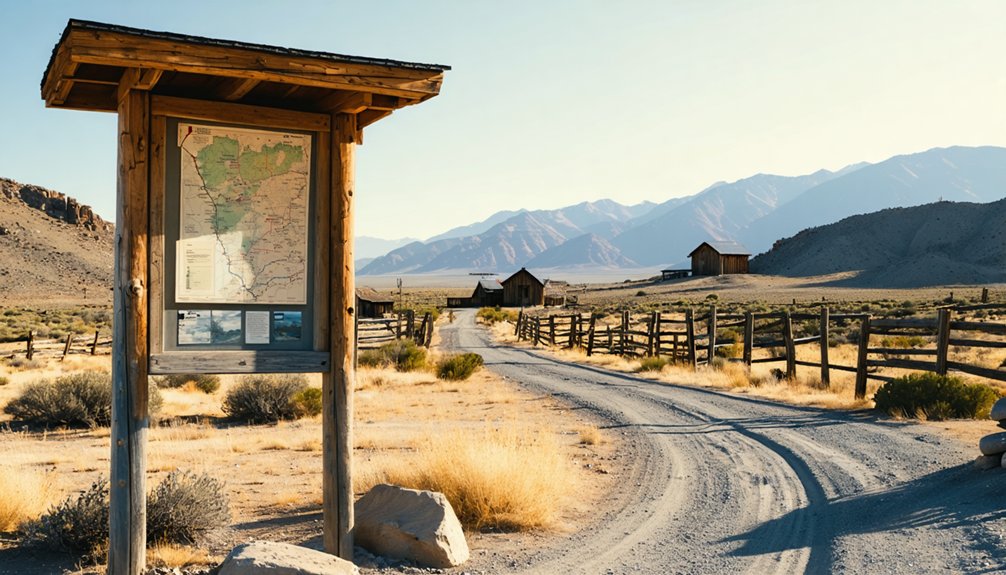
Before you point your vehicle toward Granite’s mountain perch, understand that this isn’t a Sunday drive—it’s a commitment to adventure. The visitor experience here strips away modern conveniences—no staff, no facilities, no hand-holding. Amenities availability? Zero. You’re truly on your own.
The GGW Trail winds through forest for two hours, revealing:
- Union Hall’s crumbling glory—cathedral-like ceiling beams defying gravity
- The superintendent’s stone house—Montana’s mountain aristocracy frozen in masonry
- The 100-stamp mill—industrial bones sprawling across the mountainside
Grab your trail map from Philipsburg’s Chamber before ascending. Pack water, charge your camera, and watch your kids like hawks around unstable structures. This ghost camp earned its reputation as Montana’s finest by refusing to compromise authenticity for comfort.
Frequently Asked Questions
Are There Any Entrance Fees to Visit Granite Ghost Town State Park?
Nothing’s free in this world—you’ll pay $8 per vehicle or $4 walking in. Parking availability awaits at this elevation-climbing destination, though accessibility for visitors requires traversing that steep, winding mountain road to reach freedom.
What Is the Best Time of Year to Visit Granite?
You’ll find summer ideal for unrestricted exploration, with accessible roads and extended daylight hours. Fall foliage transforms the mountainside into golden splendor, while adventurous souls embrace winter snowshoeing through silent, snow-draped ruins—pure wilderness solitude awaits.
Are Pets Allowed on the Trails at Granite Ghost Town?
You’re free to bring your four-legged companion along! Granite’s pet friendly policies welcome leashed dogs on all trails. There aren’t trail restrictions limiting your adventure—just keep them controlled while exploring these hauntingly beautiful mining ruins together.
How Long Does It Take to Explore the Entire Ghost Town?
You’ll need 1-2 hours for a complete walk through Granite’s windswept ruins. The estimated exploration time varies with your pace along steep trails, though accessibility for visitors can be challenging on the mountainside’s scattered foundations and crumbling structures.
Are There Restrooms or Facilities Available at the Park?
Need to plan ahead for your wilderness adventure? You’ll find no restrooms, drinking water, or wheelchair accessibility at this raw ghost town—just untamed ruins perched high where Montana’s frontier spirit roams free across steep, rugged terrain.