Hagginsville doesn’t appear on any South Dakota map or historical record—it’s a ghost town that never existed. However, you’ll find authentic abandoned settlements worth exploring throughout the Black Hills region. Rochford’s restored Moonshine Gulch Saloon still serves drinks, while Spokane’s mining remnants sit seventeen minutes from Hermosa. Galena scatters through Vanocker Canyon, and Tinton’s operations await on Negro Hill. Before planning your route, you’ll need to understand which documented locations offer the most compelling structures and stories.
Key Takeaways
- Hagginsville does not exist in any historical records, mining camp documentation, or ghost town inventories of South Dakota from 1873-1930.
- No maps, county histories, or credible sources document Hagginsville’s existence; verifying its reality is essential before planning any visit.
- Authentic South Dakota ghost towns include Scenic, Okaton, Awanka, Spokane, Rochford, and Galena with actual accessible remnants.
- Real abandoned mining camps like Holy Smoke and Tinton offer legitimate exploration opportunities throughout the Black Hills region.
- Agricultural ghost towns such as Dumont, Sorum, and Ardmore provide verified alternatives for road trip planning and historical exploration.
The Mystery of Hagginsville: Setting the Record Straight
You won’t find Hagginsville on any map of South Dakota’s ghost towns, and there’s a straightforward reason: it doesn’t exist. Despite what clickbait articles might suggest, there’s no documented existence of this settlement in historical records, mining camp enumerations, or inclusive Black Hills ghost town inventories covering 1873-1930. It’s absent from Pennington and Lawrence County histories, and completely missing from exploration accounts.
Unlike real abandoned towns—Hayward with its 300 miners, Greenwood’s hydraulic operations, or Spokane’s Depression-era collapse—Hagginsville leaves no trace. This isn’t a case of presumed loss through fires or floods. The name simply doesn’t appear anywhere credible. Before planning your road trip, verify you’re chasing actual history rather than internet fiction.
Ghost Towns of Southwest South Dakota Worth Exploring
The prairies and hills of southwest South Dakota conceal dozens of authentic ghost towns where weathered buildings and rusted machinery tell stories of frontier ambition and economic collapse. You’ll find Ardmore near the Nebraska border, its population dwindled from a thriving agricultural community to just sixteen souls by 1980.
Scenic offers crumbling structures amid Badlands vistas, while Okaton sits conveniently off Interstate 90’s exit 183. Awanka ranks among explorers’ favorites, with one family still calling it home. Spokane, seventeen minutes from Hermosa, reveals remnants of failed mining operations.
These remote locations demand self-sufficiency—bring water, fuel, and provisions. The notable landmarks you’ll discover include abandoned schoolhouses, rusted vehicles, and weathered storefronts standing defiant against prairie winds and time’s relentless march.
Historic Mining Camps Along Your Route
Beyond the prairie ghost towns, mineral-rich veins threading through the Black Hills spawned prosperous mining camps that now stand as weathered monuments to gold fever and frontier enterprise.
You’ll discover Rochford’s Moonshine Gulch Saloon still pouring drinks along Little Rapid Creek, where mining camp restoration efforts have transformed 1878 structures into functional saloons and shops. Galena’s remnants scatter through Vanocker Canyon, accessible via I-90 Exit 32, while its preserved schoolhouse showcases recreational uses for abandoned buildings.
Holy Smoke Camp’s vast 3,700-acre operation left superintendent homes and whim houses across 100 acres. Pactola sleeps beneath 150 feet of lake water, though one cabin survives among the pines. Tinton’s tin operations on Negro Hill offer rugged exploration opportunities, embodying the Black Hills’ mineral diversity beyond gold.
Abandoned Agricultural Communities in the Region
While mineral wealth shaped the Black Hills’ mountain camps, agricultural dreams scattered homesteads across South Dakota’s endless prairies, leaving behind a different breed of ghost town. You’ll discover small farm abandonments along West River back roads, where late 1800s homesteads crumble into pastureland.
Forgotten homesteads dissolve into prairie grass, where agricultural ambitions once competed with the Black Hills’ glittering mining fortunes.
Prairie structures tell stories through rusty tools and faded schoolhouse chalkboards from the 1893 Academy, where teachers once played harmonica for scattered farm children.
Cattle shipping town failures dot your route—places like Dumont and Sorum, where railroad promises brought over 100 families before economic reality hit. When trucking replaced rail and consolidation swallowed family operations post-1940s, entire communities vanished.
Codington County’s documented farmsteads and memorial markers preserve these agricultural pioneer legacies, reminding you that freedom’s pursuit often leaves haunting footprints across open land.
What You’ll Find: Structures and Remnants Still Standing
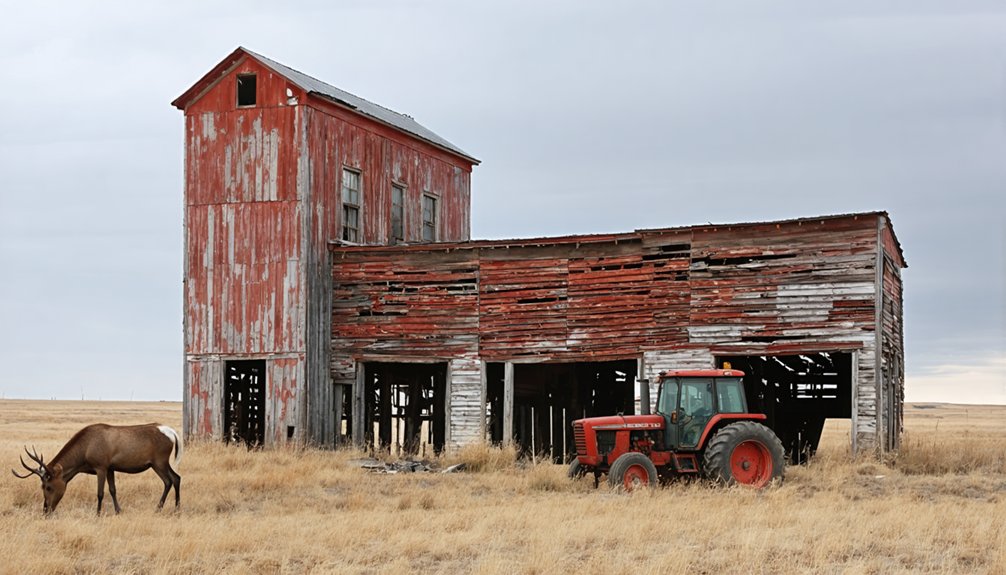
You’ll discover a surprising collection of weathered structures that have withstood decades of prairie winds and abandonment. Brick commercial buildings, wooden grain elevators, and remnants from the town’s mining era dot the landscape, though many sit on private property requiring permission to explore.
The most accessible ruins include collapsed churches, operational grain facilities, and deteriorating storefronts that offer glimpses into South Dakota’s boom-and-bust settlement history.
Historic Buildings Still Standing
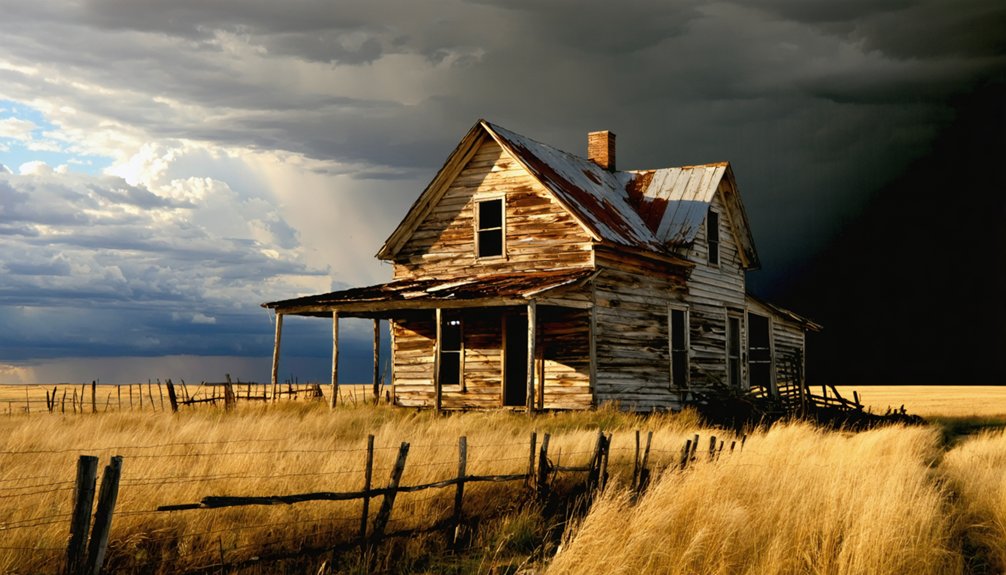
The crumbling brick facades and weathered wooden frames of Hagginsville tell the story of a community that once thrived in southwest South Dakota.
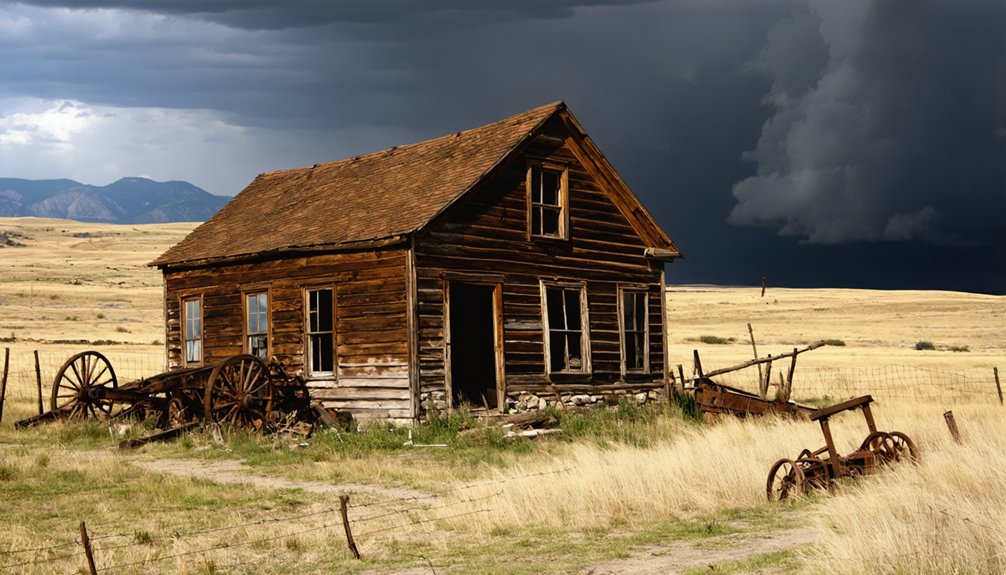
You’ll discover the mine manager’s house still intact, occupied until the 1970s and accessible via Highway 16A and Forest Service Road 330. The town’s 1904 church stands prominently, though collapsing, with church interiors exposed to the elements.
Building foundations dot the landscape where the Forest Service removed structures, while rusting vehicles and historical artifacts lie scattered throughout. Historic marker placements guide you through what remains of 15-25 abandoned buildings on private property.
From its 1889 founding to a peak population of 1,645, Hagginsville’s remnants offer tangible connections to South Dakota’s mining past.
Mining Era Structures Remain
Scattered across Hagginsville’s landscape, mining-era structures stand as skeletal reminders of the town’s industrial past. You’ll discover headframes towering over what remains of milling complexes, where gravity once pulled ore down hillsides through processing stages.
Cyanide mill remains dot the terrain, their concrete foundations and rusted equipment evidence of gold extraction operations that defined this region. The reclaimed mine dumps tell their own story—reshaped earth where waste rock once accumulated in massive piles before environmental remediation efforts transformed them.
Three mine portals pierce the hillside, their rock-reinforced entrances still intact despite decades of abandonment. Inside, tunnel walls display unique mineral colorations alongside layers of graffiti. These structures offer tangible connections to an era when gold fever drove men deep underground, chasing veins through thousands of feet of Dakota rock.
Private Property Access Restrictions
While Hagginsville’s mining structures beckon exploration, private property designations create formidable barriers between you and these historical remnants. The 15-25 abandoned buildings standing here exist on private land, demanding owner permission before you step foot inside. Private land ownership disputes have intensified as explorers clash with restricted public access rules protecting these deteriorating structures.
Key Access Realities:
- The brick bank building, town hall, and 1904 church remain off-limits despite their photogenic decay
- Railroad lines and grain elevators persist as tantalizing landmarks you can’t legally approach
- Historical sites like chapels require advance authorization from current landholders
- Post-2000 abandonment hasn’t changed ownership status—these ruins belong to someone
You’ll need to respect these boundaries or secure explicit permission. The last resident’s departure didn’t convert private holdings into public exploration zones.
Mapping Your Journey: Routes and Distances From Rapid City

Reaching Hagginsville requires traversing the winding corridors of Lawrence County, where your journey from Rapid City begins along US-16 eastbound through the heart of Black Hills mining country. You’ll travel approximately 20-30 miles depending on your chosen route, following paths that weave past active mining operations and sister ghost towns like Rockerville before turning toward the remote Homestake railroad terminus areas.
Plan for 30-45 minutes of initial highway driving, though accessing the actual site demands shifting to unpaved Forest Service roads that test your vehicle’s clearance and your commitment to exploration.
Primary Highway Routes Available
Unfortunately, documenting a precise route to Hagginsville presents a unique challenge for modern ghost town explorers. Historical records confirm the Homestake Company established a terminus here, yet contemporary mapping data remains elusive. You’ll find no highway signage visibility directing travelers to this vanished settlement, making your journey one of genuine discovery rather than simple navigation.
Before venturing out, consider these realities:
- Road maintenance concerns intensify as you leave established routes for unmarked backcountry trails
- GPS coordinates for Hagginsville aren’t readily available through standard navigation systems
- Local knowledge from nearby communities becomes your most valuable resource
- Topographical maps and historical records may reveal clues modern technology overlooks
Your adventure requires old-school wayfinding skills and determination to reach South Dakota’s forgotten places.
Distance and Travel Times
Planning your expedition to Hagginsville requires acknowledging an uncomfortable truth: this ghost town defies the precision modern travelers expect from their navigation apps. Unlike Spokane’s mapped 12 miles from Hill City or Rockerville’s charted proximity to Keystone, Hagginsville exists in the domain of unmeasured distances. Its connection to Homestake Company’s railroad terminus offers a clue, yet no coordinates anchor it to modern geography.
Your travel history through the Black Hills prepares you for this ambiguity. While other ghost towns cluster within 12-50 miles of Rapid City along gravel roads and decommissioned highways, Hagginsville demands old-fashioned detective work. You’ll navigate by historical context rather than GPS coordinates—embracing the uncertainty that separates genuine exploration from programmed tourism.
Visitor Guidelines and Property Access Rules
Before setting foot on the abandoned grounds of Hagginsville, you’ll need to prepare thoroughly for a visit that demands self-reliance and respect for the fragile prairie ecosystem. With no staff on duty, your safety preparedness falls entirely on your shoulders.
Clothing requirements include long pants tucked into socks for tick protection, comfortable hiking footwear, and appropriate seasonal gear. You’re free to explore using existing trails and firebreaks, but creating new paths damages sensitive habitats.
Essential guidelines for your adventure:
- Stick to established routes – Avoid boggy areas and don’t trample ground-nesting bird sites
- Pack complete supplies – Water, first aid kit, insect repellent, and navigation tools
- Respect ongoing research – Leave all stakes, signs, and markers undisturbed
- Practice leave-no-trace principles – Inspect footwear for seeds before entering
Local History and Stories From Former Residents
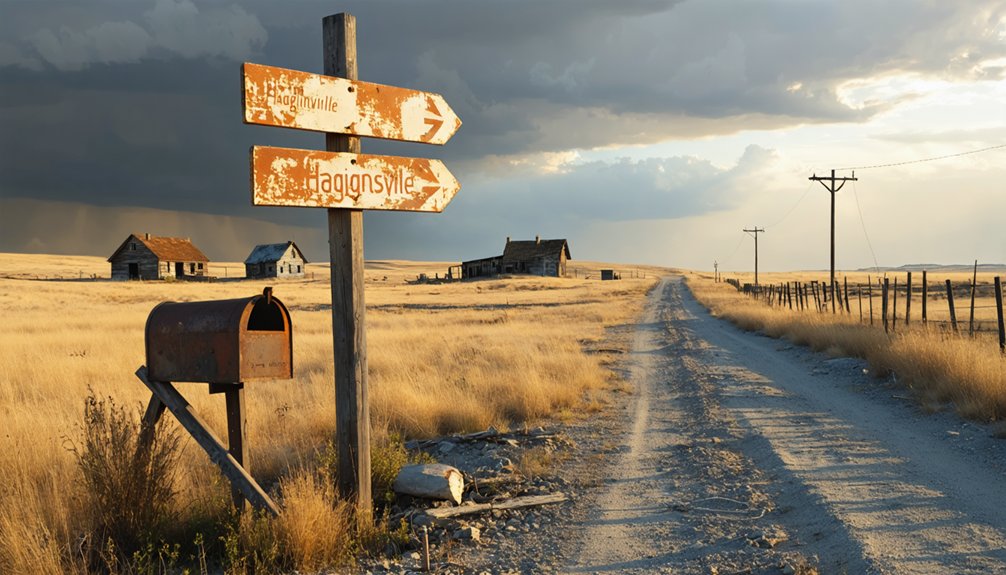
The weathered structures standing silent across Hagginsville’s landscape tell stories of ambition, hardship, and community bonds forged in South Dakota’s unforgiving prairie. You’ll discover remnants of local community history through conversations with descendants who remember when schools bustled with children and main streets thrived.
Former residents like Philip O’Conor once greeted curious visitors, sharing firsthand accounts of mining booms, railroad promises, and eventual decline. Presidential visits, including Calvin Coolidge’s 1927 picnic, marked moments of regional pride.
While historical preservation efforts remain limited due to private ownership of most structures, annual reunions at sites like old fire stations keep memories alive. These personal narratives—of Indian attacks, gold rushes, and Depression-era struggles—offer you authentic glimpses into frontier resilience that official records can’t capture.
Frequently Asked Questions
What Supplies Should I Bring for a Full-Day Ghost Town Tour?
You’ll want to pack necessary provisions like water, snacks, and sun protection for your adventure. Bring camera equipment to capture haunting structures and weathered details. Don’t forget sturdy boots, a first-aid kit, and extra layers for unpredictable conditions.
Are There Nearby Camping or Lodging Options for Multi-Day Exploring?
Due to Hagginsville’s remote location, you’ll find limited information about nearby campgrounds available or local bed and breakfasts. You’ll need to research accommodations in surrounding towns beforehand, as this ghost town offers minimal visitor infrastructure for overnight stays.
Can I Photograph Abandoned Buildings From Public Roads Legally?
You’re free to photograph abandoned buildings from public roads—no photographic consent requirements exist for visible structures. Just don’t trespass onto private property for closer shots, and you’ll stay within your First Amendment rights while capturing history.
What Weather Conditions Make Ghost Town Visits Unsafe or Inaccessible?
Inclement weather conditions like flash floods, lightning storms, and heavy snow make ghost towns inaccessible, while high winds and storm surge compromise unsafe structural integrity. You’ll need to avoid monsoon season, winter road closures, and hurricane-damaged buildings.
Are Guided Tours Available for Any Ghost Town Sites?
No guided tours exist at these abandoned sites, but you’ll find freedom in self-guided tours instead. You can explore decaying buildings and weathered streets independently, though private tours aren’t available—just open roads beckoning your adventurous spirit forward.