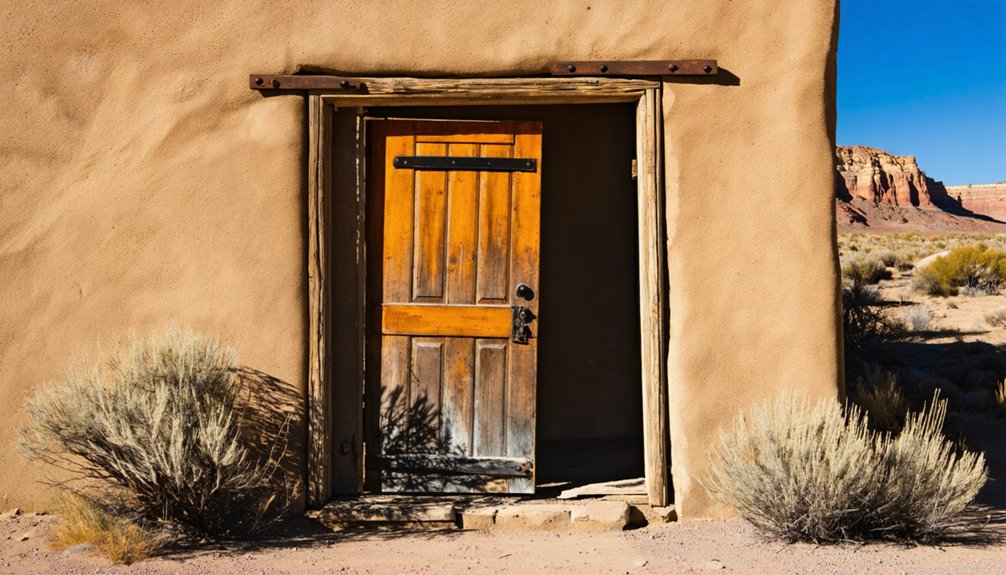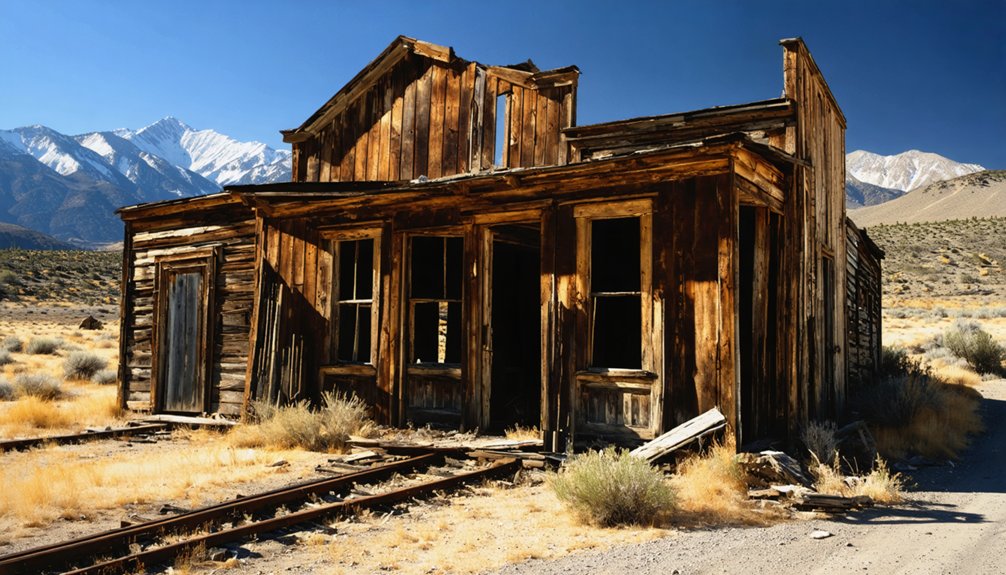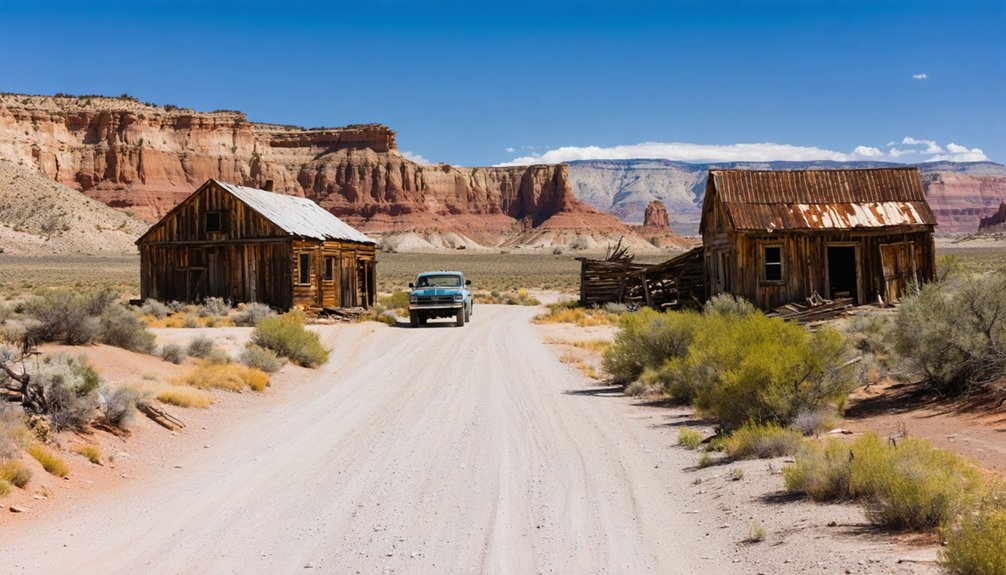
You’ll find Hamblin’s scattered stone foundations and hand-carved cemetery markers one mile apart across Washington County’s high desert at 5,832 feet, accessible via unpaved roads requiring decent clearance. This 1856 settlement became an unwitting refuge for seventeen children who survived the Mountain Meadows Massacre before floods, overgrazing, and federal polygamy enforcement scattered its families by the 1870s. Plan to visit Jacob Hamblin’s actual two-story sandstone home museum in Santa Clara, twenty miles southwest, where period furnishings and missionary guides bring the peacemaker’s story to life alongside your ghost town exploration.
Key Takeaways
- Hamblin sits at 5,832 feet elevation on the windswept plateau, accessible via unpaved roads requiring vehicles with decent ground clearance.
- The ghost town site features scattered stone foundations and Hamblin Cemetery, located one mile southwest with hand-carved pioneer headstones.
- No intact buildings remain at the abandoned settlement; expect minimal relics and unmarked ground across the high desert location.
- Jacob Hamblin Home Museum in Santa Clara, twenty miles southwest, offers furnished rooms and guided tours of his actual residence.
- The site’s historical significance includes serving as a shelter for Mountain Meadows Massacre survivors and a missionary outpost.
The Story of Jacob Hamblin’s 1856 Settlement
In 1856, Jacob Hamblin carved out a homestead on a windswept plateau 5,832 feet above sea level, where Mountain Meadow’s springs fed enough grass to support his family’s ranch and the endless stream of travelers passing through. He’d chosen wisely—his location sat directly on the 1855 Leach Cutoff, shaving 15 miles off the old Cedar City route. This wasn’t just survival; it was opportunity.
Your predecessors would’ve found Hamblin thriving here through agricultural activities that transformed spring water into cultivated fields. The settlement supported herding operations for drovers pushing livestock across the territory, while teamsters and immigrants bought supplies before tackling Leach Canyon’s wagon road.
Freedom-seekers heading west discovered this oasis where Rachel Hamblin and neighbors created community from wilderness—a self-sufficient stopping point beyond government reach.
Connection to the Mountain Meadows Massacre
You’ll find the fort’s darkest chapter unfolded in December 1857, when seventeen children—the sole survivors under age six—arrived at Hamblin seeking refuge after witnessing their families’ murders at Mountain Meadows.
Jacob Hamblin’s settlement became an unwitting sanctuary, sheltering these traumatized orphans while church leaders scrambled to conceal the truth of what happened ninety miles north. The fort’s role shifted from missionary outpost to emergency haven, its residents tasked with caring for blood-stained children who couldn’t yet speak of the horrors they’d survived.
Sheltering Massacre Survivor Children
After the September 1857 Mountain Meadows Massacre claimed 120 lives, seventeen children aged seven and younger arrived by wagon at Jacob Hamblin’s ranch on the northern edge of Mountain Meadows. Rachel Hamblin tended their wounds while the children’s emotional recovery began in this remote sanctuary.
You’ll find the site where these traumatized survivors—some blinded by injuries, others having witnessed their parents’ deaths—were dispersed among Mormon families across southern Utah.
The family reunification process took nearly two years. Captain James Lynch and Dr. Jacob Forney finally retrieved the children in April 1859, with Jacob Hamblin assisting despite his community’s involvement. Thirteen survivors reached Arkansas relatives that September at Carrollton Court House, though scars from their ordeal remained.
Standing at Hamblin’s ghost town today, you’re witnessing where survival trumped tragedy.
Fort’s Humanitarian Role
Jacob Hamblin’s ranch became an unwitting command center during the massacre’s planning stages, where military leaders argued over responsibility the morning after 120 emigrants lay dead. Yet this same location witnessed genuine humanitarian efforts that followed.
You’ll find Hamblin demonstrated ethical leadership by protecting subsequent emigrant trains—dispatching Dudley Leavitt 150 miles beyond Cedar City to guarantee the Turner-Dukes company’s safety. His 1859 disclosures to federal agent Jacob Forney contradicted the official cover-up, naming eight guilty parties and revealing white settlers planned the massacre.
While his brother Oscar recruited Paiutes and the ranch hosted militia movements, Jacob’s actions saved lives. He piloted “Gentile” merchants through hostile territory, proving that even amid Utah War tensions, individual conscience could prevail over collective deception.
Why This Thriving Community Became a Ghost Town
Founded in 1856 by missionary Jacob Hamblin, this settlement at the north end of Mountain Meadows initially thrived on a simple but steady economy—residents sold butter and cheese to emigrant trains traveling the Spanish Trail. But nature had other plans for this frontier outpost.
Environmental pressures struck first. Overgrazing stripped the land of its resources while devastating floods wiped out infrastructure. A flash flood destroyed Fort Clara, schoolhouses, and cultivated fields in the early 1860s, forcing survivors to rebuild uphill.
Personal and family hardships compounded the struggle. Three Hamblin children died after the flood. Rachel Hamblin succumbed to illness in 1865. Federal anti-polygamy enforcement scattered families across Arizona, New Mexico, and Mexico.
What Remains at the Hamblin Site Today
Today, Hamblin exists as scattered whispers of stone and memory spread across Mountain Meadow’s high desert floor at 5,832 feet. You’ll find the location’s physical features surprisingly sparse—a handful of home foundations mark where families once built their lives, and the hand-carved headstones in Hamblin Cemetery stand as the site’s most enduring monuments. These weathered markers, each uniquely chiseled by pioneer hands, tell stories that official records can’t capture.
The relics found on site remain minimal. No intact buildings survived abandonment, no rock walls frame forgotten gardens. What draws visitors isn’t abundance but absence—the freedom to walk unmarked ground where determination met harsh reality.
The cemetery sits one mile southwest of the town site, accessible via unpaved roads that demand respect and decent clearance.
Visiting the Jacob Hamblin Home Museum in Santa Clara

Twenty miles southwest of the abandoned Hamblin town site, you’ll discover where Jacob Hamblin actually lived—a two-story sandstone home in Santa Clara that couldn’t be more different from the scattered foundations you just left behind. LDS missionaries guide you through rooms furnished as they appeared in the 1860s, sharing stories of Hamblin’s peacemaking missions among the Paiute tribes.
The upstairs weaving room still evokes frontier self-sufficiency, while the underground storage room carved into the hillside speaks to practical survival.
Tours run free most days, lasting thirty minutes. Museum exhibits showcase period furniture and artifacts representing southwestern Utah’s pioneer experience. Don’t expect gift shop offerings—this authentic historic house prioritizes preservation over commercialization. You’re experiencing history unfiltered, exactly how independent travelers prefer it.
Getting to Hamblin in Washington County
From Santa Clara’s preserved pioneer home, you’re heading north into emptier country—toward coordinates that mark scattered stones rather than standing structures. Hamblin sits at 37.5364° N, 113.6078° W, elevation 5,871 feet, at Mountain Meadows’ north end. You’ll climb from St. George’s Virgin River valley through Washington County’s basin terrain, gaining nearly 2,000 feet.
Remote access defines this journey. The fort abandoned in 1890 left no maintained routes—expect primitive road conditions on approaches from Utah Route 18 or county roads branching off Interstate 15. A small cemetery’s all that survives where emigrants once stopped to trade with settlers.
Pack water, check your spare tire, and download offline maps. This isn’t preserved history behind velvet ropes. It’s raw ground where you’ll read the landscape yourself.
Exploring the Mountain Meadows Historical Area

When you reach the memorial site off Route 18, you’re standing where over 120 Arkansas emigrants died during five September days in 1857. The protective wall and monuments can’t erase what happened: militia members disguised as allies led families from their circled wagons, separated them, then executed everyone over seven years old. Seventeen children survived, scattered into Mormon homes.
For nearly two decades, official accounts blamed only the Southern Paiute—the impact on local tribe members used as scapegoats lasted generations. Subsequent investigations by authorities didn’t bring justice until John D. Lee’s 1877 execution, the sole person held accountable.
The highland valley’s quiet beauty contrasts sharply with its blood-soaked past. You’ll find the truth carved into modern plaques, finally acknowledging what was hidden for over a century.
Making the Most of Your Southwestern Utah Ghost Town Adventure
After leaving the Mountain Meadows memorial, you’ll find that Hamblin itself offers little to see—just a windswept cemetery at 5,832 feet where hardy settlers once churned butter for passing wagon trains. Yet there’s profound freedom in standing where pioneer lifestyle struggles against overgrazing and floods finally won.
High desert tourism opportunities extend beyond this ghost town:
- Visit Jacob Hamblin’s 1863 adobe home in Santa Clara (80 miles south), where missionaries offer free tours showcasing the rancher’s saddle and pioneer implements—tangible proof of survival in 110°F heat with less than 10 inches annual rain.
- Trace the historic Mormon Road and 1855 Leach Cutoff that shortened journeys by 15 miles.
- Experience sunrise at the cemetery—when golden light reveals what determination built and nature reclaimed.
Frequently Asked Questions
What Facilities or Amenities Are Available Near the Hamblin Ghost Town Site?
You’ll find minimal facilities at the remote ghost town site—just cemetery remains and foundations. No visitor center information or camping options exist here. Pack everything you need, as this isolated Mountain Meadows location offers pure backcountry solitude.
Is the Small Cemetery at Hamblin Accessible to Visitors Year-Round?
Yes, you’ll find cemetery access unrestricted year-round at Hamblin. There’s no formal visitation policies limiting your exploration—just weather conditions on those remote dirt roads. I’ve visited during spring when wildflowers frame those hand-carved headstones beautifully.
How Long Should I Plan to Spend Exploring the Hamblin Area?
You’ll breeze through this “thriving metropolis” in 30-60 minutes—there’s minimal hiking required and limited sightseeing opportunities beyond crumbling foundations. Extend your freedom-seeking adventure by combining nearby attractions for a rewarding half-day escape from civilization’s constraints.
Are There Guided Tours Available for the Mountain Meadows Area?
No guided tours are currently available at Mountain Meadows. You’ll explore independently via self-guided tours along interpretive trails with informative plaques. Consider organizing private group tours with local historians if you’re seeking deeper historical context and discussion.
What Other Ghost Towns Are Nearby for a Combined Road Trip?
You’ll discover Fort Hamblin, Pinto, and Shem clustered nearby—perfect for exploring lesser-known ghost towns in one trip. Consider visiting nearby historic sites like State Line’s chimney, twenty miles north. Spring roads get muddy, so plan accordingly.