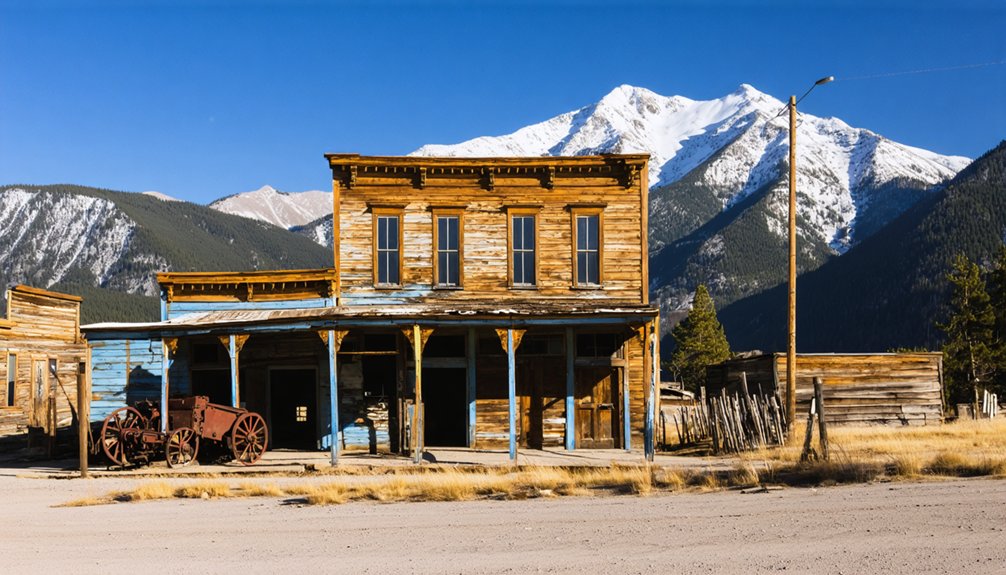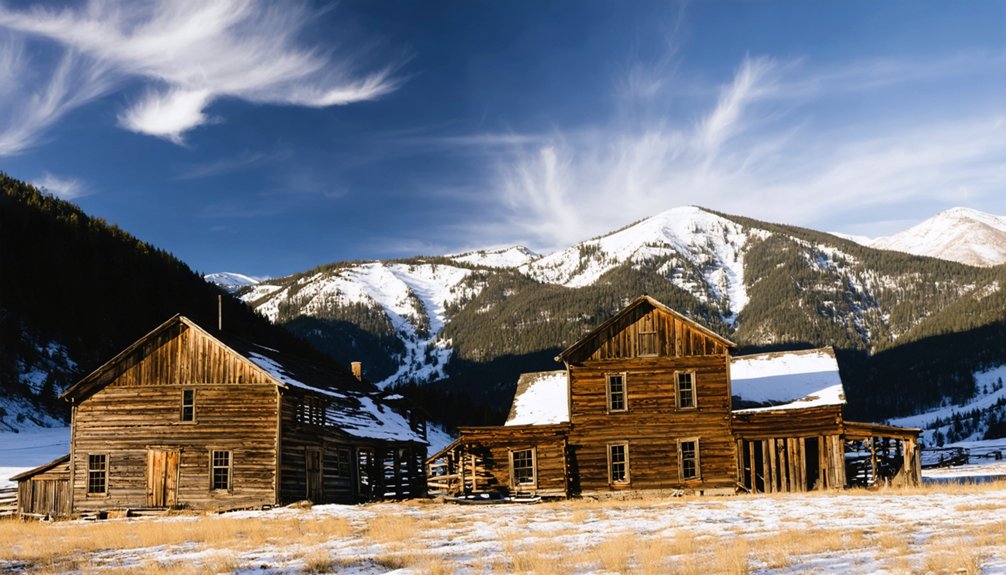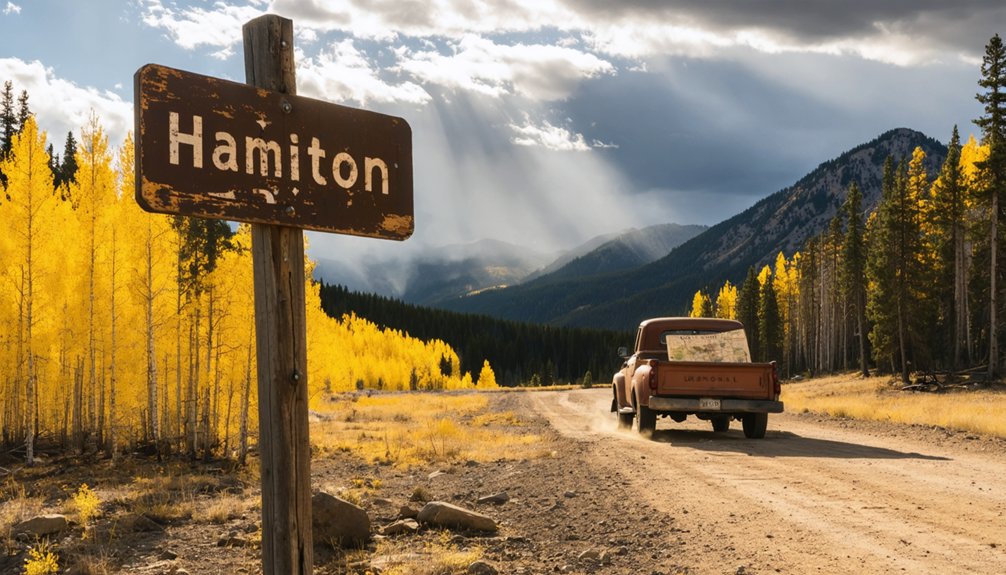
You’ll need a 4×4 vehicle and three days of supplies to reach Hamilton, a silver camp from the 1870s now reduced to scattered boards in Clear Creek Canyon’s wilderness. Plan your visit between summer and fall when temperatures range from 74–97°F and roads remain passable. The trailhead requires a 1.5-hour hike beyond Banker Mine, where several hundred souls once thrived. Today, only faint structural outlines exist beneath the campground, though nearby St. Elmo, Winfield, and Hancock offer better-preserved alternatives worth exploring on your backcountry expedition.
Key Takeaways
- Requires 4×4 vehicle past Banker Mine, followed by 1.5-hour hike to reach scattered remnants with no standing structures.
- Visit summer through fall for optimal access; fall offers fewer crowds, stable roads, and temperatures between 74–97°F.
- Pack three days’ water, food, self-recovery gear, navigation tools, and complete vehicle maintenance before departure.
- Avoid abandoned mine hazards including cave-ins and poisonous gases; bring wilderness survival manuals and emergency supplies.
- Combine with nearby ghost towns: St. Elmo (best-preserved), Winfield, Hancock at 11,054 feet, or Vicksburg cluster.
Getting to Hamilton: Routes and Road Conditions
Reaching Hamilton demands commitment from modern explorers, as this remote Park County ghost town sits deep within Clear Creek Canyon’s wilderness boundaries where vehicles can’t tread.
Hamilton’s isolated location deep in Clear Creek Canyon’s roadless wilderness makes it one of Colorado’s most challenging ghost towns to reach.
You’ll need a capable 4×4 to navigate the rough road past Banker Mine, where civilization’s mechanical reach ends at the US Forest Service gate. Here, trailhead parking logistics require careful planning—space is limited, and you’re entering genuine backcountry.
The 1.5-hour hike beyond tests your resolve through terrain where local wildlife concerns remain real; this is their domain, not yours. Your destination lies across a creek, adding another obstacle between you and the remnants of this forgotten mining camp.
Summer months offer the only reliable window for access, as Colorado’s fierce winters bury the route under deep snow, transforming an already challenging journey into an impossible one for most of the year. What awaits you at trail’s end are only ruins and decaying buildings, the sparse evidence of a town that once housed up to 10,000 residents in its 1869 heyday.
What Remains of Hamilton Today
After your boots finally touch Hamilton’s forgotten ground, prepare for disappointment—this ghost town exists more in historical record than physical reality. The historical significance of the site lies buried beneath campground boundaries, where nature’s reclaimed what man abandoned between 1860-1881.
You’ll find minimal evidence of Hamilton’s placer gold operations:
- Scattered weathered boards dissolving into earth
- Faint structural outlines marking former buildings
- Campground sites overlaying original town footprint
- No standing foundations or walls
- Zero preserved mining equipment
Cultural artifacts discovered at the site remain virtually nonexistent—high altitude winters obliterated Hamilton’s fragile wooden structures decades ago. This pattern mirrors Park County’s 80+ vanished ghost towns, where harsh elements erased physical history. The boom and bust cycle that defined most Western mining towns left Hamilton as just another casualty of fluctuating mineral fortunes. Unlike some Colorado ghost towns now covered in mining tailings, Hamilton simply dissolved back into the landscape. You’re witnessing nature’s ultimate freedom: total reclamation of human ambition.
Explorers often seek out ghost town attractions in Jefferson, drawn by the echoes of lost livelihoods and abandoned dreams. These remnants of once-thriving communities invite curiosity and contemplation, contrasting starkly with the vibrant life that once filled their streets. As nature continues its slow reclamation, visitors can engage with the haunting beauty of these forgotten places.
Best Time to Visit and Weather Considerations
When should you attempt reaching Hamilton’s scattered remains? Summer through fall offers your best window—roads grade accessible and temperatures hover between 74–97°F, though this 8,000-foot elevation keeps conditions surprisingly cool. July brings hot breezes perfect for that 1.5-hour trek from the 4WD gate, but expect peak crowds and cost variations at area attractions.
Fall delivers ideal conditions: fewer visitors, excellent road stability, and spectacular scenic contrast as pinyon and sagebrush frame the spectral ruins. You’ll dodge the cost premiums while enjoying harvest festivals nearby. The route into Hamilton showcases ragged mountains and sprawling fields that once witnessed the town’s meteoric rise to 20,000 residents.
Avoid spring’s muddy mess when snowmelt turns creek crossings treacherous. Winter? Those brutal snows that once drove ill-prepared miners into caves will block your route entirely. Snow-dusted ruins look magical, but you’ll need serious preparation for any winter attempt. Along the way, you’ll pass the little cemetery before completing the final 11-mile stretch into Hamilton.
Essential Supplies and Safety Precautions
Your journey to Hamilton’s ruins demands more than favorable weather—the remote wilderness that swallowed this mining camp whole shows no mercy to the unprepared. Vehicle maintenance checklists become survival documents here: tire repair kits, portable compressors, and oil reserves mean the difference between exploring and stranding. Master winter driving techniques before attempting higher elevations.
Pack strategically for isolation:
- Three days’ water and food supply for unexpected delays
- Self-recovery gear including earth anchors and winching equipment
- Navigation tools: maps, compass, GPS, and wilderness survival manuals
- Emergency shelter, clothing layers, and necessary medications
- Cash reserves for areas where modern payment systems don’t reach
The backcountry doesn’t accept excuses. Carry spare tires, proper footwear for hiking out, and field medical guides. Share your route plan and expected return times with a trusted contact before departing. Before entering any old mining structures near Hamilton, understand that abandoned mines harbor cave-ins and poisonous gases that have claimed countless lives. Your independence depends on self-sufficiency.
Nearby Ghost Towns and Attractions to Explore
Hamilton’s isolation dissolves when you recognize it anchors an entire constellation of abandoned settlements scattered across Chaffee County’s unforgiving peaks. St. Elmo stands as your best-preserved option at 9,961 feet—intact buildings safeguarded by historical preservation efforts draw summer explorers to structures listed on the National Register.
Winfield demands commitment: a 1.5-hour hike past the Forest Service gate reveals Clear Creek Canyon’s placer gold mining legacy alongside weathered remnants. Hancock perches even higher at 11,054 feet, though little survives from its 1880-1904 railroad camp existence.
Vicksburg clusters with Beaver City and Rockdale, showcasing boom-and-bust devastation patterns. Tarryall City‘s trajectory tells the harshest truth—thousands of prospectors dwindled to zero by 1890, leaving only a cemetery and tailing piles where William Holman’s competing town once thrived. The settlement briefly served as the temporary county seat before its inevitable collapse. Independence offers explorers narrow doorway access to weathered log cabins connected by crooked corridors frozen in time.
Frequently Asked Questions
What Was the Primary Mineral Mined in Hamilton, Colorado?
Lead ore veins carved through Colorado’s peaks defined Hamilton’s legacy. You’ll discover mineral extraction methods focused primarily on lead, alongside gold and silver, though environmental impact of mining ultimately left behind only whispers of frontier fortune-seeking.
How Long Did Hamilton Operate as an Active Mining Town?
Hamilton’s settlement duration as an active mining town spanned from 1860 to approximately 1890, though mining operations continued until 1905. You’ll find its peak years lasted just four intense years between 1859-1862 before rapid decline.
Are There Any Documented Ghost Stories or Paranormal Activities in Hamilton?
While you won’t find documented paranormal investigations in Hamilton’s archives, the cemetery’s infant graves and fire-ravaged ruins create an atmosphere where haunting occurrences feel inevitable—though frontier miners focused more on silver strikes than supernatural tales.
Can Visitors Legally Remove Artifacts or Souvenirs From the Site?
No, you can’t legally remove anything from Hamilton. Legal considerations protect every artifact under federal and state law, while preservation efforts rely on leaving everything untouched. Even taking a single nail constitutes a crime with serious penalties.
What Caused Hamilton’s Eventual Abandonment and Decline?
Hamilton’s abandonment stemmed from mining collapse after 1870, triggering economic struggles and population decline. Silver’s 1873 demonetization devastated finances, while catastrophic fires in 1873 and 1885 destroyed infrastructure, ultimately forcing the county seat’s relocation and residents’ departure.
References
- https://www.atlasobscura.com/places/hamilton-ghost-town
- https://www.ghosttowns.com/states/co/hamilton.html
- https://travelnevada.com/ghost-town/hamilton-ghost-town/
- https://valhikes.blogspot.com/2017/05/hamilton-ghost-town.html
- https://coloradosghosttowns.com/Hamilton NV.html
- https://neon.reviewjournal.com/entertainment-columns/trip-of-the-week/trip-to-hamilton-ghost-town-takes-visitors-back-in-time/
- https://shpo.nv.gov/nevadas-historical-markers/historical-markers/hamilton
- https://www.coloradocentralmagazine.com/tarryall-city-hamilton-south-parks-first-gold-rush/
- https://en.wikipedia.org/wiki/List_of_ghost_towns_in_Colorado
- https://www.coloradopast.com/index.php?category=ghosttowns&subcategory=central&selection=Hamilton