Start your Central Utah ghost town adventure in Salt Lake City, then head west to Eureka before reaching Hatton via Kanosh—you’ll navigate unmarked roads using GPS coordinates 38.83889°N, 112.45667°W through sagebrush-scented farmland. Download offline maps before cell signals disappear, pack survival essentials including water and satellite communication devices, and prepare for profound silence among weathered fence posts and crumbling foundations where Peter Robison’s 1859 settlement dreams dissolved into alkali dust. Strategic planning reveals additional abandoned mining towns that’ll transform your expedition into an unforgettable multi-site loop.
Key Takeaways
- Hatton is located in Millard County at 38°50’20″N, 112°27’24″W, accessible via Hatton Lane from nearby Kanosh.
- Download GPS coordinates (38.83889°N, 112.45667°W) before departure, as cellular signals disappear in remote desert areas.
- Expect minimal remains: weathered fence posts, foundation stones, and scattered remnants without preservation signage or guided tours.
- Combine Hatton with nearby ghost towns like Eureka, Mammoth, and Black Rock for an optimal Central Utah loop.
- Bring essential gear including offline GPS maps, satellite messenger, ample water, and first aid supplies for safe exploration.
From Petersburg to Hatton: The Story of a Forgotten Settlement
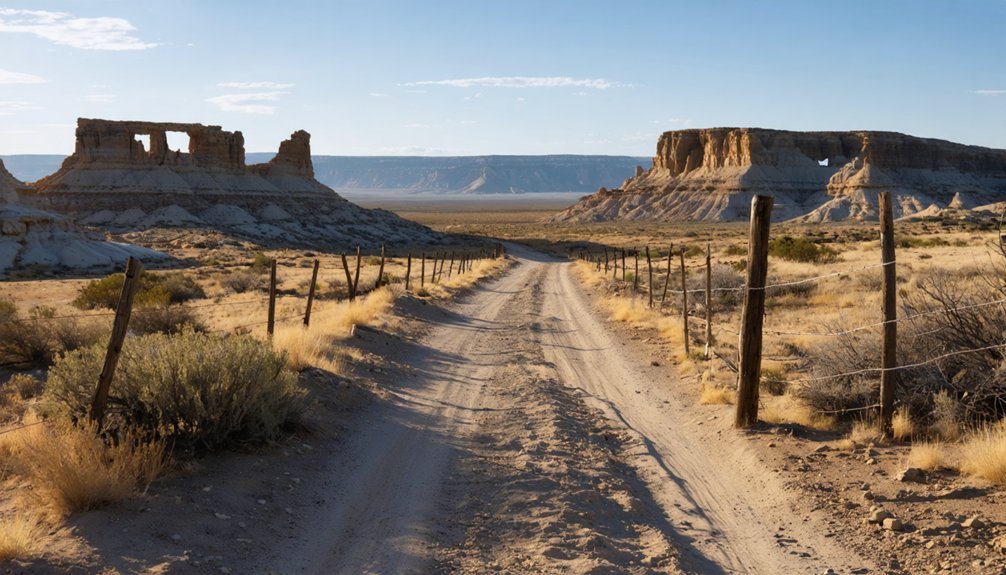
When Peter Robison and Peter Boyce rode out from Fillmore in 1859, they carved a settlement from the high desert where Corn Creek crossed the Mormon Road—three miles northwest of the Pahvant village, downstream from the Indian Farm that would shape their lives. They called it Lower Corn Creek, then Petersburg—honoring Robison’s postmaster role when he established the territory’s lifeline to civilization.
The settlement’s agricultural focus sustained families who gathered at this crossroads, where the Gilmer and Salisbury Stage thundered through between 1864 and 1871, connecting Utah’s railhead to Nevada’s silver-rich Pioche. But freedom means movement. By 1869, most settlers abandoned Petersburg for Kanosh upstream, dragging their schoolhouse behind them. The ghost they left behind became Hatton—a whisper that lingered until 1940.
Finding Hatton: Location and Access Details
At 4,826 feet above sea level, Hatton slumbers in Millard County’s high desert at coordinates 38°50′20″N, 112°27′24″W—a near-ghost town that barely whispers its existence among irrigated fields where Corn Creek once defined the boundary between ambition and wilderness.
At 4,826 feet, Hatton barely whispers its existence—a near-ghost town slumbering where Corn Creek once divided ambition from wilderness.
You’ll navigate rural landscape features along unnamed roads where geographic isolation challenges even modern GPS:
- Plot 38.83889°N, 112.45667°W into Google Maps for digital guidance
- Approach from Kanosh, three miles southeast on back roads
- Follow Hatton Lane through working farmland and scattered homesteads
- Search near Corn Creek crossing for settlement remnants
Little remains visible—just weathered fence posts, foundation stones, and the ghosts of 1859 dreams scattered beneath alfalfa rows. You’re chasing shadows here, tracing the Mormon Road’s forgotten path through sagebrush freedom.
What Remains: Exploring the Near-Ghost Town Today
Your dusty boots hit Hatton’s scattered earth, and reality fractures the romantic notion of exploration—this isn’t Grafton with its Instagram-perfect facades and movie-set charm. Hatton offers something rawer: crumbling foundations where sagebrush reclaims civilization, weathered timber frames collapsing into memory.
You’ll find no preservation efforts here, no interpretation signs explaining what stood where. The wind carries whispers through empty doorways—though unlike Grafton’s paranormal claims of cemetery spirits and crying children, Hatton’s ghosts feel purely metaphorical.
What remains demands imagination: scattered metal fragments, foundation stones marking forgotten homes, the profound silence of abandonment. You’re free to wander unguided, touching sun-bleached wood, photographing decay without constraint. This is ghost-town authenticity stripped bare—no crowds, no admissions, just you and Utah’s unvarnished past.
Building Your Central Utah Ghost Town Route
Because central Utah’s ghost towns scatter across a vast desert canvas rather than clustering conveniently, your route demands strategic planning—not the casual meander you’d attempt through California’s gold country. Target regional ghost town clusters in Juab and Millard counties where mining heritage impact remains most visible.
Your ideal multi-site loop:
- Launch from Salt Lake City westward through sagebrush flats toward Eureka’s rusting infrastructure
- Continue south to Mammoth’s weathered storefronts standing sentinel against mountain winds
- Push west into Millard County’s isolation, where Black Rock’s 1876 foundations anchor desert silence
- Complete the circuit via Fish Springs, tasting alkali dust on your tongue
Download GIS coordinates before cellular signals vanish. Respect private boundaries at sites like Iosepa’s haunting cemetery, accessible only through ranch cooperation.
Must-Visit Abandoned Towns Near Hatton
Planning a ghost town circuit around Hatton presents an immediate challenge: the town itself has faded so completely from records that even dedicated ghost town enthusiasts struggle to pinpoint its exact coordinates.
This obscurity shouldn’t deter your desert exploration—instead, let it sharpen your focus on the verified ruins scattered across Utah’s western frontier, where sun-bleached timber frames crack in hundred-degree heat and rusted mining equipment oxidizes into blood-orange sculptures. Grafton‘s photogenic remnants carry historical significance through preserved pioneer cabins, while Frisco‘s collapsed kilns whisper local folklore about silver boom shootouts. Silver Reef‘s sandstone-embedded ore defied geological norms, creating legends miners still debate. Thistle sits submerged—a modern ghost drowned by landslides.
These confirmed destinations offer tangible connections to Utah’s untamed past, replacing Hatton’s mystery with authentic frontier encounters you’ll navigate on your own terms.
Essential Tips for Your Ghost Town Adventure
The scent of sagebrush hits differently when you’re miles from pavement, watching dust devils spiral across cracked lake beds where no rescue vehicle will find you without coordinates. Staying safe while exploring these forgotten outposts demands preparation that goes beyond romantic notions of adventure.
Choosing the right gear separates memorable expeditions from disaster:
- Navigation tools: GPS units with downloaded offline maps, plus physical topographic charts as backup when technology fails
- Communication: Satellite messenger for emergencies where cell towers abandoned the landscape decades ago
- Survival essentials: Three days’ water minimum, first aid kit, and emergency shelter
- Documentation: Fully charged camera batteries and permission documents for private lands
Your freedom hinges on respecting the unforgiving terrain that claimed these settlements originally.
Frequently Asked Questions
Are There Any Restaurants or Gas Stations Near Hatton?
Hatton’s remote wilderness offers no local businesses—you’ll find neither restaurants nor gas stations in this authentic ghost town. You’re truly off-grid here, so pack supplies beforehand and embrace the rugged outdoor activities that await your adventurous spirit.
Do I Need Permission to Visit Private Property in Hatton?
Yes, you’ll need permission to explore Hatton’s private property. Contact property owners beforehand and check local laws to guarantee you’re respecting boundaries. This protects fragile ruins while letting you freely discover authentic history awaiting your adventurous spirit.
What’s the Best Time of Year to Visit Hatton?
Visit Hatton during spring or fall when weather patterns turn mild and tourist crowds vanish into desert winds. You’ll taste freedom exploring sun-warmed ruins alone, hearing only ravens calling through abandoned doorways, feeling adventure pulse through every crumbling wall.
Are There Camping Facilities Near Hatton for Overnight Stays?
There aren’t established campgrounds with modern amenities near Hatton’s abandoned ruins. You’ll find rugged dispersed camping spots where sagebrush meets desert sky. Check hiking trail conditions beforehand—you’re venturing into raw, untamed backcountry where freedom meets self-reliance.
Is Cell Phone Service Available in the Hatton Area?
Cell network coverage range is extremely limited in Hatton’s remote wilderness. You’ll face significant data connectivity limitations once you venture off main highways. Expect to disconnect completely—embracing the area’s wild isolation becomes part of your authentic ghost town adventure.