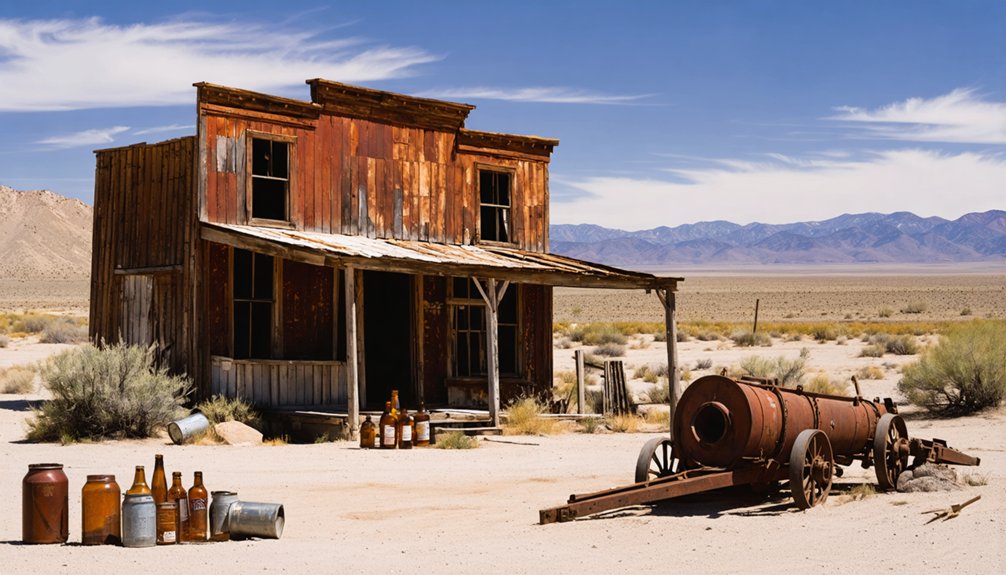
You’ll find Henry approximately 50 miles north of Wells along US Highway 93 in northern Elko County, Nevada. Pack your high-clearance or 4WD vehicle with spare tires, recovery gear, full fuel tanks, and plenty of water before heading down those gravel ranch roads. Plan your visit between late September and early November when crisp autumn air replaces the brutal summer heat that exceeds 100°F. At the site, you’ll discover crumbling depot foundations, scattered water tower remnants, and abandoned rail tracks cutting through the sagebrush, all marking where cattle cars once loaded livestock during Nevada’s steam-powered golden age. Nearby ghost towns like Rhyolite, Belmont, and Humboldt City offer additional exploration opportunities that’ll transform your trip into an unforgettable journey through Nevada’s forgotten railroad history.
Key Takeaways
- Henry is located 50 miles north of Wells, Nevada, along US Highway 93 in remote northern Elko County.
- Bring a high-clearance or 4WD vehicle, spare tires, recovery gear, full fuel, and ample water for gravel roads.
- Visit between late September and early November for mild temperatures, avoiding brutal summer heat exceeding 100°F.
- Explore crumbling depot foundations, water tower remnants, abandoned rail tracks, and 1930s-era school building remains.
- Extend your trip to nearby ghost towns including Rhyolite, Belmont, Humboldt City, and Pine Grove.
Getting to Henry: Remote Roads and Essential Preparations
Tucked away in the stark expanses of northern Elko County, Henry sits roughly 15 miles south of the Idaho border, a weathered chronicle of Nevada’s railroad past. You’ll find this forgotten depot approximately 50 miles north of Wells along US Highway 93, where the Oregon Short Line once brought life to the high desert in 1925. The ranch histories tied to Sparks-Harrell Cattle Company operations shaped this settlement, sustaining a school through the 1930s and 1940s.
Reaching Henry demands preparation befitting ghost town culture‘s independent spirit. Bring high-clearance or 4WD vehicles for gravel roads threading through stream-carved canyons. Pack spare tires, recovery gear, full fuel tanks, and ample water—isolation here isn’t forgiving. Satellite communicators and paper maps prove essential where cell signals vanish, ensuring your freedom to explore remains uncompromised.
What Remains at the Henry Railroad Site
After traversing those demanding desert tracks, you’ll discover Henry’s physical traces speak volumes about its brief railroad life. The depot’s crumbling foundations mark where passengers once disembarked, while scattered water tower remnants reveal the stop’s essential locomotive-servicing role. You’ll find abandoned rail tracks still cutting through the sagebrush, rusting mementos to the Oregon Short Line’s reach into Nevada’s interior.
School building remains from the 1930s-1940s era stand weathered but recognizable, evidence of the ranching families who briefly called this desolate spot home. Cattle industry artifacts—corroded equipment, fence posts, and branding tools—connect you to Henry Harris’s legacy. Each deteriorated structure tells stories of railroad ambition, African American pioneers, and Elko County’s cattle heritage before isolation reclaimed this windswept landscape.
Best Times to Visit and Weather Considerations
When planning your Henry excursion, target the fall months between late September and early November for ideal conditions. You’ll escape the brutal summer heat that pushes past 100°F in this exposed desert landscape while enjoying comfortable daytime temperatures perfect for exploring railroad remnants. These excellent visiting seasons deliver weather condition impacts that enhance your experience rather than threaten it.
Picture yourself discovering Henry when:
- Crisp autumn air lets you wander freely without heat exhaustion risks
- Golden light illuminates weathered timbers against Nevada’s vast sky
- Cool evenings transform the remote site into prime stargazing territory
- Mild temperatures allow extended photography sessions capturing decay’s beauty
Spring offers a secondary window, though unpredictable conditions may challenge access. Winter snow and summer extremes create genuine hazards at this remote location.
Exploring the Railroad Depot Ruins and Water Tank
The weathered remnants of Henry’s railroad depot stand witness to an era when steam locomotives ruled Nevada’s remote corridors. You’ll discover rotted timber supports and busted foundation pieces where barrels once rolled toward waiting trains. The loading dock’s skeletal framework extends toward ghost track beds, its original structure largely succumbed to decades of high desert exposure. Despite minimal timber preservation methods employed here, you can still trace the depot’s footprint through scattered concrete fragments and stem wall replacements.
The adjacent water tank ruins reveal essential infrastructure that kept Oregon Short Line operations flowing through Elko County’s ranchlands. While site restoration efforts remain nonexistent, these deteriorating structures offer authentic glimpses into 1925’s railroad logistics. You’re free to explore foundations where Henry Harris oversaw cattle shipments during Nevada’s steam-powered golden age.
Nearby Ghost Towns Worth Adding to Your Route
Beyond Henry’s crumbling railroad infrastructure, five remarkable ghost towns cluster within Nevada’s expansive terrain, each offering distinct archaeological treasures that’ll transform your dusty detour into an unforgettable exploration.
You’ll discover authentic remnants of mining-era life scattered across these abandoned settlements:
- Rhyolite’s grand train depot stands between Las Vegas and Reno, once serving 5,000 residents and 50 saloons
- Belmont’s 150-year-old courthouse anchors a historic main street layout in Nevada’s center
- Humboldt City’s stone ruins showcase early settler homes and businesses from its 1861 founding
- Pine Grove’s weathered structures mark northern Nevada’s first settlement, discovered in 1866
Each location provides unrestricted access to explore crumbling walls, roofless buildings, and forgotten storefronts where prospectors once staked their fortunes.
The Comstock Lode Legacy: Gold Hill and Virginia City
In spring 1859, two Irish miners stumbled upon bluish rock at the head of Six-Mile Canyon that would reshape American mining history forever. Peter O’Riley and Patrick McLaughlin’s discovery assayed at three-quarters silver, one-quarter gold—worth $3,876 per ton. Henry Comstock muscled his way into their claim, lending his name to what became America’s richest ore deposit.
Gold Hill emerged first, its mill processes and smelting operations producing $12 million by 1866. Virginia City followed, transforming into the West’s most influential industrial hub between Denver and San Francisco. Peak production in 1877 reached $35 million. These towns weren’t just mining camps—they were sophisticated centers where fortunes were made 3,000 feet underground, ultimately yielding over $500 million in precious metals.
Tragic Tales From Nevada’s Mining Camps
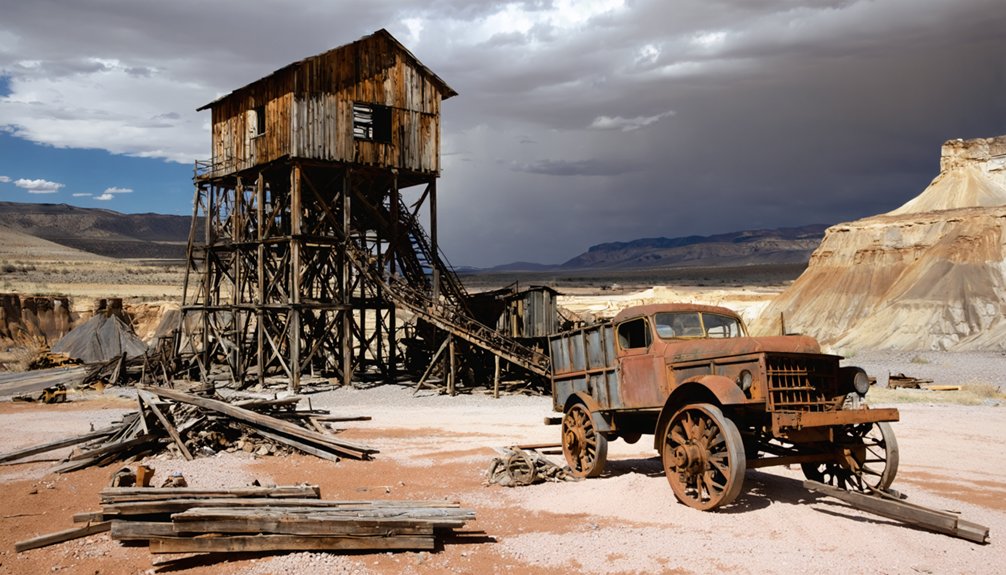
Nevada’s mining camps weren’t just built on dreams of silver and gold—they rose from ashes, blood, and tragedy that shaped their brief, violent histories. As you travel between these ghost towns, you’ll encounter stories where fortune-seeking turned deadly: brothers who froze to death in winter storms, infernos that consumed entire communities, and moonshine operations that ended in explosive disaster.
These tragedies transformed thriving camps into the abandoned ruins you see today, each crumbling foundation marking where ambition met calamity.
The Frozen Jones Brothers
How does a family’s holiday gathering turn into a nightmare etched in Nevada’s historical memory? The Jones brothers’ story haunts Gold Hill Cemetery, where harsh winter conditions claimed Henry and John in December 1871. Their father’s telegraph summoned them from Truckee Meadows, but nature had different plans.
Picture the scene that searchers discovered:
- Two frozen bodies huddled beneath a massive snowbank on Ophir Grade
- A loyal horse standing sentinel over their makeshift grave for three days
- Storm-scattered cattle wandering the desolate mountain pass
- Fresh snow continuously covering any trace of the boys’ final struggle
You’ll find toys adorning their shared headstone today—tributes to lives cut short at ages fourteen and nine. Their family history implications run deep: only three of nine Jones children survived to adulthood in Nevada’s unforgiving frontier.
Virginia City’s Great Fire
Everything Virginia City’s citizens had built—their homes, their fortunes, their dreams of silver empire—vanished in nine hours of flames that October morning in 1875. A knocked-over lamp in an A Street boarding house sparked devastation that consumed 2,000 structures across 33 blocks, driven by fierce Washoe Zephyr winds.
Fire containment efforts proved futile. Small engines couldn’t draw enough water from cisterns, and the inferno melted train car wheels on their tracks. You’ll find that 75% of the city burned—Piper’s Opera House, St. Mary’s Church, the International Hotel—all reduced to ash.
The long term economic impact was staggering: $12 million lost, mine infrastructure destroyed, and national confidence in the Comstock Lode shattered, though Virginia City’s defiant spirit rebuilt swiftly.
Gold Point Moonshine Disaster
When prohibition-era desperation met frontier ingenuity in Gold Point, tragedy struck on a freezing February night in 1929.
Unfortunately, no relevant information on Gold Point moonshine disaster exists—only mining history documents this remote settlement’s past. What survives instead are tales of silver strikes, gold discoveries, and hardscrabble miners who carved freedom from Nevada’s unforgiving landscape.
What you’ll find when exploring Gold Point’s documented legacy:
- Silver mining operations that drew fortune-seekers in the early 1900s
- The 1927 gold discovery that briefly revived dying dreams
- World War II restrictions that silenced the mills and crushers
- Final closures in the 1960s, leaving weathered structures standing guard
The real story remains written in rusted machinery and abandoned shafts—testament to those who pursued liberty beyond civilization’s reach.
Frequently Asked Questions
Are There Camping Facilities Near Henry or Must Visitors Camp Dispersed?
You’ll find dispersed camping options on nearby BLM lands since Henry lacks developed facilities. For amenities, nearby campground availability exists at Valley of Fire State Park or other Nevada recreation areas, though they require reservations and you’ll trade freedom for comfort.
Who Was Henry Harris and What Happened to Him After Construction?
Henry Harris’ life after construction continued as a legendary cowboy until pneumonia claimed him in 1937. Henry Harris’ legacy after construction endures—you’ll find his pioneering spirit livestreamed through this depot bearing his name, honoring fifty years ranching Nevada’s wild grasslands.
Can the Henry Site Be Visited Without a High-Clearance Vehicle?
Road accessibility to Henry remains uncertain without current verification, but vehicle requirements for most Nevada ghost towns favor high-clearance options. You’ll want to check conditions beforehand—remote locations demand preparation, and freedom means being ready for whatever terrain awaits.
Are There Any Guided Tours Available to Henry and Surrounding Ghost Towns?
Unlike Virginia City’s ghost-hunting expeditions or Nelson’s mine explorations, Henry remains a solitary frontier adventure. You won’t find tour schedules or local guides availability here—just raw desert freedom, where you’ll chart your own path through authentic, untamed Nevada history.
What Photography Equipment Works Best for Capturing Remote Railroad Ruins?
You’ll want a DSLR with wide-angle and telephoto lenses for versatile landscape photography techniques. Bring a sturdy tripod with adjustable settings to stabilize shots in Nevada’s harsh winds, plus extra batteries since Henry’s remote location offers no power sources.