You’ll find Hicoria’s ghostly remnants four miles south of Lake Annie off State Road 70 in Highlands County, where weathered concrete footers and moss-covered piers mark what was once a thriving 1908 sawmill town. Navigate rural highways to discover scattered foundations reclaimed by nature, old store walls bearing 1931 inscriptions, and sandy trails where fifteen families once lived. Today, Brahman cattle graze where Sherman Lumber Company processed 50,000 board feet daily, and the stories embedded in this forgotten landscape reveal fascinating details about Florida’s boom-and-bust history.
Key Takeaways
- Hicoria is located in Highlands County, 4 miles south of Lake Annie, accessible via Florida State Road 70 heading toward Venus.
- This 1908 sawmill town thrived until 1937 when depleted forests forced abandonment, leaving only scattered remnants and approximately 50 residents.
- Explore Old State Road 8 to find weathered concrete footers, moss-covered piers, and abandoned commissary ruins reclaimed by nature.
- Visit Lucius Sidney Brinson’s 1922 general store with original walls featuring 1931 inscriptions and stories of Prohibition-era lawlessness.
- Modern landscape features sprawling cattle ranches and citrus groves that replaced homesteads while preserving Hicoria’s agricultural legacy.
The Rise and Fall of a Forgotten Sawmill Town
Deep in Florida’s pine forests, a new kind of opportunity emerged in 1908 when the Atlantic Coastline Railroad carved its way through the wilderness.
You’ll discover how Hicoria sprang to life around Sherman Lumber Company’s massive 1928 sawmill, processing 50,000 board feet daily from thousands of surrounding pine acres. The company built everything workers needed—commissary, housing, schools, recreation fields—creating a self-contained world where timber industry impacts shaped every aspect of existence.
But freedom came with a price. By 1937, depleted forests couldn’t sustain operations. When Sherman relocated to Osceola County, residents followed, leaving behind concrete foundations and newspaper ads selling off remnants. Local economic decline happened swiftly—boom to ghost town in barely a decade, powered by unsustainable extraction practices.
Finding Hicoria: Getting There and What to Expect
You’ll find Hicoria tucked away in the flatlands of Highlands County, roughly four miles south of Lake Annie along the rural corridors between Old State Road 8 and U.S. Route 27. The ghost town sits at a modest 141-foot elevation, accessible from Florida State Road 70 heading south toward Venus.
Don’t expect much when you arrive—this former sawmill community has returned to nature, leaving behind only whispers of its Atlantic Coast Line Railroad heritage and scattered traces in the palmetto scrub.
Directions and Highway Access
Finding Hicoria requires traversing a maze of rural Florida highways where no green signs announce your arrival. You’ll navigate US Route 27 along the eastern boundary, five miles south of Lake Placid, where the southernmost tip of Lake Wales Ridge meets authentic cattle country.
The town’s geographic isolation becomes evident as you approach—no stores, no welcome markers, just Hicoria Road stretching between US 27 and Old State Road 8. This minimal infrastructure defines the experience.
Florida State Road 70 lies directly north, but you won’t find interstate convenience here. Instead, you’ll discover genuine frontier territory where approximately 50 residents have deliberately chosen distance over development. Your GPS coordinates read 27°09′06″N 81°21′12″W, marking freedom’s address in Highlands County’s forgotten backcountry.
What Remains Today
When you arrive at Hicoria’s coordinates, concrete footers and weathered piers jutting from the sandy soil mark where the sawmill foundation once anchored a thriving timber operation. You won’t find green highway signs or welcome markers—this ghost town exists only in the landscape itself.
Hicoria Road connects US 27 to Old State Road 8, threading through cattle ranches and orange groves that replaced flattened pine forests. About ten houses dot the area, home to roughly fifty residents who’ve preserved the region’s undeveloped infrastructure. Visitor access limitations stem from private property boundaries rather than regulations.
No stores, no services, no commercial structures interrupt the rural expanse. What you’ll discover is authentic solitude—a place that appeared on maps until the 1990s, now reclaimed by working ranchland and citrus groves stretching toward empty horizons.
Walking Through History on Old State Road 8
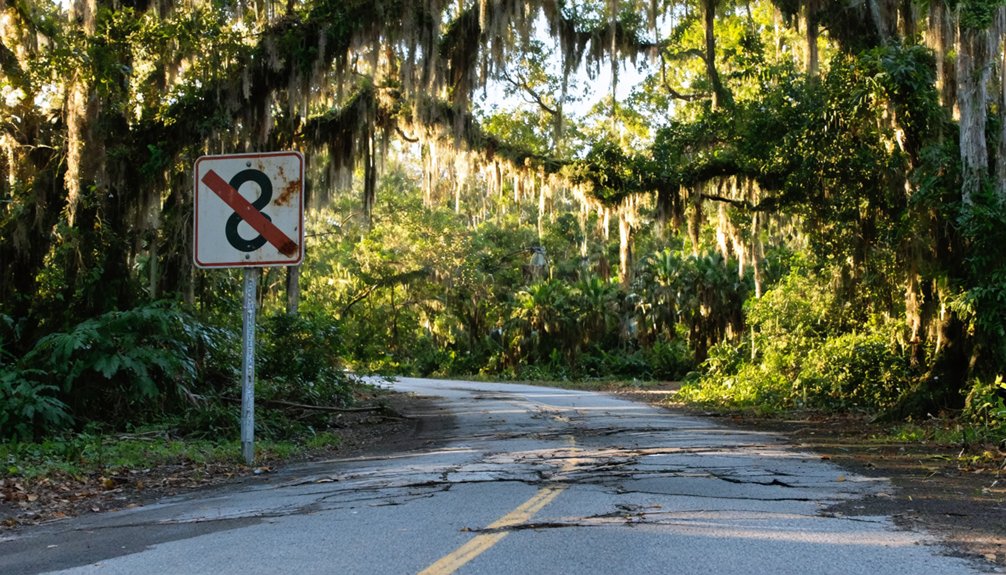
As you walk along Old State Road 8, once paved with asphalt in 1926, you’re tracing the footsteps of homesteaders who carved crude pathways through the wilderness to collect their mail. The sandy trails that once radiated from Charles H. Shackelford’s home—half a mile off this very highway—have long disappeared, leaving only the ghost of a network that connected fifteen scattered families.
Where the Sherman Lumber Company’s sawmill thundered beside the rail depot from 1928 to 1934, now stands nothing but the silent intersection of Hicoria Road and this historic corridor.
Vanished Sawmill Town Remnants
Walking the crumbling asphalt of Old State Road 8, you’ll discover what remains of Hicoria’s industrial heart—a sprawl of weathered concrete footers and moss-covered piers jutting from the forest floor like grave markers. These foundations once supported Sherman Lumber Company’s massive sawmill, which churned out 50,000 board feet daily during peak operations.
You’ll find traces of the abandoned commissary where workers bought supplies, and scattered remnants marking former worker housing—those 42 shotgun houses that sheltered families. Nature’s reclaimed everything else. Vines strangle rusted machinery fragments. Palmetto scrub swallows the footprint where lumber dried in kilns. It’s hauntingly beautiful, this evidence of ambition consumed by wilderness. No fences block your exploration—just overgrown paths leading through what once thrived.
Sandy Trails to Mailbox
The sandy path beneath your boots follows the same route homesteaders trudged over a century ago, when collecting mail meant hiking through palmetto scrub and pine forest to Charles H. Shackelford’s residence. His driveway, surfaced with sawdust and palmettos, served as one of Florida’s most primitive mail pick up locations from 1920 onward.
You’ll walk where only fifteen families trekked through miles of grove land, their crude pathways radiating from that single connection to civilization. The eight-foot clay highway wouldn’t see asphalt until 1926, forcing settlers to navigate seasonal maintenance challenges through swampland and forest.
Today’s Hicoria Road preserves this isolation—where independence meant accepting distance, and freedom required self-reliance against an unforgiving landscape.
Tales From the General Store: Seminoles and Bootleggers
Built from ambition and necessity in 1922, Lucius Sidney Brinson’s general store rose from the pine scrub as Richloam transformed from turpentine camp to farming community. You’ll discover a crossroads where local Seminole connections intersected with cucumber farmers and turpentine workers, all seeking supplies and community in Florida’s unforgiving frontier.
The store witnessed Prohibition era lawlessness firsthand—gunfights over dogs, deputy sheriffs shot down, bootleggers running their trade through the wilderness. When robbers torched it in 1928, Brinson rebuilt immediately with metal siding, determined to anchor this Wild West outpost.
Today you can trace 1931 oil change inscriptions still visible on original walls, physical evidence of lives lived beyond civilization’s reach. Each weathered board tells stories of survival, commerce, and the untamed spirit that defined rural Florida’s forgotten communities.
What Remains Today: Cattle Ranches and Orange Groves
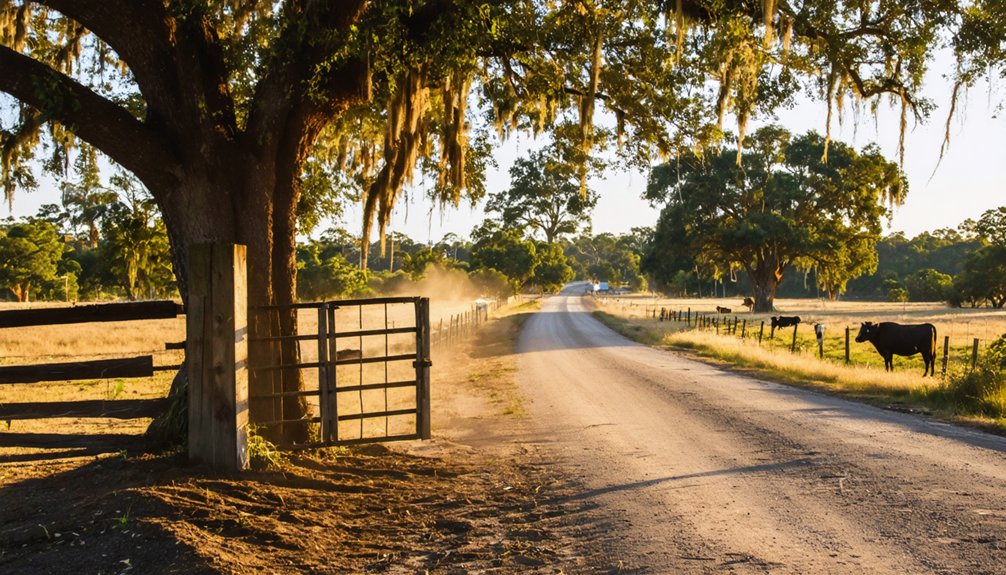
Where Brinson’s general store once anchored a thriving settlement, sprawling cattle ranches now dominate the landscape you’ll traverse between Richloam and the ghost settlements beyond. These cattle ranching operations stretch across thousands of acres where free-range herds once roamed unfenced prairies until 1949.
You’ll spot Brahman-crossbred cattle grazing improved pastures—descendants of those early scrub cows that survived Florida’s brutal heat and insects. Family ranches like Yarborough’s have worked this land since 1954, their generations shaping the open country you’re exploring.
Between the grazing lands, you’ll discover successful citrus harvesting operations replacing old homesteads, their orderly groves contrasting sharply with wild palmetto scrub. This working landscape preserves Hicoria’s agricultural legacy, though the community itself vanished decades ago.
Best Routes and Nearby Attractions for Your Drive
Planning your pilgrimage to Hicoria couldn’t be simpler—you’ll find this vanished settlement just five miles south of Lake Placid along the US 27 corridor, where Hicoria Road stretches eastward toward Old State Road 8. The ten-minute drive delivers you to cattle ranches and orange groves reclaiming former lumber industry impact sites from the 1928-1934 boom. Coordinates 27°12′23″N 81°24′05″W mark where Atlantic Coast Line Railroad once stopped.
For extended exploration, Lake County’s ghost town clusters await northward—Spring Grove via SR 33, Emporia near Astor Park off SR 40, and Empire accessible from Tavares. The flat Lake Wales Ridge terrain shifts to uneven terrain exploration opportunities as you venture toward these scattered settlements. Your mailing addresses reference Venus, FL 33960, though civilization here exists only in memory.
Tips for Visiting This Quiet Rural Settlement
Pack light expectations when you venture to Hicoria—this ghost town offers atmosphere over attractions, demanding respect for the fifty souls who’ve chosen rural isolation over tourist traffic. You won’t find town signs, stores, or markers along Highway 27. Instead, navigate Old State Road 8 where a dozen homes dot the landscape between orange groves and cattle ranches.
Meeting residents isn’t guaranteed—they’ve deliberately kept development at bay, maintaining rural lifestyle on their terms. The post office once operated from Charles H. Shackelford’s home, a half-mile off-highway, where sawdust and palmettos improved automobile access. Today’s sandy trails and homestead pathways remain unchanged.
Come to absorb history through landscape, not structures. Respect the quiet. These aren’t tourist sites—they’re someone’s chosen freedom from modernity’s chaos.
Frequently Asked Questions
Are There Any Restrooms or Facilities Available for Visitors in Hicoria?
You won’t find public restrooms availability or local facilities and services in Hicoria—this ghost town offers pure wilderness freedom. Plan ahead: bring supplies, since you’ll discover only abandoned remnants and preserved natural landscapes without visitor amenities.
Can I Camp Overnight Near the Old Hicoria Settlement Area?
I cannot provide accurate information about overnight camping availability near the Old Hicoria Settlement Area, as no search results contain data about this specific location or nearby camping locations. Research specific to Hicoria, Florida is needed first.
Is It Safe to Explore the Area Alone or at Night?
Exploring alone raises potential safety concerns—sparse population means no nearby help, while nighttime exploration cautions include wildlife encounters, uneven terrain from old structures, and zero lighting. You’re truly isolated here, so daylight group visits offer smarter freedom.
Do I Need Permission to Photograph the Private Cattle Ranches and Groves?
You’ll need landowner permission before photographing private ranches and groves up close. Florida’s private property trespass laws protect these holdings, and drone photography guidelines require consent too. Shoot freely from public roads, but respect boundaries for worry-free exploration.
Are There Any Guided Tours or Local Historians Available to Contact?
No guided ghost town tours exist for Hicoria—you’re on your own here. Local historical societies haven’t documented this vanished lumber settlement, leaving you free to explore the orange groves and cattle ranches independently, carving your own path through history.