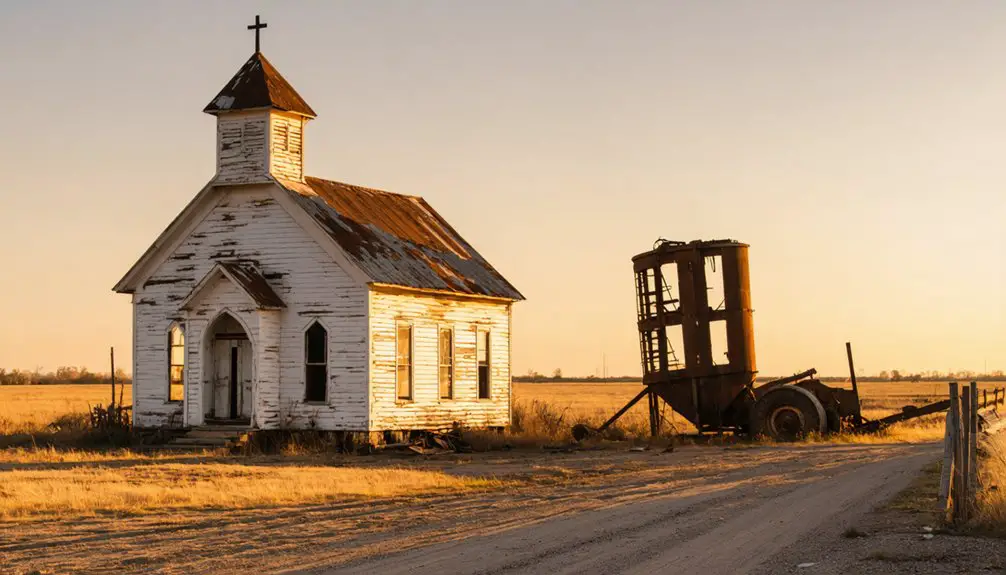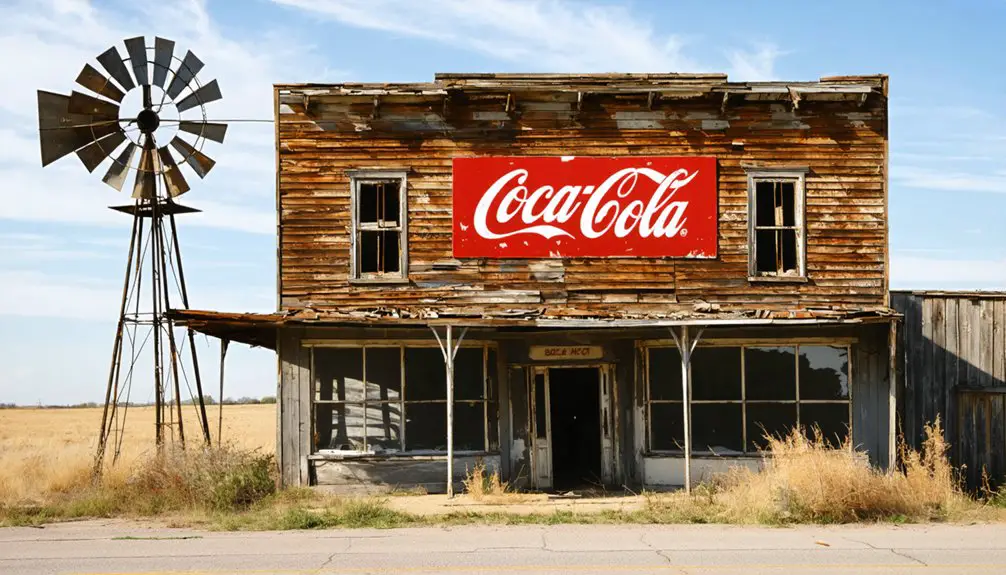
You’ll find Indianapolis ghost town at coordinates 35.551°N, 98.863°W in Custer County’s rolling plains, where a towering grain elevator still marks this former railroad settlement. Since GPS won’t recognize it, use nearby Clinton or Arapaho as waypoints and download offline maps—cell service is practically nonexistent out here. The journey requires careful planning for unpaved roads, but that weathered concrete sentinel rising from the prairie makes the navigation challenge worthwhile. Below, we’ll walk you through the complete route, ideal visiting seasons, and what remains of this 1890s agricultural hub.
Key Takeaways
- Indianapolis is located in Custer County at coordinates 35.551°N, 98.863°W, northeast of Clinton in western Oklahoma’s rolling plains.
- Use GPS coordinates and offline maps since the ghost town doesn’t appear on modern navigation systems; cell service is unreliable.
- Navigate using nearby towns like Arapaho or Clinton as waypoints, marking the E0860 RD and N2290 RD intersection as reference.
- Check road accessibility for 2WD vehicles beforehand to avoid unpaved stretches that could strand you in isolated terrain.
- The main attraction is the towering grain elevator, plus remnants of Red Rock School and the old Rock Island railroad siding.
The History Behind Indianapolis: From Frontier Settlement to Ghost Town
Indianapolis sprang to life in 1890 along the freshly laid tracks of the Rock Island railroad line, joining hundreds of hopeful settlements across Oklahoma Territory during the frontier’s final chapter. You’ll find it was named after its Indiana namesake, a common practice among settlers seeking familiar anchors in unfamiliar land.
The town’s agricultural reliance centered on its grain elevator, which processed harvests from surrounding farms. But population fluctuations hit hard during the Great Depression, draining the community’s lifeblood. Without economic diversity beyond the railroad, Indianapolis couldn’t adapt when rail routes shifted elsewhere. The settlement was inhabited from the 1800s until the late 1900s, when the last residents finally departed. The name Indianapolis itself combines Indiana, meaning Land of the Indians, with the Greek word polis for city.
Getting There: Directions and Road Access to Indianapolis
You’ll find Indianapolis tucked away in Custer County’s western reaches, where Oklahoma’s rolling plains meet fading traces of frontier ambition.
The good news is that you won’t need a high-clearance 4×4—standard county roads get you within walking distance, though I’d recommend downloading offline maps since cell service gets spotty once you’re past Weatherford.
Your best bet is using the coordinates 35.551°N, -98.862°W as your primary waypoint, then watching for the remnants of the old town grid about two miles south of Highway 33. For reference, the actual city of Indianapolis is situated on the White River in central Indiana, far to the northeast of this Oklahoma ghost town that shares its name. If you’re planning to drive from Oklahoma City to this namesake city in Indiana instead, expect a journey of 1191.86 km that typically takes around 10 hours and 38 minutes.
Locating Indianapolis in Custer County
Nestled in the rolling plains of western Oklahoma, this forgotten settlement sits at coordinates 35.551°N, 98.863°W, roughly 1,669 feet above sea level. You’ll find Indianapolis northeast of Clinton in Custer County, where geographic isolation defines the landscape. The population density here’s practically nonexistent—what remains is pure solitude.
To pinpoint this ghost town on your map:
- Reference the Indianapolis USGS quadrangle for precise topographical details
- Look northeast of Clinton (ZIP 73601) along the back roads
- Note nearby communities like Arapaho, the county seat, and East Junction
- Use GPS coordinates rather than street addresses—traditional navigation won’t help
This area embodies frontier emptiness. County Road signs and ranch gates’ll be your landmarks as you venture off beaten paths into authentic Oklahoma backcountry. Custer County itself is one of multiple counties in the United States sharing this same name, though this specific western Oklahoma location offers its own unique character.
Since Indianapolis doesn’t appear on most modern GPS systems under that name, you’ll need to rely on coordinates and old-fashioned map work to chart your course. Google Maps and MapQuest become your best allies—input nearby Arapaho or Clinton as waypoints, then navigate the connecting rural roads.
Check the 2WD road accessibility options in both platforms to avoid unpaved stretches that’ll strand you. Street View previews reveal what satellite images can’t: washouts, ruts, and seasonal weather impacts like spring flooding or winter ice that transform passable routes into muddy nightmares. The interactive map allows you to zoom in and out to view different levels of detail as you plan your approach.
Download offline PDF maps before departing—cell service is spotty out here. Monitor real-time traffic conditions and customize your route to avoid toll roads, keeping those extra miles and dollars in your pocket for the adventure ahead. Look for alternative routes if needed when road closures or unexpected obstacles appear on your selected path.
Using Grid Reference Points
Pinpointing Indianapolis demands precision navigation in a landscape where road signs vanished decades ago alongside the town itself. You’ll need solid coordinate accuracy to find this ghost town at N35° 33.092′, W98° 51.751′. Modern map integration transforms your smartphone into a frontier guide—drop those decimal coordinates (35.551, -98.862) into Google Maps and let technology bridge the century gap.
Essential Grid Reference Tools:
- Export KML files to Google Earth for satellite reconnaissance before departure
- Mark the E0860 RD and N2290 RD intersection as your primary waypoint
- Cross-reference UTM coordinates with elevation data for terrain verification
- Download offline maps—cell service won’t find you out here
Oklahoma shares its ghost town legacy with fellow Great Plains states like Kansas and the Dakotas, where economic downturns left their mark on the landscape. Before venturing underground or near suspected mining areas in Oklahoma, consult the Office of Surface Mining’s mine map repository to identify any historical coal mining operations that might pose subsidence risks. Your freedom to explore hinges on preparation. These grid points aren’t suggestions; they’re your lifeline to discovering what remains.
What You’ll Find: Exploring the Grain Elevator and Remaining Structures
When you arrive at Indianapolis, the towering grain elevator will immediately catch your eye—it’s the skeleton of a once-thriving agricultural hub that processed countless bushels from surrounding farmlands.
You’ll spot a weathered sign beside the elevator that confirms you’ve found the right place, standing as a lonely marker for a community that simply faded away.
Make sure to look for the Red Rock School site during your visit, though you’ll need to search carefully since nature has reclaimed much of what the Depression-era exodus left behind.
The old railroad siding marks where the Rock Island line once brought commerce and connection to this remote prairie settlement.
The Historic Grain Elevator
When you visit, you’ll notice these defining features:
- Vertical concrete bins built in parallel rows for maximum efficiency
- Railroad access points where farmers once loaded their harvests
- Weathered surfaces showing decades of harsh prairie elements
- Original mechanical systems still visible through broken sections
Stand beneath these towers and you’ll feel the weight of history—when small towns like Indianapolis thrived as crucial links in America’s grain distribution network, connecting Oklahoma wheat fields to world markets.
Indianapolis Identification Sign
As you approach the weathered grain elevator rising from the Oklahoma prairie, you’ll spot a humble sign that confirms what maps barely remember—this scattered collection of ruins once answered to the name Indianapolis. The sign’s design is uncomplicated, lacking any governmental pretense or bureaucratic flourish. Just weathered lettering marking a place that refused to completely vanish.
Sign deterioration tells its own story here. The elements have worked their magic—paint peeling in strips, metal oxidizing into russet patterns, wood graying under decades of sun. I’ve found that photographing this marker at different times of day reveals how light transforms decay into unexpected beauty. Bring your camera during golden hour. The sign stands as stubborn proof that some places insist on being remembered, even after everyone’s left.
Red Rock School Site
Standing beside the Farmers’ Cooperative elevator south of Red Rock, you’ll grasp how completely this place has transformed from its 1917 heyday. The grain tower anchors what remains of a town that once shipped cattle and crops by rail, its population of 500 now scattered.
The original consolidated school district merged with Marland in 1989, creating Frontier—a powerhouse that funded modern campus construction one mile east through OG&E plant taxes.
What endures here tells the real story:
- The cooperative elevator marking railway-era commerce
- The cattle dipping vat site where ranchers fought Texas fever ticks
- Relocated structures from Otoe Switch six miles south
- Tribal markers near Otoe-Missouria headquarters
You’re free to wander these open grounds, piecing together a frontier town’s arc from Otoe hunting grounds to agricultural hub to quiet remembrance.
Best Times to Visit Indianapolis Ghost Town
The golden light of late spring transforms Indianapolis, Oklahoma’s weathered grain elevator into a photographer’s dream, though most visitors don’t realize this abandoned railroad siding offers dramatically different experiences depending on when you arrive.
April through May offers ideal seasonal windows—you’ll capture stunning shots during early morning or late afternoon while avoiding brutal summer heat. The surrounding tulip poplars bloom spectacularly, framing the ruins against clearer skies.
Fall’s September through October provides similar advantages with fewer storms. Winter’s snow creates haunting atmospheres, but icy roads complicate access.
Since you’re exploring remote Custer County, consider low cost lodging options in nearby Clinton or Weatherford. Skip crowded summer weekends when temperatures soar above 95°F. You’ll appreciate the solitude and comfort during shoulder seasons.
Nearby Attractions: Red Rock School and Other Custer County Sites
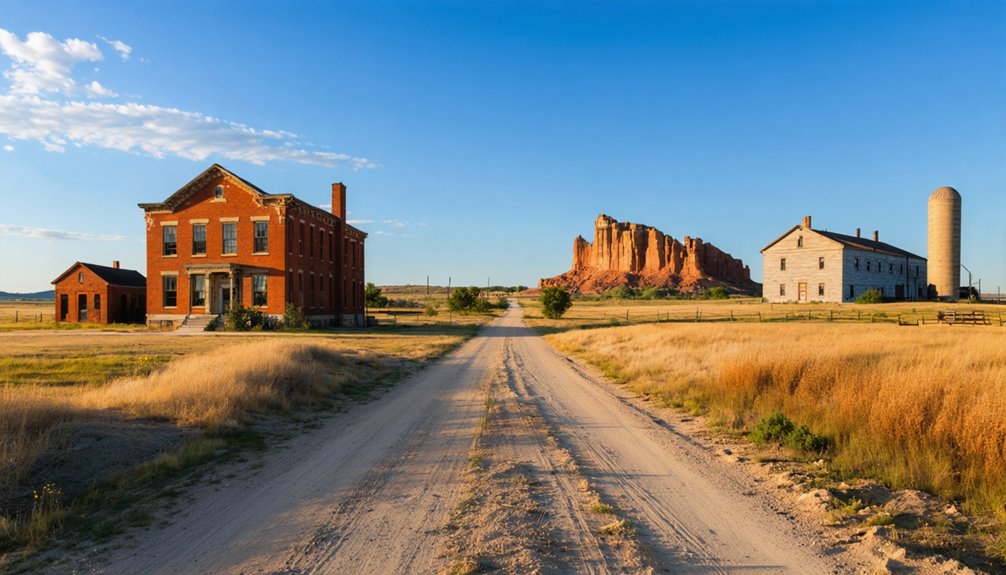
While Indianapolis itself offers limited structures to explore, your ghost town adventure gains depth when you venture fifteen miles north to discover Red Rock School’s impressive evolution from frontier one-room schoolhouse to modern consolidated campus. You’ll trace educational heritage shaped by historical native american educational influences, from Otoe-Missouri reservation lands to Choctaw farmer Lyman H. Perkins‘s 1898 donations.
Red Rock School stands fifteen miles north, preserving 125 years of frontier education from one-room beginnings to modern campus.
Regional rural school buildings worth exploring:
- Indianola’s 1909 two-story sandstone schoolhouse near Fort Smith and Western Railway tracks
- Red Rock’s 1982 campus funded by Oklahoma Gas and Electric taxes
- Wheelock Academy (1832), now a National Historic Landmark with museum access
- Wapanucka Academy’s preserved structures north of Boggy Depot
You’ll find painted plank blackboards and multifunctional community spaces that reveal how settlers prioritized education after 1901.
Creating Your Oklahoma Ghost Town Itinerary
Planning your ghost town circuit through Custer County rewards you with authentic glimpses into Oklahoma’s boom-and-bust heritage, though you’ll need realistic expectations about what remains. Indianapolis offers mainly its grain elevator, so bundle it with Independence and other nearby abandoned sites for a fuller day of exploring local history.
Pack accordingly—seasonal weather patterns swing from January’s 24°F lows to July’s scorching 70°F-plus temperatures. Winter brings snow, summer delivers relentless heat. I’ve learned to start early, escape midday extremes, and carry extra water.
Your 2WD vehicle handles these grid roads fine, giving you freedom to roam without specialized equipment. Download offline maps since cell service gets spotty. Most importantly, respect what little remains—these weathered structures tell Oklahoma’s raw, unvarnished story of ambition meeting reality.
Tips for Photographing and Documenting Your Visit

Once you’ve mapped your route through Indianapolis and neighboring ghost towns, camera gear becomes your storytelling companion. Your mirrorless or DSLR camera captures shadow subtleties that smartphones miss. Pack wide-angle lenses for sweeping abandonment scenes and primes for weathered door handles and rusted signs.
Proper lighting techniques transform ordinary shots—golden hour casts dramatic shadows across collapsed roofs, while your flashlight spotlights forgotten bottles inside the old saloon.
Master perspective enhancing compositions with these approaches:
- Frame building exteriors during golden hour for maximum drama
- Use tripods for stable interior shots in dim light
- Convert to black and white to emphasize textures and emotion
- Include yourself for scale and narrative depth
Remember: avoid basements and federal properties. Document these disappearing structures before vandalism erases Oklahoma’s frontier legacy forever.
Frequently Asked Questions
Are There Any Facilities Like Restrooms or Water Available at the Site?
You won’t find restrooms or water at Picher’s crumbling structures—they’re toxic and demolished. Pack your own supplies and scout nearby convenience stores beforehand. The existing structures are dangerously unstable, so you’ll need self-sufficiency for this adventure.
Is It Safe to Enter or Climb on the Old Grain Elevator?
No, don’t enter or climb the elevator. Structural integrity concerns make collapse unpredictable—I’ve seen weathered concrete crumble without warning. Potential asbestos hazards lurk inside abandoned facilities. Your freedom isn’t worth risking serious injury or death here.
Do I Need Permission From Landowners to Explore Indianapolis Ghost Town?
Want to explore freely? You’ll need private landowner approval for fenced areas at Indianapolis ghost town. View remains from public roads without permission, but respect posted boundaries—historical preservation concerns matter, and trespassing risks ruin access for everyone.
Are There Any Camping Areas Near Indianapolis for Overnight Stays?
You’ll find rustic campgrounds nearby at Tenkiller State Park, offering excellent accessibility for travelers seeking freedom. It’s your perfect basecamp—I’ve stayed there myself, just an hour away, with everything from primitive sites to full hookups available.
What Wildlife or Safety Hazards Should Visitors Watch for in the Area?
Watch for venomous snakes like copperheads in overgrown areas and test potential unstable structures before entering abandoned buildings. You’ll want sturdy boots, a walking stick, and awareness of your surroundings to explore safely and freely.
References
- https://kids.kiddle.co/Indianapolis
- https://www.ghosttowns.com/states/ok/indianapolis.html
- https://fromcommonground.com/a-ghost-town-revival/
- https://www.geotab.com/ghost-towns/
- http://sites.rootsweb.com/~oktttp/ghost_towns/ghost_towns.htm
- https://en.wikipedia.org/wiki/Indianapolis
- https://www.youtube.com/watch?v=45D4dbASJyE
- https://indytoday.6amcity.com/history/meet-the-two-other-us-cities-named-indianapolis
- https://www.okhistory.org/publications/enc/entry?entry=GH002
- https://www.okhistory.org/historycenter/forms/timeline.pdf