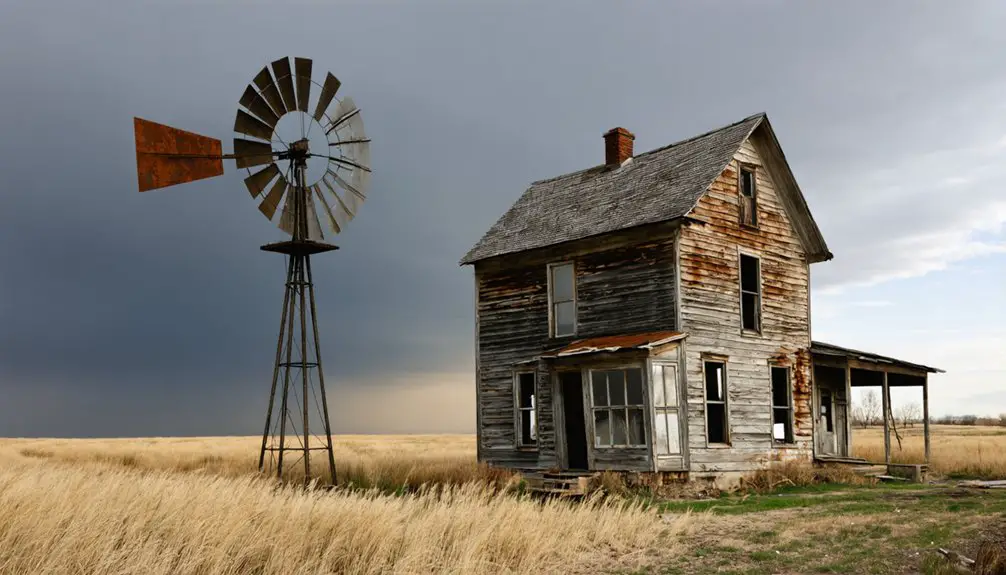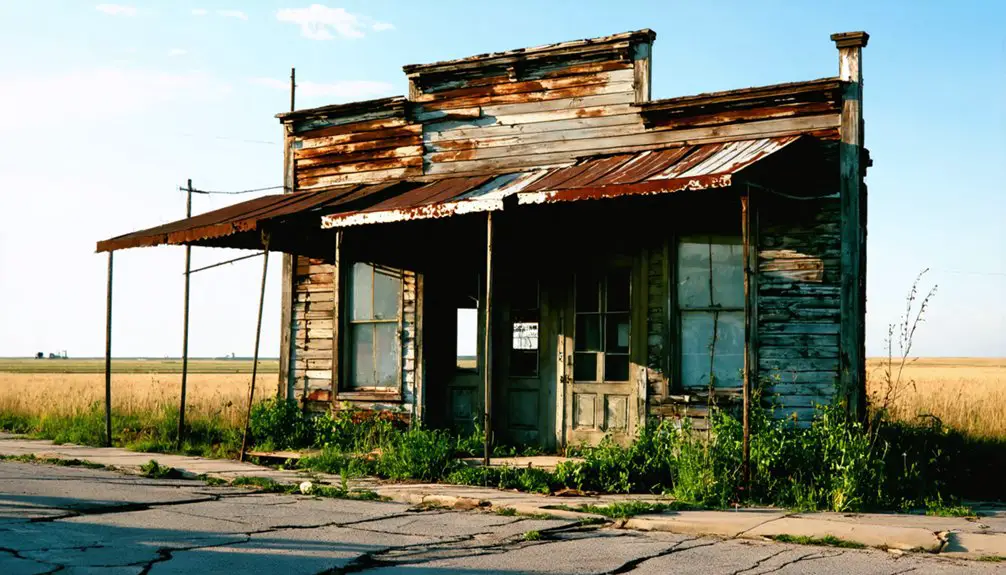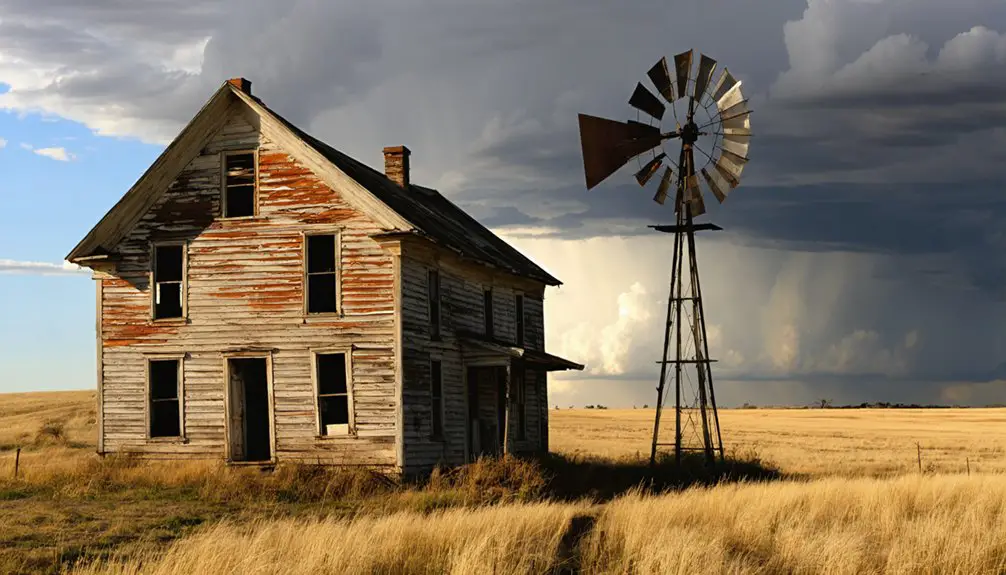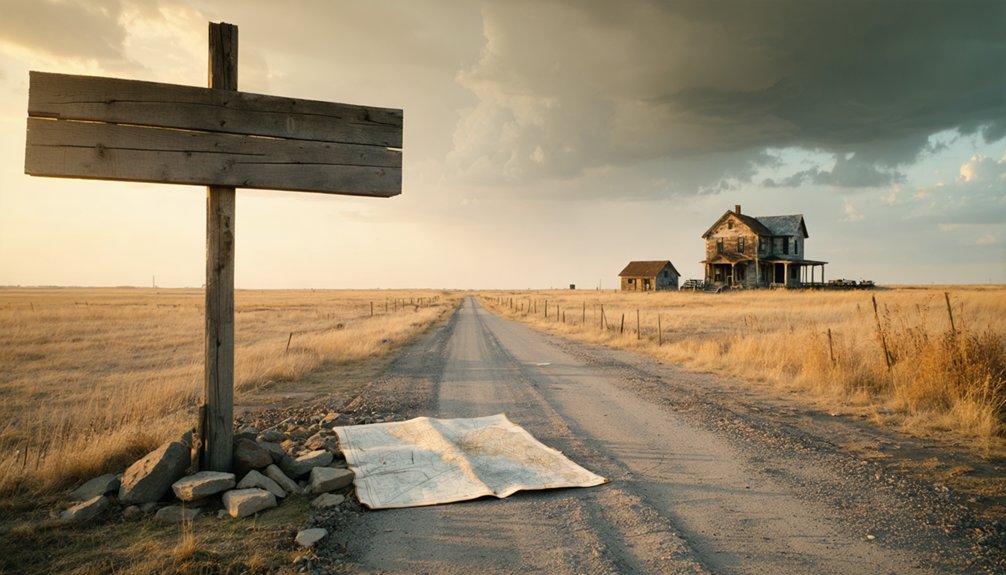
Start your Jacksonville ghost town expedition 60 miles southwest of Lincoln in Gage County, where you’ll navigate rural backroads to find tree-named dirt streets and the 1979-rebuilt Mount Zion Missionary Baptist Church, the last remnant to this 1866 African American settlement. You’ll complete the one-mile walking loop through grass-covered thoroughfares in under an hour, then extend your journey 40 miles south to St. Deroin and Brownville for a full-day Missouri River steamboat-era circuit that connects Nebraska Territory’s vanished communities.
Key Takeaways
- Jacksonville is located 60 miles southwest of Lincoln in Gage County, requiring backroad navigation and topographic maps to reach.
- Visit Mount Zion Missionary Baptist Church, established in 1869, the most tangible connection to Jacksonville’s African American founders.
- Walk the intact four-by-three block street grid with tree-named dirt roads, completing the one-mile loop in 30-45 minutes.
- Extend your trip by visiting St. Deroin and Brownville, Missouri River ghost towns 40 miles south sharing 1850s steamboat-era history.
- Plan for seasonal conditions as wagon ruts appear after rainfall and grass-covered surfaces require clearing for optimal visibility.
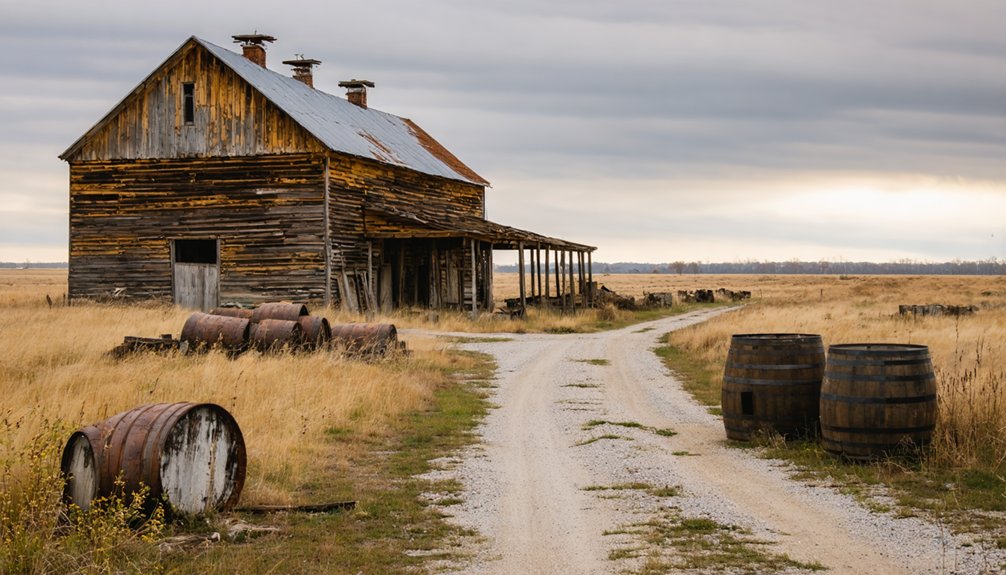
While most travelers associate Jacksonville with Florida’s bustling port city, Nebraska’s Jacksonville tells a strikingly different story—one that challenges our understanding of the naval stores industry’s geographic reach. You’ll discover a settlement whose historical significance defies the conventional Southern narrative of tar, pitch, and turpentine production.
Unlike the Carolinas’ massive operations where factors controlled vast longleaf pine forests and operators cut “boxes” into tree bases, Nebraska’s Jacksonville represents an anomaly in naval stores production methods. The state’s sparse conifer resources couldn’t support the labor-intensive gum collection that made North Carolina produce 95% of America’s pre-Civil War naval stores.
Instead, this ghost town’s story reveals how ambitious entrepreneurs pushed beyond traditional boundaries, ultimately learning that some industries remain forever bound to geography’s unforgiving constraints.
Getting to Jacksonville: Route Options From Omaha and Lincoln
Before you pack your vintage road atlas and undertake this ghost town pilgrimage, you’ll need to reconcile a geographical puzzle that’s stumped many would-be visitors: the Jacksonville in these distance metrics isn’t Nebraska’s abandoned settlement at all, but rather Florida’s sprawling metropolitan hub 1,315 miles southeast of Omaha.
Nebraska’s Jacksonville requires no interstate marathon through Saint Louis or Nashville. Instead, you’ll find this forgotten townsite roughly 60 miles southwest of Lincoln in Gage County—a manageable two-hour journey on state highways. Driving conditions favor rural two-lanes rather than congested southern corridors, while comparative costs drop dramatically: expect $15-20 in fuel versus $200+ reaching Florida’s namesake. Your actual destination demands backroad navigation skills, topographic maps, and respect for private property boundaries where prairie reclaims history.
Exploring the Preserved Mount Zion Missionary Baptist Church From 1867
Your gravel road arrival at Jacksonville’s emptied townsite reveals an unexpected survivor: Mount Zion Missionary Baptist Church, whose weathered sanctuary stands as the settlement’s most tangible connection to its 19th-century African American founders. Established in 1869 when 36 members from Black Creek Baptist Church gained permission to form their independent congregation, the site evolved from a brush arbor to a simple frame structure before reaching its present form.
The 1979 sanctuary you’ll explore replaced those pioneering buildings while preserving the original location. Church architectural details reflect community-built simplicity rather than grand design—a conscious choice by formerly enslaved people asserting spiritual autonomy. Though historical church artifacts from Reverend William Hart’s founding ministry remain limited, the structure itself testifies to 150 years of African American self-determination in Nebraska’s frontier landscape.
Walking the Tree-Named Dirt Streets of Jacksonville
Beyond Mount Zion’s weathered sanctuary, Jacksonville’s skeletal street grid materializes through prairie grass as a remarkably intact artifact of 1860s town planning. You’ll walk Oak, Elm, Maple, Walnut, and Ash—five dirt thoroughfares spanning four blocks north-south and three east-west. Original wagon ruts emerge after rainfall, revealing the muddy reality pioneers endured before railroads arrived.
The unrestored surfaces remain grass-covered, requiring seasonal clearing for visibility, yet they’re perfect for a relaxing afternoon stroll across flat terrain. Private landowner agreements preserve these paths without modern paving, protecting the grid from vehicle damage through strategic fencing.
You’ll complete the one-mile loop in 30-45 minutes, encountering prairie wildflowers and native flora that thrived here since 1866. Visit spring through fall when overgrowth doesn’t obscure Jacksonville’s tree-named corridors.
Combining Jacksonville With Nearby Missouri River Ghost Towns
You can extend your Jacksonville exploration into a full-day ghost town circuit by visiting St. Deroin and Brownville along the Missouri River, roughly 40 miles south. These settlements share Jacksonville’s steamboat-era timeline—all chartered or platted in the 1850s when river crossings determined Nebraska Territory’s commercial future.
The route connects three distinct Missouri River communities: Jacksonville’s inland railway ambitions, St. Deroin’s ferry-dependent economy that peaked at 300 residents before the 1911 flood, and Brownville’s horseshoe gulch position offering views across four states.
Multi-Town Route Itinerary
Since Jacksonville’s remote location near the Platte and Missouri Rivers junction places it within reach of several significant steamboat-era settlements, an extensive ghost town expedition can encompass five to six abandoned sites in a single day.
Begin at Jacksonville’s historical markers, then drive southeast to Brownville where local preservation efforts maintain restored buildings and the Lone Tree saloon ruins. Continue to St. Deroin within Indian Cave State Park, where trail preservation allows hiking through townsite remnants.
Head northeast to Rulo, examining Judge Miller’s claim and blacksmith shop foundations alongside original hotel structures. Complete your circuit through Nebraska City and Plattsmouth, following the Missouri River northward. This 100-mile loop traces steamboat commerce routes that once transported 80,000 westbound travelers during 1866’s peak migration year.
Steamboat Era Historical Connections
These ghost towns share a common lifeline that once pumped commerce through their streets—the Missouri River’s steamboat traffic. You’ll discover Jacksonville’s history intertwined with Brownville’s wharf, where fifteen steamers simultaneously unloaded merchandise bound for Pike’s Peak settlements.
St. Deroin’s ferry operations disruptions came when the river changed course after three decades of Iowa crossings. Steamboat decline impacts devastated these communities equally—Brownville’s ruined houses mirror Jacksonville’s abandonment as the channel silted and burrowed into sand.
The river that built these towns ultimately destroyed them, washing away wharves, ending ferry service, and stranding populations. You’re exploring sites where wagon trains once dispersed goods inland, where massive levees bordered sharp bends, and where European American speculators’ ambitions drowned alongside their riverfront investments.
Best Time to Visit and Trip Duration Recommendations
You’ll find Jacksonville’s crumbling foundations most accessible during spring and fall, when moderate temperatures between 50-70°F allow extended exploration without summer’s oppressive heat or winter’s biting winds. Historical records suggest that early settlers abandoned this Missouri River outpost gradually between 1867-1890, leaving structures that now reveal themselves differently across seasons—spring wildflowers frame deteriorating homesteads, while October’s golden light casts long shadows through empty doorframes.
Plan a 2-3 day expedition to thoroughly document Jacksonville alongside neighboring river towns like St. Deroin, allowing time to cross-reference visible architectural remnants with county land records and historical society archives.
Optimal Seasonal Visiting Conditions
While Jacksonville’s abandoned structures welcome visitors throughout the year, the seasons dramatically reshape your experience among the weathered buildings and overgrown homesteads. Spring delivers wildflower-framed ruins and sandhill crane migrations along nearby Platte River, though you’ll contend with rain-soaked paths.
Summer’s oppressive heat—often exceeding 100 degrees—demands dawn explorations, yet seasonal local event highlights like living history reenactments compensate for the sweltering midday hours.
Fall emerges as the perfect juncture: October’s haunted history tours coincide with comfortable temperatures and ideal seasonal photography conditions as golden foliage frames decaying storefrontS.
Winter transforms Jacksonville into a snow-blanketed time capsule, offering solitude and enhanced wildlife spotting, though January’s brutal cold tests your resolve.
Plan around July-August’s heat and March-May’s storms for maximum comfort among the ruins.
Recommended Itinerary Length
Because Jacksonville’s skeletal remains demand unhurried exploration to appreciate its layered histories, you’ll need at least a full day to properly photograph the collapsed general store, decipher cemetery headstones dating to the 1870s, and trace the town’s decline through remaining foundation markers.
For the ideal road trip duration, consider embedding Jacksonville within a 2-3 day western Nebraska loop that includes nearby dying settlements like Culbertson and Trenton, creating a 125-mile circuit.
Multi day itinerary planning works best when you allocate morning hours for structural documentation, afternoons for cemetery research, and evenings to witness the eerie stillness that descends across abandoned Main Street.
Extend your exploration to 4-7 days if you’re weaving Jacksonville into Nebraska’s broader ghost town network spanning 850+ miles of forgotten homesteads and railroad relics.
What Remains: Original Structures and Historical Landmarks
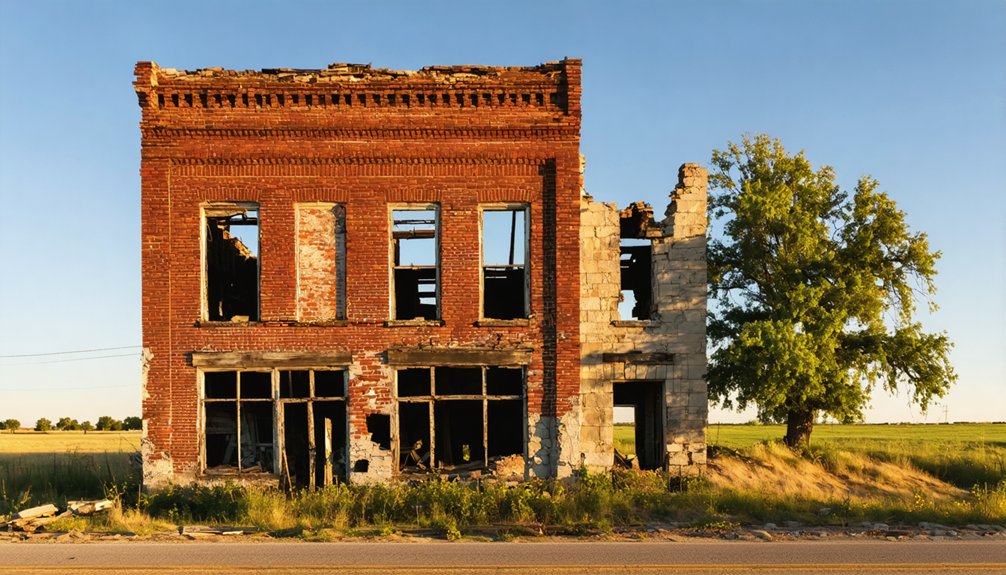
The physical remnants of Jacksonville, Nebraska’s ghost towns rest in disparate states of decay across the Missouri River bottomlands. You’ll find Cambridge’s vacant park block between University and Park Streets, platted May 8, 1857, where archeological excavations might reveal foundations from the original fifty substantial brick and frame buildings of nearby Oreopolis.
The streets don’t align with compass points—a quirk from proprietors J.L. Gibbs, J. Safford, and their partners who filed plats in 1856-1857. Summervill’s 187 acres weren’t even U.S. surveyed. At low water in Branched Oak Lake, Crounse’s foundation stones emerge, while St. Deroin’s overgrown ruins hint at native american interactions from the mid-19th century.
Spring Ranch’s 1870 bank building stands proof of resilience after 1864’s destruction.
The King’s Road Connection: From British Colony to Modern Highway
You’ll trace a route that began as an Indian trail before British engineers transformed it into the ambitious King’s Road between 1764 and 1775, stretching 150 miles from the Georgia border to New Smyrna.
Colonial administrators invested £1,150 in causeways and bridges to connect East Florida’s scattered settlements, creating a crucial artery for trade and troop movements during the Revolutionary War. Though wilderness reclaimed the road by 1821, the U.S. Army rebuilt it along the original British path in 1828, establishing the foundation for what eventually became modern U.S. Highway 1.
British Colonial Construction Era
When British forces claimed Florida in 1764, they inherited a wilderness where water-based transport ruled and overland passage remained treacherous at best. Between 1772 and 1775, you’ll find construction crew composition that included contractor Robert Bisset’s laborers—indentured Minorcans and enslaved workers—hauling pine logs through cypress swamps.
Material transport logistics proved brutal: sixteen-foot-wide causeways demanded constant timber supply across Nassau River branches.
The engineering challenge required consultation with Seminole leader Grey Eyes, who plotted routes following ancient game trails through Flagler County’s unforgiving terrain. This collaboration produced:
- Broken shell surfaces suitable for coach travel stretching from St. Marys, Georgia to St. Augustine
- Strategic bridges spanning countless creeks and rivers at £1,150 cost
- Causeway networks conquering swamps that had defeated previous attempts
You’re witnessing Britain’s ambitious corridor opening Florida’s frontier.
Modern Transportation Route Legacy
Britain’s ambitious colonial roadway didn’t vanish after the Revolutionary War—it evolved. You’re driving on King’s Highway‘s legacy every time you merge onto Interstate 95 or U.S. Route 1. Civil engineers during the 1920s paved this 1,300-mile colonial artery, transforming post riders’ paths into modern asphalt. The historical significance runs deeper than mile markers—Native American trading routes became British mail roads, then U.S. highways connecting Charleston to Boston.
When Eisenhower signed the Interstate Highway System into law on June 29, 1956, planners followed these established corridors. You’ll find the same transportation infrastructure pattern repeated westward: Texas’s El Camino Real received pink granite markers in 1915, preserving Spanish expedition routes. Today’s road-trippers trace these freedom-seeking paths through Princeton, Philadelphia, and Hampton, where colonial ambition meets contemporary wanderlust.
Photography Opportunities Along Sweetwater Creek
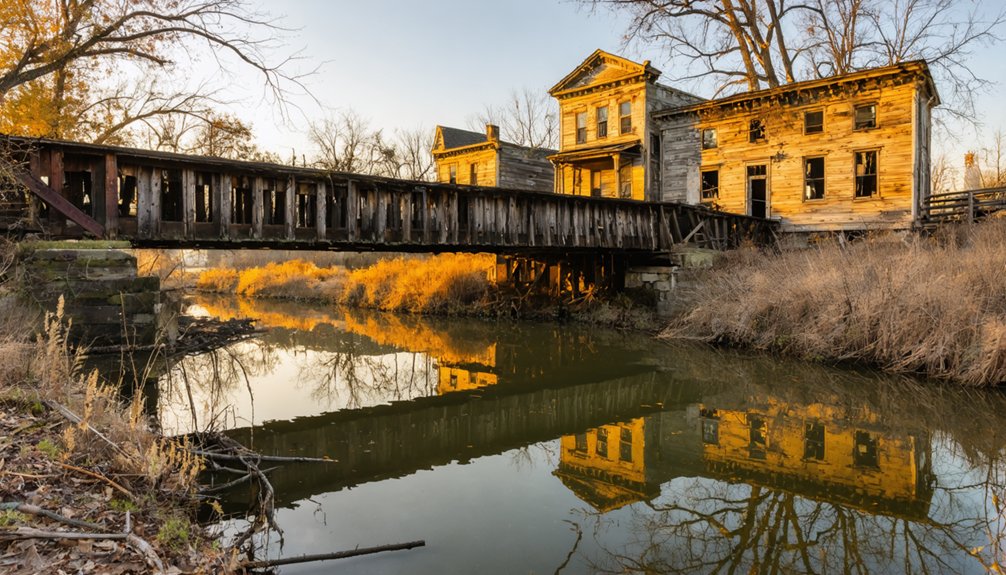
Although Sweetwater Creek itself flows quietly through Nebraska’s Buffalo County as a modest tributary of the South Loup River near the unincorporated community of Sweetwater, photographers venturing to this ghost town region will find compelling subjects in the remnants of pioneer infrastructure that once depended on its waters.
The area’s photographic potential centers on:
- Historic cabins and abandoned homesteads scattered across Beaver Township, their weathered timber telling stories of settlers who relied on that clean spring water from 1874 onward
- Railway station remnants along Highway 2, where trains once stopped between Ravenna and Hazard
- Natural creek-side compositions at 2,060-foot elevation, where early morning light illuminates the waterway that sustained this now-discontinued postal community
You’ll capture authentic frontier decay without permission barriers or modern intrusions.
Creating a Multi-Day Southeast Nebraska Ghost Town Itinerary
Southeast Nebraska’s Missouri River corridor contains the state’s densest concentration of 1850s settlement ruins, making it ideal for a three-to-four-day exploration loop that captures the arc of frontier boom and abandonment. You’ll start at Brownville, where $6,000 lots now sell for $6, examining historic infrastructure alignments that once connected fifteen steamboats to western wagon trains.
Head south to St. Deroin at Indian Cave State Park’s northern edge—former ferry crossing sites reveal how river course changes erased entire economies. Continue to Rulo and Nebraska City, both California Gold Rush-era freighting hubs. Use period plat maps from the 1857-1858 speculation wave to pinpoint Oreopolis at the Platte-Missouri junction.
Consult archival county records for forgotten sites like St. Charles, Smithland, and Troy—accessible through state park networks.
Frequently Asked Questions
Are There Any Lodging Options Near Jacksonville or Nearby Ghost Towns?
Like whispers from the past, you’ll discover nearby historic hotels in Norfolk and Madison, plus rural bed and breakfasts scattered throughout Pierce County. These authentic accommodations let you explore Jacksonville’s ghostly remnants on your own terms.
Is Jacksonville Privately Owned or Can Visitors Freely Explore the Area?
Jacksonville’s ownership remains undocumented in archives, but Nebraska’s ghost towns typically sit on private land without public access policies. You’ll need permission before exploring, as historical preservation efforts don’t guarantee open access to abandoned sites.
What Cell Phone Coverage Can I Expect in Remote Ghost Town Areas?
You’ll find cellular connectivity severely limited in remote ghost towns. Coverage quality drops markedly beyond major highways, with spotty or nonexistent signals common. Verizon and AT&T perform best, but you should prepare for extended periods without service in Nebraska’s most isolated areas.
Are Guided Tours Available for Jacksonville and Surrounding Ghost Town Sites?
Jacksonville, Oregon offers guided tours available through Historic Jacksonville, Inc., featuring costumed interpreters sharing documented pioneer tales. However, Nebraska’s ghost towns like Brocksburg and Minersville provide self-guided exploration options, letting you discover abandoned structures independently at your own pace.
Do I Need Special Vehicle Clearance for Dirt Roads in Jacksonville?
You won’t need special clearance—no permit required for standard vehicles traversing Jacksonville’s weathered passages. However, dirt road conditions demand high-clearance vehicles with sturdy tires. Check vehicle requirements like working brakes and lights before your independence-seeking expedition begins.