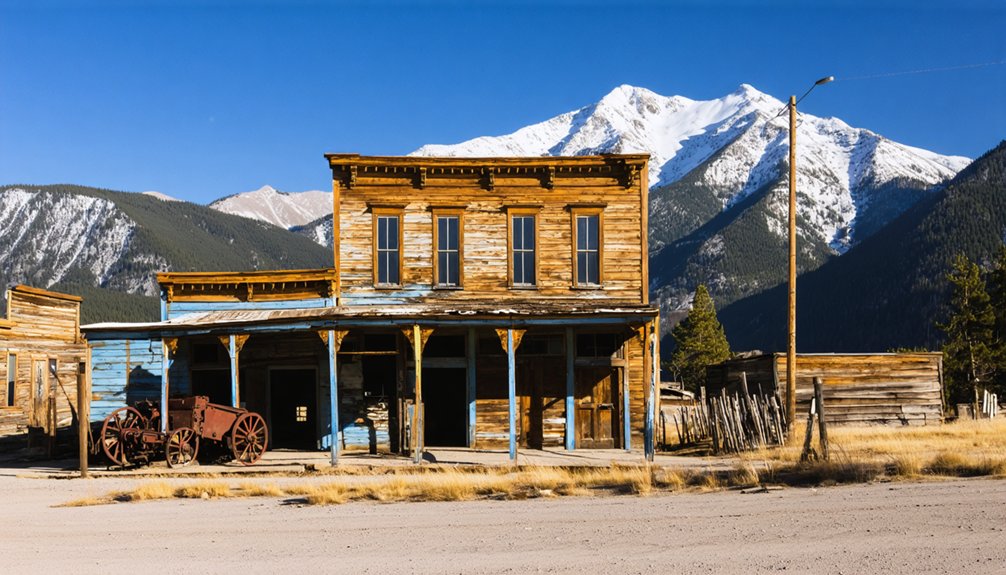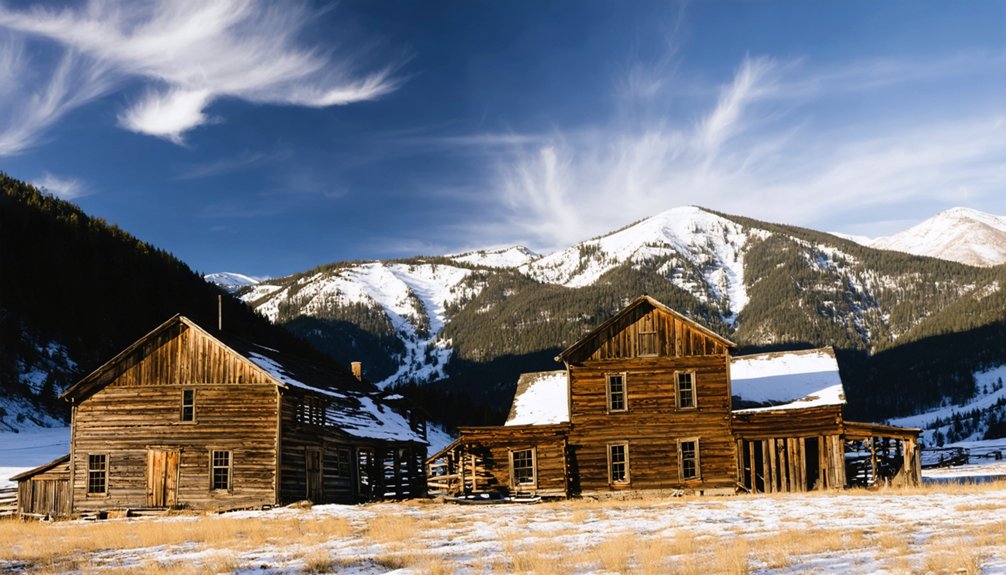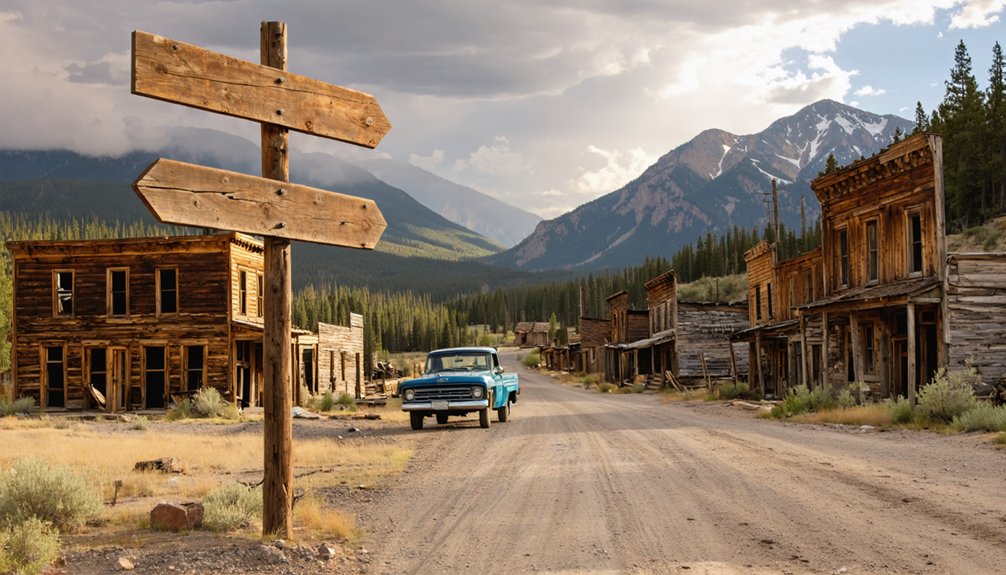
You’ll find Jefferson ghost town waiting in Park County’s rugged high country, roughly 2-3 hours southwest from Denver via US 285. Take the scenic route through Red Rocks and past Mount Evans, keeping an eye out for that weathered Jefferson sign marking your arrival. Winter demands chains and careful planning, as snow frequently closes these mountain corridors. Check real-time road conditions before departing, and you’ll discover weathered foundations, mining remnants, and the stories of Colorado’s territorial past scattered across these windswept peaks.
Key Takeaways
- Jefferson is located in Park County, approximately 2-3 hours southwest of Denver via US 285 through Bailey and Fairplay.
- Primary access routes include Denver via US 285, southern approach from Buena Vista, and Colorado Springs via US 24 west to US 285 north.
- Watch for seasonal road conditions including winter snow closures, chain law enforcement, and check real-time road conditions before departing.
- Key landmarks along US 285 include Red Rocks, Pine Junction, Bailey, Shawnee, and Red Hill Pass before reaching Jefferson.
- Jefferson was part of the 1859 Territory of Jefferson, with nearby Mount Vernon serving as the original territorial capital.
Understanding Jefferson’s Rich Historical Timeline
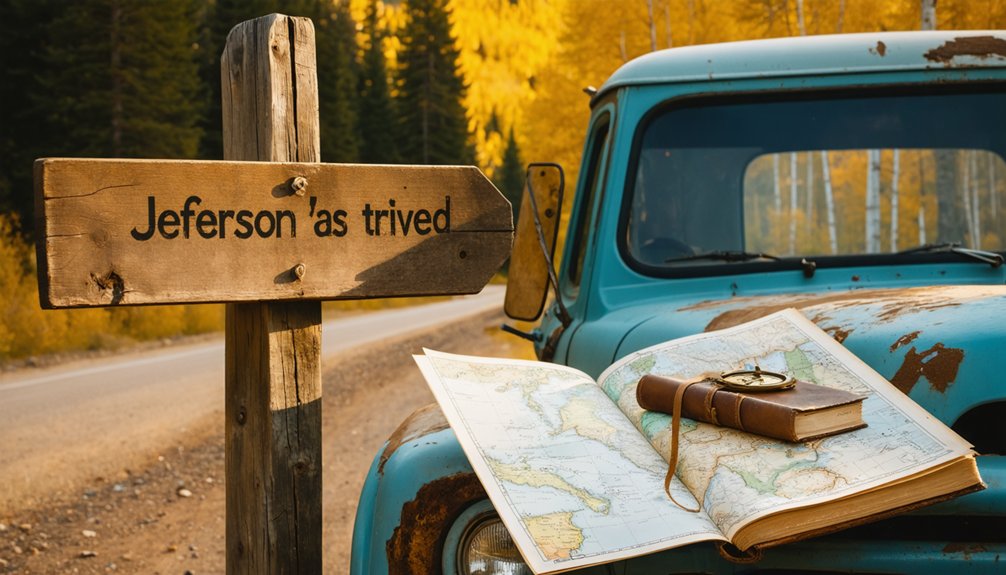
The story of Jefferson begins not with a fever—gold fever that transformed Colorado’s Front Range from Arapaho hunting grounds into a patchwork of mining camps and makeshift governments.
You’ll discover that by 1859, prospectors were so disconnected from Kansas and Nebraska authorities that they created their own Territory of Jefferson on October 24, establishing pre territorial governance that Washington never recognized.
On November 28, twelve counties emerged, including Jefferson itself. When Colorado Territory officially formed in 1861, Hispano settler conflicts surfaced in legislative chambers, revealing tensions between established communities and newcomers.
Golden became the territorial capital in 1862, cementing the region’s defiant spirit. The name Jefferson appears on multiple county locations across the United States, making it a common geographical designation that honors the third president.
In 1952, the region witnessed the groundbreaking for Rocky Flats, a nuclear weapons plant that would dramatically reshape the area’s economic and environmental landscape for decades to come.
This wasn’t just settlement—it was self-determination carved from mountain stone.
Essential Ghost Town Sites to Visit in Jefferson County
Scattered across Jefferson County’s rugged terrain, five ghost towns whisper tales of boom-and-bust cycles that shaped Colorado’s frontier identity. You’ll discover Mount Vernon first—platted in 1859, this former Jefferson Territory capital sits 2.6 miles north of Morrison along County Road 93. The geology of ghost town sites reveals gold-bearing veins that drew thousands westward. Trek the Village Walk Trail to Mathews/Winters Park’s cemetery, where weathered gravestones and stone houses stand sentinel. Despite its modest population of only 200, Mount Vernon maintained essential services including a couple of hotels, a general store, and a post office.
Venture beyond county borders to explore connected settlements: Hamilton’s 1860 placer camp in Park County, Chandler’s coal town ruins in Fremont County, and El Paso County’s agricultural ghosts—Gwillimsville and McFerran. These transportation infrastructure remnants trace stage routes and mining roads that once pulsed with fortune-seekers’ ambitions, now reclaimed by Colorado’s untamed wilderness. Many of these settlements met their demise when the railroad changed routes, leaving once-thriving communities isolated and economically unviable.
Getting to Jefferson: Route Planning and Road Conditions
You’ll find Jefferson nestled along US 285 in Park County‘s upper South Park region, about 2-3 hours southwest from Denver through dramatic mountain terrain that climbs from the Front Range foothills into high-altitude wilderness.
The route takes you through Jefferson County’s iconic landmarks—past Red Rocks’ towering formations and beneath Mount Evans’ snow-capped peaks—before the highway sweeps south toward the ghost town near Como and Grant. Jefferson County stretches from city edges to mountain peaks, encompassing the dramatic elevation changes you’ll experience on this drive.
Winter transforms this journey into a white-knuckle adventure where blizzards rake across exposed ridgelines and ice glazes the asphalt, so you’ll need to check road conditions religiously before pointing your vehicle toward these remote high-country ruins. The town operates on Mountain Daylight Time, which is seven hours behind UTC during the summer months.
Primary Access Routes
Getting to Jefferson requires traversing mountain corridors where asphalt ribbons climb through alpine meadows and pine forests toward the ghost town’s 10,000-foot perch. US Highway 285 forms your primary artery, cutting southwest from Denver through Kenosha Pass before reaching the Jefferson turnoff.
You’ll navigate 85-95 miles of mountain highway, gaining elevation to 9,500 feet where ponderosas frame distant peaks.
Your main approach options:
- Denver Route: Follow US 285 through Bailey and Fairplay (2 hours 15 minutes)
- Southern Approach: Head north from Buena Vista via US 285 (45 miles)
- Alternative connecting routes: Access via State Highway 9 from Alma through Fairplay
- Springs Access: Navigate US 24 west to US 285 north (2.5 hours)
Year round accessibility factors include chain law enforcement and snow closures, though primary corridors remain passable. Colorado’s position among Great Plains states means that while Jefferson’s ghost town status stems from mining decline, the region shares characteristics with other abandoned settlements shaped by economic shifts.
Seasonal Road Conditions
Mountain weather transforms Jefferson’s access roads dramatically between seasons, with winter storms depositing 10-20 inches across central Colorado corridors while spring runoff carves muddy channels through high-country passages. You’ll face snow accumulation impacts that turn US 285 into a technical route requiring chains and winter-rated tires. During major storms, visibility drops to near zero through snow squalls, while 60 mph gusts create instant whiteout conditions.
Check COTrip’s real-time cameras before departure—4-wheel drive won’t save you on ice-packed surfaces. Keep your tank half-full and carry cat litter for emergency traction. Chain law requirements activate without warning when conditions deteriorate. For current conditions, call 303-639-1111 to verify road status before heading into the mountains. Snow showers can continue on and off through the day, adding minor accumulations that compound existing hazards.
Wednesday’s second-wave systems bring the worst travel windows, stacking fresh powder over frozen layers that’ll test your backcountry driving skills beyond posted warnings.
From Denver’s southwestern suburbs, Jefferson materializes 51 miles down US-285 South—a straight shot that climbs steadily from the CO-470 interchange through ponderosa-studded foothills into Park County’s high country.
Your navigation cues unfold naturally along this mountain corridor:
- Pine Junction (mile 14): First landmark identification point where civilization thins
- Bailey (mile 28): Midpoint marker with services before deeper wilderness
- Shawnee (mile 40): Final outpost signaling Jefferson’s proximity
- Red Hill Pass (mile 48): Elevation peak preceding your descent into ghost town territory
Watch for the weathered Jefferson sign breaking through roadside sage—easy to miss if you’re distracted by sweeping mountain vistas. No confusing turns exist; US-285 delivers you directly to history’s doorstep where time stopped and freedom began. This historical abandonment site once thrived during Colorado’s mining era before economic decline transformed it into the ghost town visible today.
Exploring the Arapahoe City Monument and Historic Site
You’ll find the Arapahoe City monument at West 44th Avenue near Golden, where a weathered stone pedestal marks Jefferson County’s first city. Back in November 1858, the town company staked their claims here during the Pikes Peak gold rush, laying out a grid of streets to serve miners working the placer deposits along Clear Creek.
Today, this solitary marker—built from cobblestones gathered by schoolchildren in 1946—stands as the only physical reminder of the settlement that once housed eighty residents before vanishing by 1863.
Monument Location and Access
The Arapahoe City monument stands as a solitary sentinel along 44th Avenue in Arvada, roughly two miles east of Golden, where the flat expanse gives way to views of Clear Creek’s meandering path below. You’ll find it positioned between McIntyre Parkway and the Colorado Railroad Museum, north of the creek where gold-rich Arapahoe Bar once drew fortune-seekers. Unfortunately, chain-link fencing now denies direct access to this 1946 historical marker, creating a restricted site access situation along the blocked off roadway.
What You’ll Encounter:
- Stone kiosk with restored dedication plaque visible from the road
- Panoramic views of North Table Mountain and Clear Creek valley
- Chain-link barriers installed by roadway authorities several years ago
- Historic bluffs overlooking former placer mining operations
This ironically inaccessible monument commemorates freedom-seeking pioneers who established Jefferson County’s first settlement.
1858 Town Company History
When Marshall Cook, George B. Allen, and Thomas Golden formalized the Arapahoe City Town Company on November 29, 1858, they established organization leaders who’d shape this frontier settlement’s destiny. Named for the Arapahoe Indians whose native indian claims covered these lands, the town company strategically positioned itself along Clear Creek’s gold-bearing waters.
Cook’s earlier discovery of Arapahoe Bar had sparked interest, while the Doniphan Party’s rediscovery of half-buried Estes claim stones from an 1834 strike confirmed the area’s potential. You’ll find it fascinating that legendary prospectors George A. Jackson and John H. Gregory both called this place home before making their own historic strikes.
The company’s vision attracted pioneers like the Wannemaker family, who transformed wilderness into opportunity through determination and sweat.
What Remains Today
Standing at the windswept bluff where Arapahoe City once thrived, you’ll discover little more than a weathered stone monument—a humble sentinel marking Jefferson County’s birthplace. The stone monument condition reflects decades of neglect, its pedestal crumbling despite surviving since 1946. Changing donor records make plaque replacement impossible, preserving this marker’s unrepeatable historical authenticity.
Your exploration reveals:
- Monument location: Two miles east of Golden, overlooking Clear Creek’s historic mining district near McIntyre Street
- Visible remnants: Original 1946 plaque and cobblestone pedestal assembled by Fairmount schoolchildren
- Nearby landmarks: George B. Allen’s 1868 stone home and Wannemaker Ditch irrigation route
- Ghost town transformation: Agricultural fields replacing log structures from the 1859 building boom
You’re witnessing Jefferson County’s origins reduced to wind, grass, and stone.
Mount Vernon Canyon: From Toll Road to Modern Highway
Long before semis rumbled through Mount Vernon Canyon and weekend skiers jammed I-70, Dr. Joseph Castro built something revolutionary—a toll road that’d shape Colorado’s transportation for centuries. His 1860 Mount Vernon Toll Road carved through this rugged canyon, connecting Denver to mountain mining camps and generating serious revenue from desperate gold seekers.
You’re driving Castro’s vision every time you head west on I-70. The economic impact was immediate: miners reached camps faster, supplies flowed efficiently, and Denver secured its position as Colorado’s gateway city. When Jefferson County bought the toll road in 1880, they freed the route for everyone. That cultural legacy endures—your weekend freedom rides directly follow the path Castro’s wagons pioneered through this unforgiving landscape.
Crystal City and the Famous Crystal Mill Landmark
You’ll find Crystal Mill clinging to a rocky outcrop above the Crystal River—a weathered wooden powerhouse from 11893 that’s become one of Colorado’s most photographed ghost town landmarks. Getting there means traversing six miles of brutal 4WD terrain from Marble, though recent vandalism has forced owners to close the final stretch and post no-trespassing signs around the mill itself.
The structure’s improbable perch and photogenic decay have kept it standing through 130 Colorado winters, outlasting the silver boom that built it and the mining operations it once powered.
Crystal Mill’s Survival Story
Perched impossibly above the Crystal River’s churning waters, the structure known as Crystal Mill defies both gravity and time from its precarious rock outcrop. Since 1917’s abrupt closure, this 1892 powerhouse has weathered Colorado’s harshest elements through determined preservation efforts.
Historic preservation challenges demanded creative solutions:
- Treasure Mountain Ranch, Inc. secured ownership in 1954, preventing demolition
- Local historical societies from Gunnison and Aspen coordinated restoration expertise
- National Register listing recognized its unique hydropneumatic mining power system
- Crystal Mill Foundation raised funds toward a $10 million preservation goal
Today’s photographic appeal of Crystal Mill draws thousands who brave backcountry routes to witness Colorado’s most-captured landmark. You’ll find seasonal residents—6th-generation mining descendants—still protecting this legacy to frontier ingenuity and community resilience.
Accessing the Remote Site
Reaching Crystal Mill requires committing to one of Colorado’s most treacherous backcountry routes—a white-knuckle journey where County Road 3 transforms from pavement into a narrow shelf road carved into canyon walls 6 miles east of Marble. You’ll need a high-clearance 4×4 and advanced off-roading skills to navigate the boulder-strewn track hugging sheer drop-offs above the Crystal River.
Alternative off road routes include the twenty-mile Forest Road 317 from Crested Butte, traversing the notorious Devil’s Punchbowl—one of Colorado’s deadliest 4×4 trails. Winter accessibility challenges make the mill completely unreachable when snow closes these routes from November through May.
If you’re hesitant about driving, tackle the 9.4-mile roundtrip hike instead—a challenging but safer approach gaining 1,391 feet over 4-6 hours through pristine mountain terrain.
Best Times of Year for Your Ghost Town Adventure
Timing your ghost town expedition to Jefferson means traversing Colorado’s dramatic elevation swings and unpredictable mountain weather. The best months for visitation stretch from June through September, when roads shake off their winter snowpack and temperatures climb into the comfortable 70s and 80s. You’ll find ideal seasonal activities during these warmer windows, though they bring peak-season crowds.
For those looking to explore ghost towns near Hamilton, Colorado, the experience can be both haunting and exhilarating. Each abandoned settlement tells a story of its past, showcasing the remnants of Colorado’s rich mining history. Be sure to take your camera, as these forgotten places offer stunning views and unique photo opportunities against the backdrop of the Rockies.
Consider these strategic timing options:
- July-August: Warmest access with highs reaching 83°F, perfect for extended exploration and hiking
- Early September: Post-Labor Day solitude before ski season crushes in
- Late spring: Roads open by May, though high-elevation snow lingers
- Winter: December through March brings snowbound isolation—Jefferson’s temperatures plunge to the 20s, and many routes become impassable without specialized vehicles
What Remains: Structures and Artifacts to Discover
While most Colorado ghost towns surrender their secrets reluctantly through weathered boards and crumbling foundations, Jefferson’s scattered remnants demand detective work from modern explorers. You’ll find two weathered gravestones marking Mount Vernon Cemetery—their significance lies in being the only dedicated markers of Jefferson’s forgotten residents.
The stone houses standing in Mathews/Winters Park represent the town’s brief glory as the unofficial Territory of Jefferson capital, their walls whispering stories from 1859 when gold fever drew dreamers westward.
The landscape modifications tell deeper tales: where Main Street once bustled, you’ll trace subtle depressions and scattered square-cut nails. Unlike Park County’s 80+ ghost towns reduced to mine dumps and rock rows, Jefferson’s stone structures defied harsh winters, offering you tangible connections to Colorado’s untamed past.
Photography Opportunities at Jefferson Area Ghost Towns
Jefferson’s stone structures and weathered landscape become your canvas for capturing Colorado’s frontier legacy through the lens. You’ll find hidden gems throughout these remote ruins, from crumbling foundations to intact doorways framing mountain vistas.
Your photography expedition opens up possibilities beyond Jefferson itself:
- Puma City’s Rocky Outcrops – Navigate bumpy roads to capture red formations where mountain lions once prowled, accessible by regular car
- Buckskin Joe’s Stark Remains – Shoot empty mining camp scenes in western Park County’s gold rush territory
- Interior Details – Document wallpaper fragments, abandoned kitchens, and frontier artifacts when structures are safely accessible
- Historic Restoration Projects – Photograph preservation efforts at St. Elmo and Hall Valley’s standing buildings
Pack your Canon and four-wheel drive—these high-elevation ghost towns demand adventure.
Nearby Attractions and Historic Cemeteries Worth Visiting
Beyond Jefferson’s crumbling stone walls, a network of ghost town remnants and mountain recreation spots sprawls across Park County’s high country. You’ll find Buckskin Joe’s original site seven miles west of Fairplay, where a gravel road climbs to a pioneer cemetery—weathered headstones mark the graves of prospectors who chased gold into these mountains. Historic cemeteries like this offer authentic connections to Colorado’s frontier past.
If you’re looking for a road trip destination in Colorado, consider exploring the stunning landscapes of the Rocky Mountain National Park. This area offers breathtaking views, numerous hiking trails, and abundant wildlife, making it a perfect getaway for nature enthusiasts. Be sure to stop by the charming town of Estes Park, where you can enjoy quaint shops and local eateries before heading back into the wild.
Drive scenic passes for panoramic mountain views: Kenosha sits four miles north, while Boreas Pass traces an old railroad route seven miles away. The rugged Georgia Pass challenges 4×4 adventurers bound for Breckenridge.
At Jefferson Lake Recreation Area, you’ll access Colorado Trail Section #6 and backcountry camping. Tarryall’s ghost town remains lie 29 miles out, with Derby’s visible cabin ruins along County Road 77.
Frequently Asked Questions
Are There Any Ghost Town Tours or Guided Experiences Available in Jefferson County?
Want to explore Jefferson County’s haunted past? You won’t find official ghost town tours here, but self-guided walking tours let you discover abandoned building accessibility around Morrison and Golden’s eerie historic sites at your own pace.
In addition to the haunted tales of Jefferson County, there are many ghost towns to explore in Colorado that offer a glimpse into the state’s rich history. Each town has its own unique story, providing visitors with an engaging way to connect with the past. Whether it’s the remnants of old mining operations or abandoned homes, these locations evoke a sense of mystery and nostalgia that history enthusiasts will appreciate.
One intriguing area to consider is the history of Jefferson, Colorado ghost town, where visitors can uncover fascinating tales of its former inhabitants and the events that led to its abandonment. The remnants of this once-thriving community provide a haunting glimpse into the struggles and aspirations of those who sought fortune in the rugged mountains. As you wander through the remnants, you can almost hear the echoes of the past, drawing you deeper into the rich narrative of Colorado’s ghostly heritage.
What Camping or Lodging Options Exist Near Jefferson and the Ghost Town Sites?
You’ll find three established campgrounds near Jefferson—Jefferson Creek, Lodgepole, and Aspen—plus free primitive campsites at Bruno Gulch and Boreas Pass. Unfortunately, historic hotels aren’t available, but Hipcamp offers unique private stays starting at $32 nightly.
Do I Need Special Permits to Explore These Ghost Town Locations?
You won’t need permits for exploring Jefferson’s accessible ghost town sites, but respect private property considerations—many ruins sit on claimed land. Trespassing concerns are real; stick to public roads and marked trails to keep your adventure legal and worry-free.
Are the Ghost Town Sites Accessible for Families With Young Children?
Several ghost towns offer accessibility for young children, though you’ll face potential hazards for families like narrow roads, wandering kids in Eldora, and unstable buildings. St. Elmo and Animas Forks provide safer exploration opportunities for adventurous families.
What Safety Precautions Should Visitors Take When Exploring Abandoned Structures?
While adventure calls from weathered doorways, you’ll need to wear proper safety gear and exercise caution when entering structures. Test floorboards before stepping, watch for collapsing walls, and always tell someone your exploration plans beforehand.
References
- https://janmackellcollins.wordpress.com/category/colorado-ghost-towns-2/
- https://coloradosghosttowns.com/Jefferson City Colorado.html
- https://www.goldenhistory.org/arapahoe-city-jefferson-countys-first-city/
- https://en.wikipedia.org/wiki/Mount_Vernon
- https://www.jeffco.us/3160/History
- https://historicjeffco.files.wordpress.com/2012/01/hj2011timeline.pdf
- https://en.wikipedia.org/wiki/Jefferson_County
- https://www.jeffco.us/2004/Historical-Timeline
- https://historicjeffco.wordpress.com/wp-content/uploads/2015/02/2010histjeffco31.pdf
- https://www.jeffco.us/3161/Jeffco-Sesquicentennial