You’ll find Juno’s ghost town completely buried beneath Palm Beach Gardens’ modern developments, where the original 1889 townsite at Lake Worth Lagoon’s north end now lies under gated communities and Oakbrook Square shopping center. After Flagler’s railway bypassed the settlement in 1894 and an 1899 fire destroyed remaining structures, nothing survived except a single brick cistern at Twelve Oaks subdivision. Private properties restrict access to the former Dade County seat, though a historical marker stands 300 feet from where the courthouse once operated, guiding visitors through this vanished community’s complex history.
Key Takeaways
- No original structures remain accessible; the 1899 fire and modern developments like Hidden Oaks eliminated all ghost town buildings.
- Visit the historical marker near Oakbrook Square shopping center, located 300 feet west of the former courthouse grounds.
- Private gated communities restrict year-round public access to the original townsite in modern Palm Beach Gardens.
- Best visiting seasons are spring and fall with ideal 75-85°F temperatures for exploring the former Celestial Railroad terminus.
- The preserved brick cistern at Twelve Oaks subdivision marks the former dock site from Juno’s pineapple farming era.
Getting to the Original Juno Townsite
Where exactly did Juno stand before vanishing into Florida’s development boom? You’ll find the original townsite at Lake Worth Lagoon‘s north end in modern Palm Beach Gardens, where U.S. Route 1 crosses north of PGA Boulevard. The topography of the region placed Juno on the Atlantic Coastal Ridge, strategically positioned as the southern terminus for the Jupiter and Lake Worth Railway’s Celestial Railroad.
Today’s historical road network evolved from that 1889 railway bed, converted to county roads after abandonment. Flagler’s Florida East Coast Railway, built 1.5 miles west in 1894, sealed Juno’s fate by bypassing the settlement entirely. Look for the historical marker near Oakbrook Square shopping center, which occupies Commissioner Albert M. Field’s donated courthouse acre—the ghost town’s governmental heart from 1889 to 1899.
What Remains of the Ghost Town Today
Unfortunately, once you arrive at Juno’s former location, you’ll find nothing of the original settlement remaining. The 1899 fire obliterated what county officials hadn’t already relocated, leaving no remnants of town infrastructure accessible to visitors. Hidden Oaks gated community now restricts access to the historical footprint, while a shopping center occupies the former courthouse grounds.
What’s been lost to development includes:
- The Celestial Railroad terminal, dismantled after 1895
- Seven original houses and commercial buildings
- The Tropical Sun newspaper office structure
Any artifacts at private residences within Hidden Oaks remain off-limits to the public. You’ll need to rely on county archives and historical society records rather than physical exploration. The site exists as private property with zero preservation protections—a complete erasure of Florida’s frontier-era county seat.
The Rise and Fall of the Celestial Railroad
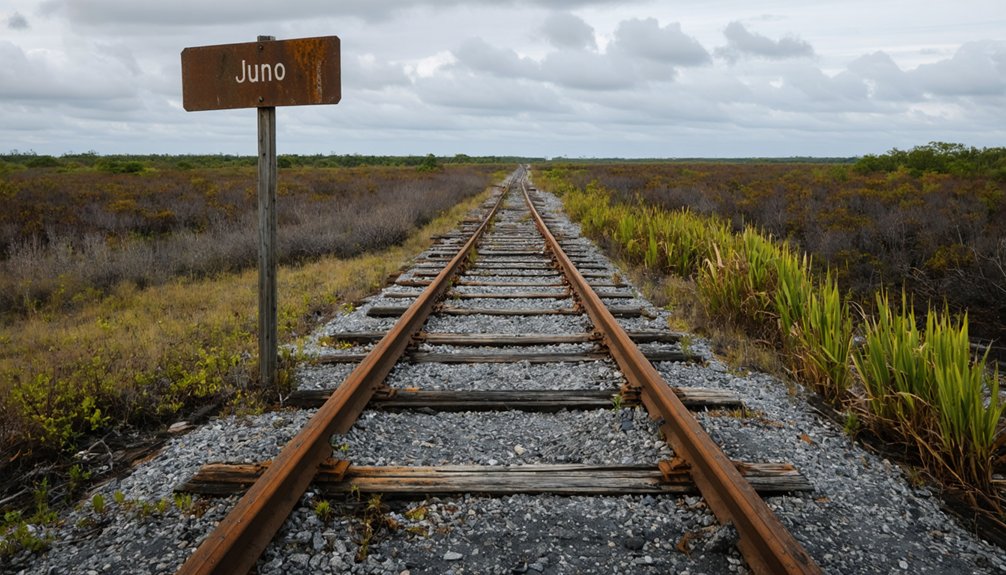
Before Juno could establish itself as Dade County’s seat, it needed reliable transportation to break its isolation along Florida’s undeveloped southeastern coast. The Jupiter and Lake Worth Railway emerged in 1889, connecting steamboat passengers across a 7.5-mile gap that previous river routes couldn’t bridge. You’ll discover this narrow-gauge line’s colorful route history through its planetary-themed stops—Jupiter, Venus, Mars, and Juno—earning its “Celestial Railroad” nickname by 1894.
However, its failed business model became evident when Henry Flagler arrived. After owners demanded excessive prices in 1894, Flagler bypassed the route entirely, extending his Florida East Coast Railway to West Palm Beach. Passengers immediately abandoned the expensive, uncomfortable Celestial for Flagler’s superior service. By April 1895, operations ceased. Within a year, only scattered spikes remained in the sand dunes.
Exploring the Former County Seat Location
You’ll find the former courthouse grounds beneath today’s Oakbrook Square shopping center, where Commissioner Albert M. Field’s donated acre once anchored Juno’s civic life from 1889 to 1899.
The original town boundaries stretched along the north end of Lake Worth Lagoon, now encompassed by modern developments including Twelve Oaks, Lost Tree Village, and Captain’s Key within North Palm Beach. A preserved brick cistern at the Twelve Oaks subdivision marks the former dock site, standing as one of the few tangible remnants of this vanished county seat.
Historical Courthouse Grounds Today
The former Juno courthouse grounds now lie beneath the Oakbrook Square shopping center, with a historical marker positioned 300 feet west of the original site at 11586 US Highway 1 in North Palm Beach. You’ll find the current courthouse marker in the Shoppes at Oakbrook parking lot, where private shopping centers have erased nearly all physical evidence of the 1890 two-story wooden structure that once governed Dade County.
The original one-acre tract donated by Albert M. Fields has been transformed by commercial development:
- Courthouse location: Now occupied by retail space at Oakbrook Square
- Surrounding neighborhoods: Twelve Oaks, Lost Tree Village, and Captain’s Key developments
- Preserved artifact: Brick cistern from the Juno dock site relocated to Twelve Oaks subdivision
Nature and development have reclaimed what the 1907 forest fire didn’t destroy.
Original Town Boundaries Explained
Standing at the historical marker today, you’re positioned roughly 300 feet from where Juno’s original boundaries began in early 1889. The settlement stretched along the north end of Lake Worth Lagoon at latitude 26.875, longitude -80.06, encompassing the courthouse, Tropical Sun newspaper office, and several residences.
When Dade County’s historical population changes reached 995 residents in 1890, Juno’s concentrated settlement justified its county seat status over scattered Biscayne Bay communities. The 1909 county boundary shifts that created Palm Beach County fundamentally altered Juno’s administrative relevance.
Today’s gated community obscures these original boundaries, though a preserved brick cistern at the former town dock site marks authentic territory. You’ll find the actual townsite south of modern Jupiter, distinct from incorporated Juno Beach established in 1953.
Preserved Artifacts and Markers
At Juno’s former county seat location, preserved artifacts reveal occupation spanning six millennia, though distinguishing 1889-1909 administrative materials from earlier deposits requires archaeological precision. You’ll find shipwreck artifacts investigation ongoing at Juno Beach, where seasoned archaeologists recovered a silver coin minted between 1554-1572 under USACE permit. Their advanced conservation lab employs specialized equipment for proper preserved artifact conservation.
Key archaeological discoveries you can trace:
- Prehistoric deposits: Chipped stone artifacts and cut banks with charcoal indicate intact subsurface cultural materials preserved up to 12,000 years
- Maritime heritage: 2023 silver coin matches artifacts Roger Smith recorded from 1988 State Underwater Archaeologist investigations
- Historical markers: Interpretive plaques at Town Hall Park, Kagan Park, and Friendship Circle document 1946-1953 town creation and pioneer memorials
DuBois Park near Jupiter Inlet holds over 300 documented excavations spanning 6,000 years.
Best Time to Visit and What to Expect
Unlike most ghost town destinations, Juno’s original townsite sits within Hidden Oaks, a private gated community that restricts public access year-round. You’ll need to seek permission before exploring this lost settlement, though accessible artifacts remain at nearby Juno Beach Town Hall.
If you gain entry, spring and fall provide ideal times for photography, with comfortable temperatures ranging 75-85°F. Weather variations through the seasons affect your experience—mild winters averaging 70°F allow pleasant exploration, while summer heat exceeding 90°F can challenge outdoor investigation.
Don’t expect standing structures. Nature reclaimed this pineapple farming community after devastating fires in 1899 and 1907. You’ll find a preserved brick cistern at Twelve Oaks subdivision and former dock sites along the Intra-Coastal Waterway, now surrounded by upscale developments covering Juno’s footprint.
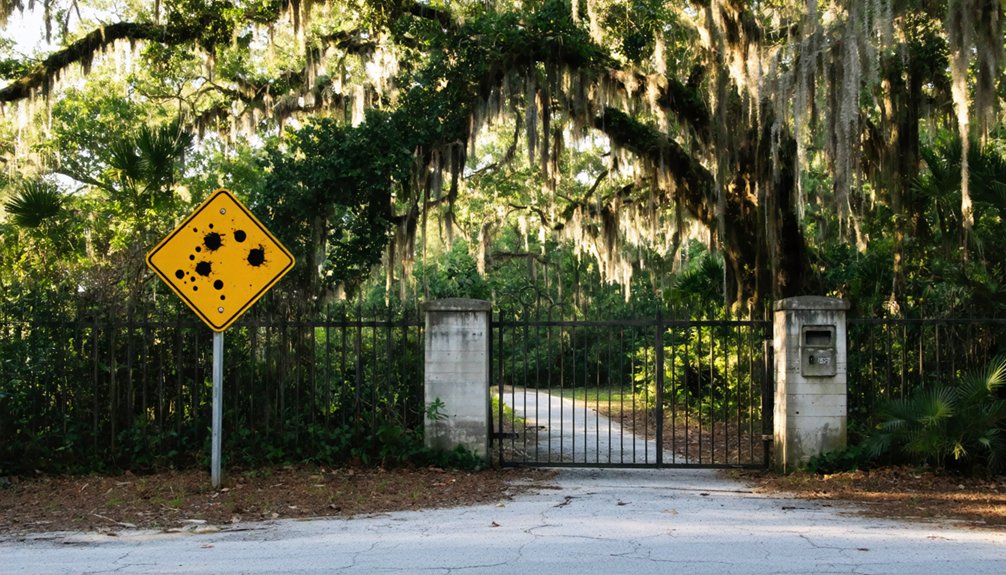
While exploring abandoned Juno townsite, you’ll encounter six modern gated communities that now occupy these historically significant lands. These secured enclaves—including Oak Harbour, Ocean Trace, and the Preserve at Juno Beach—feature manned or unmanned 24-hour security restricting public access to former settlement areas.
You must respect private property boundaries and observe from public rights-of-way, as the original ghost town’s physical remnants lie beneath these exclusive residential developments.
Accessing Hidden Oaks Community
For modern ghost town explorers, Juno Beach’s network of six gated communities presents a unique preservation challenge—remnants of Florida’s coastal development boom now stand fortified behind 24-hour security checkpoints and private entry gates. Unlike abandoned settlements you’d freely roam, these preserved enclaves—Oak Harbour, Ocean Trace, Seaview, Alicante, Cote De La Mer, and 700 Ocean Drive—employ private security measures that restrict historical documentation.
Controlled community access limitations:
- Manned and unmanned gatehouse stations require resident authorization or scheduled appointments
- Single-family homes, condos, and villas remain invisible behind perimeter walls
- 33-38 current listings provide rare glimpses inside these coastal fortresses
Your exploration depends on real estate brokers from Keller Williams, Compass Florida, or EXP Realty arranging legitimate property viewings—the only legal pathway through controlled community access barriers.
Respecting Private Property Boundaries
When you approach Juno Beach’s gated communities, Florida Statute 810.08 governs your access—trespass onto posted private property carries fines up to $500 and potential civil penalties. Communities like Ocean Trace and Seaview establish clear landscaped boundaries through fences, signage, and entrance gates that legally demarcate private zones.
The Preserve at Juno Beach employs low-density design with lush vegetation separating its 29 estate homes from public areas. You’ll find no public thoroughfares penetrating interiors of developments like 700 Ocean Drive or Oak Harbour. Access requires approved visitor entry coordinated through residents or listing agents such as Dylan Snyder (561-951-9301) for property tours.
Gated signage serves as legal notice—HOA policies prohibit unauthorized photography and solicitation. Public beach access remains available via A1A without crossing private boundaries, preserving your exploration freedom within lawful parameters.
Historical Landmarks You Can Still See
Though Juno itself vanished from Florida’s map over a century ago, tangible remnants of its storied past remain scattered across northern Palm Beach County. You’ll find these preserved sites marking the journey from historic railway stations to agricultural heritage.
Key landmarks accessible today:
- Celestial Railroad Marker along U.S. Route 1 north of PGA Boulevard, erected by the Daughters of the American Revolution in 1938, commemorating Jupiter, Mars, Venus, and Juno stations that predated Flagler’s railway empire
- Brick Cistern preserved within North Palm Beach’s Twelve Oaks subdivision, marking the original town dock and Dade County seat era (1890-1899) when pineapple plantations thrived
- Interpretive plaques at Loggerhead Park and Town Hall Park documenting the 1950-1986 fishing pier and converted gas station that served as Juno Beach’s first town hall
Nearby Attractions in Modern Juno Beach
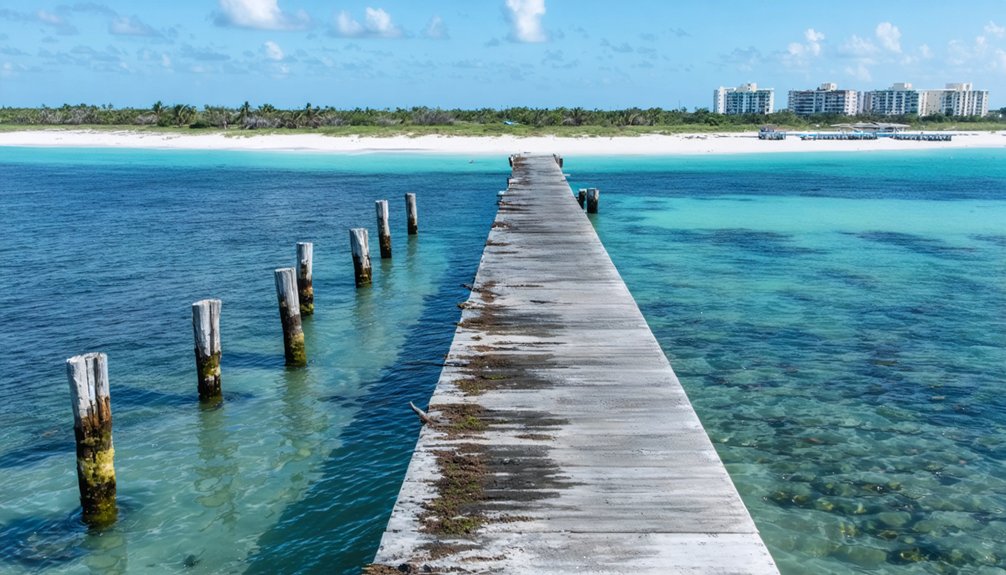
While Juno’s original settlement disappeared into history, the modern beach town that bears its name offers visitors a wealth of coastal experiences centered on environmental preservation and marine conservation.
You’ll find the Loggerhead Marinelife Center leading rehabilitation efforts for sea turtles, offering free admission and guided hatchling releases from May through October. The 990-foot Juno Beach Pier extends into the Atlantic for fishing and sunset viewing, while adjacent beaches provide guarded swimming areas and coastal wildlife habitats.
Juno Dunes Natural Area preserves 576 acres of native ecosystems with hiking trails leading to Palm Beach County’s highest natural point. Most locations feature wheelchair accessible activities, including observation platforms and waterfront paths. Kayak rentals let you explore Intracoastal mangroves where manatees and herons thrive in protected waters.
Frequently Asked Questions
What Led to the 1895 Lynching Incident in Juno?
Sam Lewis’s 1895 triple murder, including lawman Rhett McGregor, triggered the lynching. You’ll find social tensions and racial discrimination permeated South Florida’s post-Reconstruction era, when mobs routinely circumvented justice, preventing Lewis from receiving any trial before his execution.
Why Was the Railroad Nicknamed the Celestial Railroad?
The celestial railroad nickname significance came from stations named after celestial bodies—Jupiter, Mars, Venus, and Juno. You’ll find celestial railroad operations history reflects this astronomical theme throughout its route, connecting planetary-themed towns along Florida’s southeastern coast.
How Did Juno Become Dade County Seat Over Miami?
Lake Worth residents petitioned for a special election in 1889 due to political tensions with Biscayne Bay’s control. Economic factors favored northern Dade’s denser population, and you’ll find voters chose Juno over Miami by democratic majority.
What Happened to Residents After the Town Was Abandoned?
The plight of abandoned residents saw you dispersing to Palm Beach and West Palm Beach. Challenges facing former townspeople included relocating after fires destroyed structures, finding new livelihoods, and adapting as nature reclaimed Juno’s forgotten streets and memories.
Are Any Descendants of Original Juno Families Still in the Area?
You’ll find no documented descendants of original Juno families still residing locally. Current demographic trends show development pressure erasing family histories, while preservation-focused residents fight to maintain the area’s unique character against modernization threatening historical continuity.