You’ll find Kennekuk along remote gravel roads in northeast Kansas, where weathered structures dot the prairie landscape near the Missouri River bluffs. Once a thriving Pony Express station at the convergence of three major trails, this ghost town met its demise after a devastating early 1900s fire. Plan to explore nearby abandoned settlements like White Cloud and Arrington, traversing dirt paths through unchanged agricultural country. The Barrett cemetery and scattered building remnants tell stories of pioneers who never expected their bustling hub would fade into haunting silence.
Key Takeaways
- Kennekuk is located in remote northeast Kansas, requiring travel on gravel and dirt backroads through agricultural landscapes and forested bluffs.
- The town served as the first Pony Express home station west of St. Joseph at the intersection of three historic trails.
- Expect weathered remnants including decaying houses, abandoned buildings, and the intact Barrett cemetery documenting settler generations.
- Combine your visit with nearby ghost towns: White Cloud, Arrington, Padonia, and Huron for a comprehensive exploration.
- A granite marker commemorating the Pony Express station stands one-and-one-half miles southeast of present-day Horton.
The Story Behind Kennekuk’s Rise and Fall
By 1858, Kennekuk transformed into an essential stage stop, thriving through the 1880s as travelers and Pony Express riders passed through. Regional economic factors kept the settlement alive until disaster struck.
A devastating fire in the early 1900s consumed most structures, and the town never recovered. The settlement sat at the intersection of three trails, making it a crucial hub for westward-bound pioneers and freight haulers. Railroads like the Santa Fe connected nearby communities such as Morris and Waseca during this era. Today, you’re free to explore what remains of this once-bustling outpost where frontier commerce and indigenous heritage intersected.
What Remains of the Settlement Today
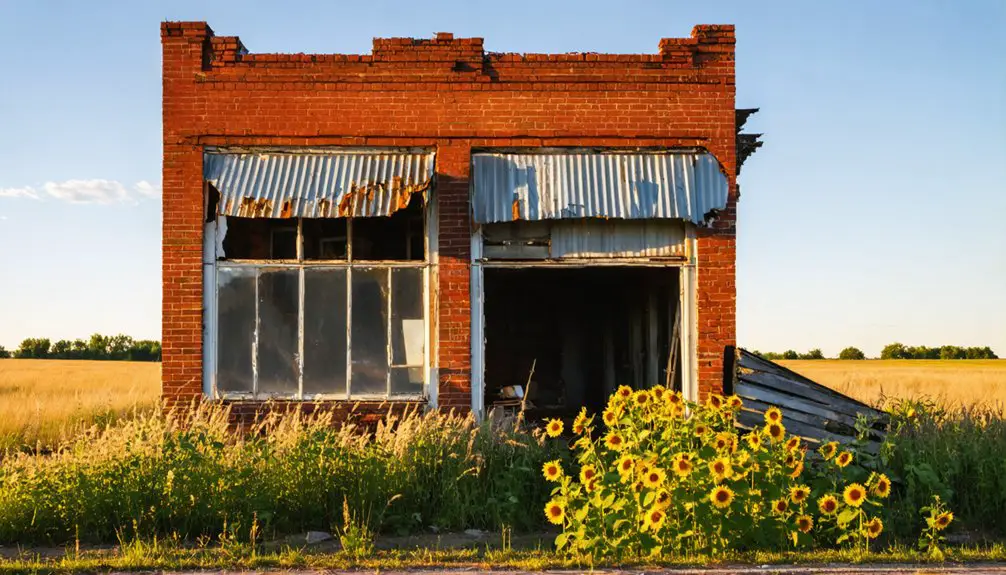
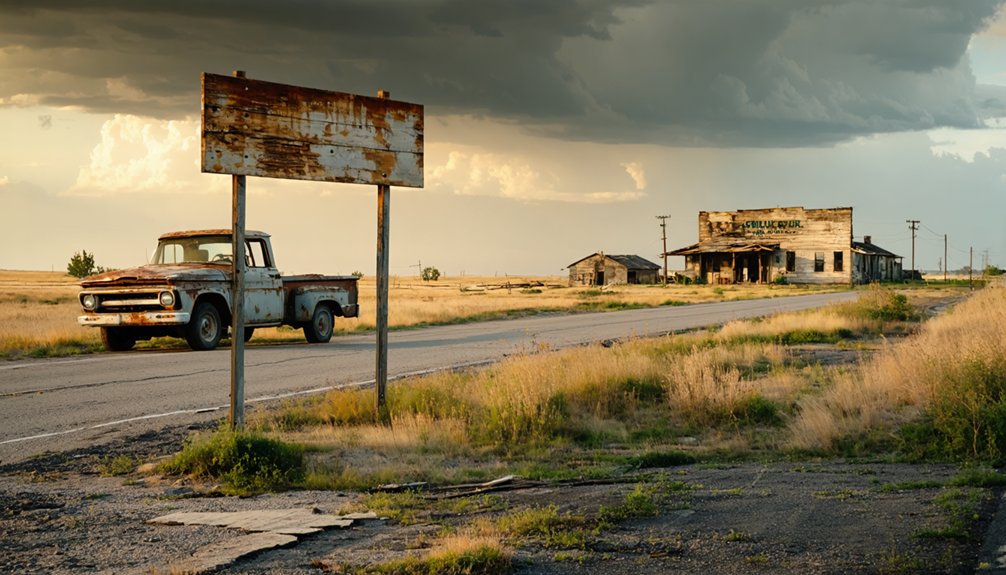
When you arrive in Kennekuk today, you’ll find a haunting collection of weathered remnants scattered across the prairie landscape. A handful of decaying residential houses stand as silent witnesses to busier times, their frames gradually surrendering to the elements.
The abandoned buildings you’ll encounter show visible deterioration—rotting wood, collapsing roofs, and broken windows tell stories of a century-long decline.
Religious sites that once anchored this community have vanished or fallen into disrepair, though you can still locate the block originally designated for worship and education during the 1859 platting. The Barrett cemetery remains remarkably intact, its headstones documenting generations of Native American, French, and Anglo-American settlers.
Gravel roads now replace the historic wagon trails that once brought travelers through this forgotten corner of Kansas. The hamlet sits in the extreme northwestern part of Atchison County, about two miles southeast of the modern town of Horton. Like many Kansas ghost towns, Kennekuk provides insight into what defines a ghost town—a once-thriving community reduced to scattered ruins and fading memories.
Getting to Kennekuk and What to Expect
Finding Kennekuk requires traversing the remote backroads of northeast Kansas, where gravel and dirt paths wind through agricultural landscapes that haven’t changed much since pioneer days. You’ll navigate about six miles north of Muscotah through Atchison County’s section 3, township 5, range 17—coordinates that matter when modern GPS fails you.
Expect rural tranquility interrupted only by distant farm equipment. The terrain grows surprisingly rugged as you approach the Missouri River bluffs, with primeval forests creating an eerie canopy over forgotten roads. Abandoned structures dot the landscape, silent witnesses to the thousands who once passed through this intersection of three pioneer trails. Atchison County’s history contains numerous certified town plats that never developed beyond the surveying stage, making ghost town exploration particularly rewarding here.
Combine your visit with nearby ghost towns like Arrington and Padonia for a full northeast Kansas circuit. Consider extending your journey to Arvonia, located near Melbourne Lake’s natural beauty, where restored buildings offer a glimpse into Welsh colonial history. Pack supplies—civilization’s sparse here, just as freedom-seekers prefer.
The Pony Express Connection and Historical Significance
Those forgotten roads you’re traveling once thundered with one of America’s most daring mail delivery experiments. Kennekuk’s importance in Pony Express operations can’t be overstated—experts designated it the first home station westbound from St. Joseph, roughly 44 miles into the wild. You’re standing where riders gulped Tom Perry’s wife’s legendary coffee (Mark Twain praised it himself) before thundering northwest toward Sacramento.
The strategic location along overland routes made Kennekuk invaluable. Three major pathways converged here: the Pony Express line, Atchison stage route, and the Fort Leavenworth-Fort Kearny military road. That April 1860 inaugural run blazed through in under ten days—half the Butterfield stage’s time. The service proved the central route’s viability and helped keep California in Union hands. From here, riders followed the Platte River valley through Nebraska, passing landmarks for roughly 300 miles before reaching the Rocky Mountain foothills.
Then telegraph wires killed the romance eighteen months later. Today, you’ll find the station site marked by a granite stone placed one-and-one-half miles southeast of present-day Horton.
Nearby Ghost Towns to Add to Your Route
Since you’ve already made the trek to Kennekuk’s desolate crossroads, you’d be foolish not to explore the cluster of forgotten settlements scattered within a thirty-mile radius. Northeast Kansas harbors some exceptional ghost towns that’ll satisfy your craving for spooky atmosphere and local lore.
White Cloud – The crown jewel of this route, featuring remarkably preserved buildings that dwarf most southern Kansas ruins
Arrington – A weathered hamlet near Atchison County where 1850s-era structures still cling to existence along forgotten roads
Padonia – Civil War-era settlement reduced to ashes around 1900; now just scattered foundations and houses
Huron – An extinct Atchison County stop with minimal remains, perfect for hardcore ghost town hunters
Many of these communities declined after Kansas became a free state, as pro-slavery settlements lost political and economic support in the years following statehood.
Pack your camera, fill your tank, and embrace the freedom of disappearing into Kansas’s forgotten corners.
Frequently Asked Questions
Are There Any Guided Tours Available for Kennekuk Ghost Town Visits?
No guided tours operate at Kennekuk—you’ll explore independently through self-guided walking tours. Historical preservation efforts remain minimal here, giving you complete freedom to wander the abandoned townsite and discover its forgotten trails at your own pace.
What Is the Best Season to Visit Kennekuk Cemetery?
Fall season whispers through weathered headstones like spirits returning home. You’ll discover Kennekuk Cemetery’s quiet ambiance during cooler temperatures, where colorful leaves frame forgotten graves perfectly. Fewer visitors mean you’re free to explore this haunting landscape without distractions or rushed schedules.
Is Camping Allowed Near the Kennekuk Ghost Town Site?
Camping isn’t available at the ghost town site itself, but you’ll find primitive camping facilities at nearby Vermillion County Park. If you’d prefer comfort after exploring, several nearby lodging options exist in surrounding towns like Vermillion.
Are There Any Local Museums With Kennekuk Artifacts or Exhibits?
Unfortunately, you won’t find dedicated Kennekuk exhibits in area museums. However, your best bet’s contacting the local historical society—they occasionally feature seasonal exhibits showcasing regional ghost towns. The cemetery remains your most authentic, unfiltered connection to Kennekuk’s past.
Do I Need Permission to Access the Kennekuk Cemetery?
You don’t need permission to visit—Kennekuk cemetery access rules follow typical rural Kansas standards, meaning you’re free to explore. Kennekuk cemetery visitation regulations remain informal; just respect the grounds, park roadside, and wander respectfully through this historic resting place.
References
- https://www.youtube.com/watch?v=0wTaBKVg3dk
- https://johnsoncoks.cottonhills.net/historic-records/old-towns.html
- https://www.youtube.com/watch?v=PfThSLZOtqg
- https://www.youtube.com/watch?v=KBXINX0xqnU
- http://www.kansastowns.us/kennekuk.html
- https://www.gutenberg.org/cache/epub/58216/pg58216-images.html
- https://legendsofkansas.com/atchison-county-extinct-towns/
- https://www.kspatriot.org/index.php/articles/56-kansas-local-history/754-towns-past-and-present-of-atchison-county.html
- https://legendsofkansas.com/kennekuk-kansas/
- https://en.wikipedia.org/wiki/Category:Populated_places_in_Atchison_County