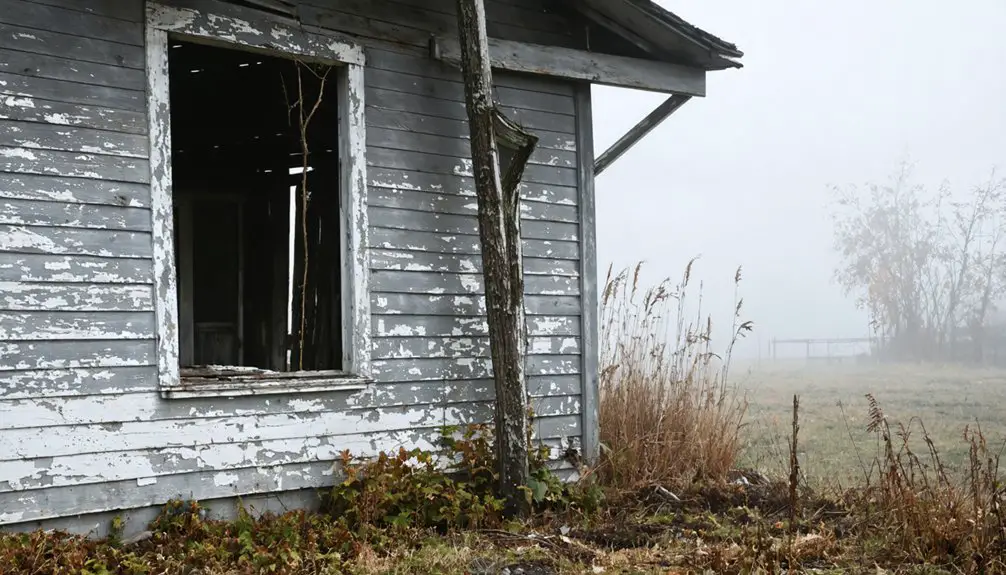
You don’t need to head out West to find a ghost town worth exploring. Kensington, Michigan sits just off I-96, where a thriving 19th-century stagecoach settlement now rests beneath Kent Lake’s surface. Founded in 1831, the village survived economic hardship but couldn’t escape rising floodwaters in the 1950s. Today, you can hike the Aspen Trail or plunge into submerged mill ruins. Stick around to uncover everything this hauntingly beautiful destination has to offer.
Key Takeaways
- Kensington, Michigan, founded in 1831, was submerged by Kent Lake in the 1950s after economic decline caused by railroad bypass in 1871.
- Access Kensington Metropark via I-96 Exit 151, with the nature center entrance two miles north, offering clear signage toward historical remnants.
- The Aspen Trail features old home foundations, rusting farm equipment, stone perimeter walls, and sunken floor outlines from the former settlement.
- Late autumn and winter offer the best above-water visibility of foundations, while early spring may expose submerged mill ruins underwater.
- Certified divers can explore intact underwater mill ruins and machinery, while above-water visitors need no certification to explore the Aspen Trail.
What Is the Ghost Town of Kensington, Michigan?
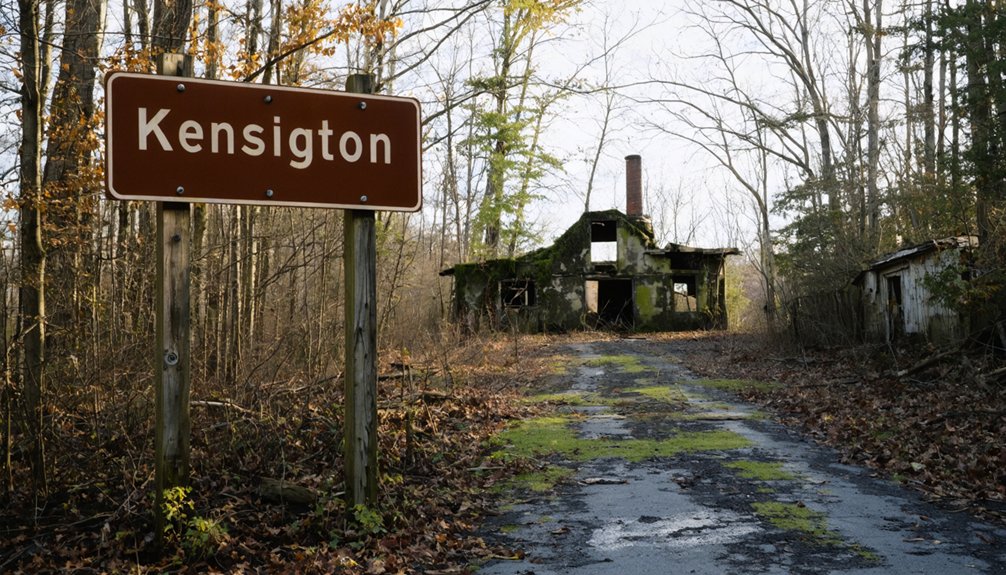
Tucked beneath the waters of Kent Lake in Oakland County, Michigan, the ghost town of Kensington is a lost settlement with a story that’s equal parts ambition and abandonment.
Joel Redway founded it in 1831, and it quickly grew into a thriving stagecoach stop along the Grand River Trail. At its peak in 1854, Kensington history shows a community of 300 residents building real lives in rural Michigan.
But when railroads bypassed the town in 1871, the economy collapsed, businesses shuttered, and families left one by one. By 1905, only four families remained.
Like many American ghost towns, Kensington didn’t just fade — it disappeared entirely, submerged when engineers dammed the Huron River in the 1950s.
Today, its stone foundations rest silently beneath Kent Lake.
How Did Kensington Grow From a Stagecoach Stop to 300 Residents?
When Joel Redway founded Kensington in 1831, he planted it along one of Michigan’s busiest travel corridors — the Grand River Trail. That strategic location made the settlement a crucial stagecoach history landmark, where travelers stopped, traded, and sometimes stayed.
Within three years, the community had its own post office, originally named Lyon. By 1836, residents had formally platted and renamed it Kensington, signaling real civic ambition.
The population dynamics tell a compelling story — from a handful of settlers to 300 residents by 1854.
You can picture the energy: wagons rolling through, merchants setting up shop, families building homes.
Every stagecoach arrival brought news, goods, and potential new neighbors. Kensington wasn’t just surviving — it was genuinely thriving, fueled by foot traffic and frontier opportunity.
Why Did the Railroads Kill Kensington Almost Overnight?
By 1871, Kensington’s fate was sealed by a single corporate decision — railroad planners routed their lines elsewhere, completely bypassing the town.
That railroad impact hit like a slow collapse. Without rail access, merchants couldn’t compete, goods cost more to move, and customers simply went where commerce flowed easier.
You’d have watched businesses shutter one by one as the economic shifts pulled opportunity toward connected towns. Villagers couldn’t — or wouldn’t — pay their bills, pushing remaining business owners out the door.
The lack of water power had already limited industrial growth, and without railroads, there was nothing left to anchor people here.
What took decades to build unraveled within a generation. By 1905, only four families remained in what was once a thriving Michigan community.
How Did Kent Lake Swallow the Last Traces of the Town?
Even after the last families drifted away, Kensington’s story wasn’t finished — engineers would deliver the final blow. In the 1950s, crews dammed the Huron River for flood control, and rising waters swallowed what remained of the village whole.
Kent Lake buried the stone foundations, mill ruins, and wooden remnants beneath its surface, sealing the submerged history beneath layers of cold, dark water.
If you love ghost town legends, this one hits differently. You’re standing at a shoreline, and an entire community rests silently below you.
Divers and history enthusiasts have spotted mill ruins still visible underwater, frozen in time since the 1800s. The lake didn’t just flood a field — it erased a living settlement, transforming a once-thriving stagecoach stop into a watery grave.
What Can You Still See Beneath Kent Lake Today?

If you peer beneath the surface of Kent Lake, you’ll find the ghostly remains of Kensington still clinging to the lakebed.
The submerged mill ruins stand as the most striking remnants, their stone structures surprisingly intact after decades underwater.
You can also spot the old home foundations scattered across the lakebed, silent evidence of a community that once held 300 souls.
Submerged Mill Ruins Visible
Beneath the surface of Kent Lake, the ghostly remnants of Kensington’s mill ruins still lie submerged, frozen in time since the Huron River was dammed in the 1950s.
These submerged structures offer a rare underwater exploration opportunity for adventurous visitors curious about what history hides below.
Here’s what you can discover beneath Kent Lake’s surface:
- Stone foundations from the original mill operations remain largely intact underwater.
- Wooden artifacts preserved by the lake’s conditions still scatter the submerged landscape.
- Mill machinery remnants sit exactly where workers abandoned them decades ago.
If you’re drawn to forgotten places, Kent Lake rewards your curiosity.
You’re fundamentally floating above a sunken town, and that’s a perspective most travelers never get to experience.
Stone Foundations Below Water
Kent Lake holds a secret most visitors never think to look for — the stone foundations of Kensington’s original mill operations, still resting on the lake bed where they’ve sat since the 1950s.
When engineers dammed the Huron River for flood control, they didn’t just redirect water — they buried an entire community beneath it.
Today, those submerged foundations represent a fascinating underwater archaeology site hiding in plain sight. If you’re paddling or boating across Kent Lake, you’re literally floating above what was once a thriving 19th-century settlement.
Historical preservation efforts have documented these remnants, ensuring Kensington’s story isn’t completely erased. The stone structures below tell you more about this ghost town‘s real scale than any roadside marker ever could.
What Above-Water Ruins Survive Along the Aspen Trail?
As you walk the Aspen Trail through Kensington Metropark, you’ll spot old home foundations half-hidden beneath the undergrowth, silent proof that a real community once stood here.
These stone remnants mark where families lived, worked, and eventually abandoned everything when the town collapsed. Scattered across the site, you’ll also find rusting farm equipment left behind by the last residents, making the trail feel less like a nature walk and more like an open-air museum of quiet decay.
Visible Home Foundation Remnants
Walking the Aspen Trail through Kensington Metropark, you’ll stumble upon several old home foundations half-hidden beneath decades of overgrowth — the last above-water remnants of a town that vanished over a century ago.
These abandoned structures carry real historical significance, marking where families once built lives before railroads and economic collapse erased everything.
Look for these three foundation features as you explore:
- Stone perimeter walls — original construction materials still holding their shape despite 150+ years of exposure
- Sunken floor outlines — depressions in the earth revealing room layouts of former homes
- Scattered fieldstone clusters — chimney remnants displaced by time and vegetation
Stay alert — the trail doesn’t announce these ruins. You’ll discover them by slowing down and reading the landscape carefully.
Scattered Historic Farm Equipment
Alongside the Aspen Trail, rusting farm equipment lies scattered across the landscape like punctuation marks in Kensington’s forgotten story.
These historic artifacts aren’t fenced off or labeled — they’re simply there, half-swallowed by grass and time, waiting for you to notice them.
You’ll pass old machinery that once worked these fields when 300 residents called Kensington home.
Unlike the submerged history resting beneath Kent Lake’s surface, these remnants exist in open air, touchable and raw. No museum glass separates you from them.
That accessibility makes the Aspen Trail uniquely rewarding.
You’re walking through a life that economic collapse and rising water erased. Each rusted piece represents a family that eventually packed up and left, abandoning everything too heavy or worthless to carry.
Is the Kensington Baptist Church Cemetery Still Standing?
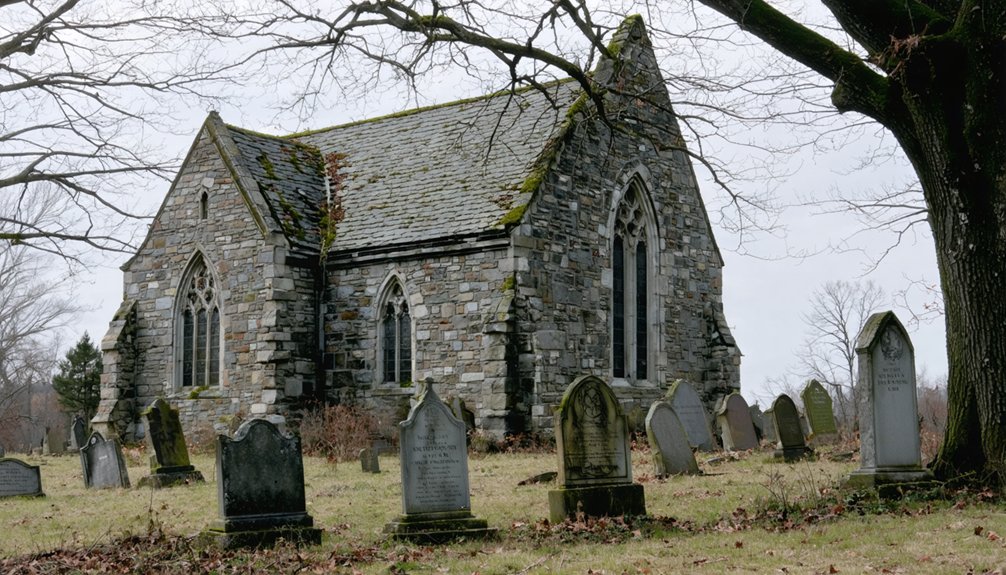
Where else in Kensington can you find a structure that’s survived founding, flooding, and near-total erasure? The Kensington Baptist Church Cemetery still stands as the town’s only visible landmark, offering a rare window into cemetery history and early burial practices of Michigan settlers.
While Kent Lake swallowed the mill ruins and I-96 erased the buildings, this cemetery held its ground.
Here’s what makes it worth your visit:
- It predates the town’s 1836 renaming, connecting you directly to Lyon-era settlers.
- Headstones reveal burial practices reflecting 19th-century frontier faith communities.
- It’s accessible within Kensington Metropark without special permits.
You’re standing where 300 residents once built lives. The cemetery doesn’t just remember Kensington — it *is* Kensington.
How Do You Get to Kensington Metropark?
If you’re ready to explore the ghost town beneath Kensington Metropark, you’ll find the easiest access point is I-96 at Exit 151.
From there, you can follow the signs directly into the park and start tracing the remnants of the old settlement.
If you’re heading to the nature center specifically, you’ll drive two miles north of I-96 to reach the entrance.
Highway Access Via I-96
Reaching Kensington Metropark is straightforward once you’re on I-96—just take Exit 151, and you’ll find yourself at the gateway to what was once a thriving 19th-century village.
This ghost town carries tremendous historical significance, and getting there couldn’t be easier. Here’s what to know before you arrive:
- Exit 151 off I-96 drops you directly near the park entrance, east of Kensington Road.
- The nature center entrance sits two miles north of I-96, perfect for orienting yourself before exploring.
- Oakland County’s Lyon Township hosts the site, making it accessible from Detroit or Lansing within an hour.
You’re not just driving to a park—you’re charting a course toward a submerged past waiting to be discovered on foot.
Nature Center Entrance Location
Once you’ve exited I-96 at Exit 151, you’ll head two miles north to reach the nature center entrance—your best starting point for exploring what remains of old Kensington.
The nature center sits east of Kensington Road, positioning you perfectly to access the park’s network of nature trails that wind through the landscape where a thriving 19th-century community once stood.
From this entrance, you’ll find clear trail markers guiding you toward historical remnants, including old home foundations visible along the Aspen Trail.
The park activities available here go beyond sightseeing—you’re free to hike, explore, and absorb the eerie silence of a place time forgot.
The nature center fundamentally serves as your launchpad into Kensington’s layered history, making it the ideal first stop on your ghost town adventure.
When Are the Ruins Most Visible at Kensington Metropark?
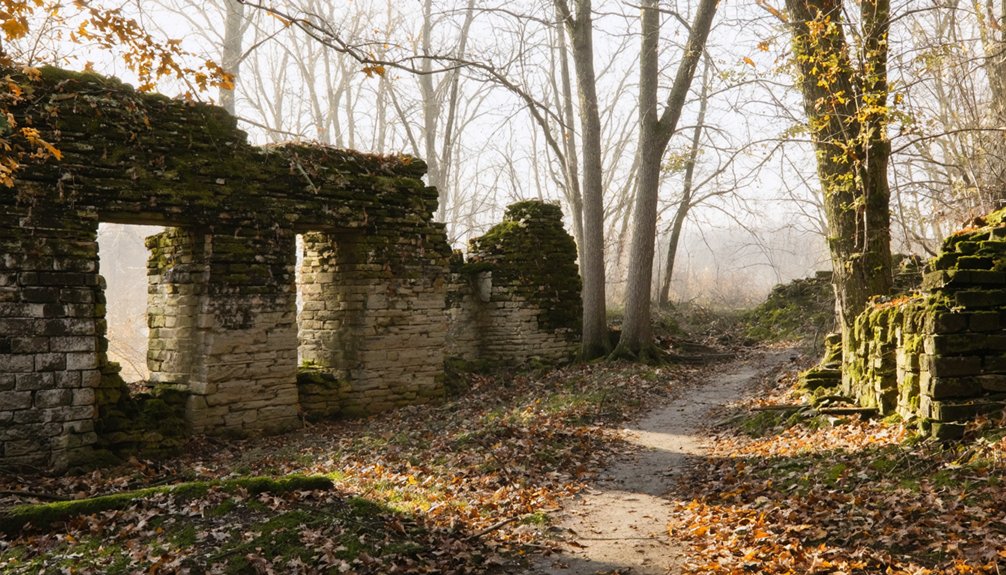
When you visit Kensington Metropark, timing matters if you want the best look at what’s left of the old village. Ruins visibility peaks during specific conditions, making seasonal exploration worth planning around.
The best times to spot remnants include:
- Late autumn — after leaves drop, old foundations along the Aspen Trail become far easier to spot through bare undergrowth.
- Early spring — low water levels in Kent Lake occasionally expose submerged mill ruins and stone foundations near the shoreline.
- Winter — snow-free frozen ground reveals subtle landscape depressions marking where structures once stood.
You’ll discover more by arriving early, moving slowly, and staying observant. The land holds its secrets well, but it rewards those who explore on their own terms.
What Should You Know Before Exploring a Submerged Ghost Town?
Exploring a submerged ghost town like Kensington isn’t as simple as showing up with a pair of swim goggles. Kent Lake covers the physical remnants of one of Michigan’s most fascinating ghost towns, and you’ll need proper diving certification to access that submerged history safely.
Always check with Kensington Metropark staff about current water conditions and permitted dive zones before entering the lake. Visibility shifts dramatically with the seasons, so plan accordingly.
Before you suit up, touch base with Kensington Metropark staff — water conditions and dive zone rules change constantly.
You’ll also want a dive buddy — maneuvering underwater mill ruins and stone foundations alone carries real risk.
If diving isn’t your thing, you can still experience the history above water along the Aspen Trail, where old home foundations surface right beneath your feet, no certification required.
Frequently Asked Questions
Are There Guided Ghost Town Tours Available at Kensington Metropark?
The knowledge doesn’t confirm guided ghost town tours, but you can explore Kensington Metropark’s haunted history independently! Walk the Aspen Trail, uncover old foundations, and create your own ghost stories among this freedom-filled, eerie landscape.
Can Visitors Legally Remove Artifacts Found Near the Kensington Ruins?
You shouldn’t remove artifacts from Kensington’s ruins. Artifact preservation laws carry serious legal implications, protecting history for everyone. Respect the site’s remnants — foundations, mill ruins, and scattered farm equipment — so future explorers can experience this remarkable ghost town too.
What Nearby Ghost Towns Can Be Combined Into One Road Trip?
You’ll find several abandoned settlements near Kensington worth exploring! Combine visits to Ore Creek, Woodruff’s Grove, and Zukey Lake for a thrilling road trip packed with historical significance, uncovering Michigan’s forgotten communities that shaped the region’s rich past.
Are There Entrance Fees Required to Access Kensington Metropark?
You’ll need to pay a vehicle entry fee to explore Kensington Metropark. Check their entrance options and park hours before you go, so you can plan your visit freely and make the most of your adventure!
What Local Museums Preserve Artifacts Recovered From Submerged Kensington?
The knowledge doesn’t specify which local museums preserve submerged artifacts from Kensington history, but you’ll discover fascinating submerged artifacts by visiting Kensington Metropark directly, where staff can guide you toward regional historical resources celebrating this lost community.
References
- http://www.kristinascarcelli.com/michigans-ghost-towns-kensington-village/
- https://99wfmk.com/kensingtonmichigan/
- https://en.wikipedia.org/wiki/Kensington
- https://99wfmk.com/kensington-ghost-town/
- https://travelswithabandon.com/2018/07/29/adventure-6-plainfield-kensington-rawsonville/
- http://www.kristinascarcelli.com/tag/michigan-ghost-towns/
- https://en.wikipedia.org/wiki/List_of_ghost_towns_in_Michigan
- https://en.wikipedia.org/wiki/Kensington_Metropark
- https://kids.kiddle.co/List_of_ghost_towns_in_Michigan
- https://www.facebook.com/AwesomeMitten/posts/-ever-heard-of-a-ghost-town-you-cant-actually-walk-through-meet-rawsonville-mic/1306717284829705/