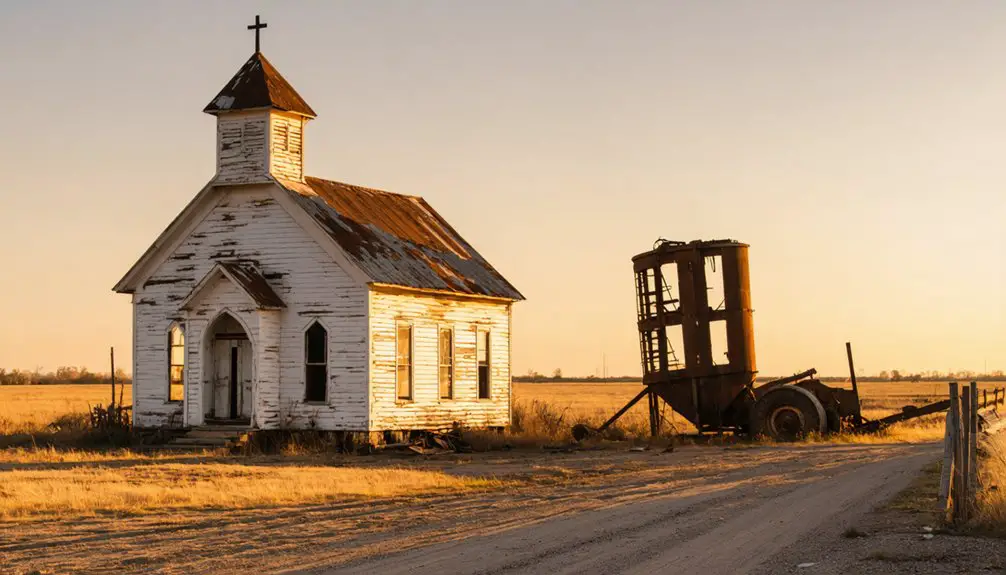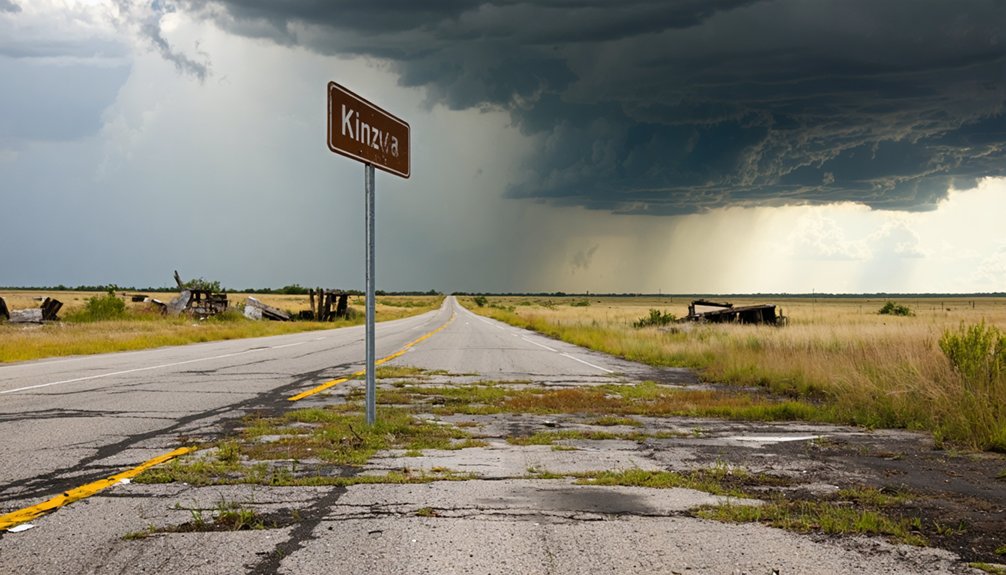
You won’t find Kinzua ghost town in Oklahoma—it doesn’t exist there. The authentic Kinzua ghost town sits in Wheeler County, Oregon, where a once-thriving lumber community of 700 people now lies reclaimed by 400,000 pine trees. Oklahoma does offer legitimate ghost towns like toxic Picher, Dalton gang hideout Ingalls, and historic Boggy Depot. These genuine sites tell stories of mining disasters, outlaws, and economic collapse that shaped the American frontier. Discover which abandoned settlements you can safely explore below.
Key Takeaways
- Kinzua ghost town does not exist in Oklahoma; no historical records or documentation support its presence in the state.
- The authentic Kinzua ghost town is located in Wheeler County, Oregon, founded in 1927 as a lumber community.
- Oklahoma offers legitimate ghost towns like Picher, Ingalls, Boggy Depot, and Beer City with documented histories and accessible sites.
- Visiting Oregon’s Kinzua provides access to 400,000 pine trees and an operational golf course marking the former mill town.
- When exploring actual Oklahoma ghost towns, avoid trespassing, unstable structures, and contaminated areas from past mining operations.
Understanding the Confusion: There Is No Kinzua Ghost Town in Oklahoma

While scanning lists of Oklahoma’s ghost towns—from the mining ruins of Picher to the submerged streets of Kaw City—you’ll search in vain for any mention of Kinzua. The Encyclopedia of Oklahoma History catalogs approximately 2,000 abandoned settlements, yet Kinzua appears nowhere in their detailed records.
Wikipedia’s alphabetical inventories skip directly from Kaw City to Red Bird without stopping at any Kinzua. County-by-county searches yield nothing. This absence matters because you deserve accurate information before planning your journey.
Questionable sources of evidence and incorrect historical claims sometimes circulate online, creating phantom destinations that waste your time and fuel. No historical society, regional blog, or video survey of northeastern Oklahoma’s mining ghosts acknowledges Kinzua’s existence. Oklahoma has the 28th largest population and 20th largest land area in the U.S., making comprehensive documentation of its estimated 2,000 ghost towns a manageable task for historians and researchers. Instead, consider visiting authentic ghost towns like Texola, where Route 66 passes through the middle of town and visitors can explore an old territorial jail dating back to 1908-1910. The truth liberates you to explore genuine abandoned sites instead.
Kinzua’s True Location in Wheeler County, Oregon
Tucked into the remote forests of Wheeler County, Oregon, the authentic Kinzua tells a starkly different story than any phantom Oklahoma counterpart. You’ll find this genuine ghost town at the head of Thirty Mile Creek, southeast of Fossil, where geographical remoteness once attracted lumberman E.D. Wetmore in 1927. He transformed 50,000 acres of wilderness into a thriving company town housing 700 souls at its peak.
The industrial heritage here runs deep—330 workers once processed Ponderosa Pine through Kinzua Pine Mills Company until 1978. Today, you’ll discover a landscape reclaimed by nature, where 400,000 pine trees now grow where homes and businesses once stood. The operational golf course remains, a solitary monument to this settlement’s remarkable rise and inevitable fall into abandonment. The town’s establishment in 1928 included 125 homes, a U.S. post office, a lake, and various facilities that made it a self-contained community. For those seeking precise navigation, the site’s coordinates place it in UTM Zone 10T, with an easting of 731933.57 and northing of 4986020.39 in the Northern Hemisphere.
Authentic Oklahoma Ghost Towns Worth Exploring Instead
Oklahoma’s landscape harbors dozens of legitimate ghost towns that eclipse any fictional Kinzua narrative with their genuine tales of triumph and tragedy. You’ll find Picher’s toxic urban decay relics standing as America’s most contaminated settlement, where lead and zinc mining left behind haunting structures.
Ingalls preserves forgotten local histories through its 1890s Dalton gang shootout sites, complete with standing buildings and markers. Boggy Depot reveals Choctaw trading heritage through crumbling gravestones in abandoned cemeteries, while Beer City’s lawless pre-statehood era echoes through No Man’s Land’s desolate terrain.
These authentic destinations offer tangible connections to Oklahoma’s boom-and-bust cycles, from Acme’s vanished gypsum operations to mining communities that define true abandonment. At its peak in 1926, Picher supported approximately 14,000 residents with bustling mills, schools, and nearly 250 mining plants before its eventual decline. Among the 359 towns using stamped postmarks, 132 have become ghost towns, with the majority of Indian postmarks now marking abandoned settlements. You’re free to explore real history without manufactured stories.
What Caused Oklahoma’s Towns to Disappear
Multiple forces converged to transform Oklahoma’s thriving settlements into silent remnants of abandonment.
Economic shifts struck hardest when resources vanished. You’ll find timber camps like Hochatown disappeared after loggers exhausted prime forests. Coal operations collapsed following McCurtain’s devastating 1912 explosion that killed 73 miners. Oil booms turned to busts overnight, leaving empty storefronts across the plains. Towns like America saw populations reach 200 before declining when nearby trees were spent and production ceased by the mid-1940s.
Environmental disasters delivered final blows to struggling communities. Picher became America’s most toxic ghost town after decades of zinc mining created 100 million tons of contaminated waste. Lead-poisoned water from Tar Creek forced mandatory evacuations. Man-made lakes like Broken Bow submerged entire settlements beneath their depths.
Railroad bypasses sealed many towns’ fates. When tracks laid through rival communities, populations followed, abandoning original sites to prairie winds and encroaching wilderness. Oil boom towns adopted unconventional names like Wolco and Whiz Bang that reflected the era’s distinctive culture.
Essential Tips for Your Oklahoma Ghost Town Adventure
Venturing into Oklahoma’s abandoned settlements demands careful preparation beyond packing your camera. These ghost towns harbor potential environmental risks from decades of extraction—lead-contaminated dust, unstable chat piles, and sinkholes lurk where prosperity once thrived. The history of mining disasters lingers in toxic soil and crumbling infrastructure.
Stay on public roads and marked pullouts; don’t trespass fenced areas or enter buildings with rotted foundations. Keep windows up while driving through dust zones, and wash hands thoroughly before eating. Distance yourself from tailings and bare earth where invisible contaminants settle. Fine particles can move far beyond obvious piles, settling on surfaces you might assume are clean.
Pack hand wipes and protective gear. Consider using drones to capture restricted areas safely from legal vantage points. Respect cleanup zones and “Keep Out” warnings—they’re protecting you from genuine hazards, not limiting your exploration. Download the Allyz® app for quick access to emergency contacts and travel assistance if you encounter unexpected situations. This freedom comes with responsibility.
Frequently Asked Questions
Are Oklahoma Ghost Towns on Private Property or Open to Public Access?
Most Oklahoma ghost towns sit on private property ownership, limiting your exploration considerably. You’ll face strict public access restrictions—you can only view from public roads and legal pullouts. Always respect boundaries and seek permission before venturing onto any parcels.
What Safety Precautions Should Visitors Take When Exploring Abandoned Structures?
You’re seeking freedom, yet abandoned structures demand caution. Stay alert for structural hazards, avoid entering unsafe buildings with unstable foundations. Don’t venture inside—collapsed floors, hidden debris, and compromised walls turn exploration deadly. Admire ruins from outside only.
Can You Camp Overnight Near Oklahoma Ghost Town Sites?
You’ll find limited campsite availability directly at ghost town sites, but Black Kettle National Grasslands offers dispersed camping with parking accommodations nearby. Skipout and Spring Creek provide vault toilets and cleared areas for your adventurous overnight stays.
Which Ghost Towns Have the Most Photogenic or Intact Remaining Buildings?
Weathered storefronts stand frozen in time—Picher offers best preserved buildings with crumbling Main Street structures, while Ingersoll’s church and Skedee’s stone foundations showcase scenic architectural features. You’ll find photographic gold among these deteriorating monuments to Oklahoma’s past.
Are Guided Tours Available for Any Oklahoma Ghost Town Locations?
Ghost towns like Kinzua lack formal guided tours, but you’ll find self-guided tours through preserved sites. Local preservation efforts maintain accessible structures, letting you explore independently. Download apps or create your own adventure through Oklahoma’s abandoned landscapes freely.
References
- https://en.wikipedia.org/wiki/List_of_ghost_towns_in_Oklahoma
- https://kids.kiddle.co/List_of_ghost_towns_in_Oklahoma
- https://en.wikipedia.org/wiki/Kinzua
- https://www.okhistory.org/publications/enc/entry?entry=GH002
- https://www.youtube.com/watch?v=zTKa5i1czdE
- https://freepages.rootsweb.com/~gtusa/history/usa/ok.htm
- https://www.kosu.org/local-news/2014-05-23/ghost-towns-all-black-oklahoma-towns
- https://abandonedok.com/class/disappearing-town/
- https://takemytrip.com/2016/08/texola-oklahoma-ghost-town/
- https://www.youtube.com/watch?v=Rwb-VwygzUI