You’ll find Knightsville two miles east of Eureka on Utah’s Godiva Mountain, accessible via Knightsville Road from Highway 6. This unique ghost town stands apart from typical Wild West mining camps—Mormon prospector Jesse Knight banned all alcohol, gambling, and vice when he founded it in 1896. Today, crumbling foundations and the National Register-listed schoolhouse remain scattered across sagebrush slopes at 6,742 feet elevation. The surrounding East Tintic Mountains offer additional abandoned sites worth exploring on your journey.
Key Takeaways
- Knightsville is located two miles east of Eureka, Utah, accessible via Knightsville Road south-east from Highway 6’s eastern edge.
- The ghost town sits at 6,742 feet elevation on Godiva Mountain’s northern slope in the East Tintic Mountains.
- Visitors can explore crumbling foundations of Jesse Knight’s unique Mormon mining town, including the National Register-listed schoolhouse foundation.
- Knightsville was a vice-free company town founded in 1896, completely abandoned by 1940 after ore depletion.
- Dirt tracks wind through scattered remains of the 1,000-resident community across sagebrush-dotted slopes as a “Class 1 – Barren Town.”
Getting to Knightsville: Location and Directions
Nestled on the northern slope of Godiva Mountain in Utah’s East Tintic Mountains, Knightsville sits at an elevation of 6,742 feet in the northeastern corner of Juab County. You’ll find this forgotten mining settlement approximately two miles east of Eureka, with location coordinates marking it at 39.95384° N, 112.10078° W. The geographic setting places you amid rugged mountain terrain where old mine shafts pierce the hillsides.
To reach Knightsville, take Knightsville Road south-east from Highway 6’s eastern edge near Eureka. After climbing about a mile, you’ll encounter multiple road spurs branching through the site. Dirt tracks wind past crumbling foundations and remnants of a once-thriving community. The area remains accessible as an open-status site, offering you unrestricted exploration of this authentic slice of Utah’s mining heritage.
The Story of Jesse Knight and His Mormon Mining Town
The weathered ruins scattered across this mountainside owe their existence to Jesse Knight, a Mormon prospector whose rags-to-riches story would become legendary throughout Utah’s mining districts. After scraping by as a sheepherder, he struck it rich with the Humbug Mine in 1896—named mockingly after skeptics who’d dismissed his claim as fraudulent. Knight’s successful business ventures eventually spanned 65 companies, extracting $13 million in ore from these mountains alone.
What made Knightsville different from typical Western mining camps was Knight’s vision. His unique philanthropic initiatives transformed raw frontier into something unusual: a company town without saloons. You’ll find remnants of the meetinghouse, school, and amusement hall he built instead—physical evidence of one entrepreneur’s determination to prove mining wealth didn’t require corrupting workers’ souls.
What Made Knightsville Different From Other Mining Camps
When you walked into most Western mining camps, you’d find whiskey-soaked saloons, gambling halls, and red-light districts lining muddy streets.
Knightsville stood apart—Jesse Knight’s Mormon convictions transformed his company town into something unprecedented, banning alcohol, tobacco, and vice entirely. Where other camps echoed with gunshots and drunken brawls, this mountain settlement rang with church bells and the laughter of miners’ families attending Sunday services instead of working underground.
No Saloons or Gambling
Unlike virtually every other mining camp that dotted the American West, Knightsville stood out for what it didn’t have. You won’t find remnants of saloons, gambling halls, or brothels here—Jesse Knight’s strict religious morality shaped this company town into America’s only mining camp completely free from such establishments.
Knight owned all the land, giving him absolute control over what businesses could operate. His Mormon values meant no alcohol consumption, no prostitution, and no gambling dens corrupting his workers. This wasn’t just idealism—Knight compensated miners with higher daily wages while closing operations every Sunday.
The result? A thriving community of 1,000 residents by 1907, living in a uniquely vice-free environment that neighboring camps mockingly called the “Sunday School mines.”
Mormon Founder’s Strict Rules
Jesse Knight didn’t just prohibit vice—he built an entirely different social contract with his workers. You’ll discover he enforced strict religious requirements through personal moral oversight, addressing behavioral concerns directly rather than issuing immediate terminations. If you drank excessively or neglected your family, you’d receive a warning from Uncle Jesse himself before facing dismissal.
His mines earned the nickname “Sunday School mines” because they closed every Sabbath—and remarkably, workers still got paid. This wasn’t simply religious accommodation; it was revolutionary labor practice. Knight paid 25 cents above prevailing wages and created infrastructure supporting faith-based living. The result? Unprecedented worker loyalty in an industry known for exploitation. His facilities became havens for displaced Mormon farmers seeking dignified work in mining camps that typically excluded them.
Family-Friendly Company Town
How did a thousand souls flourish at 6,742 feet in Utah’s East Tintic Mountains without a single saloon?
You’ll discover Knightsville defied every mining camp stereotype. While neighboring camps drowned in whiskey and vice, Jesse Knight’s company town thrived on religious values and civic infrastructure. His workers enjoyed weekly rest days, resulting in higher productivity and fewer accidents than alcohol-soaked competitors.
The town’s 65 homes, two boarding houses, stores, churches, and hotels operated entirely without liquor or tobacco. Neighboring miners mockingly called them “Sunday school mines,” yet Knightsville’s approach proved superior.
Your ancestors gathered in the brick schoolhouse for education, church services, and community meetings—the same building whose foundations you can still trace today. This wasn’t oppression; it was Knight’s vision of prosperity through discipline.
Life at Its Peak: A Family-Friendly Boomtown
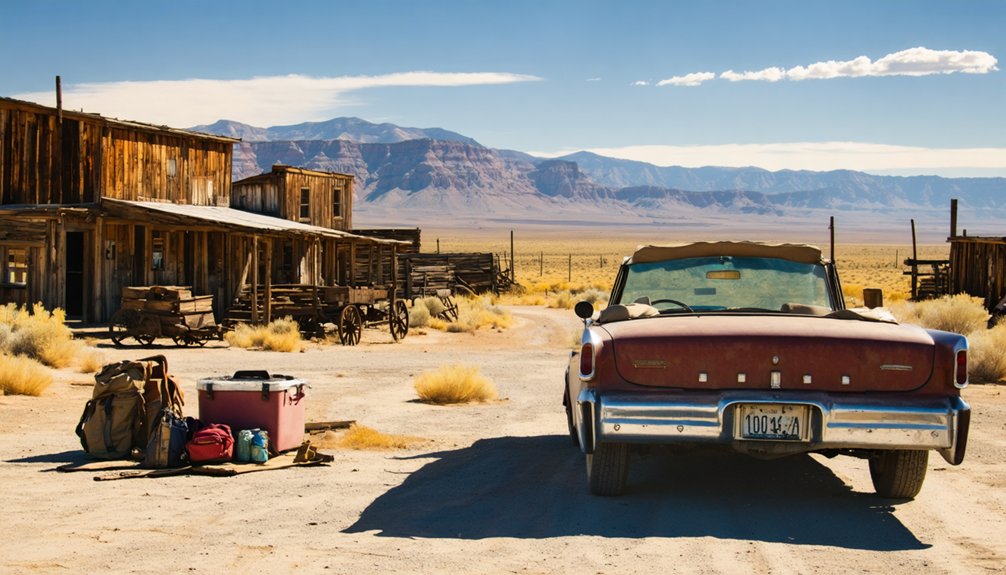
By 1907, you’d find yourself in a thriving mountain community of 1,000 souls—a rare mining boomtown where children’s laughter echoed louder than whiskey bottles. Knight’s vision had transformed Godiva Mountain from 20 scattered houses into 65 homes, two boarding houses, churches, stores, and a brick schoolhouse that took three years to complete.
What set this camp apart wasn’t just its rapid growth, but “Uncle Jesse’s” iron-clad rule: no saloons, no tobacco, and Sunday closures that sent miners to church instead of the mines.
Population and Infrastructure Growth
The remote slopes of Godiva Mountain transformed into a thriving community as Knightsville flourished during the first decade of the 1900s. You’ll discover that this settlement reached 1,000 residents by 1907, expanding from its modest start of 20 houses to 65 homes clustered at 6,742 feet elevation.
The town’s infrastructure matched its ambition—general stores, hotels, livery stables, restaurants, and confectioneries served daily needs while community religious institutions anchored spiritual life.
The brick schoolhouse details tell a remarkable story: when county funding initially proved elusive due to low student numbers, management cleverly hired a father of eight children to solve the problem. This impressive schoolhouse foundation still stands today, listed on the National Register of Historic Places, marking where frontier families built something substantial in Utah’s East Tintic Mountains.
Knight’s Moral Standards Enforced
Behind Knightsville’s impressive physical development stood Jesse Knight’s unwavering moral vision—one that would make his mining camp unlike any other in the American West. You’d find no saloons here—Knight’s religious control extended across every property he owned, creating “the only mining camp in the United States without a saloon.” His personal conduct standards weren’t suggestions; employees faced termination for neglecting families or consuming alcohol and tobacco.
While neighboring miners mocked these restrictions, you couldn’t argue with results: higher productivity, fewer accidents, and stable family life attracted workers weary of typical mining camp chaos. Knight’s devout Mormon principles shaped hiring decisions and residency requirements, transforming raw frontier land into a community where you’d raise children without vice’s corrupting influence.
The Rise and Fall of the Humbug Mine
When Jesse Knight arrived in Utah’s Tintic District in 1896, he carried nothing but determination and a hunch that contradicted conventional mining wisdom. A local engineer dismissed his prospect as “humbug,” but Knight’s unconventional mining techniques proved the experts wrong. After two months of digging, he struck rich silver and lead ore on August 6, 1896. He proudly named it the Humbug Mine—a deliberate jab at his doubters.
The mine’s success made Knight wealthy and earned him the nickname “Mormon Mining Wizard.” For nearly two decades, the Humbug fueled prosperity, helping the town reach 1,000 residents by 1907. But ore depletion and mine closures began in 1915, triggering an inevitable decline. By 1924, only two mines remained operational, and all work ceased by 1940.
What You’ll Find at the Ghost Town Site Today
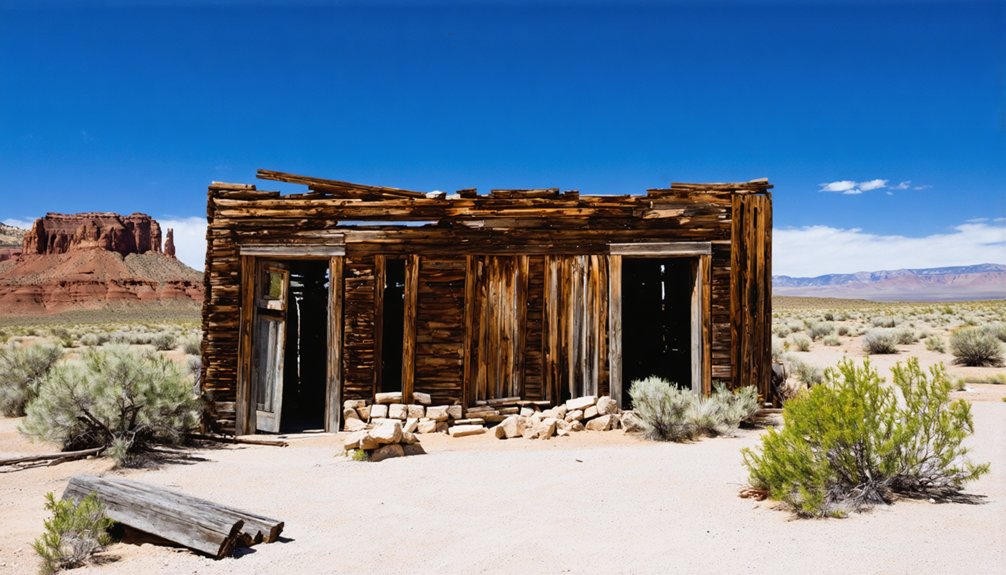
Standing at 6,742 feet in the East Tintic Mountains, Knightsville exists today as what ghost town enthusiasts classify as a “Class 1 – Barren Town”—essentially a collection of crumbling foundations scattered across sagebrush-dotted slopes two miles east of Eureka.
You’ll discover these mining remnants foundations amid scenic mountain views:
- The schoolhouse foundation (NRHP #79003485), one of Utah’s documented educational ruins
- Community center foundations connected by faint dirt tracks
- Tailings piles marking former extraction sites
- Godiva Mountain slopes where 20 original houses once stood
What won’t you find? Any standing structures. The town’s complete abandonment by 1940 meant homes were moved, salvaged, or left to collapse. You’re free to explore these GPS-marked coordinates (39.951361, -112.097486) and imagine the thousand souls who called this desolate site home.
Exploring the Cemetery and Mining Remnants
While most of Knightsville has surrendered to the elements, the cemetery stands as the site’s most intact feature—weathered headstones marking the final resting place of miners, their wives, and children who died when this desolate slope actually meant something. These grave markers tell stories of a Mormon-dominated community that thrived near the Humbug Mine between 1896 and 1915, when nearly 1,000 residents called this dry, saloon-free settlement home.
Beyond the burial sites, you’ll find scattered debris and the schoolhouse foundation—officially listed on the National Register of Historic Places. Old foundations dot the landscape where 65 homes once stood before relocation to Eureka by 1924. It’s stark evidence of rapid abandonment after the mines closed in 1940, leaving behind fragments of Jesse Knight’s paternalistic “Sunday School” mining camp.
Best Time to Visit and What to Bring

Timing your visit to Knightsville requires balancing Utah’s dramatic temperature swings with accessibility to this remote corner of Juab County. You’ll find the most favorable conditions from late April through mid-June and late August to mid-October, when temperatures moderate and roads remain passable. Winter visits demand serious preparation for snowfall and freezing conditions.
Essential clothing recommendations for your ghost town expedition:
- Layered garments managing 30°F+ temperature shifts between day and night
- Sturdy footwear traversing 2WD dirt roads and mining remnants
- Rain protection against flash floods in canyon terrain
- Sun shields and ample water combating dry heat
Seasonal amenities are nonexistent here—you’re completely self-reliant. Pack snow chains for winter adventures, and always bring backup supplies. This unregulated freedom demands respect for Utah’s unforgiving climate.
Nearby Attractions in the East Tintic Mountains
Your journey to Knightsville positions you perfectly for exploring the broader East Tintic Mountains, where abandoned mining infrastructure and weathered ghost towns cluster within a few miles of each other. The Tintic Railroad Tunnel stands as a monument to early 1900s mineral transport, its cool, echoing interior surrounded by rugged mountain scenery.
You’ll discover historic mining artifacts scattered throughout the district—from the Centennial Eureka Mine to preserved headframes at surface plants. The Sunbeam Mine and Tintic Smelter Site hold National Register status, while Silver City Cemetery tells stories of those who sought fortune here.
Venture to Boulter Peak at 8,308 feet for panoramic vistas, or explore Black Rock Canyon’s trails. Eureka’s Main Street showcases Italianate architecture, with the Tintic Mining Museum preserving the region’s legacy.
Frequently Asked Questions
Is Knightsville Safe to Explore With Children and Families?
Knightsville’s ghost town safety depends on staying aboveground at the schoolhouse foundation—it’s family friendly when you avoid abandoned mines entirely. You’ll find freedom exploring visible ruins, but sealed structures pose serious risks to children and shouldn’t be entered.
Can You Camp Overnight Near the Knightsville Ghost Town Site?
You can’t camp at this ghost town that once housed 1,000 residents. Nearby camping options exist in Eureka, just two miles away, offering accessibility for visitors seeking freedom to explore Knightsville’s mining history during daylight hours.
Are There Any Fees to Visit or Explore Knightsville?
You won’t pay admission fees to explore Knightsville’s haunting ruins—it’s completely free to wander. There aren’t guided tours either, giving you total freedom to discover tailings piles, foundations, and mining remnants at your own pace.
What Wildlife Might You Encounter in the East Tintic Mountains Area?
You’ll encounter mule deer, elk, coyotes, and mountain lions roaming free. Bighorn sheep sightings occur in rocky terrain. Diverse bird species include raptors, owls, and waterfowl. Rattlesnakes, lizards, and small mammals like rabbits and squirrels thrive throughout these untamed mountains.
Is Four-Wheel Drive Required to Reach the Knightsville Ghost Town?
Four-wheel drive isn’t explicitly required, though road conditions suggest high-clearance vehicles work best. You’ll navigate dirt tracks with accessibility options varying by weather—check Utah’s 511 system before departing to guarantee your freedom-seeking adventure goes smoothly.