Your ghost town road trip to Lancaster City starts in Hill City, South Dakota, where you’ll navigate Forest Service roads through pine-covered gulches to reach Nimrod Lancaster’s 1877 settlement. You’ll discover weathered cabins, stone foundations, and remnants of Black Hills gold fever just miles from better-known Deadwood. The journey takes you past additional abandoned mining camps like Rochford and Mystic, where frontier dreams ended in economic collapse. This expedition requires proper planning for remote terrain, historical preservation awareness, and understanding of the dangers lurking in century-old structures and contaminated mining sites.
Key Takeaways
- Start in Rapid City, take Highway 44 west to US-385 north, then navigate Rochford Road onto unmarked forest service routes.
- Require a four-wheel-drive vehicle with high clearance; avoid trips during rain when roads become impassable mud trenches.
- Bring GPS coordinates (44°22′45″N 103°46′27″W), water, emergency supplies, and sturdy boots for remote, trail-less terrain.
- Never enter unstable structures or mine shafts; century-old supports collapse and toxic contaminants persist in soil.
- Visit nearby ghost towns like Rochford and Mystic to explore additional remnants of the 1870s Black Hills gold rush.
The Rich Mining Heritage of Lancaster City and the Black Hills Region
When gold glinted in French Creek during the 1874 Custer Expedition, it sparked a frenzy that would transform the northern Black Hills into a labyrinth of mining camps and boomtowns. You’ll find Lancaster City among these forgotten settlements, laid out by Nimrod Lancaster in 1877 as prospectors swarmed the geological formations of the Black Hills.
By late 1875, mining had spread north to Whitewood Creek, establishing districts around Deadwood and Golden. The region’s mineral processing innovations revolutionized extraction—starting with the Jones and Pinney stamp mill at Golden Gate in December 1876, where 900-pound iron weights pounded ore relentlessly.
The legendary Homestake Mine, located in April 1876 and sold to George Hearst for $70,000, would employ over 2,000 men and operate for 126 years, proving low-grade ore could yield fortunes. The mine eventually reached over a mile and a half below the earth’s surface, making it the deepest mine in the Western hemisphere. As placer deposits became exhausted by 1880, hard rock mining processes became the established method of extraction throughout the Black Hills.
Getting There: Routes and Access to Lancaster City Ghost Town
Your journey to Lancaster City begins in Rapid City, where you’ll head west on Highway 44 before turning north onto US-385, the main artery slicing through the Black Hills’ pine-covered ridges.
After passing Pactola Lake‘s shimmering waters, you’ll need to navigate onto Rochford Road or George Frink Road, eventually shifting to unmarked forest service routes that wind toward the ghost town’s coordinates at 44°22′45″N 103°46′27″W.
This 40-mile trek demands a four-wheel-drive vehicle and dry weather conditions, as the final approach follows rugged backroads where Lancaster City’s abandoned remains sit silent among the hills. Like nearby Rockerville, which still had standing buildings in 2006, the level of preservation you’ll encounter depends on when abandonment occurred and subsequent environmental impacts. Interestingly, the name Lancaster City shares its designation with Lancaster City F.C., an English football club that was formed in 1911 as Lancaster Town F.C., though the South Dakota ghost town predates this naming by several decades.
Driving Directions and Highways
Nestled at coordinates 44°22′45″N 103°46′27″W in Lawrence County’s rugged terrain, Lancaster City rests deep within the Black Hills’ network of mining-era thoroughfares, accessible through a combination of modern highways and historic backcountry roads.
Your journey begins in Rapid City, following these primary routes:
- Highway 44 West to Highway 385 Junction – This connection leads you into the Black Hills’ heart, where scenic byways replace urban corridors.
- Highway 385 North toward Rochford Road – The central artery for backcountry exploration, connecting ghost towns throughout Lawrence County.
- I-90 Exit 30 via Boulder Canyon – An alternative eastern approach near Deadwood, threading through historic mining territory.
Highway 385 serves as your lifeline, branching into forgotten roads where Lancaster City awaits among fellow remnants like Besant and Blacktail. As you navigate these routes, watch for abandoned railroad grades throughout the northern Black Hills, remnants of the standard and narrow gauge lines that once followed miners into these mountains.
Parking and Trail Access
Upon reaching the vicinity of Lancaster City’s barren coordinates, you’ll find yourself traversing a landscape where conventional parking infrastructure never existed and certainly won’t materialize from the prairie grass now. Your vehicle becomes a temporary marker along weathered county roads, pulled onto whatever shoulder the eroded path offers. High-clearance capability isn’t optional—it’s survival.
Parking area challenges multiply with seasonal rains that transform access routes into impassable mud trenches.
From your roadside position, unmarked trail conditions define your approach. No maintained pathways guide you through the ghost town’s scattered foundations. Instead, you’ll navigate by instinct across neglected terrain, following faint depressions where miners once walked. The barren site demands self-reliance; bring GPS coordinates, water, and realistic expectations about what “trail access” means in Lawrence County’s forgotten corners. If you’re seeking more structured ghost town experiences, consider the Cowboy Ghost Town attraction at I-90 Exit 390 in Buffalo Ridge, which offers a different but equally atmospheric journey into South Dakota’s past. Like many South Dakota ghost towns, Lancaster City exists in various states of decay, with only traces of its former infrastructure remaining visible to determined explorers.
Exploring Lancaster City: What Remains of Nimrod Lancaster’s 1877 Community
Though the Black Hills mining boom of 1877 drew thousands to Dakota Territory, few traces remain of the community Nimrod Lancaster carved from these rugged slopes at 44°22′45″N 103°46′27″W. The town founder’s legacy exists primarily in historical records rather than architectural remains.
When you explore this Lawrence County site, you’ll discover:
- Foundation depressions where the Springer Lancaster mill once processed ore from surrounding claims
- Scattered mining debris including rusted equipment fragments and tailings from the Durango gold-mining company operations
- Faint trail patterns marking routes between vanished structures that housed Deadwood area pioneers
Today’s landscape has reclaimed Lancaster’s planned streets. You’re effectively walking through memory, where vegetation now thrives where miners once toiled during South Dakota’s defining gold rush era.
Nearby Ghost Towns Worth Adding to Your Itinerary
While Lancaster City offers historical significance, the surrounding Black Hills landscape contains five additional ghost towns that’ll transform your expedition into a detailed survey of 1870s-1890s mining culture.
Galena’s 1876 boom brought over 1,000 prospectors to Vanocker Canyon, leaving an intact schoolhouse amid natural beauty. Rochford’s cemetery preserves miner graves alongside operational general store—local legend mingles with contemporary life. Mystic’s restored buildings document the railroad-logging nexus that defined modest settlements. Spokane delivers authentic abandonment: stone walls and forest-reclaimed foundations surround the shuttered 1890 mine site. Tin Camp represents mining’s harshest reality—an 1880s settlement abandoned when deposits proved worthless, now reduced to subtle traces challenging dedicated explorers.
Each location reveals different facets of Black Hills extraction economics, accessible via Highway 44, US-385, and I-90 corridors. Keystone’s transformation from 1880s mining community into a gateway for Mount Rushmore illustrates how these settlements adapted to survive beyond the gold rush era. Venture further into Lawrence County’s ghost towns, where Black Hawk, Englewood, Terraville, Tinton, and Trojan await exploration along historic mining routes.
Safety Tips and Preservation Guidelines for Visiting Historic Mining Sites
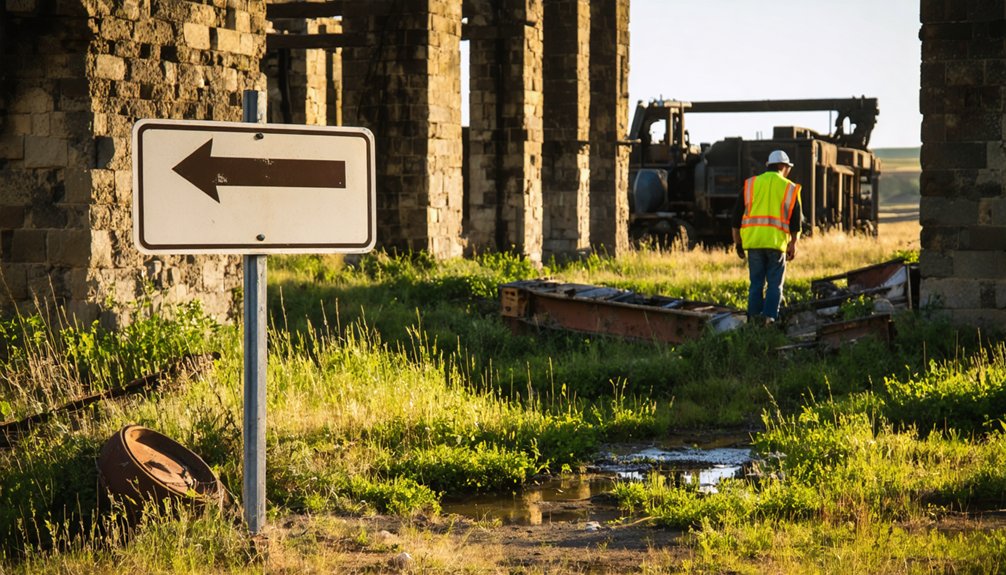
Exploring these abandoned settlements demands awareness that historic mine sites harbor genuine dangers masked by their picturesque decay. These crumbling structures and exposed shafts remain subject to personal protection requirements that safeguard modern mining operations. While you’re free to wander Lancaster City’s remnants, respect the landscape’s inherent hazards.
Essential precautions for your ghost town exploration:
- Never enter unstable structures or mine shafts—century-old timber supports collapse without warning, and hidden vertical drops prove fatal.
- Wear sturdy boots and carry emergency supplies—remote Black Hills locations offer no immediate rescue services.
- Document, don’t disturb—removing artifacts destroys historical context for future visitors and violates preservation ethics.
Though industrial hygiene monitoring no longer occurs at abandoned sites, residual contaminants from mercury and arsenic processing persist in soil and water. The original operations likely employed draglines and excavators to remove overburden layers before accessing ore deposits beneath Lancaster City’s surface.
Tales of Outlaws, Miners, and Supernatural Encounters in the Black Hills
The Black Hills’ ghost towns pulse with stories of Deadwood’s lawless gunfights settled man-to-man, where no established government reigned during the late 1800s gold rush.
You’ll find over 600 abandoned mining sites where tragedies unfolded—from Cambria’s coal operations to the hard rock camps at Hornblend and Blue Lead—each marked by rusted shafts and scattered tailings that witnessed both fortune and disaster.
Local legends persist of mining widows haunting Deadwood’s historic buildings, their faint footsteps and shadowy figures documented on ghost tours that preserve the restless spirits of the 1800s mining era.
Lawless Days of Deadwood
When gold glittered in the Black Hills streams during 1874, fortune seekers descended upon the Dakota Territory with a fever that transformed wilderness into bedlam. Deadwood erupted in 1876 as a lawless camp, swelling from nothing to 5,000 souls by late 1870s, then 12,000 by 1877.
Without US government recognition, you’d find:
- Character profiles ranging from gamblers and madams to gunslingers like Wild Bill Hickok, who arrived July 1876 only to meet his end holding aces and eights
- Economic evolution driven by gold-hungry miners alongside ruthless businessmen operating in moral vacuum
- Chaos fostering corruption where fortunes materialized and vanished overnight
This untamed haven operated beyond law’s reach, where Seth Bullock would later impose order and Al Swearengen’s Gem Theater epitomized frontier vice.
Mining Tragedies and Legends
Beyond Deadwood’s gambling dens and gunfights, darker forces haunted the Black Hills mining camps—forces you couldn’t shoot or negotiate with. Ghastly mining disasters claimed countless prospectors who ventured too deep into unstable shafts, seeking fortunes that became their tombs.
Collapsed tunnels entombed entire crews, while toxic gases silently suffocated those who’d escaped cave-ins. The region’s outlaw legends intertwined with unexplained mining phenomena—spectral lights flickering in abandoned drifts, phantom pickaxe sounds echoing through sealed passages, and apparitions of lost miners warning others away from dangerous veins.
These supernatural encounters became as much a part of Black Hills folklore as Wild Bill’s assassination. Whether born from grief, guilt, or genuine otherworldly activity, the stories persisted through generations, transforming tragedy into legend and reminding modern explorers that some debts to the earth remain unpaid.
Haunted Sites and Tours
Visitors who traverse Deadwood’s weathered boardwalks today walk paths where genuine tragedy birthed enduring supernatural folklore. The 1877 murder-suicide at Lone Star Saloon prompted the Black Hills Weekly Times to conduct paranormal investigations, documenting ghostly activity that terrified upstairs tenants. That building’s now a parking lot, but the documented hauntings remain part of historic preservation efforts.
Your ghost town exploration reveals three compelling haunted destinations:
- Mount Moriah Cemetery – Where 100,000-120,000 annual visitors encounter Wild Bill Hickok’s relocated grave, moved uphill when developers claimed the original flatter burial grounds
- Lone Star Saloon site – Former scene of Kitty’s violent death, investigated by 19th-century journalists
- Lancaster City ruins – Nimrod Lancaster’s 1877 mining settlement at 44°22′45″N 103°46′27″W, abandoned and silent
Frequently Asked Questions
What Accommodations Are Available Near Lancaster City for Overnight Stays?
You’ll find budget-friendly hotels in nearby Aberdeen and Watertown, approximately 30 miles from Lancaster City. While historic bed and breakfasts aren’t documented in this remote prairie region, campgrounds offer authentic frontier-style lodging experiences under vast Dakota skies.
Are There Guided Tours Available for Lancaster City Ghost Town?
No guided tours exist for Lancaster City—it’s not a South Dakota ghost town. You’ll find self-guided tours at authentic Black Hills sites like Spokane or Mystic instead. Deadwood offers structured ghost tours, but Lancaster remains geographically misidentified.
What Is the Best Season to Visit Lancaster City?
Fall offers you the ideal Lancaster City exploration experience. You’ll enjoy mild temperatures perfect for wandering abandoned structures, while vibrant fall foliage frames crumbling foundations beautifully. Fewer crowds mean you’re free to discover this forgotten mining settlement at your own pace.
Do I Need Permits to Visit Lancaster City Ghost Town?
You won’t face permit requirements or visitor regulations when exploring this windswept remnant of frontier ambition. Lancaster City’s barren landscape remains freely accessible—a symbol/emblem/representation of South Dakota’s open-range spirit where history-seekers roam unencumbered across abandoned mining dreams.
Are There Restaurants or Facilities Near Lancaster City for Visitors?
You’ll find minimal visitor facilities near Lancaster City’s remote prairie location. Plan ahead by bringing supplies, as dining options require driving to distant towns. The ghost town’s isolation mirrors its frontier past—you’re truly venturing off the beaten path.
References
- https://www.sdpb.org/rural-life-and-history/2023-08-21/some-black-hills-ghost-towns-and-their-origins
- https://www.sdhspress.com/journal/south-dakota-history-2-2/some-black-hills-ghost-towns-and-their-origins/vol-02-no-2-some-black-hills-ghost-towns-and-their-origins.pdf
- https://www.blackhillsbadlands.com/blog/post/old-west-legends-mines-ghost-towns-route-reimagined/
- https://en.wikipedia.org/wiki/Lancaster_City
- https://www.geotab.com/ghost-towns/
- https://americanbusinesshistory.org/a-real-goldmine-the-homestake-story/
- https://history.sd.gov/museum/docs/Mining.pdf
- https://blackhillsminingmuseum.com/learn/history
- https://www.sdpb.org/learn/dakota-pathways/miningboomsandbusts
- https://www.mininghistoryassociation.org/BlackHills.htm