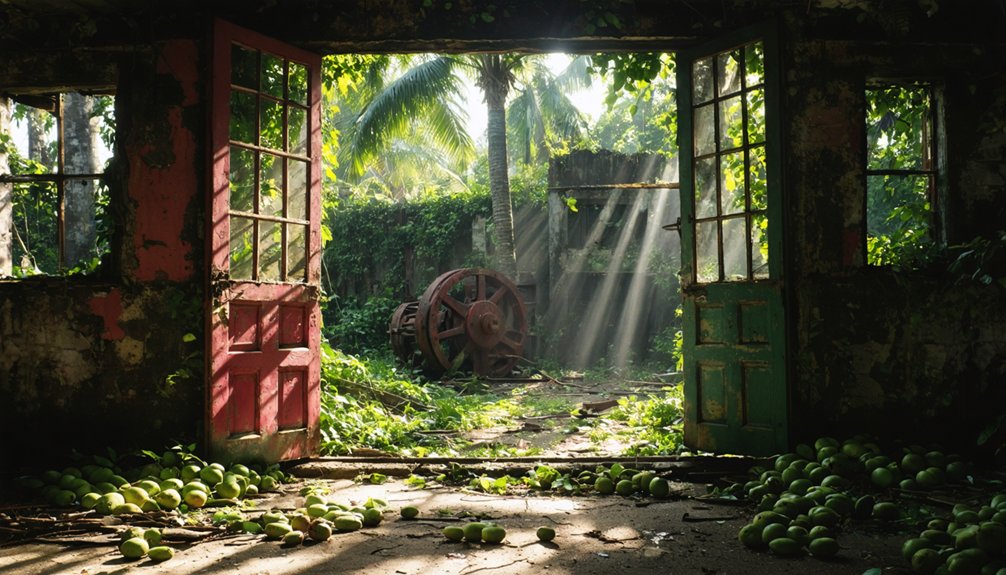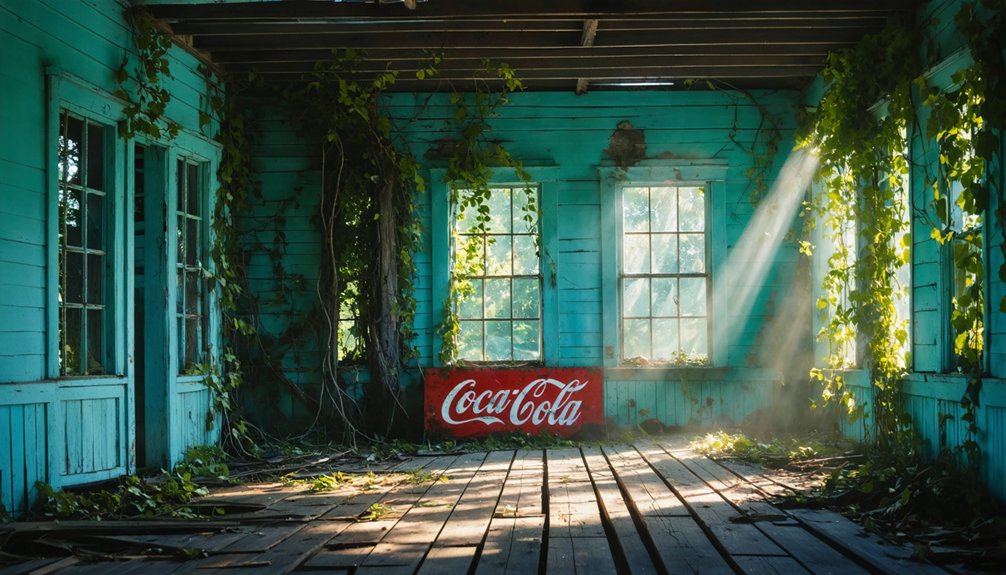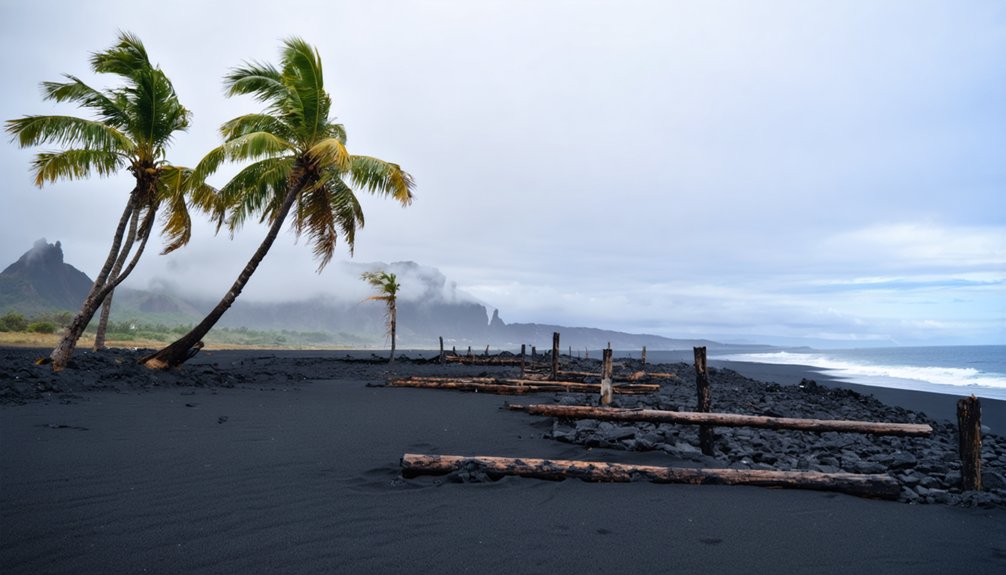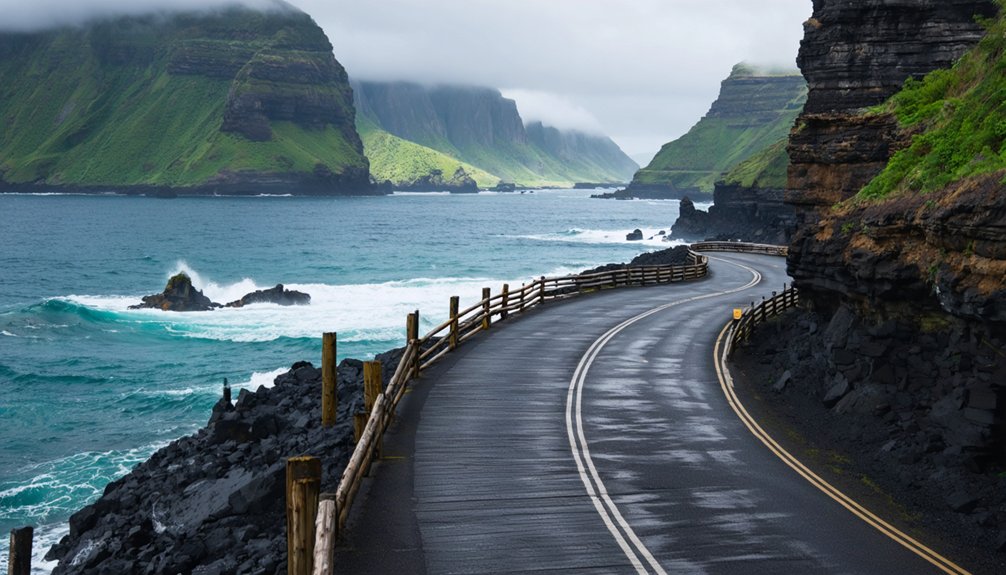
You’ll find Laupahoehoe Point along Highway 19 on Hawaii’s windswept Hamakua Coast, where abandoned storefronts and rusting fishing boats tell stories of a thriving village erased by the 1946 tsunami. The memorial lists 24 names—students and teachers swept into the Pacific—while lava tubes wind beneath your feet and tropical vines reclaim what remains. Visit the Train Museum for haunting photographs, then walk the black rock shore where fishermen now cast lines. The ancient taro terraces and sacred landscapes hold secrets that reveal themselves to those who linger.
Key Takeaways
- Drive the winding coastal highway to Laupahoehoe Point, where stark lava flows meet the Pacific and abandoned storefronts remain.
- Visit the tsunami memorial monument listing 24 victims at the former school site overlooking craggy black rocks.
- Explore the Train Museum’s vintage photographs documenting the thriving village erased in minutes by the 1946 tsunami.
- Walk the beach park where fishing boat relics rust and fishermen cast lines where homes once clustered.
- View ancient taro terraces and irrigation channels still traceable before tropical forest reclaimed the historic Hawaiian settlement.
The Historic Fishing Village That Time Forgot
The lava spoke first, carving Laupahoehoe Point into existence 65,000 years ago when molten pāhoehoe flows from Mauna Kea’s dying breath crept down the gulch and hardened into an angular cape jutting into the Pacific.
Hawaiian fishermen built their lives here on alkalic basalt cliffs, harvesting sea turtles and cultivating taro in terraced fields that climbed toward the sky. You’ll find their descendants’ abandoned store fronts rotting in the humidity now, tropical vines strangling what commerce once thrived.
Fishing boat relics rust along the shore where families loaded sugar, cattle, and hope onto ships bound for distant markets. By the late 1920s, they’d vanished—those who’d survived packed their memories and fled upland, leaving Laupahoehoe Nui to the ghosts.
When Disaster Struck: The 1946 Tsunami Tragedy
Standing on the point today, you’ll feel the weight of April 1, 1946, when three massive waves—each arriving fifteen minutes apart—erased the thriving school community in minutes.
The third wave proved most devastating, reaching heights that swept sixteen students and five teachers from their cottages into the churning Pacific.
Local survivors still mark the date as one of Hawaii’s darkest mornings, when 159 souls across the islands perished before breakfast, including twenty-four from this single, exposed peninsula.
Three Devastating Waves
At 2:29 a.m. on April 1, 1946, a magnitude 8.6 earthquake tore through the seafloor near the Aleutian Islands, that remote arc of land stretching between Alaska and Russia’s Kamchatka Peninsula. A 100-foot wall of water obliterated a lighthouse on Unimak Island, then raced toward Hawaii at 500 mph.
The wave patterns arrived systematically—45-foot swells struck Kauai four hours after the quake, reaching Hilo an hour later at 37 feet. What you need to understand about tsunami impacts: they don’t come alone. Waves arrived every 15 minutes, each dragging debris seaward before the next surge. The third or fourth wave proved deadliest at Laupahoehoe, crushing teacher cottages and sweeping 24 victims into the Pacific. No warning system existed—just the ocean’s terrible rhythm.
School’s Tragic Loss
When Marsue McGinnis heard the knock on her cottage door that morning, she’d been teaching at Laupahoehoe School for barely a year—a young woman from Ohio who’d traded cornfields for this remote Hawaiian peninsula where the school sat perched above black lava rocks. “Come see the tidal wave!!” someone shouted, and she stepped outside with her three roommates—Dorothy Drake, Helen Kingseed, and Fay Johnson—to watch what seemed like a harmless surge.
The wave took all three of them. Twenty-four souls from the school community vanished that day—lost childhoods torn from families who’d trusted this oceanfront campus.
The community aftermath transformed everything: cottages crushed, windows shattered, and Peter Nell mourning his wife and children. They rebuilt the school safer inland, reopening in 1952 on higher ground.
Stories of Survival and Loss
The knock on Marsue McGinnis’s cottage door came just after sunrise on April Fool’s Day, 1946. The Ohio teacher watched a small surge from her doorway, then ran as a massive wave obliterated her home. She clung to a log for nine hours in thirty-foot seas before rescuers dropped a raft from above. One of those rescuers became her husband—a symbol of resilience in adversity born from tragedy.
Children had gathered on the beach moments earlier, grabbing flopping fish as water receded. Then the surge pulled them out. Bus driver Morito transported drenched students just before the largest wave struck. Peter Nell lost his wife and three children. The lasting impact on community echoes through annual memorial services at the point where twenty-four lives vanished.
What Remains: Exploring the Coastal Ghost Town
Driving down the winding coastal highway toward Laupahoehoe Point, you’ll notice how the landscape shifts from verdant rainforest to something starker—exposed lava flows that seem to pour directly into the churning Pacific. Unlike the popular maui volcano tours, this peninsula requires no guide, no crowds.
You’ll find the monument where the school once stood, its 27 names etched in stone overlooking craggy black rocks. The Train Museum preserves what’s left—vintage photographs showing cottages that stood meters from shore, a thriving village erased in minutes.
Lost lava tubes wind beneath your feet as you wander the beach park. Fishermen cast lines where homes once clustered. The point remains haunted, peaceful—waves crashing exactly where they did that April morning.
Ancient Hawaiian Heritage and Sacred Landscapes
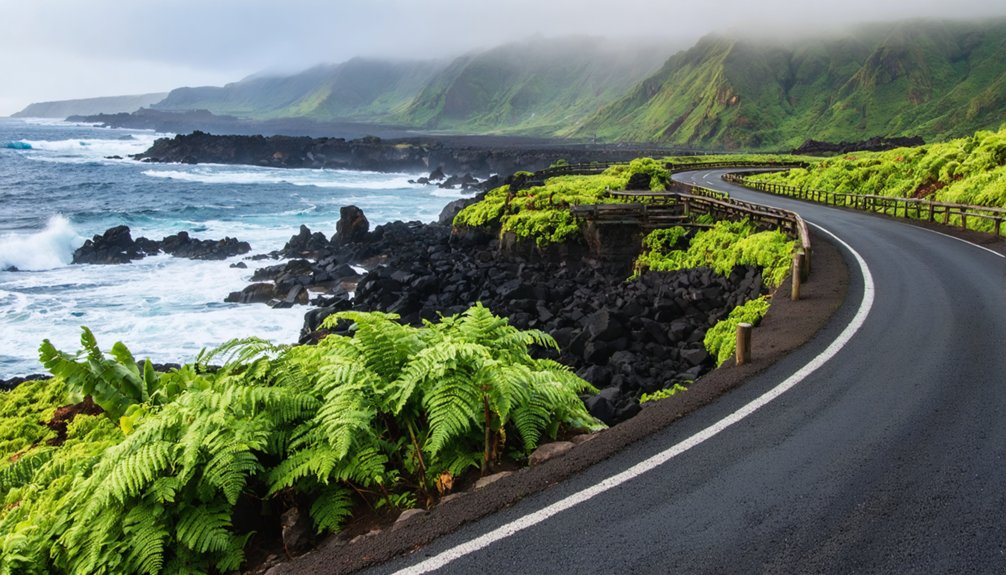
You’ll find the peninsula’s leaf-shaped silhouette was born from divine conflict—when fire goddess Pele and snow goddess Poliahu battled across Mauna Kea’s slopes, their cosmic struggle sent rivers of molten rock into the sea 65,000 years ago.
Beneath your feet, ancient taro terraces lie buried under layers of volcanic soil, their irrigation channels still traceable where the forest hasn’t reclaimed them entirely. The upland forests once served as sacred gathering grounds, those wao akua regions where commoners ventured cautiously to collect medicinal plants and precious woods, always mindful they walked among the gods.
Pele and Poliahu Legend
Long before roads scarred the Big Island’s slopes, ancient Hawaiians gathered near what would become Laupāhoehoe to witness holua sledding—a death-defying sport where competitors hurtled down oiled volcanic tracks at sixty miles per hour on narrow wooden sleds.
During one legendary race, Poliahu, the snow goddess of Mauna Kea, competed against her sisters when a stunning maiden challenged her supremacy. The stranger was Pele in disguise. When Poliahu won, the earth trembled violently.
Pele’s volcanic power exploded through Mauna Kea’s caverns, hurling molten rock skyward. Poliahu fled upslope, casting her snow mantle across the advancing inferno. Poliahu’s icy defenses transformed eruptions into glaciers, ultimately driving Pele back to Kīlauea.
The cooled lava flows created Laupāhoehoe’s distinctive landscape, while Mauna Kea’s desolate summit remains forever wrapped in Poliahu’s protective snow.
Buried Taro Field Complexes
Beneath Laupāhoehoe’s dramatic coastal cliffs lie secrets that most visitors never glimpse—ancient taro terraces buried under centuries of landslides and volcanic sediment. The 1822 landslide at Laupahoehoe Nui preserved an entire lo’i system, creating a time capsule of Hawaiian agriculture.
Archaeological teams have mapped these deposits, revealing a buried agricultural chronology spanning 800 years of hydraulic engineering genius—stone-faced terraces carved into boulder fields, irrigation channels fed by side-valley streams, and sediments carefully transported to build planting soil.
You’re witnessing conservation efforts that honor this legacy. The valley’s isolation once protected taro culture until the early 20th century. Today’s $1 million restoration aims to revive these systems as living classrooms, reconnecting people with ancestral wisdom that once fed over 400,000 Hawaiians across more than 20,000 acres.
Sacred Forest Gathering Grounds
When you step into Hawaii’s sacred forest sanctuaries, you’re entering living temples where ancient Hawaiians gathered under towering koa canopies to conduct birth ceremonies, seek refuge, and commune with their gods. At Kūkaniloko’s weathered stones beneath eucalyptus and coconut palms, two rows of eighteen stones mark where chiefs witnessed royal births, transferring divine power through bloodlines. You’ll find fresh lei offerings honoring ancestors who walked this hallowed ground.
Further south, Puʻuhonua o Hōnaunau’s refuge welcomed kapu breakers seeking sanctuary behind its Great Wall, where spiritual cleansing rituals on the Alealea platform restored their standing. The Hale o Keawe once housed twenty-three chiefs’ bones, radiating protective mana across the compound. These mana revival ceremonies kept communities spiritually balanced, traditions you can still feel resonating through ancient timber and stone.
The Monument: Honoring the Victims
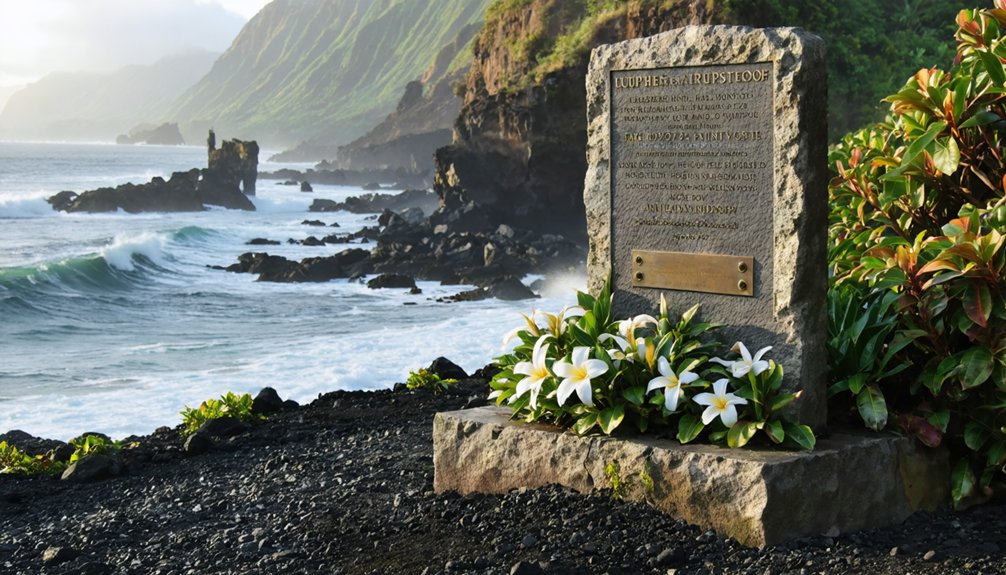
Perched on a knoll overlooking the restless waters of Laupahoehoe Bay, the memorial rises from a pedestal of black lava rock—a stark reminder that this peaceful coastline once claimed twenty-four lives in a matter of minutes. You’ll find their names engraved on granite, circled by iron railings that frame your contemplative solitude. Sixteen students, four teachers, and a teacher’s wife with her three children—all swept away when that April morning in 1946 turned catastrophic.
The poignant memorial demands you pause. Read the dedication plaque. Study the newspaper clippings in the nearby pavilion. These weren’t just statistics—they were neighbors, kids playing hooky to watch unusual waves, teachers who’d shared cramped cottages on the peninsula below. Stand here long enough, and you’ll understand why Laupahoehoe relocated its school to higher ground.
Getting There: Routes Along the Hamakua Coast
The journey to Laupahoehoe unspools along Highway 19, a serpentine ribbon of asphalt that traces the Hamakua Coast from Hilo northward through what remains of Hawaii’s sugar plantation era. You’ll wind past vintage sugar mill ruins crumbling beneath jungle vines, their rusted machinery monuments to forgotten prosperity.
Consider these essential stops:
- Pepe’ekeo Scenic Drive – A four-mile detour through cathedral-like canopies where moss-draped bridges span cascading streams
- Umauma Falls and scenic lookout viewpoints – Pull over frequently; each curve reveals another waterfall threading through emerald valleys
- Kalopa State Park – Stretch your legs on the nature trail at 2,000 feet elevation
Pack offline maps—cell reception vanishes beneath the banyans. Expect rain showers that materialize from nowhere, painting everything in deeper shades of green. The road demands patience, rewarding dawdlers with magic.
Hidden Archaeological Treasures in Laupahoehoe Nui Valley
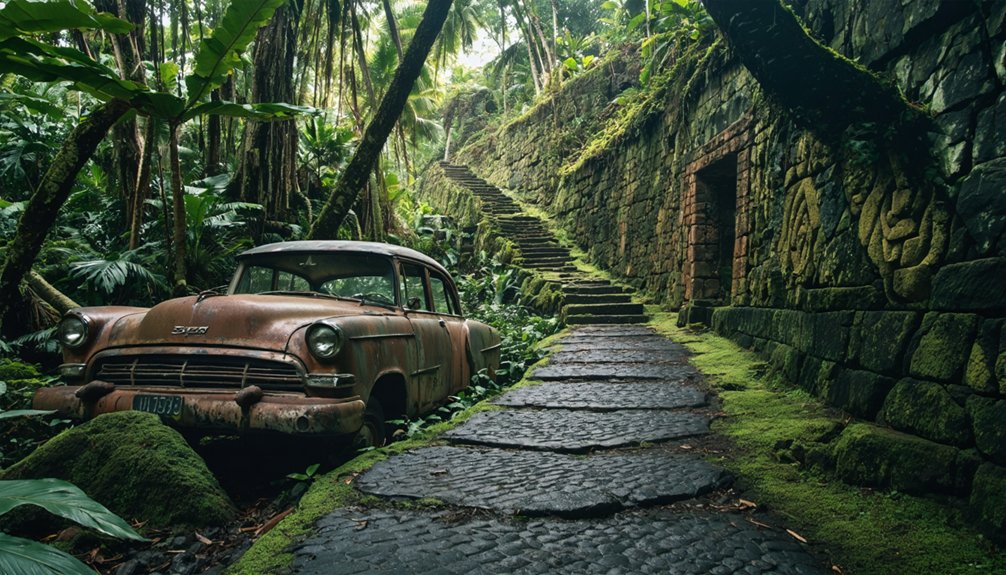
Beyond the 1,200-foot cliffs that wall off Laupahoehoe Nui Valley from casual visitors lies an archaeological wonderland that time has barely touched. You’ll discover well preserved lo’i complexes buried beneath an 1822 landslide, their ancient taro sediments revealing what Hawaiians cultivated centuries ago. Stone platforms and terraces dot the landscape—some serving as heiau, others marking burial sites where ancestors rest in lava caves.
The valley’s päpa’i shelters, woven from koa and ferns, still hide in the understory. Named sites like Pu’ukoa honor the forest that once thrived here, while fractures in pahoehoe flows conceal artifacts and traditional hawaiian rock art. This remote ahupua’a preserves knowledge that mapping projects can barely capture—a living library accessible only to those willing to time their crossing with the tides.
Best Times to Visit and What to Bring
- Waterproof hiking boots for traversing wet valley trails and volcanic rock formations
- Rain jacket (November and March bring heaviest downpours)
- Snorkeling gear to investigate submerged ruins along the shoreline
May through October brings plumeria blooms scenting the abandoned homesteads, while summer’s calm waters make shoreline archaeological sites more accessible than winter’s powerful swells.
Frequently Asked Questions
Are There Any Restaurants or Food Options Near Laupahoehoe Point?
You’ll find Pāpaʻaloa Country Store & Cafe as your main option, plus Minit Stop for quick bites. While small local eateries are limited here, you won’t spot food truck options nearby—but the fresh-made meals satisfy hungry road-trippers perfectly.
Can I Swim or Enter the Water at Laupahoehoe?
Swimming isn’t recommended here—ocean conditions remain treacherous year-round with dangerous currents and crashing surf. You’ll find public safety advisories posted throughout. Instead, explore the tide pools on calmer days, where you can safely experience the water’s edge.
Is There an Admission Fee to Visit the Monument?
No admission fee bars your path to the memorial. You’ll find monument accessibility completely free, though monument maintenance depends on donations. The concrete platform and iron railing stand open 24/7, welcoming wanderers seeking this haunting coastal tribute.
Are There Guided Tours Available for the Ghost Town Area?
You’ll find no guided tours weaving through Laupahoehoe’s abandoned buildings—freedom calls you to create self-guided tours instead. Wander independently through weathered structures, letting whispers of the past become your only companion on this haunting journey.
Where Is the Nearest Lodging to Laupahoehoe?
You’ll find The Palms Cliff House Inn closest to Laupahoehoe’s center, offering intimate accommodation options within easy reach. Its proximity to town center lets you explore freely, then retreat to coastal comfort after wandering the ghostly, wave-battered ruins.