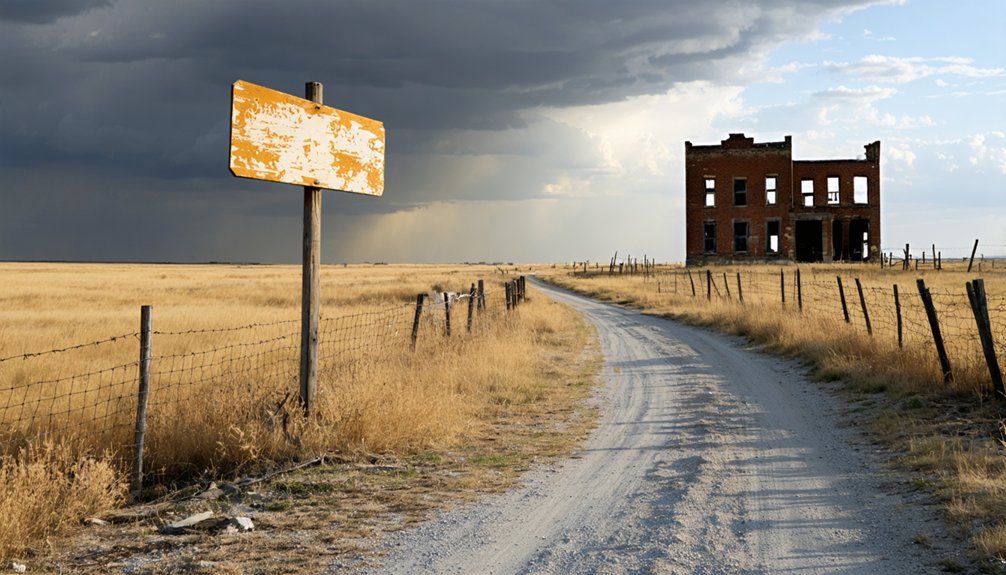
You’ll drive 350 miles westward across Kansas, cutting through Dodge City on US-50 before turning north onto rural county roads where Lexington awaits. Pull onto the grassy shoulder near weathered fence posts—there’s no formal parking. The cemetery offers the most tangible connection to the past, while foundation stones peek through prairie grass and that haunting church steeple breaks the horizon. Check KanDrive beforehand since weather dictates road conditions, and you’ll discover why railroad abandonment sealed this town’s fate.
Key Takeaways
- Travel 350 miles west across Kansas via US-50 through Dodge City, then turn north on rural county roads.
- Check road conditions on KanDrive or dial 511 before departing, as weather affects rural road access.
- Park on the grassy shoulder near weathered fence posts; no formal parking areas exist at the site.
- Explore the cemetery, scattered foundation stones, weathered church steeple, and 1870 schoolhouse rubble independently.
- Lexington became a ghost town after railroad abandonment sealed its fate in the late 1800s.
Lexington’s Founding Story and Early Settlement Days
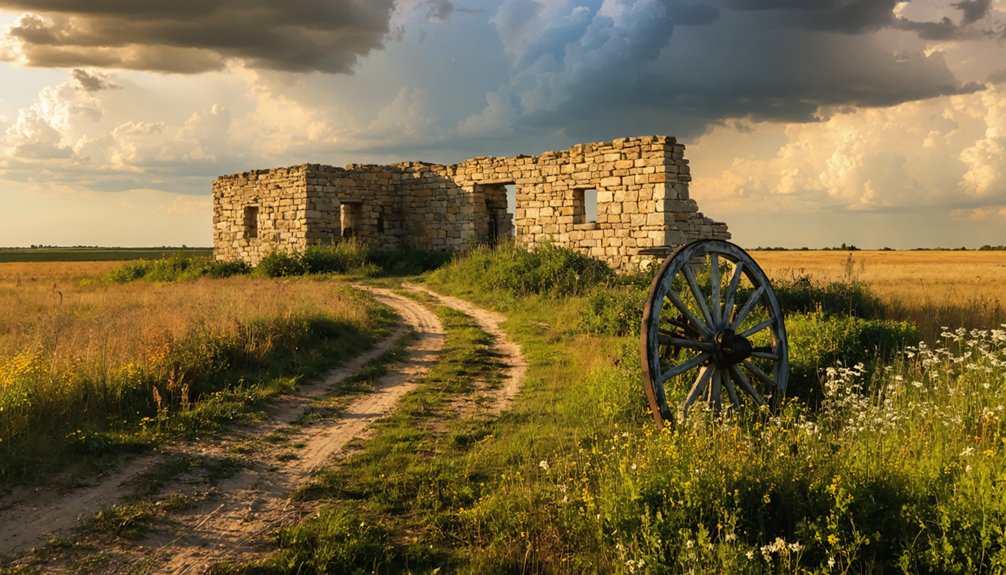
Nine ambitious men gathered in November 1885 with a shared vision—four from Bluff Creek precinct and five from Ashland—to form what they initially called the Aurora Town Company. You’ll find they quickly discovered another Kansas town claimed that name, so they rechristened it Lexington, officially filing on December 3, 1885.
Key community leaders like Ben L. Stephens pioneered the settlement, relocating his six-month-old claim house to become the town’s first building in early 1886. By the time the official plat was recorded on February 18, 1886, four landowners had each deeded 40 acres for the new site.
Newspaper descriptions from the County Beacon document ten businesses operating by June 1886—doctors, blacksmiths, and merchants carving civilization from Clark County prairie.
How Railroad Development Shaped Lexington’s Destiny
While ambitious settlers were platting Lexington’s streets in early 1886, they watched the horizon for the transformative force that would make or break their prairie town—the railroad.
For Lexington’s settlers, survival wasn’t about ambition or hard work—it was about steel rails and the distant whistle of progress.
You’ll discover that Lexington’s fate hinged on the Lexington Subdivision, originally built in 1881 by the Elizabethtown, Lexington and Big Sandy Railroad. These competing infrastructure projects crisscrossed Kansas like veins of opportunity, each promising prosperity through federal land grants of 5,000 acres per mile.
Railroad expansion strategies transformed the state into wheat country, but they were ruthlessly selective. Towns blessed with depots flourished; those bypassed withered.
Lexington eventually joined the ghost town roster when its rail connection was abandoned, proving what frontier settlers already knew—without steel tracks linking you to markets, your town’s destiny was sealed.
What Remains: Exploring Lexington’s Architectural Footprint
When you arrive in Lexington today, you’ll find the cemetery standing as the most tangible link to the town’s past, its weathered headstones marking families who once walked these vanished streets.
Scattered foundation stones peek through the prairie grass where homes and businesses lined the main thoroughfare, creating a ghost map you can trace on foot. The structural evidence is sparse but deliberate—each remaining fragment tells you exactly where neighbors gathered, where children played, and where a community’s dreams took root before the railroad passed them by.
Current Standing Structures
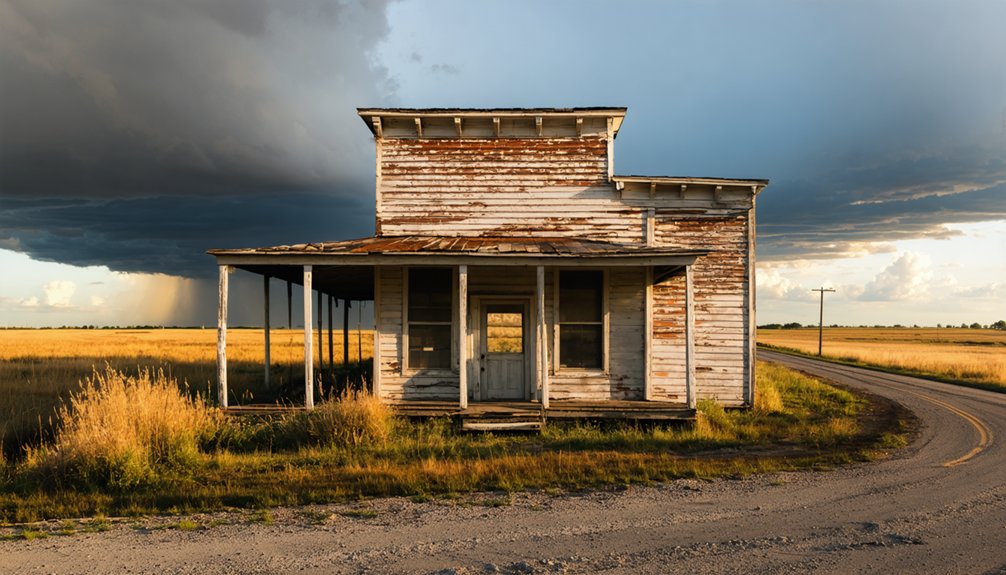
Today’s Lexington reveals itself in fragments—a weathered church steeple breaking the horizon, crumbling foundations tracing what used to be Main Street, and a few outbuildings sagging into the prairie grass. You’ll spot the century-old church still standing prominently, occasionally hosting services for those who remember.
Near the roadside, the 1870 schoolhouse exists as rubble, though fundraising efforts aim to preserve what’s left. This two-story structure once served as one of Lexington’s key community gathering points, hosting dances when the town thrived.
Most deteriorated structures blend into working farmland now—a garage here, a barn there, foundations outlining forgotten businesses. Memorial markers help you piece together the layout. Pull off US 50, walk the grounds yourself, and you’ll find accessibility easy, with history literally underfoot across these open Kansas plains.
Cemetery and Foundation Evidence
Beyond the standing buildings, Lexington’s most enduring stories lie in its cemetery grounds and the stone foundations scattered across the grassland. You’ll discover memorial markers weathered by decades of Kansas winds, their inscriptions fading but still legible to determined explorers. The burial ground shows minimal disturbance, preserving the final resting places of pioneer families who shaped this settlement.
Stone foundations emerge from the prairie grass, marking where homes and businesses once thrived. You can trace building footprints by walking the perimeter of these rectangular remnants. Limestone blocks, hand-cut and mortared, reveal the craftsmanship settlers brought westward. These archaeological fragments let you reconstruct Lexington’s layout—mapping Main Street’s commerce, residential blocks, and the town’s ambitious scope before abandonment claimed it.
Getting There: Directions and Road Access to Lexington
Reaching Lexington from DeSoto means committing to a 350-mile westward journey across Kansas’s gradually flattening terrain, where I-35 south eventually gives way to a web of state highways cutting through wheat country.
You’ll navigate through Dodge City on US-50 before turning north onto rural county roads—the kind where gravel kicks up against your undercarriage and GPS signals fade in and out.
There’s no formal parking area waiting at the ghost town’s coordinates; instead, you’ll pull onto the grassy shoulder near weathered fence posts, your tires settling into the same ruts that mark where other curious travelers have stopped before.
Route Options From Desoto
When planning your journey to the ghost town of Lexington, you’ll find De Soto serves as an ideal launching point, situated where modern highways converge with historic routes that once carried settlers across the Kansas prairie.
From De Soto, you’ve got serious freedom to roam. Take Lexington Avenue—the old K-285 that once guided travelers before 1999—as it curves northeast through open country. This historic corridor connects you directly to regional highway alternatives including K-32, just five miles north via 189th Street or 158th Street.
For wider exploration, county infrastructure connections like CR 2 bridge the Kansas River, linking you to US-24 and US-40. I’ve found these back routes reveal Kansas’s soul better than any interstate. K-10‘s four exits give you flexibility, while I-435 and I-70 offer quick escapes when wanderlust calls.
Road Conditions and Parking
The pavement ends about two miles before Lexington materializes from the prairie, and that’s when your road trip transforms into something genuine. Dirt roads snake through Kansas grasslands, the same routes that replaced the 1880s railroad connections. You’ll notice abandoned cars and trucks slowly disappearing into the weeds along these paths—ghost vehicles guarding a ghost town.
Road access conditions depend entirely on recent weather. After rain, these dirt roads become treacherous mud traps. Check KanDrive or dial 511 before you venture out for real-time updates on road conditions and construction detours affecting your route.
As for parking facilities? There aren’t any. Pull off wherever the road widens near empty intersections. You’ve got the freedom to explore completely on your terms.
The Economic Forces Behind Lexington’s Abandonment
Like many frontier settlements that rose with fervent optimism only to crumble into dust, Lexington’s demise wasn’t sealed by a single catastrophe but by a perfect storm of economic pressures that strangled the town’s significance year after year.
You’ll find the economic influences that doomed Lexington followed a brutal pattern:
- Political isolation – Proslavery sympathies divided the community, driving away settlers and investment after Kansas declared itself free
- Railroad bypass – When tracks laid through neighboring settlements, Lexington lost its shipping advantage for agricultural goods
- County seat failure – Missing this essential designation eliminated government jobs that sustained town demographics
- Geographic irrelevance – Highway development routed travelers elsewhere, starving local businesses of customers
Each factor compounded the next, transforming bustling Main Street into windswept prairie.
What to See at the Former Town Site
Arriving at Lexington’s former townsite off US Highway 54, you’ll encounter a landscape that speaks through absence rather than presence. Scattered foundations and rubble piles emerge from overgrown vegetation, blending seamlessly into surrounding farmland. You won’t find historical markers here—just the raw evidence of commercial buildings from the town’s brief peak.
The adjacent railroad tracks tell the story best. Their active line runs tantalizingly close, symbolizing the missed opportunity that sealed Lexington’s fate. Walk the quiet fields freely, camera in hand, capturing remnant infrastructure reclaimed by nature.
The isolated cemetery remains your most tangible connection to the past. Weathered markers dating to the 1880s document early settlers who believed this place had a future. It’s a brief stop, but one that captures boomtown failure perfectly.
Nearby Ghost Towns to Add to Your Kansas Itinerary
Your Lexington visit positions you perfectly to explore Lincoln County’s remarkable collection of 13 ghost towns, including Paris, Potsy, and Towerspring, all within a 30-mile radius accessible via connecting gravel roads.
I’d recommend plotting a northern loop through Graham County’s 11 abandoned settlements—Fargo and Wild Horse offer particularly well-preserved structures—before circling back through Norton County’s Devizes and Rockwell. These western Kansas counties form the state’s densest ghost town corridor, where you’ll find crumbling schoolhouses, weathered grain elevators, and pioneer cemeteries every few miles along Highway 18 and its rural offshoots.
Regional Ghost Town Clusters
While Lexington anchors your ghost town exploration, the real treasure lies in discovering how Kansas’s abandoned settlements cluster together like forgotten constellations across the prairie. Regional demographic shifts and environmental factors impacting towns created distinct patterns worth tracking:
- Northeast Kansas: Potwin Place and Auburndale fell to Topeka’s expansion in 1899, while Prairie City’s stone ruins and America City’s cemetery of 460 souls tell darker stories of disease outbreaks.
- Central Kansas: Bushong’s 27 stubborn residents prove some towns refuse to die completely, while Kipp survived until 1957.
- Southeast Kansas: Trading Post guards the Marais des Cygnes River as the county’s first permanent settlement.
- Southwest Kansas: Lake City’s 47 residents contrast sharply with revived Ulisses’s 5,800 population.
Efficient Multi-Site Route Planning
Understanding these regional patterns sets the foundation, but translating geography into actual driving routes transforms abstract clusters into a conquerable day trip. You’ll master site sequencing by anchoring at Lexington, then sweeping east on US 50 through LeLoup, Homewood, and Agricola—three stops within 40 miles covering 1900s railway decline.
Mapping logistics becomes intuitive when you pair highway proximity with historical timelines: Homewood’s 1906 schoolhouse sits just off the original US 50 alignment, adding zero backtracking. Day two, pivot west on US 54 toward Bloom, where gravel roads connect Lincoln County’s Cedron and Milo efficiently. Rush and Mitchell County sites like Belfield extend your loop to 100 miles round-trip, capturing 10+ ghost towns without redundant mileage. Freedom lies in flexible sequencing, not rigid itineraries.
Notable Abandoned Settlements Nearby
Five ghost towns within an hour’s drive of Lexington anchor the most historically dense pocket of Kansas’s vanished settlements, each preserving distinct architectural remnants from the state’s boom-and-bust railway era.
You’ll discover these notable nearby mining settlements and remnants of the railroad infrastructure:
- Castleton (Reno County) – Operating post office 1872-1957, few weathered homes standing, famously doubled as “Sevillinois” in 1952 filming
- Bloom (Lane County) – Accessible off US 54, time-forgotten despite highway proximity
- LeLoup – Along US 50 with minimal structures, unforgettable name story worth the detour
- Homewood – Features restored 1906 schoolhouse, bypassed when highways modernized, St. John’s Cemetery marking 1885-1915 settlement period
Each site offers unrestricted exploration through Kansas’s authentic frontier collapse, no tour groups required.
Best Times to Visit Lexington and What to Bring

When planning your ghost town road trip to Lexington, timing can transform a dusty stroll through history into either a memorable adventure or an endurance test against Kansas’s temperamental climate. Spring and fall deliver ideal conditions—temperatures hovering in the 50s to 70s let you explore Campbell House’s equestrian ruins without sweating through your shirt or freezing your fingers. Avoid July’s scorching heat and February’s bitter winds that’ll make photographing abandoned buildings miserable.
Pack layered clothing, sturdy boots for uneven terrain, and plenty of water. March and November offer minimal seasonal tourist crowds while keeping historical lodging options affordable. You’ll navigate crumbling foundations and weathered structures comfortably, with enough daylight to discover Arrington’s mineral springs remnants before shadows swallow the prairie’s forgotten stories.
Photography Tips for Capturing Ghost Town Remnants
Because abandoned buildings swallow daylight into their weathered gaps and crumbling doorways, your camera becomes a time-capturing tool that’ll freeze Lexington’s decay before nature erases it completely. You’ll want to arrive during golden hour when shadows carve drama across peeling paint and collapsed roofs.
Master these techniques for haunting results:
- Mount your tripod for long exposure techniques that transform drifting clouds into ghostly streaks above ruins
- Pack wide-angle lenses to capture entire structures in their desolate contexts
- Experiment with infrared photography to reveal otherworldly textures invisible to naked eyes
- Bring handheld flashlights for light painting during exposures—sweep beams across dark interiors while your shutter stays open
Dawn shoots offer soft lighting that’ll emphasize artifacts without harsh contrasts, letting weathered details tell their stories naturally.
Understanding Lexington’s Role in Kansas Territorial History
While your lens captures Lexington’s crumbling facades, the weathered bricks beneath your boots witnessed one of America’s most volatile chapters—a six-year powder keg that ignited the Civil War.
From 1855 to 1861, this territorial capital served as ground zero for the clash between a pro slavery constitution drafted within Constitution Hall and fierce free state resistance emanating from nearby Lawrence. You’re standing where fraudulent elections, armed militias, and political maneuvering shaped the nation’s future.
The Lecompton Constitution—drafted to perpetuate bondage—failed spectacularly when Kansans rejected it in January 1858. That defeat marked slavery’s first major loss on American soil. Today’s quiet streets belie the chaos that once defined this place, earning it the haunting title: “Where Slavery Began to Die.”
Frequently Asked Questions
Is Overnight Camping Permitted at the Lexington Ghost Town Site?
Overnight camping isn’t explicitly permitted at Lexington’s ghost town site. You’ll need to explore nearby overnight parking options instead, as local camping regulations restrict camping to designated areas only. Check with authorities before settling in for freedom.
Are There Any Safety Hazards to Watch for While Exploring?
Like stepping through a wild frontier, you’ll face potential rattlesnake presence in overgrown areas and loose building materials from decaying structures. Watch for contaminated soil, unstable ground near mines, and windblown dust carrying heavy metals throughout.
Can I Enter Remaining Structures or Are They Off-Limits?
No structures remain at Lexington—the townsite’s completely vanished into farmland. You can’t enter anything because private property restrictions block access to the former ordnance plant grounds. Only the cemetery’s reachable, and structural integrity concerns don’t apply to empty fields.
Do I Need Special Permits to Visit Lexington Ghost Town?
No special permits needed for visiting Lexington’s public areas. However, respect private property ownership boundaries—some structures may belong to landowners. Bring cameras for historical documentation requirements if you’re researching, but casual exploration remains freely accessible.
Are There Any Guided Tours Available for Lexington?
Looking for organized exploration? You won’t find guided tour availability in Lexington’s windswept ruins—only self-directed wandering awaits. However, private ghost tour options exist in nearby Kansas City and Independence, offering structured paranormal adventures beyond these abandoned plains.