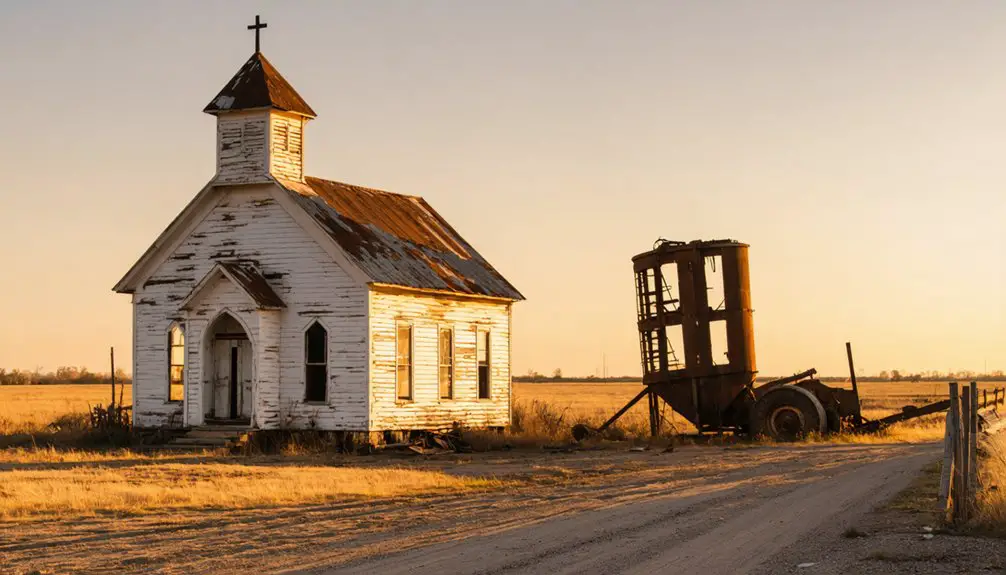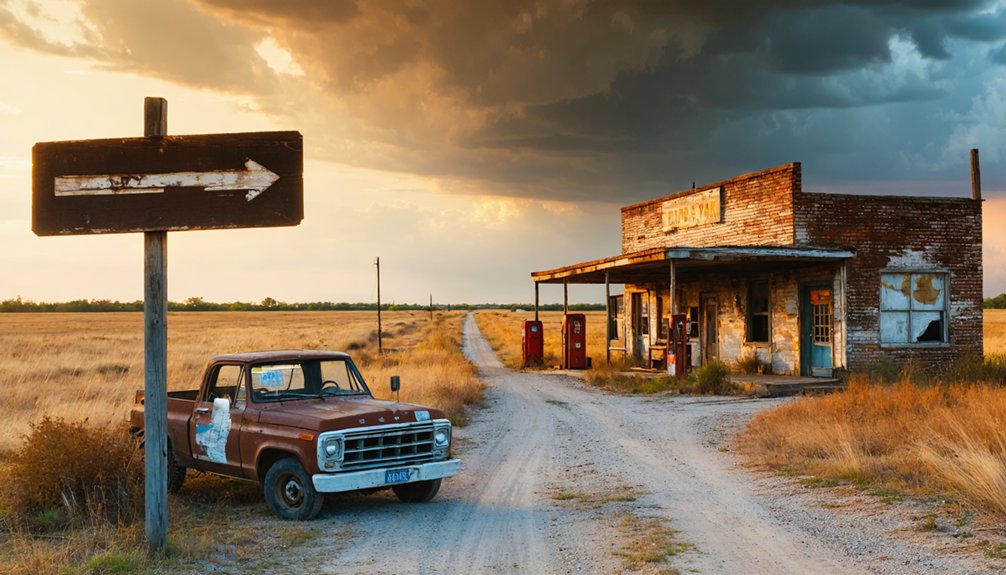
Your ghost town road trip to Liberty, Oklahoma starts 70 miles north of Tulsa off Highway 75 near Quapaw, where this twice-incorporated community defies typical abandonment narratives. Unlike Picher’s toxic chat piles and 14,000 evacuated residents, Liberty’s structures still stand—a town that refused erasure despite dwindling from peak population. You’ll need sturdy boots for exploring nearby settlements like Red Bird’s weathered church and Sacred Heart’s decaying mission buildings, and early morning light captures the most dramatic photographs of these forgotten corridors where preservation met persistence.
Key Takeaways
- Liberty is located 70 miles north of Tulsa, accessible via OK-28 near Quapaw along US Highway 75’s eastern corridor.
- Unlike typical ghost towns, Liberty remains inhabited with standing structures, having incorporated in 1978 after avoiding annexation.
- Visit nearby Picher Memorial Plaza to see chat piles, abandoned schools, and toxic mining remnants from environmental catastrophe.
- Wear sturdy boots, pack extra water, and plan early morning visits for optimal photography and cooler temperatures.
- Respect private property boundaries and avoid entering structurally compromised buildings during your exploration of abandoned sites.
Liberty’s Unique Story: From Rural Settlement to Twice-Incorporated Town
When Wallace W. Baird arrived from Illinois in 1912, he purchased forty acres that’d become Liberty’s foundation near present-day 206th and Sheridan. His son-in-law Luther Spradling held the family patriarch’s vision to protect this community from annexation by surrounding towns. He designated the farmland specifically for incorporation, ensuring participation remained voluntary.
The community’s preservation efforts took sixty years to achieve—Liberty finally incorporated on October 1, 1978, with Luther’s son Jack as mayor. You’ll find something remarkable here: Liberty incorporated twice, first in 1978 and again in 1982, spanning 6.1 square miles across Tulsa and Okmulgee counties. The population fluctuated from nineteen residents in 1990 to 220 by 2010, reflecting families who chose to join this independent community along Highway 75.
What Makes Liberty Different From Traditional Ghost Towns
Unlike the crumbling ruins of Picher with its toxic chat piles and Superfund designation, Liberty never experienced the catastrophic collapse that defines traditional Oklahoma ghost towns. You won’t find abandoned mine shafts or condemned buildings here—Liberty’s story reflects economic diversification rather than boom-bust devastation.
While Picher’s 14,000 residents fled lead contamination and that final EF-4 tornado in 2008, Liberty’s incorporation milestones tell a different tale. The town incorporated twice, maintaining its municipal status through gradual decline instead of sudden exodus. No environmental disaster forced families out overnight. You’ll discover a community that adapted rather than abandoned, where structures still stand and remnants of daily life persist.
Liberty represents resilience—a town that refused complete erasure despite changing fortunes.
Mapping Your Route: Highway 75 and Nearby Abandoned Communities
Stretching 432 miles from Kansas to Texas, US Highway 75 cuts through Oklahoma’s eastern corridor like a thread connecting forgotten settlements to modern life. You’ll find Liberty approximately 70 miles north of Tulsa, accessible via OK-28 near Quapaw—coordinates 36.95°N 94.78°W guide your navigation precisely.
The highway 75 access points unveil a chain of abandoned town history worth exploring. Red Bird’s weathered church stands sentinel in Wagoner County, while Sacred Heart’s 1879 mission buildings decay gracefully in Pottawatomie County.
Vernon’s derelict structures dot McIntosh County landscapes, and Yeager’s remnants whisper Hughes County stories from 1902.
Each junction presents choices—turn east toward ghosts, or continue south another fifty miles. This isn’t just driving; it’s curating your own expedition through Oklahoma’s unscripted past.
Essential Stops: Picher Memorial Plaza and Other Notable Ghost Town Sites
Though dozens of ghost towns scatter across northeastern Oklahoma, Picher Memorial Plaza stands apart as the most haunting manifestation to environmental catastrophe you’ll encounter on Highway 69. Eight miles north of Miami, this roadside memorial tells the story of a mining boomtown that produced $20 billion in ore before toxic chat piles and contaminated groundwater forced complete evacuation in 2009.
Stop here to witness:
- Towering chat piles—massive gray mountains of mining waste that once doubled as children’s playgrounds
- The Tri-State Zinc and Lead Ore Producers Association Office, housing mining artifacts from the boom era
- Abandoned notable mining structures including Picher-Cardin High School and scattered mercantiles
- Warning fences marking hazards from contamination and underground shaft collapses
You’re free to explore from designated areas, though subsidence risks and lead contamination demand caution.
Planning Tips for Your Oklahoma Ghost Town Adventure
Before you load your camera and head toward Oklahoma’s abandoned settlements, understand that ghost town exploration demands more preparation than typical road trips. You’ll need sturdy boots for traversing crumbling structures and uneven terrain where nature’s reclaiming what humans left behind. Pack extra water—these locations lack amenities, and summer heat’s unforgiving across Oklahoma’s plains.
Among the various ghost town attractions in Oklahoma, each site tells a unique story of bygone eras. Be sure to visit sites like the historic town of Geary, where remnants of old buildings provide a glimpse into the past. Additionally, the eerie silence in the outskirts of Red Oak invites those willing to explore the mysteries left behind.
Research local ghost town lore before arriving; understanding a settlement’s backstory transforms empty buildings into compelling narratives. Early morning offers the best photo opportunities, when golden light cuts through broken windows and casts dramatic shadows across weathered facades. Download offline maps, since cell service disappears in remote areas. Always respect private property boundaries and never enter structurally compromised buildings. Your freedom to explore exists only when you’re prepared and responsible.
Frequently Asked Questions
Are There Any Guided Tours Available for Oklahoma Ghost Towns?
No guided tours exist for Oklahoma’s rural ghost towns like Liberty. You’ll find self-guided tours through apps like Pocketsights, letting you explore abandoned sites at your own pace. Urban ghost walks focus on Oklahoma City and Guthrie instead.
What Are the Best Seasons to Visit Liberty and Nearby Ghost Towns?
Spring and fall offer ideal weather conditions for your ghost town adventures, with temperatures between 52-68°F. You’ll discover local historical society events during these seasons, plus vibrant wildflowers or autumn colors framing those weathered buildings perfectly.
Can I Enter Abandoned Buildings in Ghost Towns Legally?
You can’t legally enter most abandoned buildings without permission due to trespassing concerns. Even seemingly forgotten structures have owners. Take safety precautions seriously—I’ve seen rotted floors collapse unexpectedly. Respect boundaries while exploring Oklahoma’s haunting landscapes from outside.
Are There Hotels or Camping Options Near Liberty, Oklahoma?
You’ll find civilization’s safety nets scattered nearby—Hampton Inn & Suites Tulsa South-Bixby sits 6.14 miles away, while bed and breakfast accommodations and RV park facilities dot surrounding towns like Glenpool and Coweta, letting you explore Liberty’s ruins freely.
Do I Need Special Permits to Photograph Ghost Town Sites?
You’ll need private property access permission since Liberty sits on private land. Skip permits for simple photography, but avoid trespassing concerns by contacting landowners first. Respect boundaries—it protects your freedom to explore responsibly and keeps doors open.