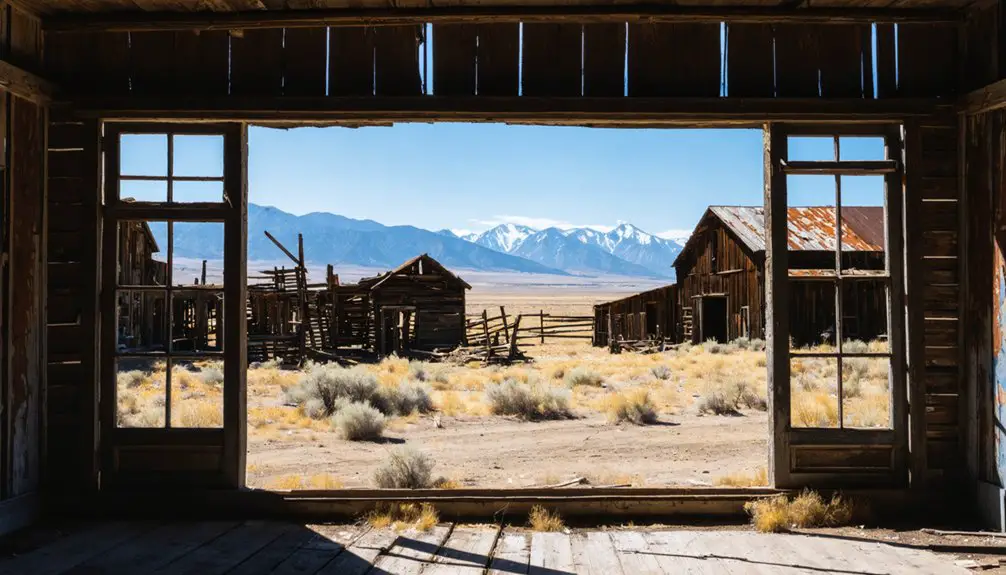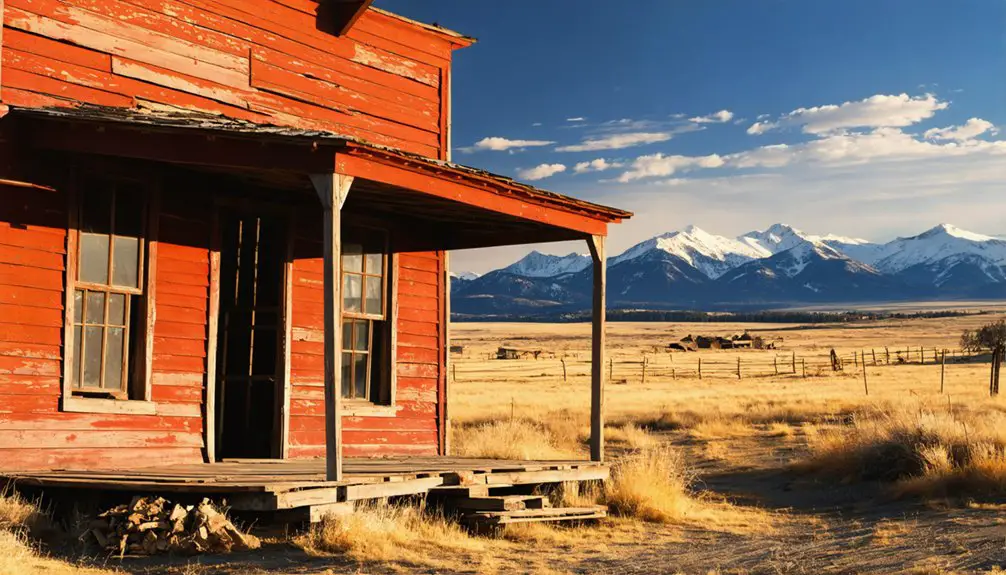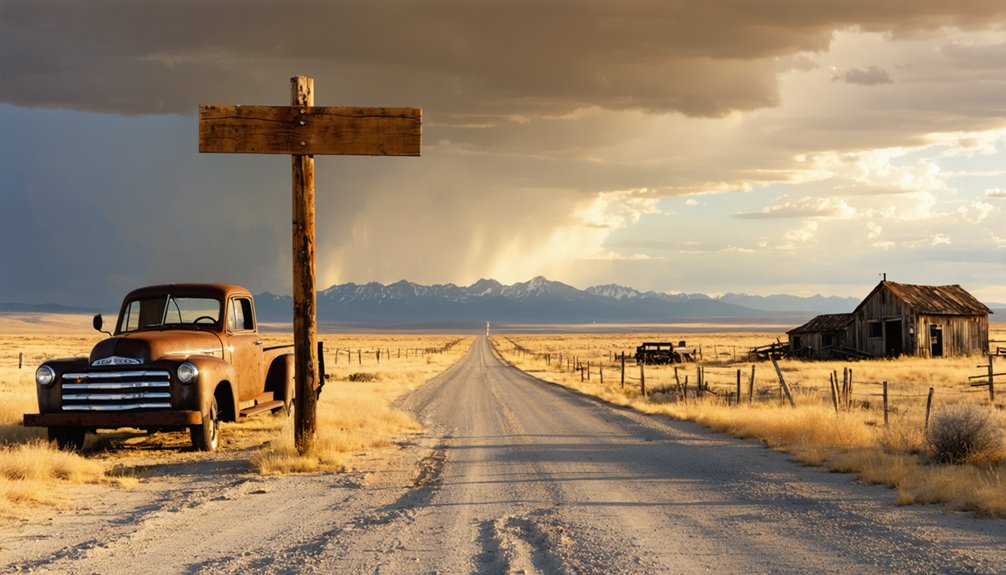
Start your Lion City adventure in Melrose, taking Montana Highway 41 across the Big Hole River before turning onto Trapper Creek Road. You’ll need a high-clearance 4WD vehicle for the rugged twelve-mile journey through Beaverhead National Forest, passing three other ghost towns before reaching Lion City’s fifteen weathered structures perched at 9,000 feet. The remote mining camp sits beneath Lion Mountain, approximately twelve miles west of Melrose, where nineteenth-century cabins stand unmanicured among the stripped hillsides. There’s much more to discover about timing, conditions, and what awaits.
Key Takeaways
- Lion City sits at 9,000 feet, 12 miles west of Melrose, featuring 15 weathered structures from the 1872 silver boom era.
- Access requires a high-clearance 4WD vehicle or UTV for the challenging 12-mile Trapper Creek Road through Beaverhead National Forest.
- The route passes four ghost towns including Glendale’s smelter ruins and Trapper City’s stamp mill before reaching Lion City.
- Nearby Hecla offers extensive ruins of a corporate mining town that housed 3,000 workers and produced $22 million in ore.
- Winter travel requires studded tires; call 511 for road conditions as county plowing begins only after 6 inches of snow.
The Historic Mining Legacy of Lion City
The glint of silver changed everything for Lion Mountain in 1872. You’ll find remnants of a district that once ranked among the West’s leading silver producers, where nine major mines—including the massive Cleopatra—honeycombed 20 miles of underground tunnels through the peaks.
Mining technology advancements transformed the operation: overhead cable cars shuttled ore four miles downslope to stamp mills, while the Glendale smelter processed nearly one million ounces of silver annually. The smelter built in 1875 helped alleviate the difficulties of transporting ore across the rugged terrain. Yet ore processing challenges demanded constant innovation.
The district’s prosperity ended abruptly when the Sherman Silver Purchase Act was repealed in 1893, devastating the once-thriving mining operations. Mining continued on a much smaller scale afterward, but the golden era had passed.
Getting to Lion City: Route and Road Conditions
Your adventure to Lion City begins in Melrose, a quiet ranching community where Montana Highway 41 crosses the Big Hole River. From here, you’ll head west on Trapper Creek Road into increasingly rugged territory where historic land claims still mark the landscape.
What You’ll Need to Know:
- Vehicle Requirements: This primitive route demands a high-clearance 4WD vehicle or side-by-side UTV like a Polaris General
- Route Markers: Watch for Glendale’s old smelting facilities, then Trapper City’s stamp mill ruins
- Terrain Challenges: Heavily mined areas create rough, uneven roads through the Trapper Creek drainage
- Surrounding Wilderness: You’re traveling through Beaverhead National Forest with nearby wilderness areas flanking your path
- Distance: Expect twelve challenging miles through four ghost towns scattered across remote gulches
Lion City sits at the head of the Trapper Creek drainage, positioned adjacent to Hecla, making it one of the most remote settlements in the district. Glendale sits at approximately 5,630 feet elevation, marking the lower portion of this historic mining corridor.
What to Expect at the Ghost Town Site
Perched at 9,000 feet beneath the windswept summit of Lion Mountain, Lion City greets visitors with approximately 15 weathered structures scattered across terrain that nature has been slowly reclaiming since the 1890s. You’ll find the Head House and other buildings displaying the rugged building materials used in late 19th-century mining camps—hand-hewn timber, rough-cut lumber, and functional designs built to withstand brutal mountain winters.
The forest surrounding these remnants didn’t exist during operation; miners stripped every tree to feed the smelter’s insatiable furnaces.
Don’t expect polished tourist amenities or on-site interpretive signage here. Lion City remains largely unmanicured and unmanaged, giving you authentic access to Montana’s mining heritage without barriers or restrictions. The town sits about 12 miles west of Melrose at the head of the Trapper Creek drainage. You’re free to explore at your own pace and risk. If you encounter references to Hecla during your research, note that Hecla is a disambiguation page that lists multiple articles associated with that title.
Nearby Attractions: Hecla and Glendale
Just a mile downhill from Lion City, Hecla’s sprawling ruins tell the story of corporate ambition on a scale that dwarfs its wild neighbor. The Hecla Mining Company built this planned community between 1881 and 1900, producing $22 million in ore while housing up to 3,000 workers.
What You’ll Discover:
- Company housing options foundations scattered across hillsides where boarding houses once sheltered miners working year-round at 9,550 feet
- Industrial infrastructure remnants including 20 miles of accessible mine tunnels and massive coke ovens that produced 100,000 bushels of charcoal monthly
- Miners’ stone staircases carved into mountainsides, still climbable after 120 years
- The smelter stack north of Glendale, standing sentinel over reforested hills once stripped bare
- Methodist church remains and schoolhouse foundations built for 200 pupils
Hecla was part of the Bryant Mining District, which also included the now-vanished towns of Greenwood and Trapper City. The district’s mines continued intermittent operations through various boom-and-bust cycles until final closure in 1965.
Vehicle Requirements and Seasonal Access
Getting to Lion City demands more than an ordinary sedan and fair-weather planning. The gravel access roads off Interstate 90 climb steep, single-lane grades that’ll test your vehicle’s capability. Your tire recommendations shift dramatically with seasons—all-season rubber won’t cut it once November hits. Winter travel requires genuine snow tires or traction devices, with chains mandatory when enforcement begins. Montana law permits studded tires during winter months for good reason.
These Forest Service roads suffer from inadequate maintenance funding, producing nearly 1,500 tons of sediment annually across erosive soils. Construction windows close half the year when freeze sets in. Trail closures happen without warning when mud threatens erosion. County roads receive plowing and sanding only after snow accumulates to 6 inches, with main roads and intersections prioritized first. The challenging conditions reflect broader infrastructure issues, as Montana’s aging roads increasingly require more work zones and repairs throughout the state. Before committing to the journey, dial 511 for twice-daily condition updates during winter reporting season, November through April, when access becomes genuinely challenging.
Exploring the Mines and Remaining Structures
What remains of Lion City’s glory days hides beneath a century of Montana weather and forest reclamation. You’ll discover foundations, cabin ruins, and scattered mining equipment that make exceptional subjects for ghost town photography. The underground mining operations once penetrated 20 miles of tunnels through Lion Mountain at 9,550 feet elevation, though these adits are now extremely dangerous to enter.
Time and nature conspire to bury Lion City’s mining legacy, yet scattered remnants still reward the dedicated explorer.
What You’ll Find:
- Collapsed cabin structures and boarding house foundations near the former 20-stamp mill site
- Rusted mining equipment, ore cart remnants, and cable car anchor points scattered throughout
- Hecla Mine’s company town ruins approximately one mile from Lion City proper
- Deteriorating snow shed timbers that once protected paths to working mines
- Original timber regrowth reclaiming stripped hillsides from the 1890s smelter operations
Never enter mine shafts—they’re unstable death traps.
Canyon Creek Charcoal Kilns Along the Way
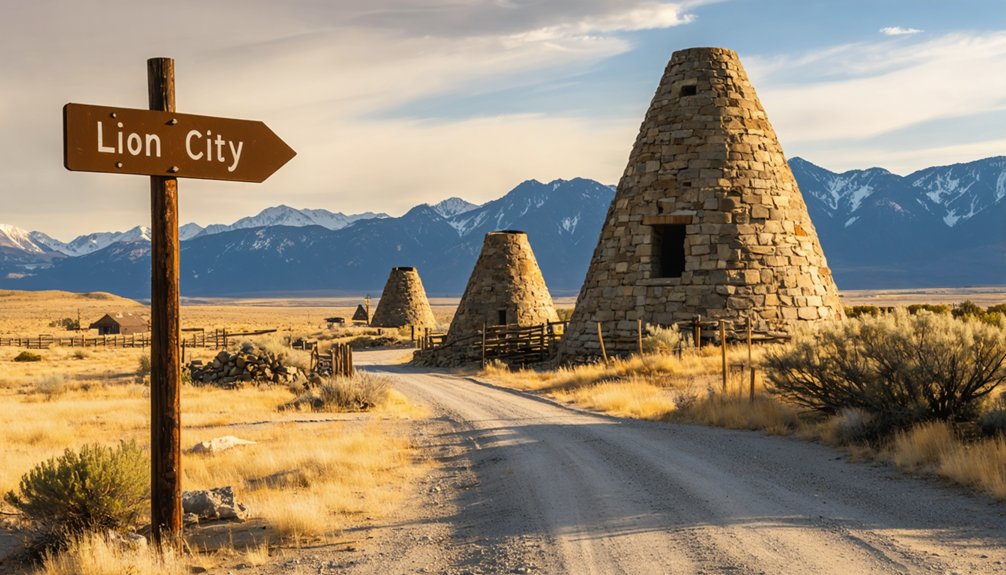
Before you reach Lion City’s scattered ruins, the Canyon Creek Charcoal Kilns stand like industrial monuments to Montana’s silver boom. Twenty-three beehive-shaped structures, each 20 feet tall, fueled commercial smelting operations from 1884 to 1901, consuming over 11,000 acres of lodgepole pine. You’ll find three kilns restored and painted white—stark against the forest—while others crumble naturally, their brick shells split by time and temperature.
The process was brutal efficiency: wood fed through 500-yard chutes, burned six to eight days with minimal oxygen, monitored by smoke color alone. Historic preservation efforts maintain interpretive trails, though you’ll need 4WD for the forested access road. These kilns supported $20 million in silver and lead production, their National Register status barely capturing their raw industrial power.
Frequently Asked Questions
Are There Camping Facilities Available Near Lion City Ghost Town?
You’ll find primitive campsites scattered across BLM lands surrounding Lion City, offering freedom to explore scenic hiking trails through abandoned mining territory. Nearby Melrose provides additional options, though dispersed camping lets you embrace authentic backcountry solitude.
Is Cell Phone Service Available in the Lion City Area?
You’ll find cell tower coverage virtually nonexistent in Lion City’s remote wilderness. Don’t count on backup power reliability either—this ghost town’s off-grid isolation demands you embrace true disconnection. Prepare accordingly, download maps offline, and relish the untethered freedom.
Are Pets Allowed When Visiting Lion City Ghost Town?
While there aren’t specific pet policies posted for Lion City, you’ll likely be fine bringing leashed dogs to this remote site. Standard Montana public land rules apply—keep pets leashed, pack out waste, and respect visiting hours and wildlife safety protocols.
What Are the Entrance Fees or Permits Required to Visit?
You won’t pay entrance or parking fees at Lion City—it’s completely free to explore. No permits are required for day visits either. Just bring your 4WD vehicle and pioneer spirit, though nearby accommodations in Melrose require advance planning.
Are Guided Tours Available for Lion City and the Mines?
No guided tours by local historians operate at Lion City—you’ll embrace self-guided exploration options instead. You’re free to wander among weathered structures and mine adits at your own pace, discovering history independently through this remote mountain ghost town.
As you delve deeper into the fascinating sites, you’ll uncover various ghost town attractions in Carter, Montana that tell the stories of its once-thriving mining community. Each corner reveals remnants of a bygone era, from crumbling buildings to old equipment left behind. It’s a unique opportunity to connect with history in an untouched landscape.
Exploring the ghost towns to explore in Montana offers a similar sense of adventure and discovery. Each town has its own unique tale, often marked by the struggles and triumphs of those who once lived there. As you navigate the abandoned streets, you may find yourself reflecting on the resilience of those who shaped Montana’s rich history.
References
- https://www.youtube.com/watch?v=Y_j6RF66jqs
- https://www.ghosttowns.com/states/mt/lioncity.html
- https://southwestmt.com/ghosts/ghost-towns/glendale-and-canyon-creek-charcoal-kilns/
- https://www.legendsofamerica.com/mt-hecla/
- https://ghosttownfinder.com/towns/lion-city-montana
- https://www.youtube.com/watch?v=pPN9_gOpmq0
- https://en.wikipedia.org/wiki/Hecla
- https://ravallimuseum.org/ghost-towns-revisited-lion-city-hecla/
- https://www.glendalemontana.com
- https://westernmininghistory.com/towns/montana/glendale/