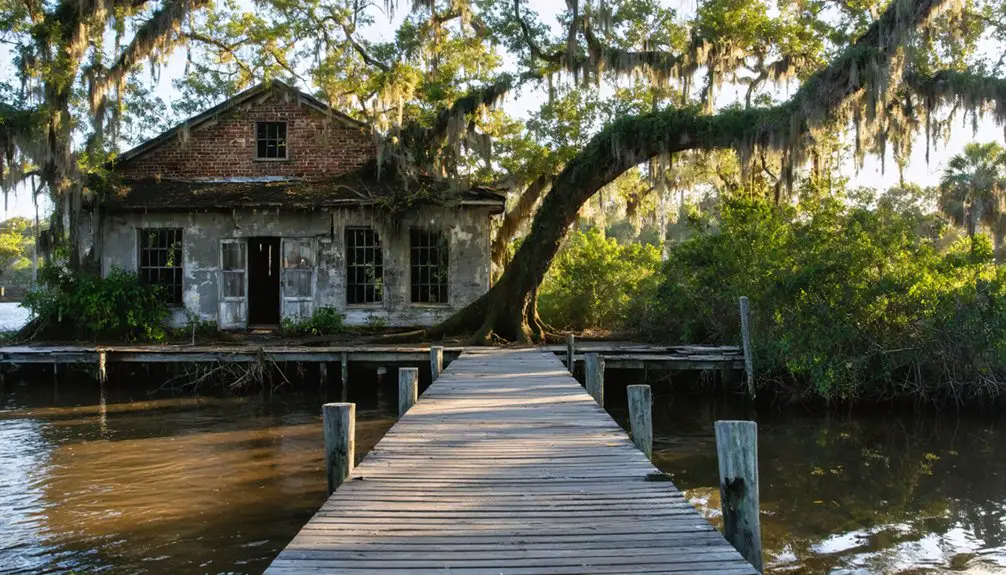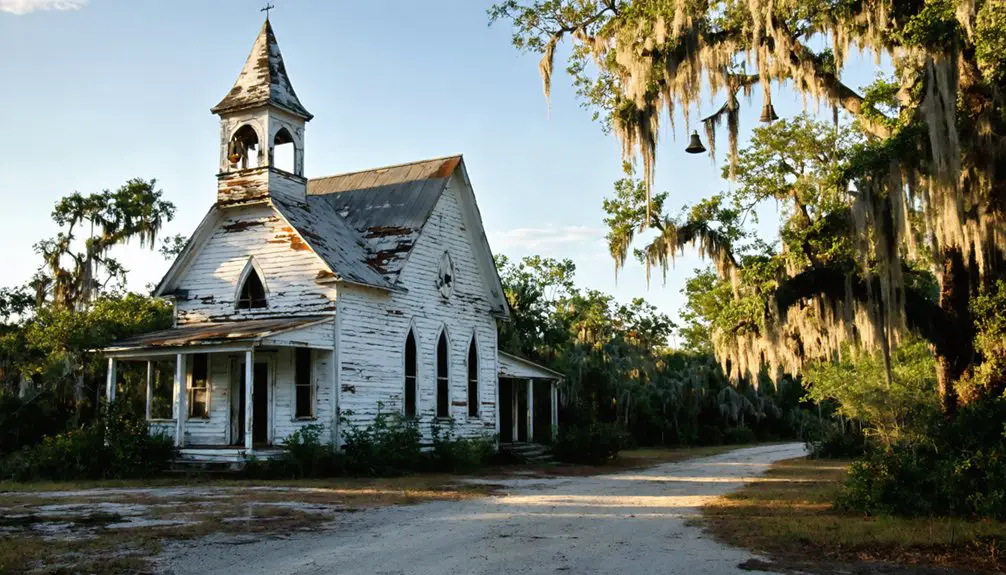
Liverpool’s ghost town lies three miles south of Fort Ogden in DeSoto County, accessible via US 17 and SR 70. You’ll find moss-covered phosphate drying bins and crumbling concrete foundations along the Peace River, remnants of the 1880s mining boom that collapsed when operations moved inland to Bartow. Visit between November and March for the best conditions—lower humidity and comfortable 60s-70s temperatures make exploring these industrial ruins easier. The journey through Florida’s phosphate frontier reveals fascinating layers of history.
Key Takeaways
- Liverpool’s ruins are located three miles south of Fort Ogden in DeSoto County along a remote Peace River stretch.
- Visit between November and March for optimal 60s-70s temperatures, lower humidity, and better water level conditions for exploring.
- Access the site via US 17 and SR 70, using Fort Ogden as your launching point into the area.
- Expect to see crumbling concrete phosphate drying bins, warehouse foundations, and decaying barge loading structures from the 1880s.
- Respect private land boundaries throughout the area and navigate carefully to reach the remote riverside ghost town remnants.
The Rise and Fall of a Florida Phosphate Boomtown
Fortune hunters descended on central Florida’s riverbanks in the 1880s, armed with little more than picks, shovels, and dreams of striking it rich. Captain LeBaron’s 1881 discovery south of Fort Meade triggered a phosphate rush that transformed sleepy riverside settlements into bustling mining camps.
The land value boom was staggering—Peace River acreage skyrocketed from $1.25 to $300 overnight. Over 200 companies clawed phosphate from Bone Valley’s fossil-rich deposits, while Peter Bradley consolidated 22 operations into his American Agricultural Chemical empire.
Liverpool emerged as a key shipping point, but steamship transportation challenges plagued the shallow harbor. When fire destroyed Hull’s drying facilities in 1902 and Tampa’s deeper waters proved more competitive, Liverpool’s fate was sealed. By 1900, 215 mining outfits had collapsed to just 50 survivors.
What Remains: Exploring Liverpool’s Physical Remnants Today
When you arrive at Liverpool’s site along the Peace River, you’ll find nature has reclaimed nearly everything—except the stubborn moss-covered foundations of phosphate drying bins that rise from the undergrowth like industrial gravestones. The remnants cluster near what’s now the Sunny Breeze Golf Course, where manicured fairways meet wild riverbank and the ghosts of barge loading docks still cling to the water’s edge.
You can trace the old dock sites along the Peace River’s bend, where crumbling concrete and rusted metal fixtures mark the spots where fortune-seekers once shipped tons of phosphate to distant markets.
Moss-Covered Phosphate Foundations
Crumbling concrete blocks emerge from beneath thick blankets of Spanish moss and palmetto scrub, marking the skeletal remains of Liverpool’s phosphate drying bins along the Peace River’s edge. These weathered foundations represent the southernmost terminus of the Peace River Phosphate Mining Company Railroad, where tons of processed ore once awaited barge transport to Charlotte Harbor.
The remnants’ architectural significance lies in their connection to the 1902 Hull fire that destroyed 7,000 tons of phosphate, prompting construction of these replacement facilities. The phosphate bins’ building materials—reinforced concrete designed to withstand Florida’s humidity and heavy loads—still testify to industrial ambitions that barely outlasted a decade.
You’ll discover these moss-draped monuments three miles south of Fort Ogden, silent witnesses to a boom-and-bust cycle that defined early 1900s Florida.
Sunny Breeze Golf Course Location
Today’s Sunny Breeze Golf Course occupies ground where Liverpool’s riverfront commerce once thrived, its manicured fairways concealing the town’s scattered foundations beneath decades of sod and sand. Original course designer Andy Anderson laid out the championship 18-hole parkland in 1971, threading narrow fairways through what was once Liverpool’s bustling center. You’ll find the course at 8135 SW Sunnybreeze Road, just twenty minutes south of Arcadia on US-17.
The golf course amenities include a sprawling practice range with forty tees and a nine-hole executive course added in 2001. Water hazards dominate eleven holes—perhaps fed by the same Peace River tributaries that powered Liverpool’s steamboat economy. As you navigate doglegs and sand bunkers, you’re literally playing over history.
Peace River Dock Sites
Where Liverpool’s docks once clanged with phosphate-loading operations, you’ll now find mostly silence and scattered ruins along the Peace River’s banks. Moss-covered foundations of phosphate drying bins mark the spots where John Cross’s barges carried their cargo toward Charlotte Harbor. You’ll need to know exactly where to look—these remnants don’t advertise themselves.
The abandoned dock structures tell a story of phosphate export decline and diminished shipping capacity that sealed Liverpool’s fate. When the harbor proved too shallow for large freighters and mining shifted inland to Bartow in the 1920s, these riverside loading stations became obsolete. Today, weathered warehouse foundations and crumbling infrastructure are all that remain of Liverpool’s once-thriving river port operations.
Getting There: Directions to the Liverpool Ghost Town Site
Reaching Liverpool’s remnants requires careful navigation to a remote stretch of the Peace River in DeSoto County, where moss-draped foundations peek through palmetto scrub three miles south of Fort Ogden.
From Arcadia, head west on SR 70 for eight miles, then navigate carefully using coordinates 27°02.7’N, 81°58.2’W as your guide. Fort Ogden serves as your launching point—US 17 and SR 70 provide primary access routes to this vanished phosphate town.
You’ll face private land concerns throughout the area, so respect property boundaries while seeking the old dock sites. Water levels fluctuation along Peace River affects visibility of Liverpool Island’s features and the crumbling phosphate bin foundations. The Charlotte Harbor barge route once bustled here; now silence reigns where commerce thrived in the 1880s.
Best Time of Year to Visit This Peace River Ghost Town
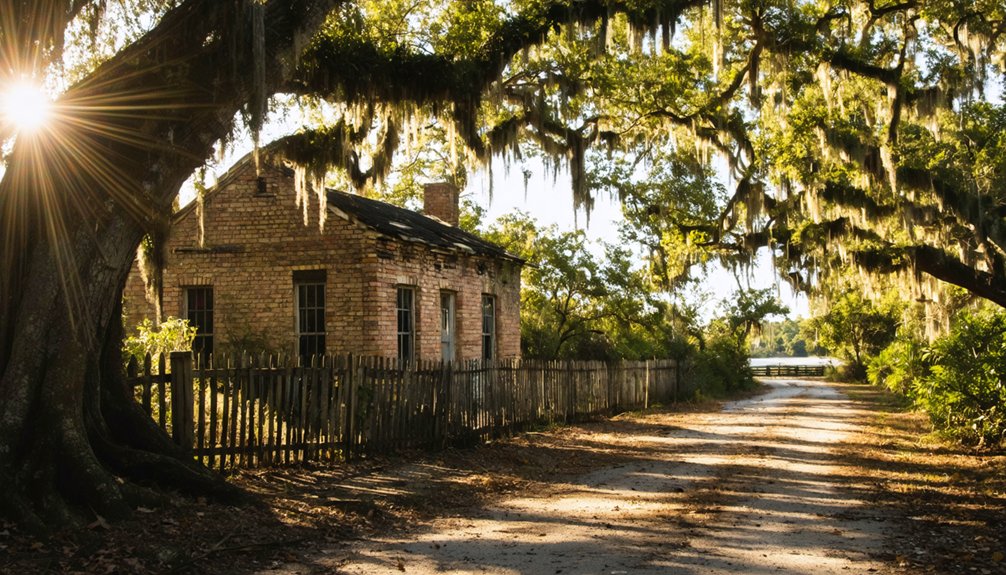
You’ll find the best conditions for exploring Liverpool’s ruins between November and March, when temperatures hover in the 60s and 70s, and Florida’s oppressive humidity retreats. The cooler, drier air makes hiking through overgrown trails and examining crumbling foundations far more comfortable than battling summer’s relentless heat and afternoon thunderstorms.
During these months, the Peace River runs clearer and lower, revealing more of the shoreline where Liverpool’s phosphate mining legacy left its mark, while migratory birds and active wildlife add movement to the otherwise silent ghost town landscape.
Cooler Dry Winter Months
The dense humidity and sweltering heat that blanket Florida’s interior from May through October give way to remarkably pleasant conditions once winter arrives along the Peace River.
You’ll find November through March transforms this ghost town into an explorer’s paradise, with seasonal weather patterns delivering crisp mornings and comfortable afternoons perfect for wandering Liverpool’s forgotten ruins.
The climate conditions during these cooler months mean you can trek through overgrown pathways without battling oppressive temperatures or afternoon thunderstorms. Mornings might greet you with temperatures in the 50s, climbing to the mid-70s by afternoon—ideal for photographing crumbling structures and investigating what remains.
The dry season also means easier navigation through the terrain, as reduced rainfall keeps trails more accessible and mosquito populations mercifully diminished.
Wildlife and River Conditions
Beyond the favorable temperatures, wildlife activity surges during winter months along the Peace River, creating both spectacular viewing opportunities and legitimate safety considerations for ghost town explorers. You’ll encounter sandhill cranes, herons, and bald eagles thriving in the river’s meandering swamps and hardwood hammocks. Organizations like Peace River Wildlife Center focus on rehabilitating native species while protecting local ecosystems from invasive threats.
Winter Wildlife Considerations:
- Watch for roadside vultures, cranes, and raccoons—drive cautiously through Liverpool’s abandoned areas
- Observe fishing line disposal protocols; entangled pelicans and sea birds need emergency intervention
- Maintain distance from bobcats, foxes, and coyotes, especially during dusk hours
- Report injured native wildlife to rehabilitation centers operating 8 a.m. to 5 p.m. daily
The Peace River’s Charlotte Harbor estuary provides exceptional habitat diversity for your exploration.
Avoiding Florida Summer Heat
While summer temperatures soar into the oppressive mid-90s with suffocating humidity along the Peace River, you’ll find Liverpool’s crumbling structures far more enjoyable during spring and fall’s temperate windows.
March through May and September through November deliver mid-70s to mid-80s temperatures—perfect for exploring abandoned foundations without wilting under Florida’s brutal sun.
You’ll dodge the hurricane season chaos and black fly swarms that plague June through August. Late September through October offers the sweet spot: reduced crowds after Labor Day, lower rental rates, and spectacular sunsets illuminating weathered timbers.
Reducing sun exposure becomes effortless when you’re not battling peak summer intensity, while maintaining energy levels throughout your ghost town exploration feels natural in these milder conditions. October stands as the ultimate choice for unrestricted wandering.
The Steamboat Era: Liverpool’s Connection to Charlotte Harbor

Paddle wheels churned through Charlotte Harbor’s murky waters by the 1860s, connecting Florida’s Liverpool to a maritime revolution that had transformed its English namesake decades earlier. While Liverpool, England pioneered enclosed tidal docks in 1715 and launched its first steamship in 1817, Florida’s waterways embraced steamboat technology advances by mid-century.
Steam-powered progress bridged two Liverpools across the Atlantic, transforming isolated Florida settlements into thriving maritime commerce hubs by the 1860s.
You’ll discover how these vessels became lifelines of independence, hauling citrus, cotton, and livestock to northern markets.
Liverpool’s Steamboat Legacy:
- Commercial riverboats navigated treacherous Ocklawaha River routes after post-Civil War snag removal
- Competing lines operated from Jacksonville to Silver Springs by the 1890s, creating international trade networks
- Steam power freed settlers from sail’s dependence on wind and tide
- The automobile revolution ended this maritime era by 1920, leaving ghost towns behind
Walking the Grounds: What to Look for at the Abandoned Town Site
The crumbling phosphate drying bins rise from the undergrowth like industrial tombstones, their moss-covered foundations marking Liverpool’s transformation from bustling mining hub to Florida wilderness.
You’ll discover scattered remnants of the 1880s processing infrastructure—concrete foundations where drying plants once stood, decaying barge loading structures along the Peace River’s edge, and overgrown railroad track beds connecting vanished mines. The environmental impact remains visible in disturbed soil patterns and depleted phosphate deposits surrounding the site.
Look for the Orange Grove Hotel’s foundation stones and the general store’s footprint near the commercial center. These fragments hold immense historical significance as evidence of Florida’s phosphate boom.
Fort Ogden: Your Three-Mile Side Trip North
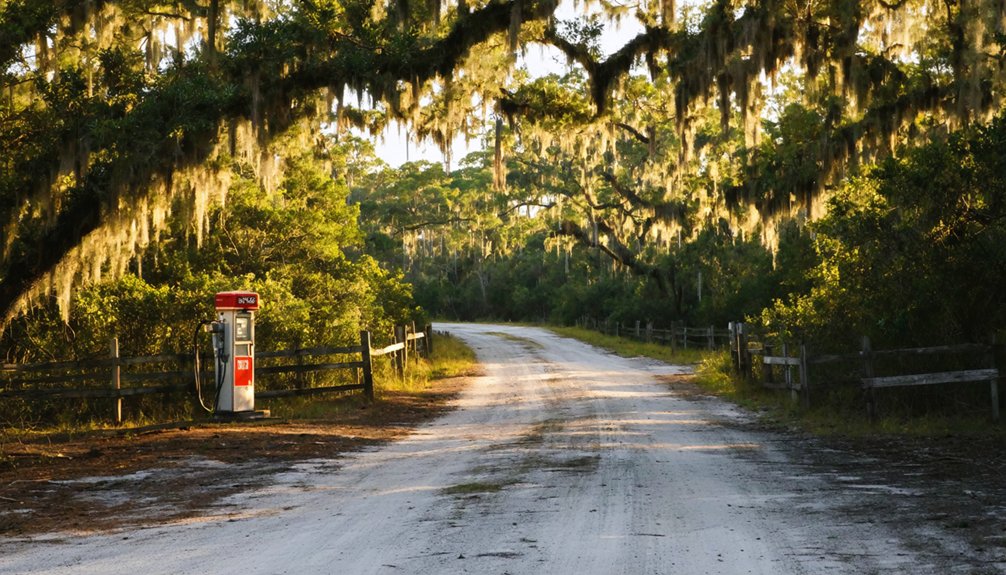
Just three miles north of Liverpool’s ghostly remains, Fort Ogden offers a compelling companion destination that bookends your journey through Florida’s frontier history. You’ll discover where Captain Edmund A. Ogden’s 8th U.S. Infantry established their strategic position during the Big Cypress campaign against the Seminoles in July 1841.
What awaits you:
- Fort Ogden’s military history reveals Second Seminole War tactics and frontier survival strategies
- Walking trails wind through the original post boundaries where soldiers once patrolled
- Interpretive markers detail the fort’s role as an advanced position during the conflict
- Abandoned structures restoration efforts showcase DeSoto County’s commitment to preserving this outpost
You’re free to explore at your own pace, imagining the isolation these soldiers endured. The site’s sparse remains speak volumes about frontier hardship and determination.
Photography Tips for Capturing Moss-Covered Ruins
You’ll find Liverpool’s crumbling structures draped in emerald moss come alive under Florida’s overcast skies, which bathe the textures in soft, even light perfect for capturing every cushioned detail.
Position your tripod low and parallel to moss-covered walls, using wide-angle lenses to exaggerate the twisted lines of decay while keeping your camera stable in the humid air.
Pack remote shutter triggers and polarizing filters—the moisture here demands vibration-free shots and glare control as fog rolls between foreground ruins and distant treelines.
Best Lighting and Angles
Capturing moss-draped ruins demands attention to how light interacts with decay, and golden hour delivers the most forgiving conditions for your lens. You’ll find atmospheric lighting conditions transform Liverpool’s crumbling structures into dramatic subjects when sunrise or sunset bathes moss in warm, textured glow without harsh highlights.
Master these techniques for compelling compositions:
- Position yourself low to frame moss-covered foundations against fading skies during long exposures
- Use side lighting from handheld LEDs to sculpt moss edges and separate subjects from shadowed backgrounds
- Paint with flashlights during 30-second exposures, hitting moss from multiple angles with colored gels
- Practice strategic shadow placement by blocking excess light with your body, maintaining mystery in darker zones
Wide apertures like f/4 combined with tripod stability let you capture intricate moss patterns while preserving the haunting atmosphere that makes these ruins unforgettable.
Equipment for Humid Conditions
Florida’s subtropical climate turns Liverpool’s abandoned structures into moisture traps where humidity hovers above 60% year-round, creating a battlefield for your camera gear. You’ll need dry boxes packed with silica gel packets for air conditioned storage between shoots—fungus thrives at these levels, degrading lens coatings and causing glue separation.
Minimize lens changes inside moss-draped buildings where cooler camera interiors attract condensation to your sensor. Keep absorbent microfiber cloths accessible for constant wiping, and acclimate equipment to ambient temperature before shooting to prevent fogging. Consider microclimate monitoring with a portable hygrometer to assess real-time moisture risks.
Weather-sealed bodies won’t save you here—you’ll still need post-shoot drying sessions with dehumidifiers. These crumbling structures demand vigilance, but proper moisture protection lets you capture their haunting beauty without sacrificing your equipment.
Combining Your Visit With Other Desoto County Attractions
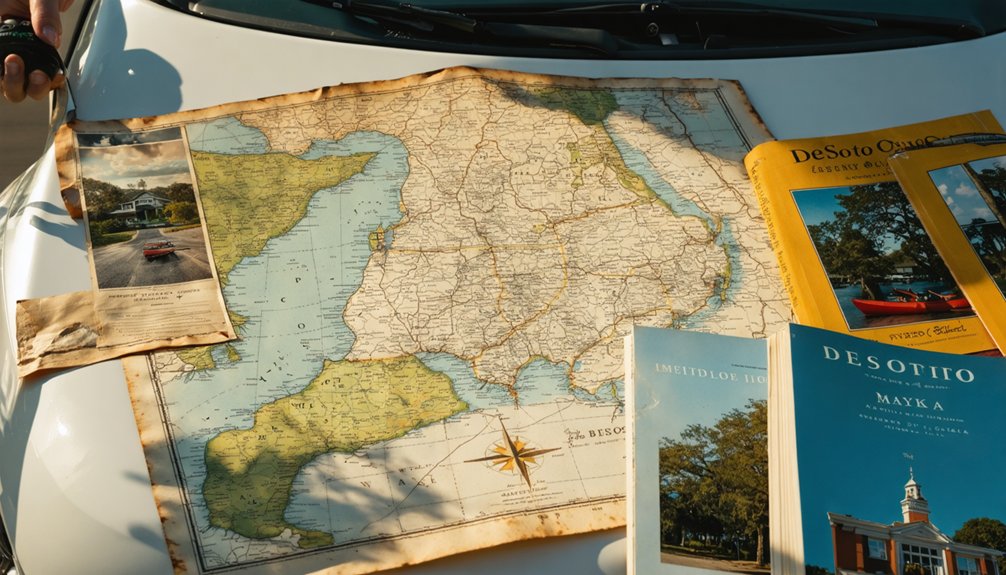
While Liverpool’s phosphate foundations and moss-draped ruins merit their own exploration, the surrounding DeSoto County landscape unfolds additional layers of Old Florida history within a compact radius. Fort Ogden sits just three miles north, where you’ll discover diverse agricultural activities through citrus grove remnants and a historical walking tour showcasing 1880s architecture. Natural Florida landscape features like Peace River‘s scenic corridors connect these sites seamlessly.
Extend your ghost town adventure:
- Fort Ogden Walking Tour – Historic landmarks and Bill Simmons’ general store area reveal citrus-era commerce
- Pioneer Cemeteries – 1860-1896 graves from farming, logging, and turpentine communities
- Peace River Exploration – Follow phosphate barge routes to Charlotte Harbor with riverside views
- Railroad Heritage – Track the 1926 Patmac locomotive and mining company routes
Safety Considerations When Exploring Abandoned Historic Sites
Before you step into Liverpool’s crumbling phosphate structures or peer through moss-curtained doorways, you’ll need to understand that these atmospheric ruins harbor genuine dangers beneath their photogenic decay. Industrial ghost towns demand asbestos evaluation before exploration—those deteriorating walls and ceiling tiles likely contain fibers that’ll wreak havoc on your lungs.
The phosphate mining legacy means potential hazardous waste disposal sites lurk throughout the area.
Gear up properly: respirator masks, thick-soled boots, and long sleeves aren’t optional. Travel with at least two companions, test every floor before trusting your weight to rotted boards, and inform someone of your exact location. These aren’t playground ruins—they’re genuine hazards wrapped in historical significance. Your freedom to explore comes with responsibility for your own safety.
Frequently Asked Questions
Can You Camp Overnight Near the Liverpool Ghost Town Site?
You’ll find primitive camping at Pioneer Park in nearby Zolfo Springs, just miles from Liverpool’s ruins. Availability of nearby campgrounds makes overnight stays logistics simple—you’ll enjoy riverside sites with stone tables while exploring this forgotten phosphate town’s mysteries.
Are Guided Historical Tours of Liverpool Available?
No guided tours exist for Liverpool’s overgrown ruins, but you’re free to explore self-guided tours along Peace River’s banks. Virtual historical tours aren’t available either—you’ll discover moss-covered phosphate foundations through your own adventurous spirit and curiosity.
Is Fishing Allowed on the Peace River Near Liverpool?
Yes, you’re free to fish Peace River near Liverpool! While river conditions fluctuate seasonally, you’ll find abundant fish species including bass, bluegill, catfish, and gar. Spring through summer offers prime opportunities for your angling adventures.
What Wildlife Might I Encounter While Exploring the Area?
You’ll spot alligators basking along riverbanks, black bears roaming wooded areas, and bald eagles soaring overhead. White-tailed deer, bobcats, and various wading birds frequent the region. While spotted owls aren’t native here, you might encounter barred owls instead.
Do I Need Special Permission to Access the Ruins?
You’ll need to obtain permission from landowners before exploring, as 80% of ghost town ruins sit on private property. Respect private property boundaries—the accessible public roads lead to viewable remains, but venturing onto surrounding land requires owner consent.
Planning a ghost town road trip requires careful preparation to ensure a respectful visit. Research popular ghost towns, keeping in mind safety precautions and potential weather challenges. Ghost town road trip tips can help you maximize your experience while being mindful of the sites’ historical significance.