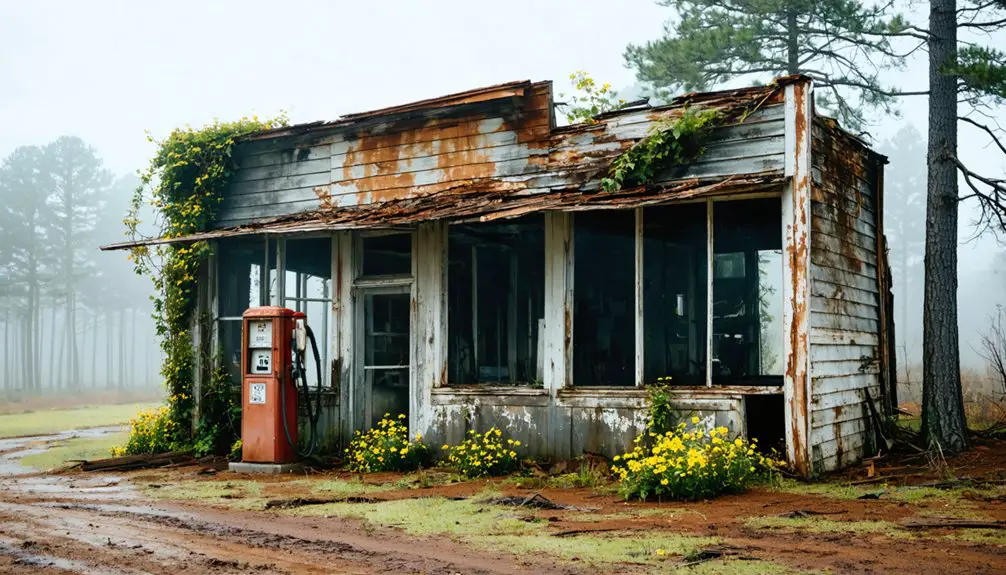
Take Exit 2 off I-10 into Hancock County’s NASA buffer zone, where Logtown’s sawmill empire vanished after commanding nearly 2 million acres. You’ll discover the National Historic Landmark cemetery with 435 graves beneath 300-year-old oaks, building footings from the world’s once-largest sawmill, and wetlands reclaiming industrial ruins. The 1961 government evacuation completed what the 1930 timber collapse began, scattering 3,000 residents and leaving forgotten roadbeds beneath regenerating pines. Your journey through this remote delta reveals how federal mandates and economic forces conspired to erase entire communities.
Key Takeaways
- Take I-10 Exit 2 from either Gulfport or Louisiana; services are unavailable in the buffer zone, so prepare supplies beforehand.
- Visit Logtown Cemetery, a National Historic Landmark with 435 graves dating to 1868 under ancient oak trees.
- Explore remnants of H. Weston Mill’s footings, once the world’s largest sawmill employing 1,200 workers.
- The NASA buffer zone contains abandoned homesteads, forgotten roadbeds, and overgrown family cemeteries accessible for exploration.
- Best visited during prescribed burning season when 185 bird species and endangered wildlife inhabit reclaimed wetlands and oak hammocks.
Getting to the Remote Location at the Mouth of Pearl River
Nestled where the Pearl River surrenders to the Gulf of Mexico, Logtown sits just seven feet above sea level in Hancock County’s remote buffer zone—a 125,000-acre acoustic sanctuary protecting NASA’s John C. Stennis Space Center. You’ll reach this ghost town via I-10, taking Exit 2 whether you’re rolling west from Gulfport or east from Louisiana.
The forgotten settlement once thrived on natural resource extraction, its sawmills harvesting virgin pine forests along the riverbanks. Commercial shipping history echoes through the confluence of Bogue Homa and Pearl River, where mills processed timber bound for distant ports.
Today, your journey requires self-reliance—services vanish within the buffer zone. Consider the secondary route through Pearlington to trace the original Pearl River trade corridors before traversing the final approach.
What Remains of Logtown Today
Upon arrival, you’ll discover Logtown exists now as scattered architectural fragments and reclaimed wilderness. Building footings mark where the H. Weston Mill—once the world’s largest sawmill—dominated 400 acres of Hancock County terrain.
You’ll find the cemetery’s 435 graves still standing beneath 300-year-old oaks and pines, a National Historic Landmark preserving former residents’ final resting places. Aboveground mausoleums punctuate the landscape alongside reinterred graves from Gainesville Cemetery.
Nature’s reclaimed the industrial ruins, creating a mosaic of wetlands, freshwater marsh, and maritime oak hammocks. Preservation efforts by Wildlife Mississippi focus on restoring native longleaf pine savannas through prescribed burning.
While archaeological excavations continue documenting the site’s history, you’ll witness 185 bird species and endangered wildlife reclaiming this ghost town’s bones.
Exploring the Historic Cemeteries and Oldest Graves
Beyond the reclaimed wetlands and industrial ruins, Logtown Cemetery stands as the community’s most tangible connection to its past. This National Historic Landmark shelters 490 memorial records beneath 300-year-old oak and pine canopies, with grave marker preservation efforts documenting settlers from the mid-1800s. You’ll find Leonard Kimball W.’s weathered headstone from 1868 marking the oldest original grave, while early burial customs reveal the community’s settlement patterns through families like the Jopes, Marquez, and Dorr lineages.
The cemetery reveals its history through:
- Hand-carved masonry markers scattered among pine needle-covered plots
- Unmarked graves mapping forgotten residents claimed by NASA’s expansion
- Weathered inscriptions telling stories of pioneers who carved civilization from Mississippi wilderness
Public trails now connect this displaced community’s final resting place to the Coastal Birding Trail.
The Rise and Fall of Mississippi’s Lumber Industry Hub
Long before NASA rockets thundered across the marshlands, the rhythmic bite of crosscut saws and the crash of longleaf pines echoed through what locals called Cabanage Latanier—”palmetto camp.” Jean Baptiste Rousseve established the area’s first permanent settlement in 1788 on a 1,000-arpen Spanish land grant, building his home where Logtown would eventually rise.
By 1889, Henry Weston’s empire commanded nearly two million acres, employing 1,200 men who processed 40 million board feet annually. The financial impact on surrounding towns was staggering—Weston’s East Louisiana Railroad hauled a thousand logs daily while company-owned schooners distributed lumber coastwide. This influence on regional transportation reshaped commerce throughout the Pearl River watershed.
Then silence. By 1930, the forests stood stripped bare, mills shuttered, and 3,000 residents scattered like sawdust on the wind.
Understanding the NASA Buffer Zone Displacement
When the federal government designated 13,500 acres as a safety buffer for the Stennis Space Center rocket testing facility in 1961, Logtown’s remaining scattered homesteads found themselves inside a mandatory evacuation zone. You’ll find families who’d weathered the timber industry’s collapse were suddenly ordered to abandon their ancestral land for rocket testing operations.
The displacement transformed this landscape into:
- Empty homesteads with weathered porches where moss now claims rocking chairs and kudzu vines snake through broken window frames
- Overgrown family cemeteries surrounded by “No Trespassing” signs, their iron gates rusted shut against descendants seeking connection
- Forgotten roadbeds disappearing beneath pine seedlings, leading nowhere except to concrete foundations where freedom-loving communities once thrived
This government mandate completed what economics began, erasing Logtown from active maps while preserving its ghostly remains.
Best Time to Visit and Weather Considerations
Your expedition to Logtown’s abandoned homesteads demands careful timing, as southern Mississippi’s weather swings from oppressive summer heat to surprisingly bitter winter cold spells. The ideal visiting months are March and April, when temperatures hover between 65-79°F—perfect for exploring crumbling structures without battling 92°F summer scorchers or unexpected coastal freezes that occasionally drop to 16°F below zero.
Seasonal precipitation patterns bring 50-65 inches annually, with April’s 5.44-inch average creating muddy trails through the ghost town. You’ll encounter persistent humidity year-round (70-76%), though spring’s mild conditions make it bearable.
Summer’s oppressive atmosphere, with over 100 days exceeding 90°F statewide, will drain your energy fast. Winter offers cooler exploration opportunities, but occasional freezing temperatures can catch you off-guard in this Gulf Coast region.
Nearby Lost Communities Worth Discovering
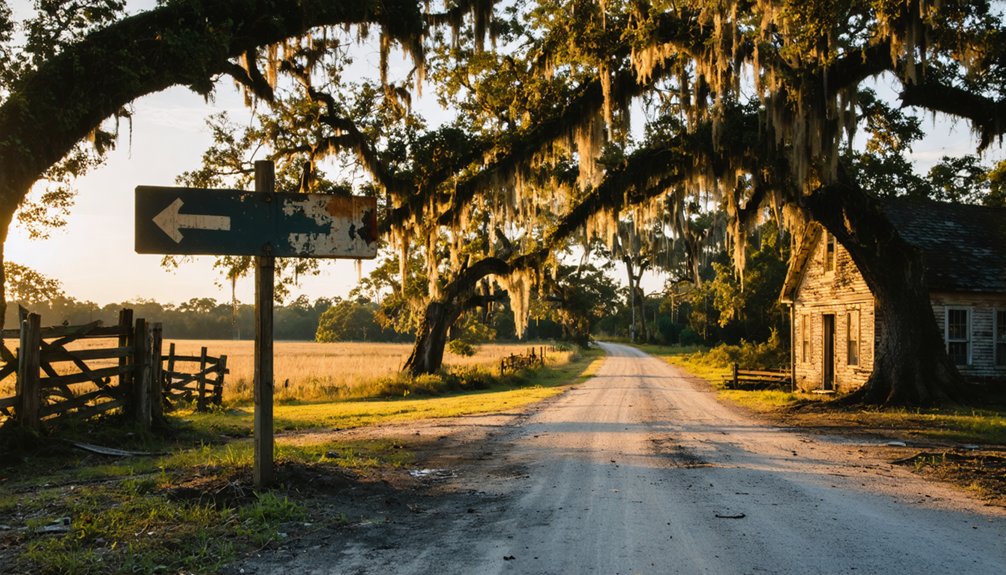
Your exploration of Logtown opens doors to several sister communities that met the same fate in the early 1960s. Santa Rosa once thrived along the Pearl River’s edge, its timber-fed economy mirroring Logtown’s sawmill heritage before NASA’s bulldozers arrived.
Just beyond, you’ll find scattered traces of Napoleon and Gainesville—including the haunting Gainesville pine tree and weathered graveyard headstones—standing as silent witnesses to the five coastal settlements erased for America’s space ambitions.
Santa Rosa’s River History
Envision this vanished world:
- Wooden pirogues traversing the bifurcated river mouth where British forces later camped before New Orleans
- Spanish surveyors demarcating boundaries along Pleistocene bluffs towering above the eastern banks
- French explorers misplacing provisions overboard, unintentionally naming landmarks like “Pea Island”
Napoleon and Gainesville Ruins
While Logtown’s remnants whisper from the Mississippi woods, other vanished settlements along the great river’s path tell even more dramatic tales of prosperity turned to dust.
Napoleon once thrived at the Arkansas-Mississippi confluence, its strategic location making it Desha County’s seat and bustling port. When Union forces dug through a protective island in 1863, they sealed the town’s fate. Relentless currents devoured Napoleon’s riverbank, toppling buildings into churning waters. By 1874, nothing remained. Mark Twain called it a “town of innumerable fights“—now it’s just sandbars.
Nearby Gainesville met similar doom through economic decline due to Mississippi flooding. You’ll find their stories preserved only in courthouse records and fading memories, cautionary tales of man’s hubris against nature’s power.
Photography Tips for Ghost Town Exploration
When sunlight slants through the shattered windows of Logtown’s abandoned buildings, you’ll want your camera ready to capture the haunting interplay of light and decay. Pack a tripod for capturing light during golden hours when dawn’s glow transforms weathered wood into amber treasure. Your wide-angle lens will swallow entire storefronts, while 50-100mm glass pulls intimate details from the ruins.
Golden hour transforms Logtown’s decay into amber treasure—bring your tripod and wide-angle lens to capture light dancing through shattered windows.
Master these techniques for freezing moments:
- Frame your subject through doorways and broken windows to create layers of abandonment that draw viewers deeper into Logtown’s forgotten narrative.
- Spotlight architectural details with your flashlight during blue hour, painting door handles and ornamental ironwork with dramatic shadow play.
- Bracket three exposures for HDR composites that balance Mississippi’s intense sky against shadowy interiors.
Keep horizons level, remove distractions, and let atmosphere guide your processing.
Combining Your Trip With Stennis Space Center Tours
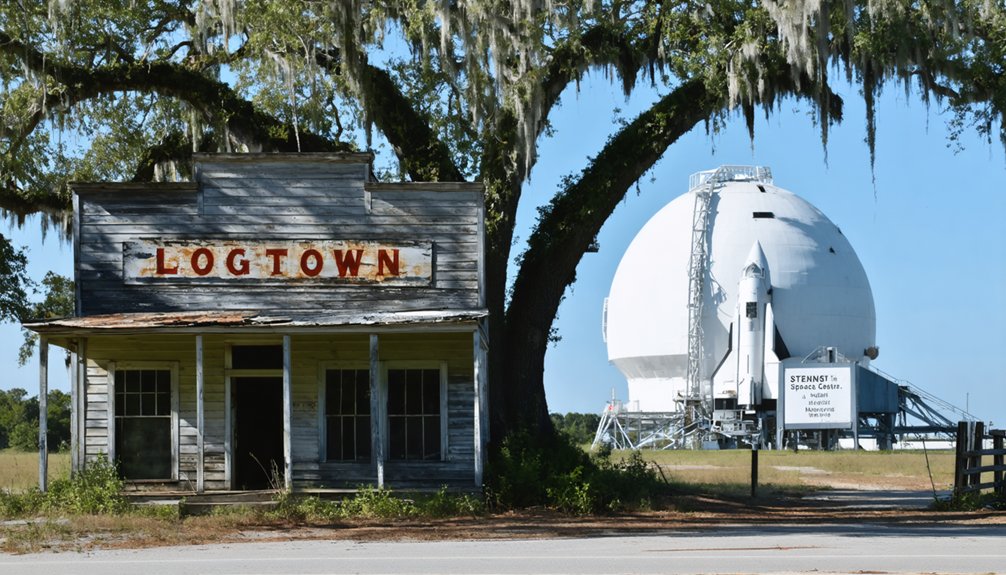
After capturing Logtown’s weathered facades and sun-bleached storefronts, you’ll find America’s rocket testing frontier just fifteen miles south. While guided tours of Stennis Space Center aren’t available in person, the INFINITY Science Center at Exit 2 delivers extraordinary access to space exploration history.
You’ll encounter unique photo opportunities at INFINITY Science Center, including the massive Saturn V first stage with its five F-1 engines and the preserved Apollo 19 rocket that never reached the moon. The Apollo 4 command module sits alongside astronaut suits and actual moon rock.
If you’re lucky, unpredictable rocket test firings might shake the ground during your 2-3 hour visit. Virtual tours online reveal the secure facility’s engine testing operations that shaped humanity’s journey beyond Earth.
Frequently Asked Questions
Are There Any Safety Concerns When Exploring the Abandoned Logtown Area?
Look before you leap—you’ll face federal patrols, venomous snakes, unstable foundations, and treacherous mud roads. Wildlife preservation concerns and environmental impact studies restrict access, but Possum Walk Trail offers safer, sanctioned exploration through Logtown’s haunting ruins.
Can You Still See Remnants of the Old Railroad or Logging Equipment?
Unfortunately, you won’t find any decaying infrastructure or logging equipment—everything vanished when NASA cleared the land. Natural overgrowth has reclaimed the site completely, leaving only cemeteries and historical markers to hint at Logtown’s industrial past.
Is Permission Required to Access the NASA Buffer Zone Areas?
Yes, you’ll need permission—NASA’s buffer zone has strict private land access restrictions and environmental regulations. While the wilderness beckons freely, you must submit a Range Request Application with 24-hour notice and check in at gate reception centers.
What Happened to Residents Who Were Displaced During the Relocation?
Displaced residents faced relocation challenges as they scattered to nearby towns like Picayune and Pearlington. The impact on displaced residents proved traumatic—some homes were transported, others demolished, while families struggled under overwhelming stress during forced removal.
Are There Any Local Guides or Tours Available for Logtown?
No formal guided tours exist, but you’ll find volunteer-led historical preservation efforts at Logtown Cemetery and local community events at nearby NASA Infinity Science Center. The three-mile Possum Walk Trail offers excellent self-guided exploration through pine forests.