Planning a ghost town road trip to Ludlow, California means heading to Historic Route 66 via Interstate 40, exit 50, roughly 57 miles east of Barstow. You’ll explore railroad ruins, the Bagdad-Chase Mine remnants, and crumbling Route 66 relics in the heart of the Mojave Desert. Visit between October and April to avoid brutal summer heat, and pack at least one gallon of water per person. There’s far more to this forgotten desert crossroads than first meets the eye.
Key Takeaways
- Ludlow is accessible via Interstate 40, exit 50, situated approximately 57 miles east of Barstow along historic Route 66 in the Mojave Desert.
- Visit between October and April to avoid extreme summer heat exceeding 110°F, and arrive early morning for optimal photography conditions.
- Pack at least one gallon of water per person daily, as the nearest reliable water source is 27 miles away in Newberry Springs.
- Key attractions include half-buried railroad track ruins, scattered switching hardware, and remnants of the Bagdad-Chase Mine located 10 miles from town.
- Ludlow pairs well with stops in Barstow and Kingman, making it a natural midpoint along one of America’s most iconic road trip corridors.
What Makes Ludlow, California Worth the Drive?
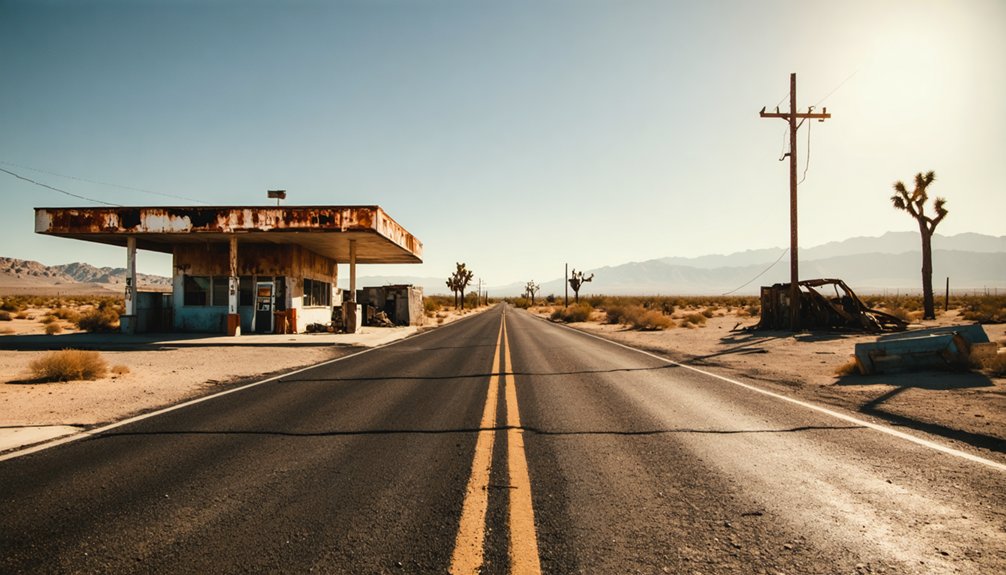
Tucked along the sun-scorched stretch of historic Route 66 in California’s Mojave Desert, Ludlow is a ghost town that layers over a century of American history into a single, walkable landscape.
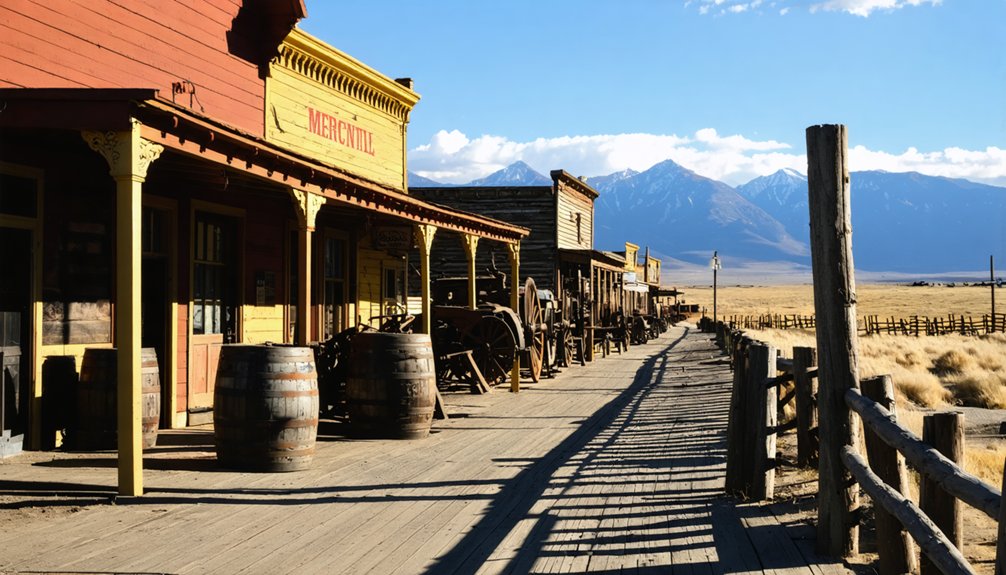
You’ll find railroad-era ruins, a deteriorating pioneer cemetery, and the skeletal shell of Ludlow Mercantile waiting to be explored on your own terms.
Ludlow Attractions span two distinct eras — the mining boom of the early 1900s and the Route 66 highway culture that followed — giving you twice the story in one stop.
Two ghost town eras collide here — mining boom relics and Route 66 nostalgia, layered into one sun-bleached stop.
For Desert Photography, the crumbling adobe walls, rusted tracks, and vast open sky create raw, compelling compositions.
This isn’t a sanitized tourist site. It’s an honest, wind-worn piece of American history baking freely under the Mojave sun.
Ludlow’s History: From Rail Town to Route 66 Ghost Town
What you’re walking through in Ludlow didn’t happen by accident — it happened in layers. The Santa Fe Railroad planted this desert outpost in 1882 as a water stop, embedding Railroad History into the Mojave’s bones.
Then gold hit the Bagdad-Chase Mine in 1900, and suddenly Ludlow’s Mining Legacy pulled hundreds of workers, merchants, and dreamers into the dust. By 1907, the town had schools, hotels, and its own rail line.
But mining faded, and so did Ludlow — until Route 66 arrived in 1926, breathing fresh life into its sun-baked streets. Dust Bowl travelers rolled through needing gas, food, and a place to rest.
Then I-40 bypassed it entirely. Each collapse left something behind, and that’s exactly what you’re standing in now.
How to Get to Ludlow on Historic Route 66
To reach Ludlow, take Interstate 40 to exit 50, roughly halfway between Kingman and Barstow in the heart of the Mojave Desert.
From there, you’ll pick up the historic Route 66 alignment, the same two-lane ribbon of asphalt that once carried Dust Bowl travelers, truckers, and adventurers across the American Southwest.
Following this older road west leads you directly into Ludlow’s layered past, where two distinct ghost town areas reveal themselves along both the highway and the railroad tracks.
Interstate 40 Exit Directions
Reaching Ludlow is straightforward: take Interstate 40 to exit 50, roughly halfway between Barstow and Kingman, and you’ll land directly on the historic Route 66 alignment.
Among your exit options, this single interchange serves both directions efficiently, dropping you onto the old Mother Road without hassle.
Heading east from Barstow, you’ll cover about 57 miles before spotting the Ludlow exit signs.
Coming west from Kingman, it’s roughly 75 miles. Either approach cuts through open Mojave Desert, so keep your fuel tank full and water within reach before you commit.
Once off the interstate, the older ghost town ruins stretch westward along the railroad tracks, while the newer highway-era remnants sit closer to the interchange.
You’re free to explore both on your own terms.
Historic Route 66 Alignment
Driving the historic Route 66 alignment into Ludlow adds a layer of context that the interstate simply can’t offer.
Once you exit I-40, follow the old road west and you’ll feel the shift immediately — the pavement narrows, the pace drops, and the desert opens up around you. You’re traveling the same stretch that Dust Bowl families crossed desperately searching for a better life.
Historic landmarks like the Ludlow Mercantile shell and deteriorating cemetery line your path, each carrying local folklore about boom-era miners, railroad workers, and road-weary travelers.
The older ghost town ruins run parallel to the railroad tracks, and you can explore them on foot. This alignment doesn’t just get you somewhere — it tells you exactly where you’re in American history.
When to Visit Ludlow and Beat the Desert Heat
Because the Mojave Desert doesn’t forgive careless planning, timing your visit to Ludlow is as important as packing water. Desert conditions turn brutal fast, so choosing the best visiting window protects both you and your experience.
Follow these guidelines before you go:
- Visit October through April — temperatures stay manageable, letting you explore ruins comfortably.
- Avoid July and August — midday heat regularly exceeds 110°F, making extended outdoor exploration genuinely dangerous.
- Arrive early morning — you’ll photograph the ghost town in golden light before heat peaks.
- Carry at least one gallon of water per person — nearest reliable water sits 27 miles west in Newberry Springs.
Plan smart, and Ludlow rewards you with raw, unfiltered desert history.
What to Pack for a Desert Ghost Town Road Trip?
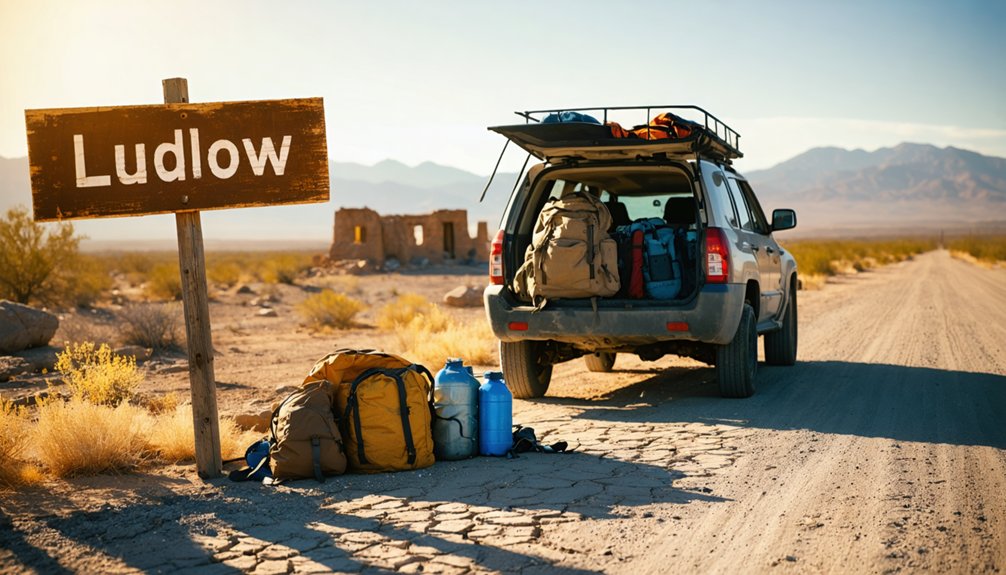
What you pack for a desert ghost town road trip can mean the difference between an unforgettable adventure and a dangerous ordeal.
Ludlow’s Mojave Desert heat is relentless, so your packing essentials should prioritize desert survival above everything else.
Carry at least one gallon of water per person daily, since local water isn’t available. Pack high-SPF sunscreen, a wide-brimmed hat, sunglasses, and lightweight, breathable clothing that covers your skin.
Sturdy closed-toe shoes protect your feet across uneven ruins and rocky terrain.
Bring a first-aid kit, a charged phone, and a physical map, since cell service is unreliable. High-energy snacks, a flashlight, and a portable phone charger round out your kit.
Pack smart, and Ludlow rewards you with raw, untamed history.
The Best Ghost Town Ruins to Explore in Ludlow
When you wander through Ludlow’s ruins, three sites stand out as essential stops: the crumbling shell of the Ludlow Mercantile, the weathered pioneer cemetery, and the ghostly stretch of old railroad tracks that once drove the town’s economy.
You’ll find the Mercantile’s skeletal walls frozen in time, while the cemetery quietly marks the lives of miners, railroad workers, and Route 66 travelers who built and passed through this desert outpost.
Walking the rusted rail lines connects you to Ludlow’s busiest era, when ore trains and borax shipments made this remote Mojave stop a genuine hub of commerce.
Ludlow Mercantile Shell Remains
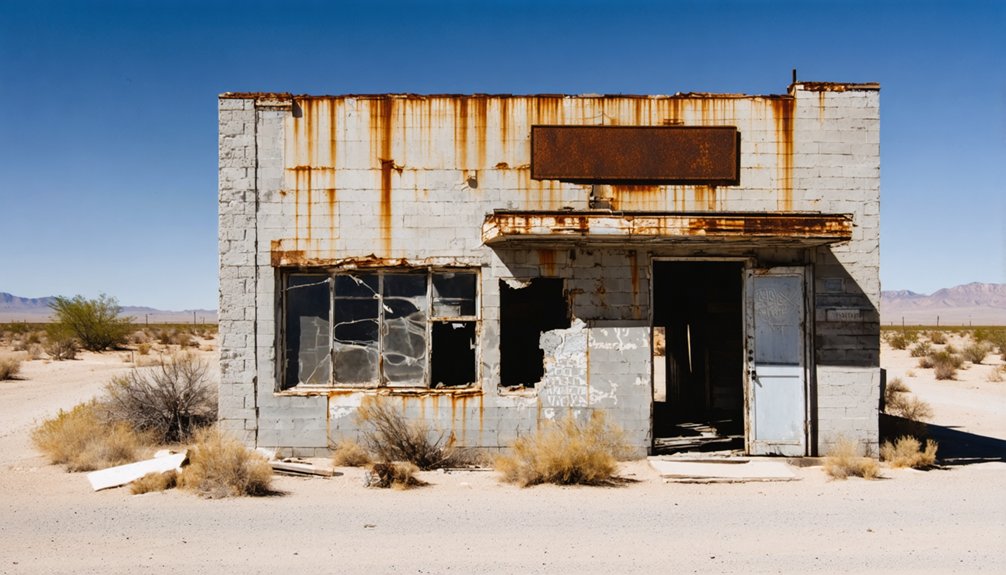
Among Ludlow’s ghost town ruins, the skeletal shell of the Ludlow Mercantile stands as the most striking remnant you’ll encounter. This weathered structure captures ghost town nostalgia while showcasing Ludlow architecture at its rawest form — sun-bleached walls standing defiantly against the Mojave’s relentless heat.
Take time to notice:
- Crumbling exterior walls that once sheltered travelers along Route 66
- Exposed structural framework revealing early 20th-century desert construction techniques
- Surrounding debris fields scattered with artifacts from Ludlow’s commercial peak
- Desert reclamation in progress — wind and sand slowly consuming what remains
Walk the perimeter carefully, photograph the textures, and let the silence sink in.
You’re standing inside a living time capsule that no museum could authentically replicate.
Pioneer Cemetery Exploration
Beyond the Mercantile’s crumbling walls, Ludlow’s pioneer cemetery waits a short walk away — quieter, more intimate, and perhaps more haunting.
Here, weathered markers tell pioneer stories that the desert has slowly tried to erase. You’ll find headstones tilted by decades of wind and shifting sand, some barely legible, others completely reclaimed by the Mojave.
Cemetery preservation hasn’t always kept pace with time’s damage, so you’ll want to move carefully and respectfully among the graves.
Don’t move markers or disturb the ground — what remains is fragile. Photograph what you see, because conditions change season to season.
Standing here, you’re not just visiting ruins; you’re connecting with real people who built something extraordinary in an unforgiving landscape.
That weight stays with you long after you’ve driven away.
Railroad Track Ruins
Steel rails half-buried in desert sand mark Ludlow’s most evocative ruins — the railroad tracks that once carried gold ore, borax, and Dust Bowl travelers across the Mojave.
Walking these remnants connects you directly to railroad history spanning decades of boom and decline. For meaningful ghost town exploration, focus on these highlights:
- Tonopah-Tidewater Railway corridor — follow the old rail bed toward the original 1882 townsite
- Ludlow-Southern Railroad remnants — ore-hauling line that once ran to Barstow’s processing mills
- Atlantic and Pacific Railroad foundations — Ludlow’s founding infrastructure, still partially visible
- Rusted switching hardware — scattered equipment revealing daily operational complexity
You’ll read the landscape differently once you understand these tracks weren’t decorative — they were Ludlow’s entire economic lifeline.
What’s Left of the Bagdad-Chase Mine?
Roughly 10 miles from Ludlow’s ruins, the Bagdad-Chase Mine sits quietly in the Mojave, its once-booming operation reduced to scattered remnants baking under the desert sun.
Understanding Bagdad-Chase history puts the scale of this place into perspective — gold discoveries around 1900 sparked a regional frenzy, with ore initially yielding $17,000 per thousand tons.
Miners employed hard-rock mining techniques to extract that wealth, shipping ore by rail to Barstow’s mills because local water was too scarce to process it on-site.
Today, you’ll find weathered structural remnants and desert-worn equipment slowly surrendering to the landscape. It’s a raw, unfiltered snapshot of ambition meeting harsh reality.
Pair your visit with Ludlow’s ruins for a full picture of how gold and rail shaped this forgotten corner of California.
How Ludlow Fits Into a Barstow-to-Kingman Drive
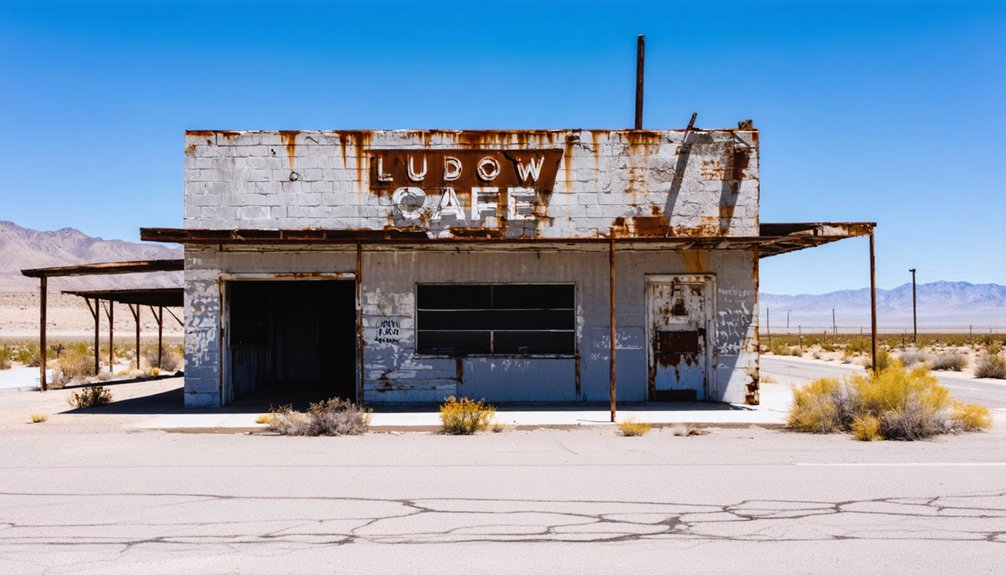
Stretching nearly 200 miles between Barstow and Kingman, the Barstow-to-Kingman corridor along I-40 and historic Route 66 places Ludlow almost exactly at its midpoint, making it a natural stopping point for anyone driving the route.
You’ll find Route 66 nostalgia and ghost town legends packed into one convenient desert pause. Use Ludlow strategically:
- Refuel at the interstate-side services before pushing deeper into the Mojave.
- Explore ruins along the historic Route 66 alignment running parallel to the railroad tracks.
- Photograph the deteriorating Ludlow Mercantile shell and pioneer cemetery.
- Plan mileage knowing Barstow sits 27 miles west and Kingman roughly 100 miles east.
Ludlow rewards the freedom-seeking traveler who refuses to let the interstate dictate the entire journey.
How to Make Ludlow Part of a Longer Route 66 Road Trip
Ludlow sits at the heart of one of America’s most iconic drives, and weaving it into a longer Route 66 road trip transforms a simple detour into a layered journey through American history.
You’ll find Ludlow attractions pair naturally with stops in Barstow to the west and Kingman to the east, letting you stretch your Route 66 experiences across desert landscapes, mining ruins, and roadside Americana.
Start in Santa Monica, follow the Mother Road eastward, and let Ludlow’s crumbling mercantile and pioneer cemetery remind you how dramatically this corridor has shifted over a century.
From Santa Monica’s coast to Ludlow’s ruins, the Mother Road tells a century of transformation in crumbling walls and forgotten graves.
You’re not just passing through ghost towns — you’re tracing boom-and-bust cycles that shaped the American Southwest.
Pack water, keep your tank full, and give yourself room to wander off-schedule.
Frequently Asked Questions
Is There Cell Phone Service or Wi-Fi Available in Ludlow?
Don’t count on reliable cell service or wi fi options in Ludlow’s remote Mojave Desert location. You’ll want to download offline maps, charge your devices, and embrace the freedom of truly disconnecting before you explore these haunting ruins.
Are There Any Overnight Camping Options Near Ludlow’s Ghost Town Ruins?
You won’t find designated campgrounds directly at Ludlow’s ruins, but you can explore nearby BLM land for dispersed camping. Check camping regulations first, then you’ll enjoy the freedom of waking near incredible nearby attractions like the Bagdad-Chase Mine!
Is It Legal to Take Artifacts or Souvenirs From Ludlow’s Ruins?
Those crumbling walls whisper Ludlow’s forgotten soul — don’t silence them forever. You shouldn’t take artifacts; artifact preservation laws carry serious legal implications, protecting history’s fragile echoes for every future wanderer who craves freedom through these desert ruins.
Are Ludlow’s Ruins Accessible for Visitors With Mobility Challenges?
Ludlow’s ruins aren’t wheelchair accessible — you’ll navigate rough desert terrain to explore its historical significance. Bring sturdy gear, embrace the adventure, and let the raw, untamed landscape fuel your spirit of freedom and discovery.
Has Ludlow Ever Appeared in Films, TV Shows, or Music Videos?
Ever wonder why Ludlow’s eerie ruins feel so cinematic? The Ludlow filmography isn’t well-documented, but Route 66’s legend inspired TV series and songs. You’ll find Ludlow music references woven into America’s open-road freedom culture.
References
- https://digging-history.com/2013/12/18/route-66-ghost-towns-ludlow-california/
- https://www.youtube.com/watch?v=SF-pLcs3D6k
- https://wend.ca/?p=65160
- https://www.theroadwanderer.net/RT66ludlow.htm
- https://www.youtube.com/watch?v=9Ewl4WRurvU
- https://www.desertusa.com/desert-california/ludlow-ca.html
- https://www.exploratography.com/blog-66/ludlow-cal-rt-66
- https://digital-desert.com/blog/exploring-ludlows-history/