Your ghost town road trip through Macoupin County starts at Carlinville’s Million Dollar Courthouse, then winds through Standard City’s vanished mining settlement where 650 workers once extracted 4,000 tons of coal daily before the entire town disappeared by 1925. You’ll discover Greenridge’s abandoned 65-structure community, explore the largest collection of Sears kit homes in America, and trace Native American burial mounds along Macoupin Creek. Fall’s bare branches reveal hidden foundations that summer foliage conceals, while spring wildflowers mark forgotten trails where immigrant miners’ descendants still share stories passed down through generations.
Key Takeaways
- Visit abandoned mining settlements like Standard City and Greenridge, where coal operations once thrived before complete abandonment in the 1920s.
- Explore Carlinville’s architectural landmarks including the Million Dollar Courthouse, Anderson mansion, and 156 Sears kit homes from 1918.
- Discover haunting sites like the Irish laborers’ mass graves, Coliseum Ballroom, and the Gothic 1869 Macoupin County Jail building.
- Explore Native American heritage sites including Middle Woodland burial mounds and the Mississippian Starr Village near Macoupin Creek.
- Plan visits during fall or spring for optimal 45-70°F temperatures and improved visibility of hidden foundations and trails.
The Rise and Fall of Schoper: A Complete Mining Town Vanished
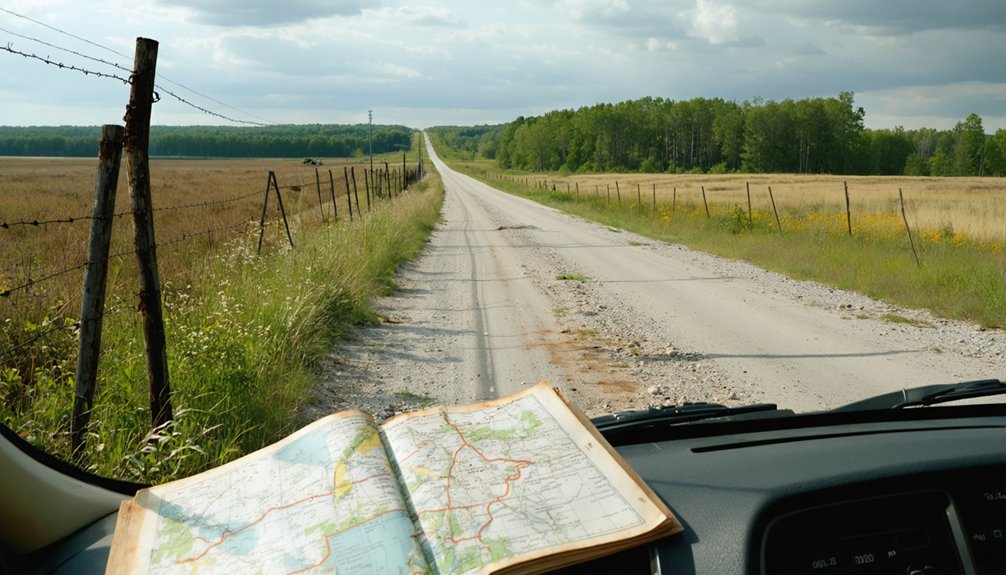
In 1918, when World War I created a desperate coal shortage across America, Standard Oil of Indiana spotted opportunity on Thomas Schoper’s 500-acre family farm. They’d discovered a seven-foot coal seam beneath the soil, perfectly positioned between the Chicago and Alton railroad.
What happened next was pure American ambition: Standard City erupted from nothing, complete with Sears Modern homes for supervisors and boarding houses for workers.
At its peak, you’d have witnessed Illinois’s largest coal operation—650 men hauling 4,000 tons daily from the Schoper mine alone. Another 450 men worked at the Berry Mine, producing 2,000 tons per day. Like the fluorite miners of Rosie Claire, these workers faced hazardous conditions underground, risking their lives daily in the pursuit of essential resources. But by July 1925, it was over. Those empty town streets tell the story: nine of twelve houses disassembled and shipped away on boxcars.
Today, you’ll find only abandoned farmland where 1,100 miners once worked.
Million Dollar Courthouse: Where Scandal Meets the Supernatural
While Standard Oil‘s ambitious mining town crumbled back into farmland by 1925, another monument to excess still dominates Macoupin County’s landscape—though this one’s been standing since 1870. You’ll spot the courthouse dome rising 191 feet above Carlinville, its magnesium limestone walls gleaming between 40-foot Corinthian columns. Architect Elijah E. Myers designed America’s largest courthouse on a $150,000 budget, but financial mismanagement ballooned costs to $1,380,500—19% of the county’s entire property value.
The architectural splendor came at a brutal price. Farmers lost land, residents fled, and the county clerk reportedly escaped by train amid graft investigations. You’ll find Lincoln’s signed documents inside, but locals still whisper about limestone mysteriously appearing in private mansions. Walk through those three-foot-thick fireproof walls and feel the weight of forty years’ debt. The county didn’t burn the last bond until July 1910, finally closing the book on this extravagant chapter. Step into the central stair hall and look up at the coffered saucer dome crowning the judge’s bench, where justice was dispensed to pay for its own temple.
Discovering Anderson Through the Historic Mansion
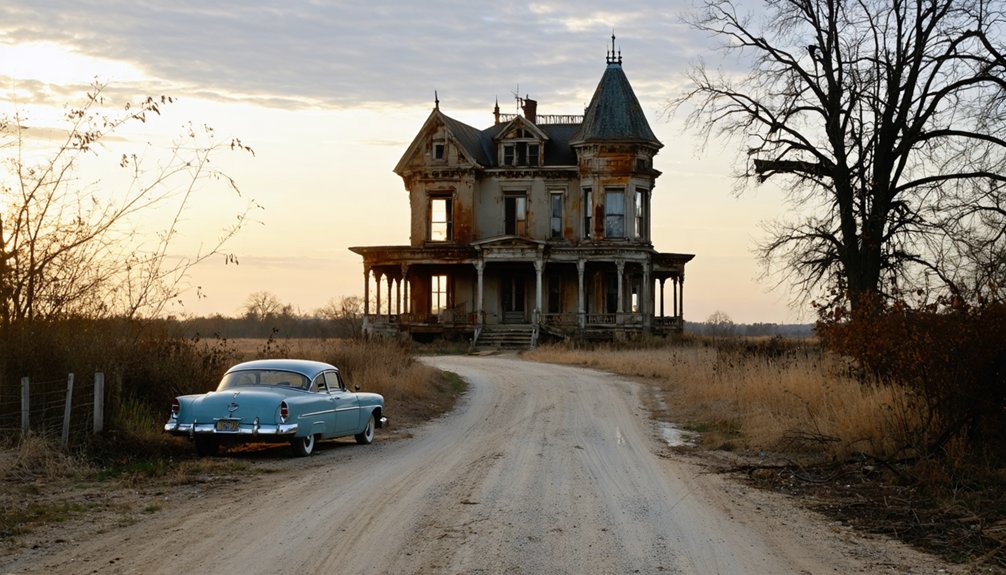
Just blocks from the courthouse that bankrupted a county, you’ll discover redemption in the form of an 1883 banker’s mansion that actually delivers on its promise. C.H.C. Anderson built this Italianate-Queen Anne hybrid as a wedding gift for his son, and the thirteen-room treasure reveals Macoupin County’s genuine prosperity through paired columns, stick-style tower, and original stained glass.
You’re free to explore without rigid tour packages—just show up Wednesdays or call ahead. The $5 admission grants access to period outbuildings, including a one-room schoolhouse and blacksmith shop. The property earned its spot on the National Register of Historic Places in 1992. An herb garden adds another historical dimension to the grounds, offering a glimpse into 19th-century domestic life.
Holiday events transform the mansion each December, with all thirteen rooms decorated and Christmas trees throughout. May and September festivals add antique farm equipment displays and home-cooked food. The grounds even accommodate weddings if you’re planning something unconventional.
Greenridge: Tracing What Remains of a Forgotten Settlement
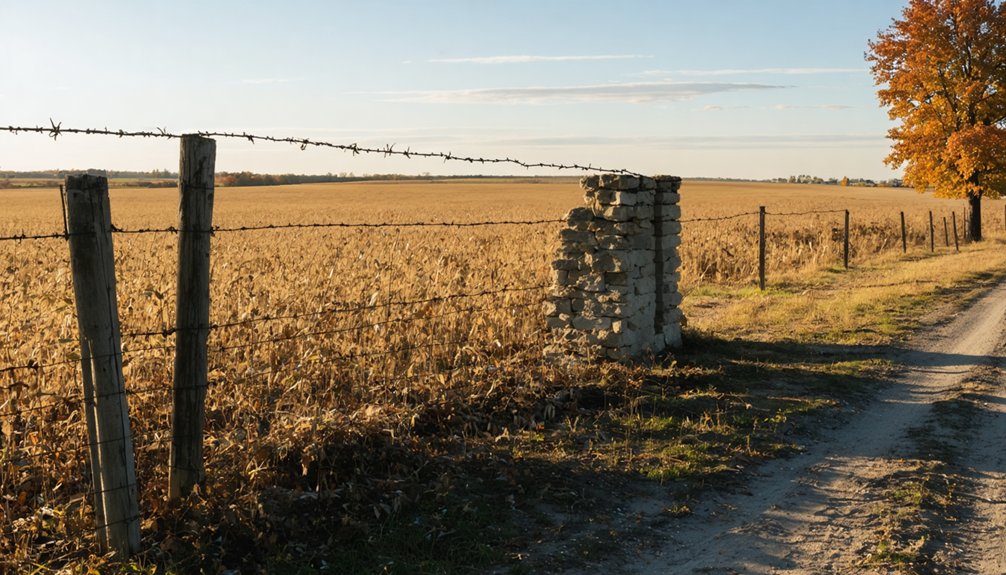
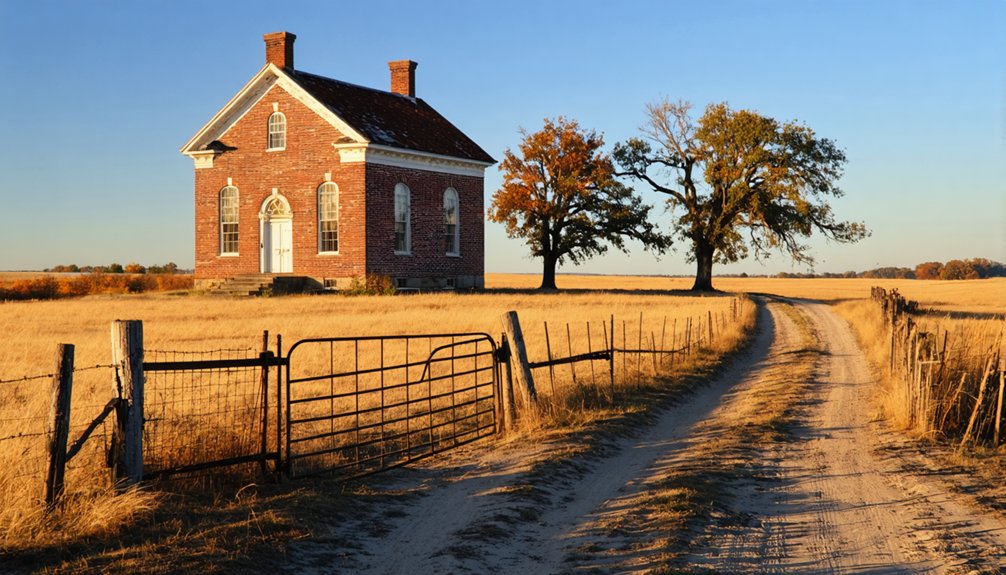
You’ll find Greenridge two miles north of Nilwood on Route 4, where a single house and scattered tree lines mark what was once a thriving 300-person coal mining settlement. The Green Ridge Mining Company built these 65 structures in the late 1800s, but when the mine closed in 1923, families packed up and left within a decade, abandoning their homes to the Illinois prairie.
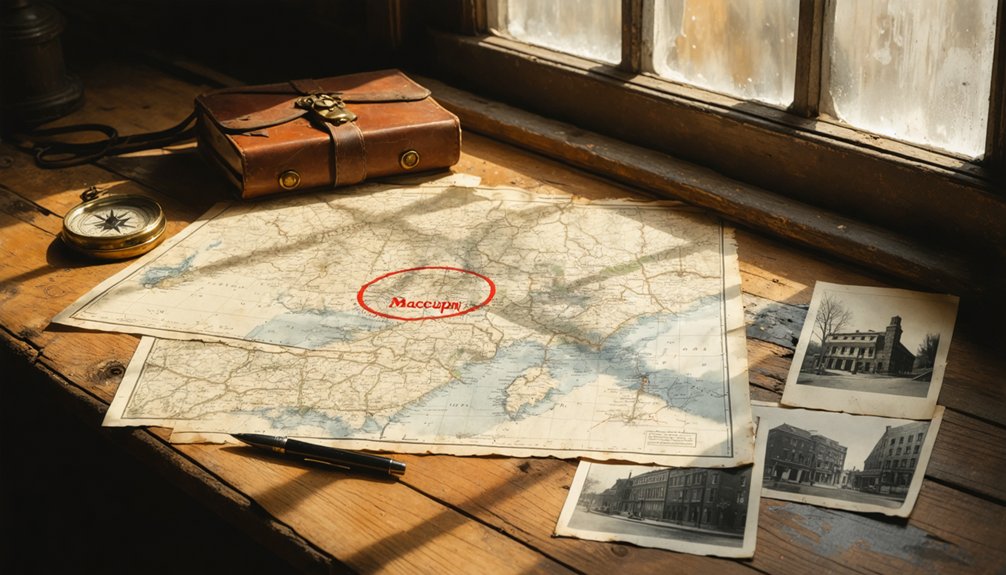
Today, you can park along Green Ridge Road and walk the overgrown paths where miners once crossed railroad tracks to reach the tipple, though you’ll need a topographic map to distinguish the old town boundaries from farmland. The railroad is no longer operational, cutting off what was once a vital transportation link for the mining community. This forgotten settlement served as the hometown of James Bullough Lansing, founder of the JBL Speaker Company, who was born here in 1902.
Mining Heritage and Decline
At the turn of the twentieth century, the Greenridge Mining Company carved a settlement from the prairie two miles north-northeast of Nilwood, planting rows of green-painted houses alongside a railroad spur that hummed with coal trains. By 1910, this operation joined twenty-one other mines extracting Macoupin County’s rich Herrin seam, where mechanical cutters pulled coal from depths exceeding 240 feet.
The miners here belonged to District 12’s United Mine Workers, organizing against wage cuts that swept through central Illinois during the bitter 1897 Virden strike. The workforce drew from immigrant communities including Italians, Russians, Croatians, and Bohemians who followed the coal economy into Macoupin County’s expanding mining towns. The community maintained a school with 65 to 70 pupils of various nationalities, while a night school program helped men advance in their mining work. When the seam played out and labor conflicts intensified, Greenridge’s mining decline came swift and absolute. By the 1920s, every resident had scattered to Nilwood and Girard, leaving only foundations and memories where a community once thrived.
Physical Remnants Today
The vanishing of Greenridge left subtle scars across the prairie landscape that you can still trace if you know where to look. Drive two miles north-northeast from Nilwood on Route 4, then follow Green Ridge Road into what locals call empty farmland.
You’ll spot structural deterioration patterns in concrete road segments from the 1926 Route 66 era, crumbling where mining operations once dominated the northeast sector. Tree clusters mark railroad crossings where 65 houses stood. Foundation remnants concentrate in the downtown zone, while geological landscape alterations reveal where dual rail lines carved the eastern and western boundaries.
One residential structure reportedly survives near the original settlement core—a solitary witness to 300 vanished lives.
Accessing the Historic Site
The site demands exploration on foot. No tour guides, no visitor centers—just you and the landscape.
Follow the railroad embankment for orientation, then venture into the surrounding fields where foundations occasionally surface after spring plowing.
Bring sturdy boots and your sense of adventure. This isn’t sanitized history; it’s raw, unfiltered territory where Macoupin County’s original settlers staked their claims against wilderness.
Polk Township’s Dark Railroad Camp History
Between 1849 and 1852, nearly 800 Irish laborers carved the Sangamon-Alton railroad through Macoupin County’s creek bottoms and hills, fleeing the potato famine only to face death in a windswept tent camp. You’ll find their story etched into section 13, where construction conditions turned lethal when cholera swept through in 1851-1852.
These immigrant labor stories ended with roughly 200 men buried in mass graves along the hillside east of the tracks. Without medical care, the Irish workers dropped where they stood. Their companions hammered together wooden crosses that eventually rotted away, leaving no trace of the dead.
Today, you’re free to walk these grounds where Macoupin Creek crosses the old railroad bed—a haunting reminder that America’s infrastructure rose on anonymous backs.
Route 66 Landmarks Connected to Prohibition Era Ghosts
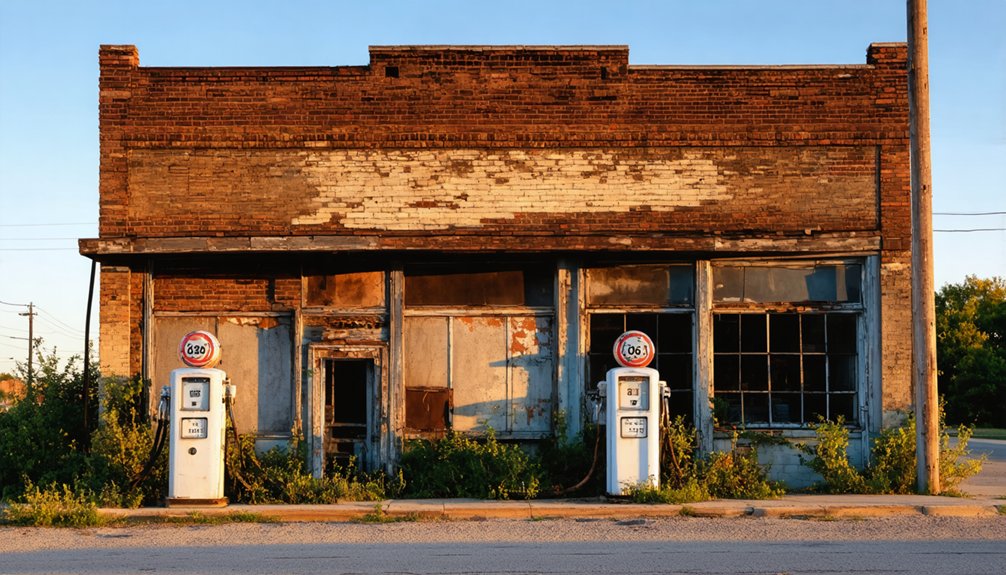
When bootleggers and coal miners collided along Macoupin County’s stretch of Route 66, they left behind more than crumbling dancehalls—they created legends soaked in whiskey and blood.
Where coal dust met bootleg whiskey, Macoupin County’s Route 66 became a corridor of crimson folklore and defiant spirits.
Three Prohibition-Era Sites That Still Echo:
- Coliseum Ballroom in Benld – This Route 66 icon thrived during speakeasy nightlife, its owner mysteriously vanishing in 1930, body pulled from Sangamon River. Mary Elaine Sexton kept the music playing until 2011’s fire.
- Auburn’s 1931 Brick Road – Built just as bootleg spirit production was ending, this National Register segment saw its share of midnight runs.
- Macoupin County Jail – The 1869 Gothic fortress with cannonball-embedded walls held rumrunners until 1988.
You’ll find steel silhouettes dancing where shadows once hid contraband deals.
Essential Stops in Downtown Carlinville
Beyond bootlegger hideouts and speakeasy shadows, Carlinville reveals a different kind of time capsule—one built with million-dollar ambitions and mail-order dreams. You’ll find America’s largest collection of Sears kit homes here—156 structures that Standard Oil erected for miners in 1918. Historic architecture tours wind through these neighborhoods where mail-order catalog pages became working-class reality.
Downtown’s centerpiece remains the Million Dollar Courthouse, flanked by the 1869 Cannonball Jail with embedded ammunition in its stone walls. The Marvel Theatre’s 1960s marquee still beckons from Main Street, while community redevelopment initiatives have transformed the square into a pedestrian-friendly district.
Track down Route 66‘s path through town, marked by wayside exhibits at Broad and Nicholas. You’re walking where Lincoln once practiced law—no ghost required.
Native American Heritage Sites Along Macoupin Creek
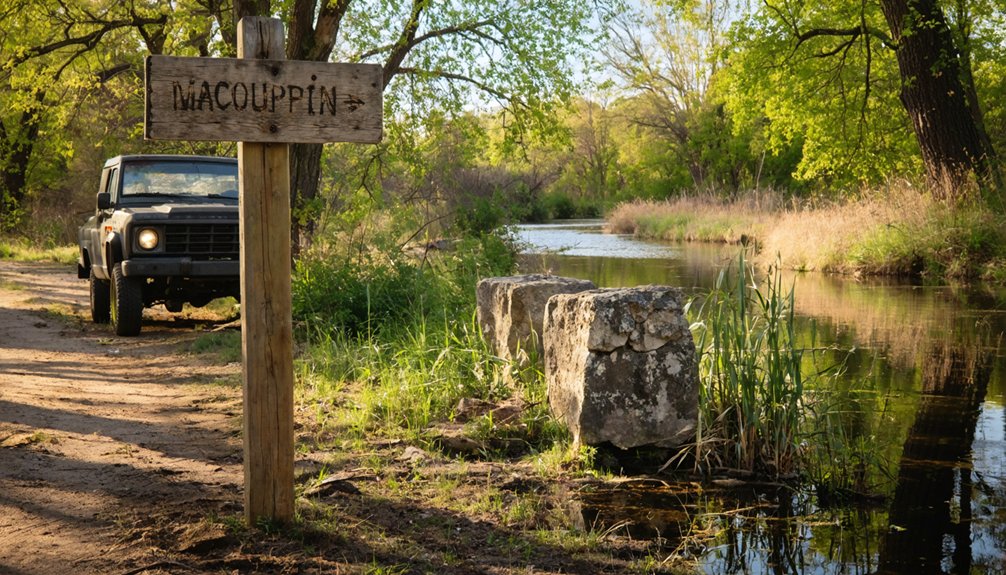
Long before Sears catalogs and courthouse cornerstone ceremonies, the bluffs overlooking Macoupin Creek witnessed 2,000 years of continuous human presence. You’ll find burial mounds along Macoupin Creek marking Middle Woodland settlements from 150 BCE, while the Mississippian Starr Village site southwest of Carlinville yielded the remarkable Macoupin Creek figurine—a kneeling shaman carved around 1250 CE.
Three Sites That’ll Reconnect You With Ancient Freedom:
- Bunker Hill Native Trail marker on Route 159, documenting early native migrations through Bunker Hill where Peoria, Kickapoo, and Winnebago peoples stopped at natural springs
- Starr Village bluff overlook (39°12′02″N 90°00′49″W) where hunters commanded unobstructed views
- Millville School area encampments northeast of Bunker Hill, among 44 pre-settlement sites
These hunting camps chose elevation over convenience—freedom over comfort.
Best Times and Seasons for Ghost Town Exploration
Your boots crunch through October’s fallen leaves as courthouse shadows stretch long across Bunker Hill’s empty Main Street—this is ghost town exploration at its finest. Fall’s 50-70°F temperatures and bare branches reveal hidden foundations you’d miss beneath summer’s dense foliage.
Spring brings wildflower-marked trails and comfortable 45-65°F conditions, though muddy paths demand waterproof boots. Winter offers rattlesnake-free exploration with crystal-clear sightlines through leafless trees, but you’ll need layered clothing for 20-45°F mornings.
Summer’s brutal 75-90°F heat and thick vegetation obscure essential archaeological features. Understanding seasonal weather patterns means packing suitable gear recommendations: lightweight layers for spring and fall, insulated clothing for winter dawns, and frankly, just skip July altogether. Rauchfuss Hill State Recreational Area stays open year-round, letting you chase ruins on your schedule.
Photography Tips for Capturing Historic Structures and Ruins
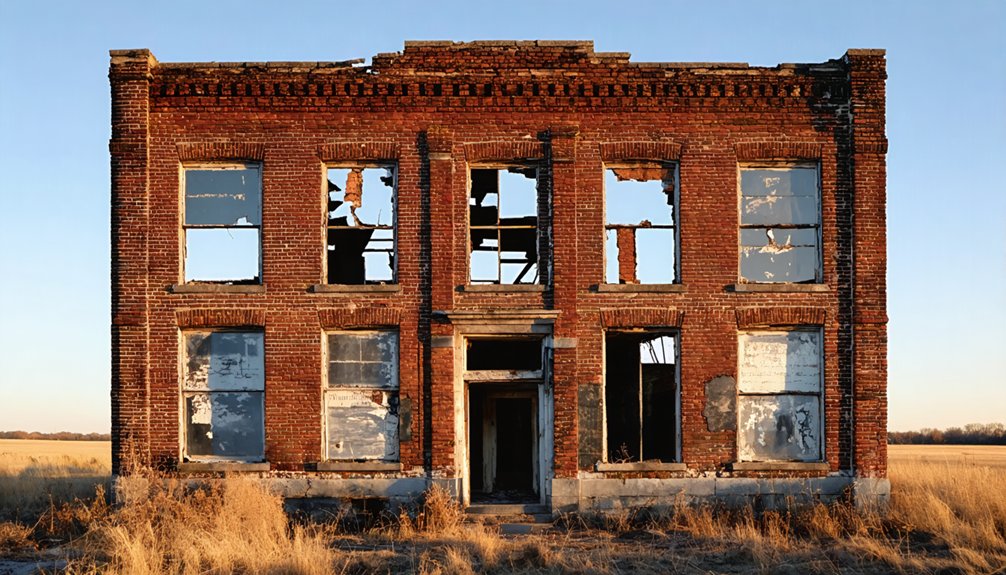
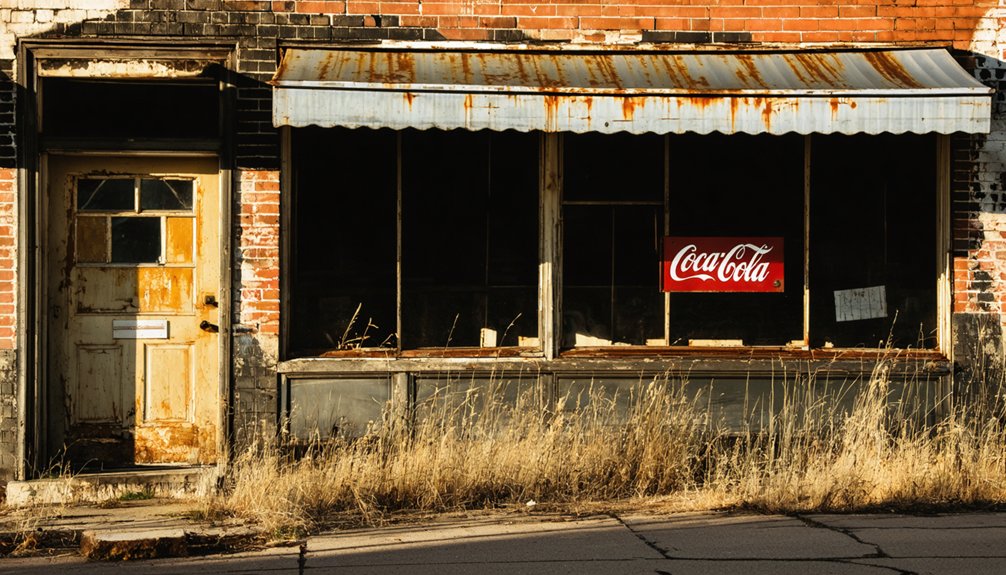
When dust motes float through a collapsed ceiling’s single shaft of sunlight, you’ve found the shot that’ll haunt viewers long after they scroll past. Macoupin’s crumbling structures demand mastery of framing techniques—use doorways and staircases to shape your compositions while low-angle shots amplify the disorienting vastness above.
Lighting control separates amateur snapshots from portfolio pieces: bracket your exposures in static scenes, then paint abandoned furniture with flashlight beams against natural window glow.
Capture these elements for emotional impact:
- Peeling paint and weathered textures that whisper decades of neglect
- Nature’s invasion—ivy strangling brick, roots splitting foundations
- Personal artifacts left behind—a rusted coat hook, dusty schoolbooks
Your wide-angle lens transforms confined spaces into hollow testimonies of abandonment. Long exposures blur drifting clouds above roofless walls, merging past with present.
Frequently Asked Questions
Are There Guided Ghost Tours Available at the Million Dollar Courthouse?
While you won’t find supernatural-themed ghost tours, you’ll discover guided tours showcasing the courthouse’s historical significance twice daily during Christmas in Carlinville weekend. This architectural marvel’s scandalous past might haunt you more than any specter could.
What Safety Precautions Should Visitors Take When Exploring Abandoned Ghost Town Sites?
Wear appropriate footwear like sturdy boots and exercise caution around unstable structures—crumbling walls can collapse without warning. You’ll want gloves, long sleeves, and a respirator too. Always explore with friends, never solo, and tell someone your plans.
Do I Need Special Permission to Access Private Property Ghost Town Locations?
Yes, you’ll need permission before exploring private ghost town properties. Respecting private boundaries isn’t just courteous—it’s essential. Contact landowners directly, explain your intentions honestly, and you’ll often find folks surprisingly welcoming to curious adventurers.
Which Ghost Towns Have the Most Remaining Structures to Photograph and Explore?
Carlinville offers the most exploration opportunities with its preserved Million Dollar Courthouse and rumored tunnel system featuring architectural features of ghost towns. Buda’s preservation efforts for abandoned structures include the feed mill, chapel ruins, and historical newspaper building you’ll want to photograph.
Are Overnight Ghost Hunting Experiences Offered at Any Macoupin County Historic Sites?
Step into the darkness—you’ll find overnight paranormal activity investigations at Carlinville’s Million-Dollar Courthouse. These haunted historic landmark tours run 7 PM to 1 AM for $48, letting you explore freely where spirits have lingered since 1867.
References
- https://www.americanhauntingsink.com/carlinville
- https://www.bumpinthenight.net/courthouse
- https://macoupin.illinoisgenweb.org/history/polktownship.html
- https://drloihjournal.blogspot.com/2022/09/lost-towns-of-illinois-schoper-illinois.html
- http://livinghistoryofillinois.com/pdf_files/History of Macoupin County
- https://www.geotab.com/ghost-towns/
- https://en.wikipedia.org/wiki/List_of_ghost_towns_in_Illinois
- https://www.youtube.com/watch?v=0M_47g1TGIw
- https://www.youtube.com/watch?v=fcV1Ybd2cnA
- http://theamericanbottom.org/itinerarySix.html