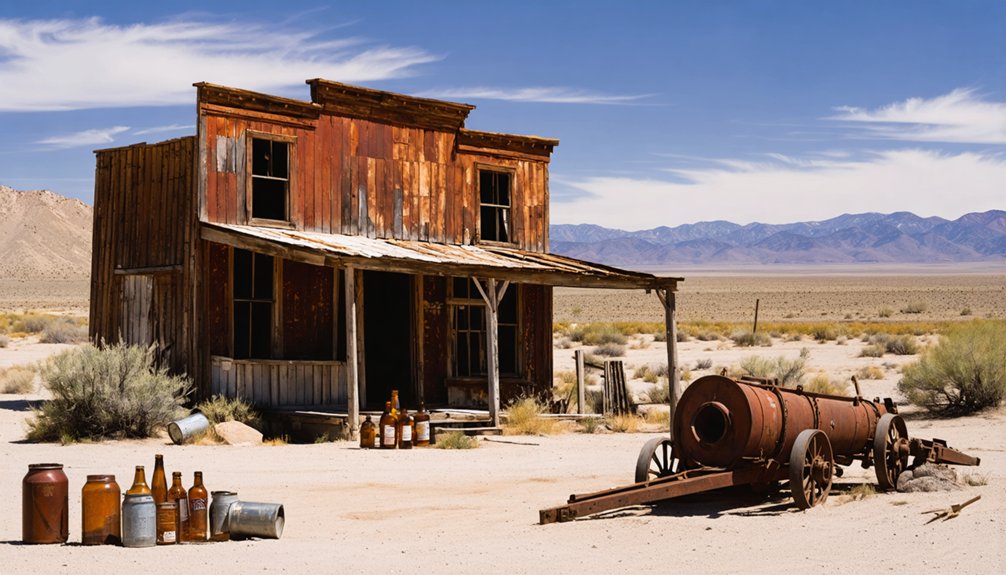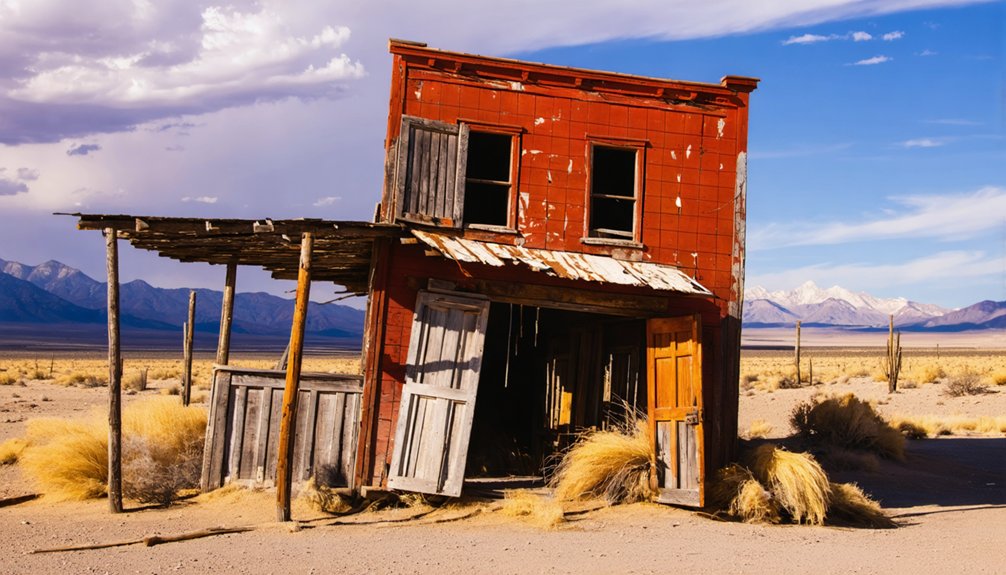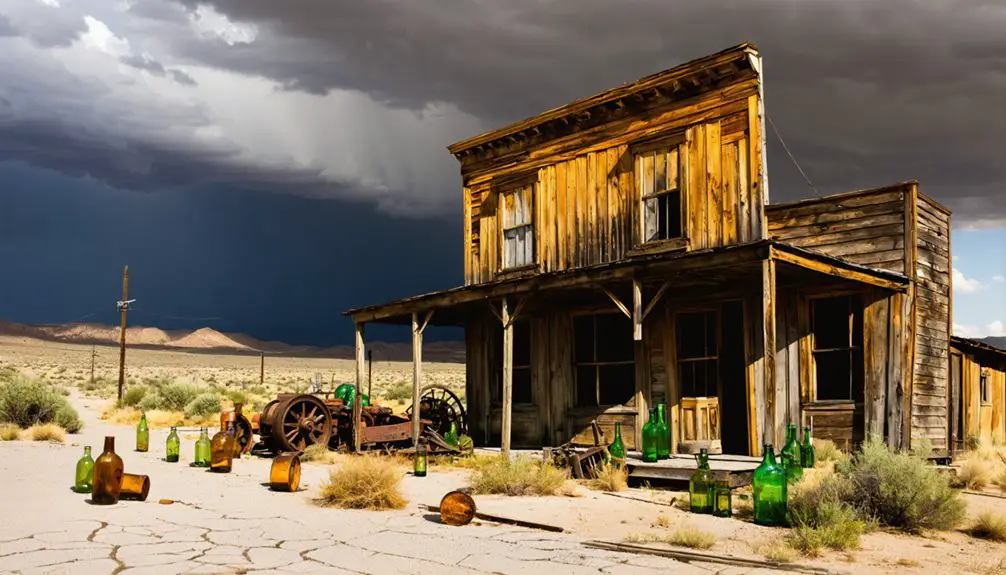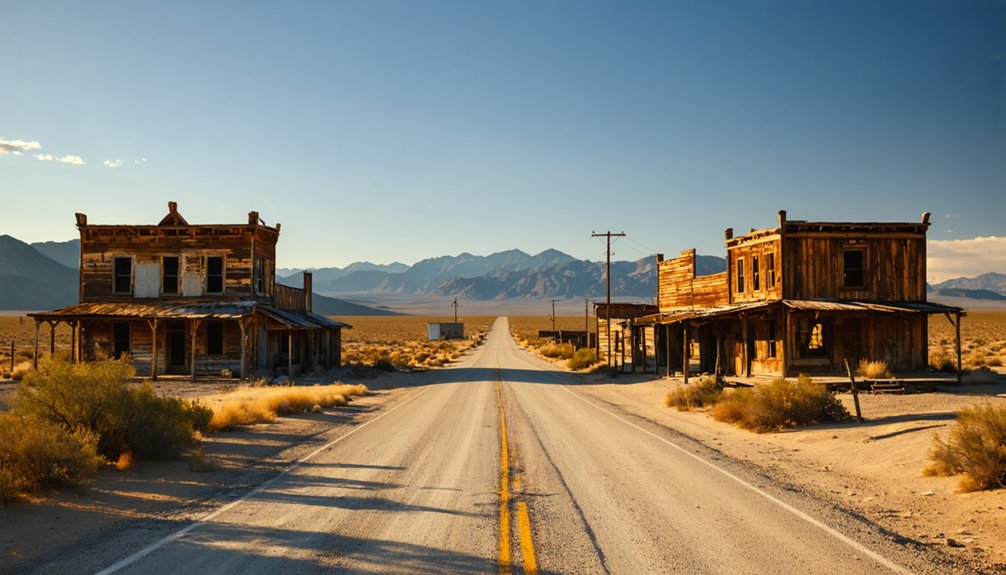
You’ll need a high-clearance vehicle and downloaded GPS waypoints to reach Marietta, nestled at Teel’s Marsh’s edge in remote Mineral County—16 miles from Mina or 25 miles from Hawthorne. This 1877 borax boomtown rewards your effort with impressive stone ruins of F.M. “Borax” Smith’s general store, scattered mining workings, and eerie caretaker trailers frozen in time. Watch for wild burros descended from miners’ pack animals, explore carefully around abandoned shafts, and discover where Nevada’s entire borax industry began before richer Death Valley deposits emptied this rowdy thirteen-saloon camp by 1892.
Key Takeaways
- Marietta sits at Teel’s Marsh edge in Mineral County at coordinates 38.243°N, 118.339°W, accessible from Mina or Hawthorne.
- A high-clearance vehicle is essential for navigating the remote Nevada backcountry terrain to reach the ghost town.
- Download GPX waypoints and study satellite maps before departing, as cell phone coverage is unavailable in the area.
- Explore F.M. Smith’s stone general store, mining workings, Little Chinatown remnants, and abandoned mineshafts with extreme caution.
- Visit during morning or evening in spring or fall for best wild burro viewing among the ruins.
The Rise and Fall of Nevada’s First Major Borax Mining Town
Long before borax made Marietta famous, salt scrapers worked the crusted surface of Teels Marsh in 1867, hauling their harvest by camel train to Virginia City’s silver mills. Everything changed in 1872 when F.M. “Borax” Smith identified ulexite deposits while cutting firewood at Columbus Marsh. He staked Nevada’s first borax claims, and by 1877, Marietta exploded into existence at the marsh’s edge.
You’ll find traces of classic boom town culture here—thirteen saloons served hundreds of workers in this rowdy bachelor camp, where stage robberies hit thirty times in 1880 alone. Labor conditions were harsh, especially for uncounted Chinese workers who never made official records. The borax plants cranked out six tons daily until 1892, when Death Valley‘s richer colemanite deposits emptied the town overnight.
Mining saw a brief revival in 1938 when the Joe Rutty mine started large-scale operations and planned to erect a new mill. Today, the BLM manages the abandoned townsite as the Wild Burro Range, where approximately 85 wild burros roam freely among the crumbling stone and adobe ruins.
Getting to Marietta: Location and Access Details
Nestled at the edge of Teels Marsh playa in remote Mineral County, Marietta sits at coordinates 38.243°N, 118.339°W—a location that demands serious navigation prep before you head out. GPS coordinates accuracy becomes critical here, as the maze of mining roads can confuse even experienced desert rats. Your transportation route planning should account for Mina (16.1 miles northeast) or Hawthorne (24.9 miles northwest) as launching points.
You’ll need a high-clearance vehicle—these aren’t paved suburban streets. The terrain’s pure Nevada backcountry: sagebrush, dirt mounds, and faint tracks branching toward abandoned mines. Download GPX waypoints and study satellite maps before leaving cell coverage. Remember that Mineral County operates on Pacific Time Zone, so adjust your departure schedule accordingly if you’re coming from a different time zone.
Structures appear about a mile up from the main site, rewarding those who venture beyond the obvious. The Marietta Mining District once produced uranium and other mineral commodities, leaving behind the ruins you’ll explore today. This isn’t a hand-holding tourist trap; it’s genuine exploration territory.
What Remains: Exploring the Historic Ruins
When you arrive at Marietta’s scattered ruins, the impressive stone and adobe walls of F.M. “Borax” Smith’s general store command immediate attention—this isn’t some flimsy wood shack that collapsed decades ago. The substantial construction reflects the town’s prosperous 1870s-1880s heyday, when 13 saloons and multiple stores supported booming silver operations.
Beyond the main townsite, you’ll discover:
- Mining workings stretching two miles north-northwest, including the Moho Mine and scattered shafts from various revival attempts through the 1950s
- Little Chinatown remnants where immigrant laborers lived
- Eerie caretaker trailers with miner’s personal effects still inside—food in pans, functioning refrigerators—creating unsettling recent evacuation circumstances
Wild burros wander freely among rusty cans and crumbling walls, while abandoned mineshafts punctuate the landscape, demanding cautious exploration. You’ll also notice large stone-walled corrals that once served as the equivalent of today’s covered parking garages, protecting valuable livestock and equipment from the harsh desert elements.
Teel’s Marsh: Where the Borax Boom Began
Just two miles south of Marietta’s crumbling walls, Teel’s Marsh stretches five miles across the basin floor—a deceptive playa that launched Nevada’s entire borax industry. When F.M. “Borax” Smith discovered ulexite here in 1872 while cutting wood, he couldn’t have imagined his find would transform this wetland into a powerhouse operation.
By 1875, his borax extraction techniques yielded six tons daily, requiring twenty-eight teams of sixteen horses each for transport. The marsh wetland conditions made mining challenging but lucrative—salt deposits had already fed Virginia City’s silver mills since 1867. Earlier camel trains had hauled salt by camel from the lakebed to the mining boomtown, proving the route’s viability.
You’ll find the southeastern section where Chinese laborers operated the plants until 1892, when Death Valley’s richer deposits ended Teel’s reign. The scattered ruins mark where Nevada’s borax empire began.
The Wild Burros of Marietta Range
You’ll likely spot wild burros roaming the sagebrush flats around Marietta—descendants of the pack animals that hauled borax and supplies for 19th-century miners. These shaggy, sure-footed creatures now graze freely across the 64,466-acre Marietta Wild Burro Range, often approaching the ghost town’s crumbling structures with curious indifference.
The BLM surveys show roughly 450-500 burros currently inhabit this designated range, making encounters nearly guaranteed during early morning or late afternoon visits. The range faces potential changes as the BLM has proposed helicopter-assisted gather operations to reduce the wild burro population in this protected area. Wild Horse Education and other advocacy groups promote non-lethal population management methods, such as fertility control, as alternatives to permanent removal of these iconic animals.
Burro Viewing Opportunities
The Marietta Wild Burro Range sprawls across 68,000 acres of high desert terrain where you’ll find the only federally designated wild burro herd in the United States. Recent helicopter surveys counted 387 burros roaming these windswept valleys, though burro population impacts have sparked ongoing debates about management approaches.
Your best viewing opportunities depend on understanding burro conservation strategies and natural behaviors:
- Morning and evening hours offer prime sightings when burros move between water sources and grazing areas
- Spring and fall seasons provide comfortable temperatures for extended observation periods
- Patient roadside watching near ghost town remnants yields encounters with jacks, jennies, and foals
These descendants of prospectors’ pack animals follow age-old survival instincts, practicing natural rest rotation across the range. Their presence connects you to Nevada’s mining heritage while witnessing living history. Observers have noted that burros prune dry flammable grasses, providing an important ecological service in the desert landscape. Wild Horse Education advocates for preservation of this historic herd through comprehensive management planning that ensures future generations can experience these remarkable animals.
Historical Role in Mining
When prospectors struck pay dirt in the Marietta Mining District during the late 1800s, their sure-footed burros became the backbone of an unusual desert enterprise. These hardy pack animals hauled salt from Teels Marsh’s ancient lakebed to Virginia City’s silver mills, where it served as essential flux for ore processing. Starting in 1867, salt transportation kept mining operations humming across Nevada’s Comstock Lode.
Marietta itself wasn’t your typical gold rush town—it thrived on borax and salt deposits discovered in 1877. The burros you’ll see wandering these ruins are descendants of those original working animals, abandoned when larger Death Valley borax strikes killed the town’s operations by the 1890s. Their ancestors literally built this ghost town, one salt-laden pack train at a time.
Nearby Mining Sites Worth Visiting
Beyond Marietta’s crumbling walls, you’ll find a triangle of historic mining sites that defined Mineral County’s boom years. The Endowment Mine sits hidden in the Excelsior Mountains’ weathered slopes, while Teel’s Marsh spreads across the valley floor where borax operations once rivaled Death Valley’s production.
Each site offers distinct terrain—from silver-bearing adits carved into mountainsides to the stark white expanse of the marsh where you can still spot remnants of processing equipment half-buried in alkaline soil.
Historic Moho Mine Operations
Perched at 7,201 feet in Mineral County’s Silver Star Mining District, the Moho Mine stands as one of the region’s most intriguing underground operations from the early 1900s. Discovered in 1903, this sprawling 0.8-mile network of prospects delivered impressive mining operations quality, with lessee production amounts totaling $75,000—remarkable for that era.
You’ll find evidence of serious extraction efforts here:
- 1,200-foot main adit plus multiple shorter tunnels totaling 3,500 feet of workings
- Shafts plunging 300 feet deep into gold-silver veins averaging 25 g/t Au and 300 g/t Ag
- 1979-1981 exploration campaigns by Minerals Management Co., proving the site’s enduring appeal
The Moho vein exhibited exceptional grades compared to surrounding deposits, explaining why lessees kept returning through the 1930s revival period.
Teel’s Marsh Borax Discovery
Just three miles northwest of Marietta’s crumbling foundations, Teel’s Marsh holds a discovery that changed Nevada’s mining landscape forever. In 1872, wood cutter Francis M. Smith stumbled upon Nevada’s first borax deposits here—rich ulexite crystals that outclassed anything previously known. The early discovery details reveal Smith’s shrewd eye: he collected samples, confirmed their superior grade through assay, and quickly staked claims with his brother Julius.
This windswept lakebed became the world’s principal borax source, shipping 30-ton loads via iconic 24-mule teams across 160 miles of desert to Wadsworth. The significance of local deposits lasted two decades until richer California sources emerged in 1892.
Today, you’ll find a dry marsh where 85 wild burros roam freely—fitting guardians for a site that sparked an empire.
Endowment Mine Exploration Route
While most visitors content themselves with photographing Marietta’s skeletal buildings, the real treasures lie in the ridgelines above—where the Endowment Mine’s weathered headframe still marks Nevada’s oldest producing claim in this district.
You’ll find the trailhead 2,400 feet west of the Sultan group, accessible via all-weather gravel roads from Highway 95. The path winds through altered rock at 6,919 feet elevation, revealing:
- Five-level workings with visible winzes and stope remnants from $1.5 million in ore production
- Abandoned equipment from Bradshaw’s WWII-era strategic metals operation
- Northwest-trending silver-lead veins ripe for mineral research and specimen collecting
The Blackhawk system sprawls across adjacent ridges—636 claims covering bonanza-grade potential that modern prospectors still chase through these unrestricted mountains.
Essential Preparations for Your Remote Desert Adventure
Before setting out for Marietta’s weathered ruins, you’ll need to transform your vehicle into a self-sufficient desert expedition unit. Check your spare tire’s functionality—these graded dirt roads don’t forgive mechanical failures 30 miles from Mina. Verify your fuel gauge and pack two gallons of water per person daily, plus high-calorie snacks in insulated coolers.
Vehicle precautions extend beyond basics: load emergency tools and jumper cables for remote breakdowns. Pack warm layers despite the desert heat—temperature swings are dramatic. Wide-brimmed hats and sturdy boots aren’t optional when landscape hazards include rattlesnakes and open mine shafts scattered throughout the Marietta mining district.
Download offline maps before leaving Hawthorne. Cell service vanishes along that 9.5-mile dirt stretch, and you’ll want daylight for traversing unstable terrain around those crumbling structures.
Extending Your Trip Through Death Valley Mining Country
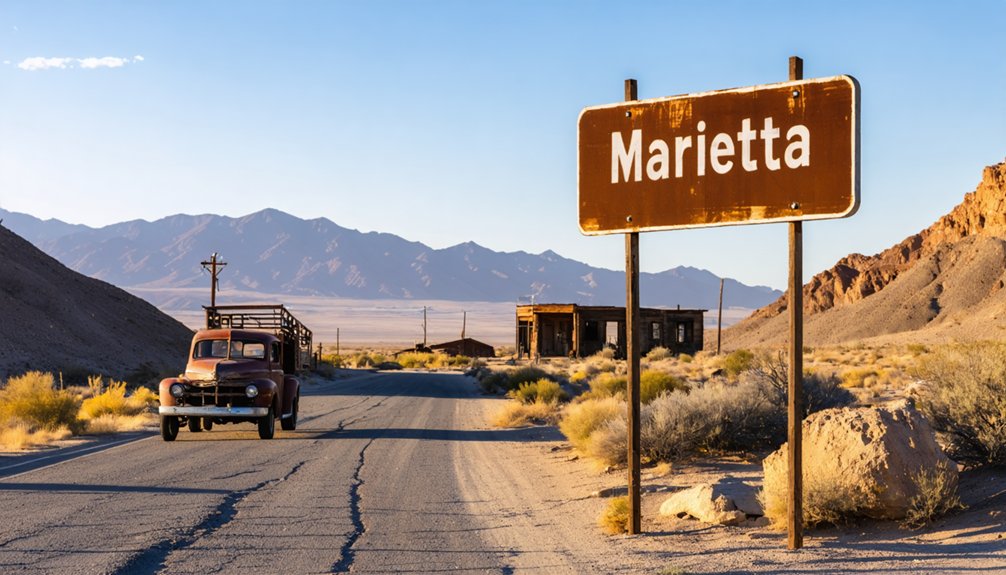
Marietta’s isolation sets the perfect staging ground for a multi-day exploration of Death Valley’s mining frontier. You’ll discover how mining town economics transformed barren desert into bustling communities, then abandoned them just as quickly when ore ran out.
Essential stops along your extended route:
- Rhyolite – Nevada’s most accessible ghost town features the iconic bottle house, crumbling bank walls, and a preserved train depot
- Leadfield – Remote 1926 townsite requiring high-clearance vehicles through Titus Canyon’s dramatic one-way passage
- Chloride City – Scattered ruins at 4,800 feet elevation showcase remote environmental challenges miners faced daily
Each location reveals authentic mining artifacts, from rusted equipment to cement foundations. Pack extra water, fuel, and emergency supplies—you’re venturing where cell service disappears and help’s hours away.
Frequently Asked Questions
Are There Any Guided Tours Available for Marietta Ghost Town?
You’re flying solo here—no guided tours availability exists for Nevada’s Marietta Ghost Town. Local tour companies don’t operate in this remote BLM wilderness. You’ll navigate the rugged dirt roads independently, embracing complete freedom to explore at your own pace.
For those seeking a different kind of adventure, consider the chance to explore ghost towns near Caselton. Each abandoned settlement tells a story of the past, revealing remnants of once-thriving communities. As you wander through the decaying structures, you’ll discover the rich history that surrounds these forgotten places.
Another intriguing option is exploring ghost towns near Star City. These eerie locations offer an immersive experience into the lives once lived there, with hauntingly beautiful landscapes that have been untouched for decades. As you delve into these sites, you’ll encounter fascinating artifacts and remnants that spark the imagination and evoke a sense of nostalgia.
Can Visitors Camp Overnight Near the Marietta Ruins?
No direct camping options exist at Marietta ruins itself, but you’ll find excellent accessibility for visitors at nearby Sunrise Valley RV Resort and Gold Point Ghost Town, both offering full amenities within easy driving distance of the site.
What Is the Best Season to Visit Marietta, Nevada?
Like Goldilocks finding her perfect porridge, you’ll discover fall offers the ideal balance—mild winters ahead, manageable crowds behind, and comfortable 50-70°F temperatures perfect for exploring ruins at your own adventurous pace.
Are There Any Fees Required to Explore the Ghost Town?
You won’t pay any entrance fees to explore Marietta Ghost Town—it’s completely free under BLM management. However, accessibility considerations include requiring a 4×4 vehicle and traversing ten miles of rugged dirt roads without cell service.
How Long Should I Plan to Spend Exploring Marietta?
Plan 1-2 hours for your self-guided walking tour of Marietta’s ruins. You’ll want extra time for photography opportunities among the stone structures, wild burros, and desert landscapes—especially during golden hour when lighting’s perfect.
References
- https://forgottennevada.org/sites/marietta.html
- https://kids.kiddle.co/Marietta
- https://www.youtube.com/watch?v=5lcTZy_SWlA
- https://www.focalworld.com/threads/of-borax-and-burros.29116/
- https://americanwildhorse.org/stories/exploring-the-marietta-wild-burro-range-in-nevada-7410
- https://travelnevada.com/ghost-town/marietta-ghost-town/
- https://www.destination4x4.com/marietta-nevada-ghosttown/
- https://en.wikipedia.org/wiki/Francis_Marion_Smith
- https://www.youtube.com/watch?v=mgNAEkzaT1k
- https://www.mulemuseum.org/frank-shaw-and-the-first-death-valley-20-mule-team.html