You’ll find Mason ghost town in remote Butte County at GPS coordinates 44.8148556°N, 103.8190750°W, where this 1912 prairie settlement has nearly vanished into the South Dakota landscape. Start your journey from Rapid City, heading east through Belle Fourche for supplies before traversing seasonal gravel roads to the site. Nature has reclaimed most structures, leaving only faint depressions and scattered foundations beneath prairie grass. Pack essential supplies, monitor weather conditions, and prepare your camera to capture what little remains of this windswept frontier community that thrived until economic hardship scattered its residents.
Key Takeaways
- Mason ghost town is located in Butte County, western South Dakota at GPS coordinates 44.8148556°N, 103.8190750°W.
- Start from Rapid City, drive eastward through Belle Fourche for supplies, then use GPS for final gravel road stretch.
- The site has virtually no standing structures remaining, with only faint depressions and obscured foundations visible.
- Pack adequate supplies and monitor weather conditions, as the remote location lacks services and road signs.
- The post office operated from 1912-1940 before the town declined due to economic hardship and harsh winters.
Historical Background of Mason’s Founding and Decline
When Mason sprang to life in 1912 on the windswept South Dakota prairie, it carried the name of a local family who’d already planted roots in this unforgiving landscape. You’d have found a busy little community thriving on agricultural operations, complete with a post office serving settlers who’d wagered everything on this frontier opportunity.
But freedom comes with risks. Rural economic pressures squeezed tight when farming alone couldn’t sustain the town’s survival. Weather impacts on settlement proved ruthless—those brutal Dakota winters drove families away year after year. Without diversified industry or employment alternatives, residents faced a stark choice: abandon their dreams or face hardship. Similar to Ardmore, which was founded in 1889 as an agricultural town but declined after the Great Depression, Mason’s fate was sealed by economic hardship.
Eventually, Mason’s population hemorrhaged until only empty structures remained, transforming this once-promising settlement into the ghost town you’ll discover today. Like other abandoned settlements in the region, Mason represents one of many sites in various states of disrepair scattered across South Dakota’s landscape.
Geographic Location and How to Find Mason in Butte County
Mason rests in the remote stretches of Butte County, tucked into western South Dakota’s sprawling prairie landscape where civilization grows sparse and the horizon stretches endlessly. You’ll need the exact coordinates provided—44.8148556°N, 103.8190750°W—to navigate this remote rural setting where traditional road signs won’t guide you.
Punch these GPS coordinates into your device and prepare for off-highway exploration through terrain that demands self-reliance.
Essential navigation points:
- Don’t confuse this location with Mason in Cass County, North Dakota (47.0735886, -97.3289774)—they’re entirely separate ghost towns
- Study county maps beforehand since cell service vanishes in Butte County’s backcountry
- Pack supplies for unexpected delays; isolation defines this territory
This journey rewards those who embrace uncertainty and crave authentic discovery beyond tourist trails. The region sits well removed from the Mason-Dixon line, which historically divided northern and southern states much farther east.
What Remains at the Mason Ghost Town Site Today
When you arrive at Mason’s coordinates today, you’ll find a landscape that’s returned almost entirely to nature, with little more than faint depressions in the earth hinting at where buildings once stood.
The post office that served this community from 1912 to 1940 has vanished completely, leaving no visible trace of the structure that anchored daily life for nearly three decades.
What few foundations might remain are obscured by prairie grass and soil, making this one of South Dakota’s most thoroughly erased settlements. Unlike nearby Cottonwood with its town hall still standing, Mason has left virtually no architectural remnants behind.
For those interested in exploring more substantial historic sites with documented paranormal activity, the Trans-Allegheny Lunatic Asylum in West Virginia operated from 1864 to 1994 and remains one of the largest hand-cut stone masonry buildings in the Western Hemisphere.
Abandoned Structures and Buildings
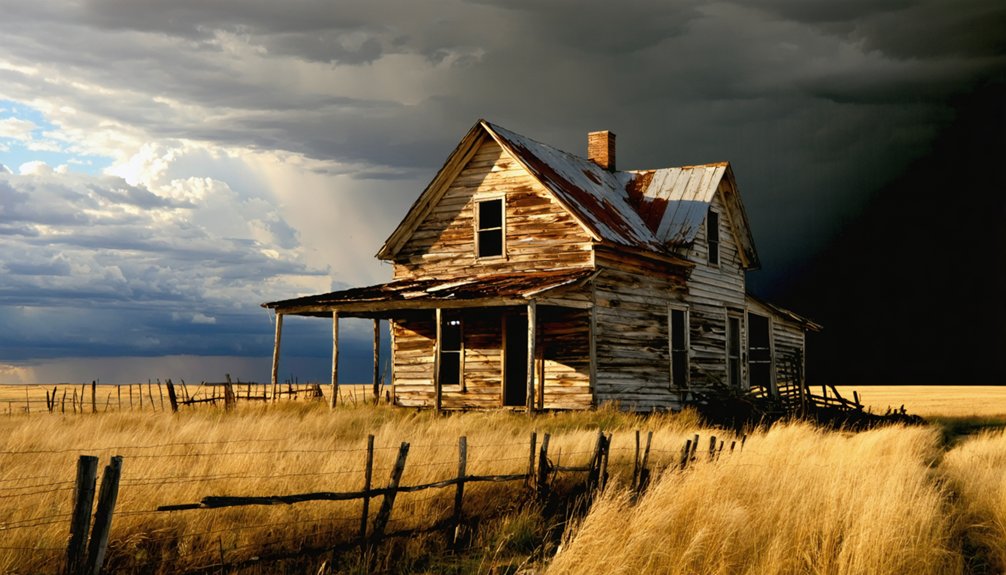
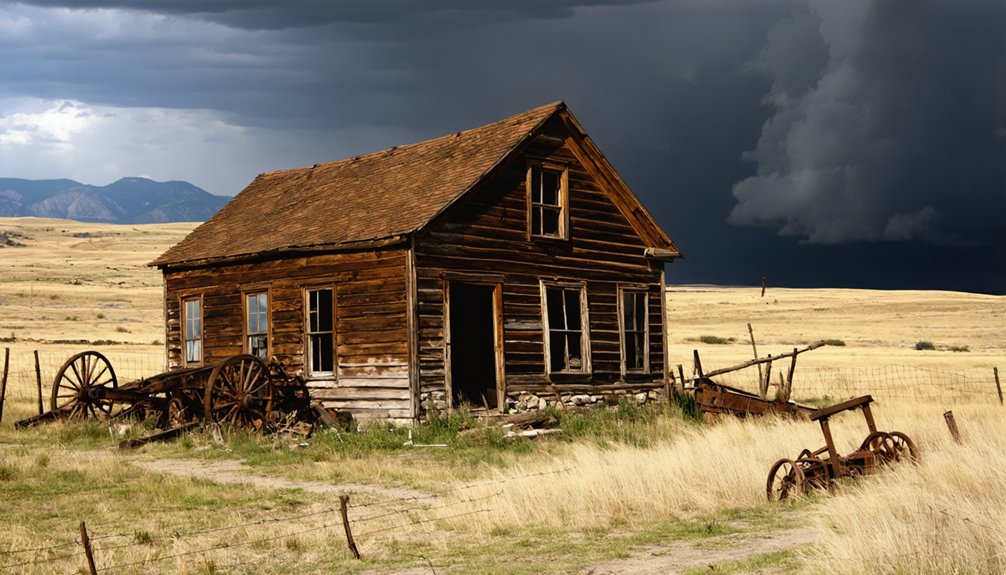
A handful of weathered structures stand as silent sentinels across the Mason townsite, their crumbling frames offering tangible evidence of the community that once thrived here. You’ll discover abandoned houses with dilapidated rooftops sagging under decades of Dakota weather, their interiors still cluttered with tattered furnishings and peeling wallpaper remnants that whisper stories of former residents.
The two-floor caretaker’s house commands attention with its overhanging porch, though its leaning walls and deteriorated siding reveal time’s relentless march.
What you’ll encounter:
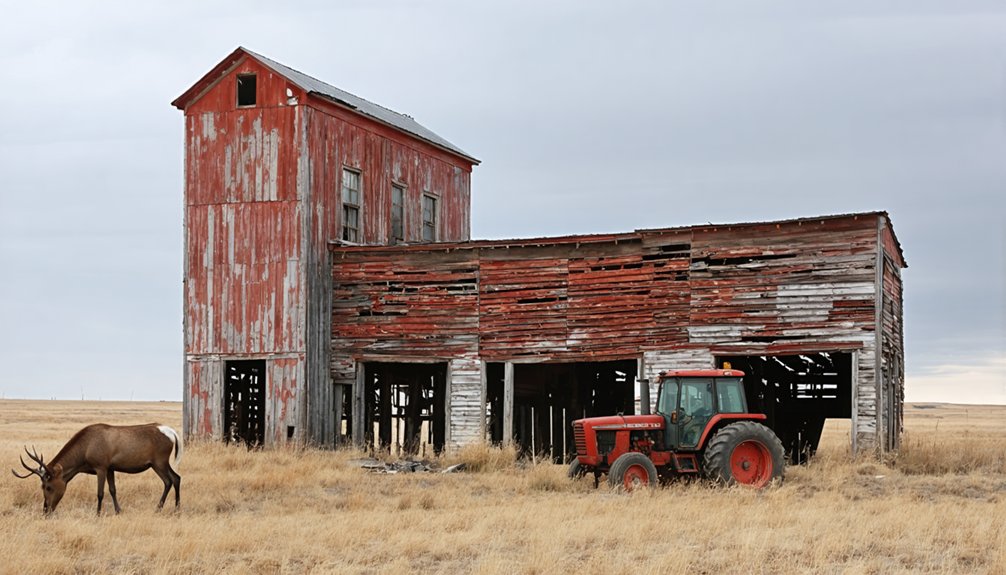
- Old garage and workshop spaces where mechanics once labored over pioneer machinery
- Scattered outbuildings dotting the prairie landscape, each marking where daily life unfolded
- Personal artifacts left behind—intimate glimpses into lives suddenly abandoned
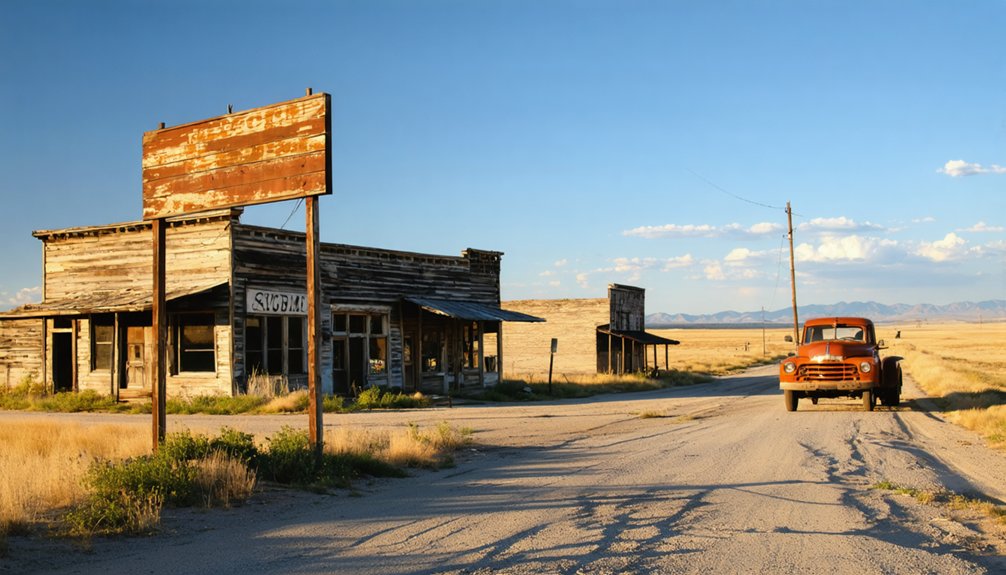
- Rusting automobiles from the 1940s/50s surrounding the caretaker’s house, their hulking frames now swallowed by encroaching vegetation
These decaying monuments to frontier ambition stand unguarded, waiting for explorers seeking authentic connections with America’s vanished past. While wooden structures have largely fallen apart, the brick dwellings have proven more resilient against the elements.
Post Office Historical Remnants
Among the weathered remnants scattered across Mason’s windswept landscape, the former post office has vanished almost entirely from the physical record. You won’t find dedicated markers or preserved structures commemorating where postmaster documentation once tracked deliveries between 1912 and 1940. The building either decayed naturally or was dismantled after closure, leaving only empty spaces among the ghost town’s ruins.
The post office’s historical significance lives through records documenting its operational span rather than physical walls. As you explore Mason’s accessible routes through Butte County, you’re witnessing how economic shifts transformed a viable settlement into scattered foundations. Much like the skilled craftsmen who once built enduring structures across America, the original builders of Mason created foundations meant to last, though time and abandonment ultimately reclaimed what construction techniques had established. The absence itself tells the story of abandonment and rural decline.
Best Routes and Driving Directions for Your Road Trip
Traversing to Mason entails charting a path through the rugged grasslands of northwestern South Dakota, where your journey commences along well-maintained highways before shifting to the remote county roads of Butte County. From Rapid City, strike north on US-85 for approximately 80 miles, then navigate eastward through Belle Fourche—your gateway to lodging options like AmericInn or Super 8.
The final stretch demands attention to seasonal road conditions, particularly gravel surfaces that transform with weather. Before departing Belle Fourche, fuel up and grab provisions near 8th Avenue Bakery or other local establishments.
Essential Waypoints:
- Belle Fourche serves as your base camp, offering fuel, provisions, and overnight stays before the final push
- GPS coordinates 44°48′53.48″N 103°49′8.67″W become critical when pavement ends and prairie roads converge
- Monitor weather patterns in Mountain Time zone, as spring snowmelt and summer storms dramatically alter backcountry accessibility
Nearby Black Hills Attractions and Other Ghost Towns to Visit
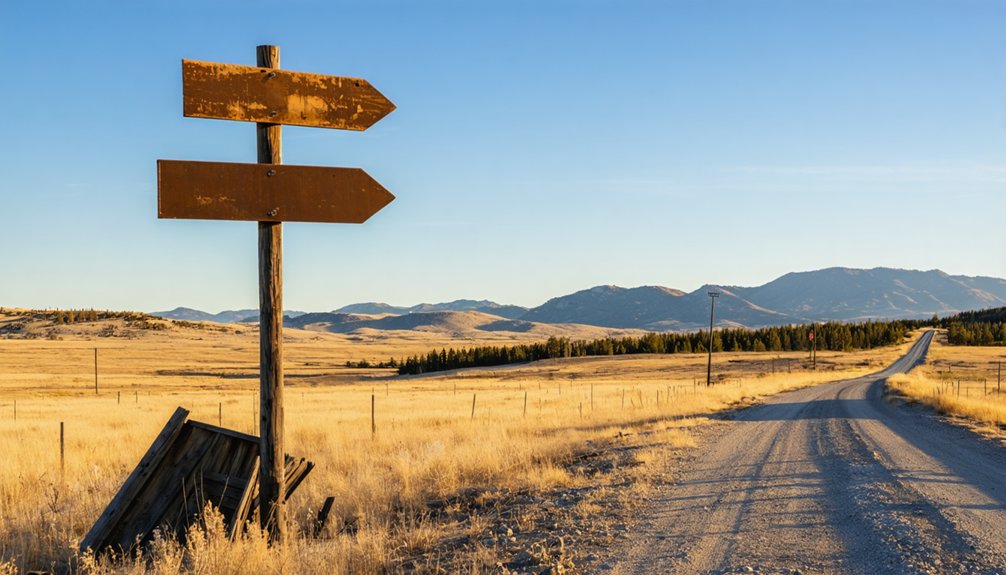
Your journey to Mason opens up the entire Black Hills region, where world-famous monuments and natural wonders lie within easy driving distance. Mount Rushmore‘s presidential sculptures and Wind Cave’s intricate boxwork formations anchor a collection of attractions that’ll fill multiple days of exploration.
Beyond Mason itself, several other ghost towns dot the surrounding hills, creating opportunities to piece together an extensive tour of South Dakota’s abandoned mining camps and forgotten settlements. For a striking geological contrast, venture about an hour east to Badlands National Park, where the prairie landscape gives way to dramatic eroded formations.
Black Hills Regional Attractions
While Mason offers a glimpse into South Dakota’s forgotten past, the surrounding Black Hills region bursts with monumental attractions that draw millions of visitors each year. You’ll discover Mount Rushmore’s 60-foot presidential faces and the ongoing Crazy Horse Memorial carving, both celebrating American heritage through granite sculpture.
The landscape diversity spans 1.2 million acres of Black Hills National Forest, where you can hike Black Elk Peak or ride the 109-mile Mickelson Trail. Custer State Park showcases roaming bison herds and dramatic Needles Highway tunnels, while Spearfish Canyon’s waterfalls cascade beside historic Deadwood’s Wild West saloons.
Regional tourism infrastructure connects these attractions through:
- Scenic byways linking Iron Mountain Road to Needles Highway
- Adventure operators offering helicopter tours and underground mine explorations
- Historic sites from Native American landmarks to gold rush destinations
Neighboring Ghost Town Routes
Beyond Mason’s weathered foundations, the Black Hills harbor over 600 ghost towns where gold fever once drove thousands into canyons and gulches that now echo only with wind.
You’ll find Rochford just miles away, its abandoned buildings scattered among silent mines where hard rock operations once thundered. Continue to Mystic in Pennington County, where a historic chapel rises above the mining town landscape like a monument to forgotten dreams.
Galena awaits in Vanocker Canyon, its 1876 schoolhouse standing photogenic against canyon walls. Further south, Ardmore straddles the Nebraska border along Highway 71—its preserved Main Street and brick dwellings frozen since the railroad era.
Each stop reveals another chapter of frontier ambition, where prosperity vanished but ruins remain for those seeking authentic Western exploration.
Essential Supplies and Preparations for Exploring Remote Locations
Setting off to explore Mason, South Dakota requires careful preparation, as this remote ghost town sits far from modern conveniences and emergency services. You’ll need to approach this adventure with self-sufficiency in mind, packing lightweight gear that won’t weigh you down during exploration yet covers essential survival needs.
Your preparation checklist should include:
- Documentation and emergency contacts: Carry passport copies, medical emergency contacts, and vaccination records stored separately from originals
- Health and hydration essentials: Pack an extensive first-aid kit with bandaids, antibacterial ointment, medications, and a reusable water bottle with filter for safe drinking
- Safety and navigation tools: Bring a portable flashlight, safety whistle, GPS-enabled smartphone, and TripWhistle app for location sharing
Quick-dry clothing, protein bars, and portable power sources round out your essential supplies for this off-grid expedition.
Photography Opportunities and What to Expect at the Site
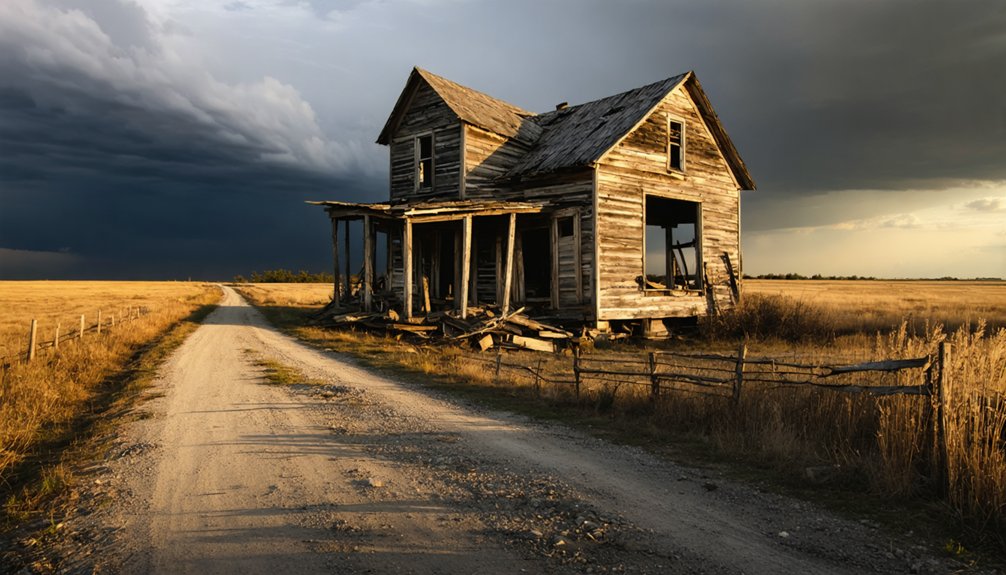
When you arrive at Mason’s coordinates in the vast Butte County prairie, you’ll find a landscape where absence speaks louder than presence. Weathered foundations and building outlines from the 1912 settlement offer subtle photographic perspectives against endless open plains.
The post office era remnants—scattered debris and collapsed dwellings—create compelling compositions of rural decay framed by South Dakota’s big sky.
Golden hour transforms these minimal ruins, casting long shadows across foundations while soft light reveals textures in aged materials. Wide-angle shots capture the isolation’s scale, emphasizing how nature reclaims what the Mason family once built. Bring lens protection for dust and wind in this arid environment.
Expect quiet solitude rather than dramatic structures. Mason rewards photographers who appreciate subtlety—the poetry found in what’s vanished rather than what remains standing.
Research Resources and Historical Records for Further Exploration
Tracing Mason’s story requires piecing together fragments from scattered archives across South Dakota. You’ll find the most concrete evidence in Butte County’s registers of deeds, where land transactions reveal who staked claims between 1912 and 1940.
Post office records confirm Mason’s operational years, marking its rise and abandonment. For broader context, explore digitized archival records through CORE’s academic databases, which analyze county histories and atlases using geographic perspectives. County land deeds disclose patterns of settlement and railroad plats that never materialized beyond paper.
Essential research starting points:
- Butte County Historical Society holds community histories and early settler documentation
- National Register of Historic Places provides comparative data on nearby preserved towns like Mystic
- Academic PDFs define ghost town classification criteria, helping you understand what qualifies Mason’s abandoned status
These resources let you reconstruct Mason’s narrative independently.
Frequently Asked Questions
Is Overnight Camping Allowed at the Mason Ghost Town Site?
The Mason ghost town site doesn’t offer designated camping areas or overnight parking logistics. You’ll need to explore nearby Black Hills National Forest dispersed camping options instead, though site amenities availability there remains minimal for your freedom-seeking adventure.
Are There Any Private Property Restrictions or Access Fees?
Looking for unrestricted exploration? You’ll need to respect private land ownership at Mason’s ghost town site. Public access guidelines require viewing from roads only, with no entry fees but strict trespassing laws protecting property rights throughout South Dakota.
What Is the Best Season to Visit Mason Ghost Town?
You’ll find the best touring season runs from late May through September, when ideal weather conditions bring comfortable 70s temperatures and clear skies. September’s your sweet spot—mild days, minimal crowds, and perfect light for exploring Mason’s abandoned structures freely.
Is Cell Phone Reception Available in the Mason Area?
Cell phone coverage reliability in Mason’s remote area is extremely limited. You’ll likely experience minimal to no cellular data connectivity in this isolated ghost town, so download maps and information before you venture off-grid into South Dakota’s backcountry.
Are Guided Tours of Mason Ghost Town Available?
No guided tours operate at Mason Ghost Town—you’ll explore independently on your own schedule. There’s no set guided tour duration or guided tour schedule, giving you complete freedom to wander and discover this abandoned settlement at your preferred pace.
References
- https://en.wikipedia.org/wiki/Mason
- https://en.wikipedia.org/wiki/List_of_ghost_towns_in_South_Dakota
- https://www.powderhouselodge.com/black-hills-attractions/fun-attractions/ghost-towns-of-western-south-dakota/
- https://icatchshadows.com/okaton-and-cottonwood-a-photographic-visit-to-two-south-dakota-ghost-towns/
- https://www.youtube.com/watch?v=jmSADvq4Lek
- https://core.ac.uk/download/pdf/345016075.pdf
- https://falloutfanon.fandom.com/wiki/Mason
- https://www.southdakotamagazine.com/travel-like-1938
- https://kids.kiddle.co/Mason
- https://tc.maptons.com/1181278