You’ll find McCormick along State Route 6 in Lewis County, where forest has swallowed most traces of the lumber town that once housed 300 workers. Navigate using GPS coordinates and ZIP code 98572, as signage is scarce. Download offline maps before you go—cell service vanishes here. The Willapa Hills Trail cuts through crumbling foundations and moss-covered timber artifacts, offering ghostly solitude for those willing to hike rough terrain. Winter roads turn treacherous, and nearby dining options close Sundays, so plan accordingly for discoveries that await beneath the ferns.
Key Takeaways
- Navigate using GPS coordinates and ZIP code 98572, as McCormick is unincorporated with limited wayfinding signage along State Route 6.
- Download offline maps before visiting, as cell service is unreliable in this remote Lewis County location.
- Explore the Willapa Hills Trail to access old road beds, crumbling foundations, and timber artifacts reclaimed by forest.
- Respect private property boundaries while photographing foundation stones and railroad grades documenting the town’s disappearing history.
- Avoid winter visits when unpaved surfaces become slick, and prepare for limited dining options, especially on Sundays.
Getting to McCormick: Routes and Road Conditions
Tucked into the forested hills of Lewis County, McCormick sits along Washington State Route 6 like a forgotten bookmark between the pages of rural America. You’ll find it west of Pe Ell and just east of Walville’s former townsite, at an elevation of 466 feet.
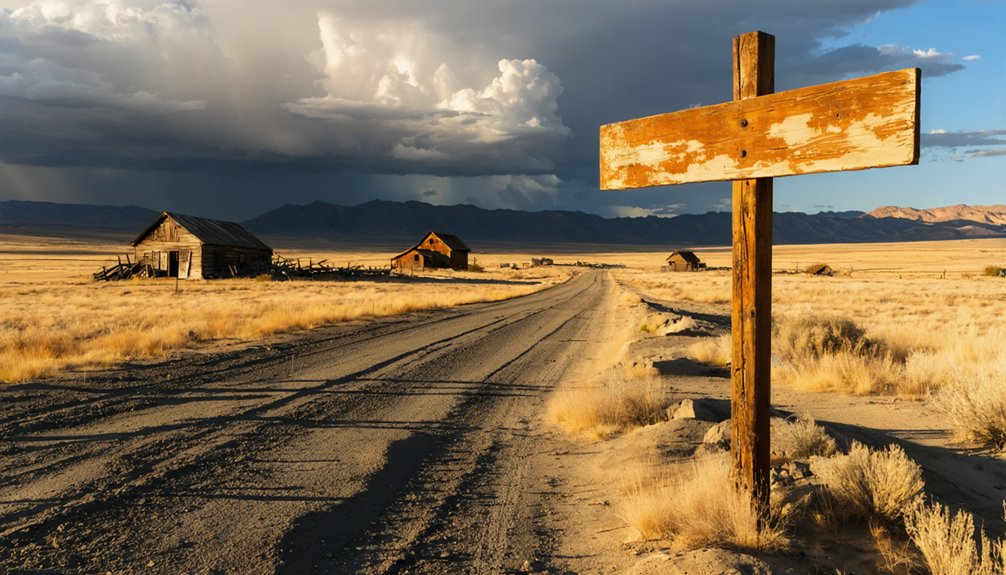
Don’t expect limited wayfinding signage to guide you—this ghost town’s unincorporated status means you’re traversing by GPS coordinates and ZIP code 98572. Route 6 provides your primary access through rolling terrain, though seasonal access challenges can complicate winter visits when Pacific Northwest rain turns unpaved surfaces slick.
The Willapa Hills Trail cuts through the area, offering adventurous souls an alternative pathway. The area’s history echoes settlements like those along Stevens Creek in 1715, where early American pioneers established cow-pens and trading posts in similarly remote wilderness. If you’re planning to explore on Sunday, be aware that dining options may be limited, as many small-town establishments close for the day. There’s no municipal infrastructure here, just county-maintained roads and the freedom of forgotten landscapes waiting for your discovery.
The Rise and Fall of a Lumber Town
When Harry McCormick and F.B. Hubbard established their lumber operation in 1897, they created more than just a mill—they built a thriving community of 300 workers two miles west of Pe Ell. The company’s specialty in telegraph cross-arms kept Western Union supplied and Lewis County’s finest timber flowing.
You’ll find it remarkable that the mill survived three devastating fires, including the near-total destruction of 1909, before finally closing in 1927. The decline of the lumber industry hit hard here, leading to complete dismantling by 1931.
Community shift after mill closure brought unexpected changes—a tuberculosis sanatorium operated from 1935 to 1941, marking the metamorphosis from industrial powerhouse to ghost town. Marzell Muller constructed the impressive mill facility, which featured a distinctive sundial that remained visible to the community. Today, the town shares its name with various other McCormick locations and individuals listed in disambiguation references.
What Remains: Exploring the Ghost Town Today
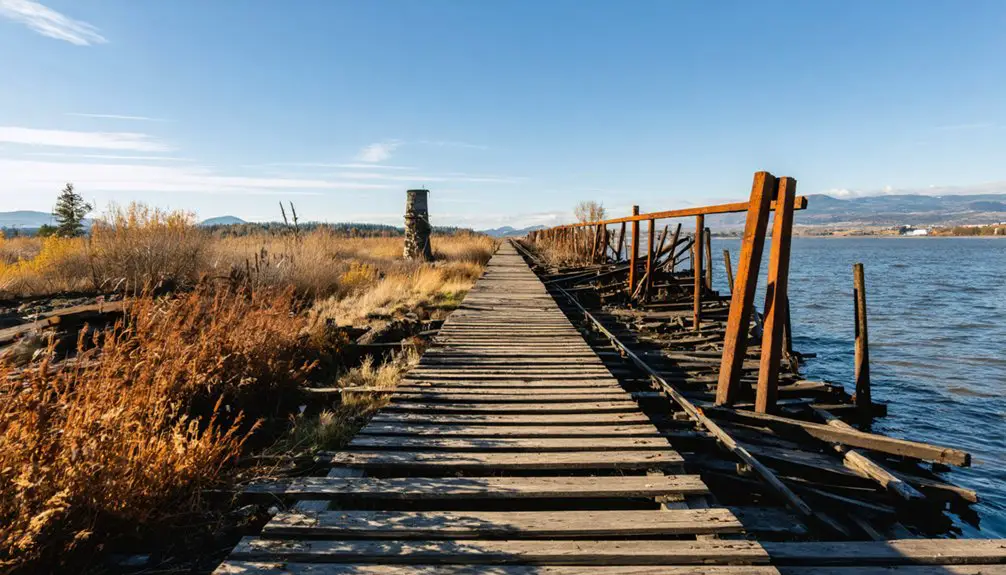
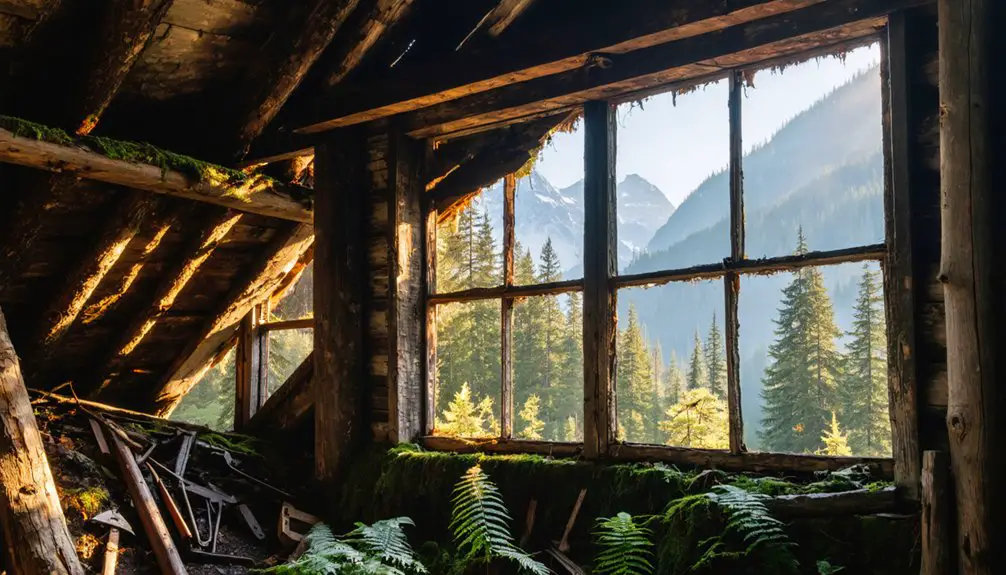
Standing where McCormick once thrived, you’ll discover a landscape that’s reclaimed what industry temporarily borrowed. The forest has swallowed most traces of the sawmill that operated here until 1930, but determined explorers find crumbling foundations hidden beneath moss and ferns. You’ll navigate old road beds along the Willapa Hills Trail, spotting timber artifacts that hint at the town’s bustling past.
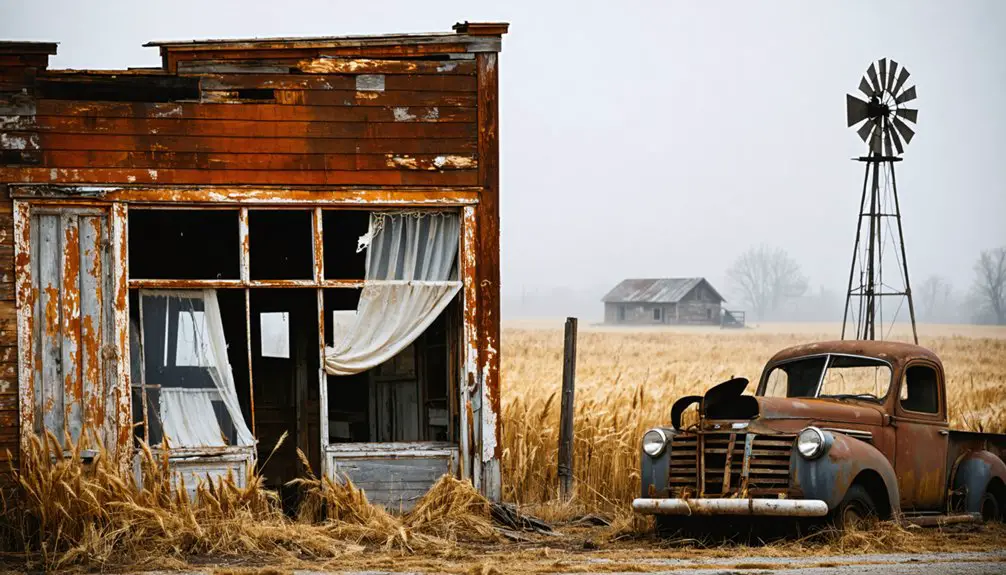
Respect private property boundaries—some structures survived into the 1950s, and ownership remains complicated by that Lewis-Pacific County line split. There’s no museum here, just authentic decay. Bring sturdy boots for day-hiking through these Washington woods. The absence of crowds means you’re free to contemplate history without barriers, discovering McCormick on your own terms amid its quiet, ghostly solitude. Like many mining towns in Washington’s mountains, the rough terrain and harsh winters eventually contributed to abandonment, though McCormick’s demise was tied to timber rather than precious metals. Unlike the notorious 70 saloons that once lined Bodie’s streets, McCormick’s infrastructure was modest, focused purely on the timber industry that sustained it.
Nearby Walville and the Willapa Hills Trail
Just two miles south, Walville’s story unfolds with even more dramatic contradictions than McCormick’s quiet fade. This lumber town literally straddled two counties—Lewis and Pacific—splitting the sawmill itself down the middle. County boundary issues created absurd complications: kids supposedly attended different schools depending which side of their house they slept in.
What makes Walville compelling are its hidden labor demographics. Japanese workers and immigrants built this mill while management lived in pretentious offices above the valley. The town was named in 1903, combining the first syllable of Walworth with the last of Neville from the lumber company that established it. By 1930, the denuded hills forced closure. Today, you’ll find the Willapa Hills Trail cutting through where the mill once stood. Six occupied homes remained by the 1950s. Now? Just forest reclaiming what industry abandoned, accessible via trails where lumber once rolled out.
Essential Tips for Your History-Focused Adventure
Download offline maps since cell service proves unreliable. Respect private property boundaries—George Fraser’s 1954 purchase means some areas remain off-limits.
Photograph foundation stones and railroad grades along the Willapa Hills Trail. You’re documenting what’ll disappear completely within another generation.
Frequently Asked Questions
Are There Any Guided Tours Available for Mccormick Ghost Town?
No guided tours exist for McCormick Ghost Town since it’s not a confirmed Washington location. You’ll find freedom exploring verified ghost towns through self-guided tours along walking trails at sites like Molson, where you’ll discover artifacts independently.
The ghost town history of McCormick adds an intriguing layer to the region’s past, even if it remains elusive to formal exploration. Many remnants of the town’s existence have faded, but passionate history enthusiasts often seek out tales and myths surrounding McCormick’s brief period of prominence. As you wander through the more established sites, you’ll gain a deeper appreciation for the stories that shaped Washington’s frontier life.
What Happened to the Residents After the Mill Closed in 1927?
You’ll find residents didn’t relocate—they simply drifted away as the mill died. Some salvaged abandoned properties while others clung on until 1941. No organized community relocation occurred; people just followed opportunity elsewhere, leaving McCormick to the forest.
Can I Camp Overnight Near the Mccormick Ghost Town Site?
You can’t camp overnight at McCormick Forest Park itself, but you’ll find nearest campgrounds like “The Ghost Town” Hipcamp site nearby. The historical significance of site makes day exploration rewarding before heading to surrounding camping areas.
Are There Any Historical Photographs of Mccormick During Its Operating Years?
Historical photos from operating years of McCormick are extremely scarce. You’ll find more luck with archived newspaper accounts of town activities in regional collections, though even these require dedicated searching through Washington State Historical Society archives.
Is the Tuberculosis Sanatorium Building Still Standing and Accessible?
The sanatorium’s fate remains shrouded in time’s fog—no records confirm the building’s survival. You’ll find accessibility restrictions nonexistent because the site’s current condition stays unverified. Before venturing out, scout locally to avoid chasing ghosts that’ve vanished completely.
References
- https://kids.kiddle.co/McCormick
- https://en.wikipedia.org/wiki/McCormick
- https://mccormickscchamber.org/about/about-mccormick-county/history/
- https://www.randomconnections.com/mccormick-county-photo-trek/
- https://en.wikipedia.org/wiki/Walville
- https://stephentravels.com/top5/ghost-towns/
- https://abandonedonline.net/category/region/midwest/
- https://www.historylink.org/File/22815
- https://en.wikipedia.org/wiki/Charles_R._McCormick_Lumber_Company
- https://www.bonnermilltownhistory.org/milltown