You’ll find Midian’s ghost along Butler County Road 100, where an oil boomtown that pumped 9% of America’s WWI fuel supply vanished into prairie grass. Bring a camera for early morning light—it’s perfect for spotting metal fragments from the removed cemetery arch and photographing empty horizons where derricks once crowded the skyline. Pack water and study historical maps before traversing Butler County’s 406-mile back road network, because this single-resource town’s four-year burn teaches lessons about boom-and-bust economics that still echo across Kansas’s oil fields.
Key Takeaways
- Midian sits in Butler County, Kansas, accessible via 406 miles of back roads near the historic El Dorado oil fields.
- The town thrived 1916-1920 as Cities Service’s company town before oil depletion caused complete abandonment by 1950.
- Visit early morning for best light to photograph prairie remnants where drilling rigs and worker housing once stood.
- The cemetery’s wrought iron arch monument was removed around 1995; exact coordinates require historical records and field investigation.
- Combine your trip with El Dorado’s oil heritage sites to understand the regional boom that produced 9% of America’s WWI oil.
The Oil Boom That Built Midian
The prairie beneath Butler County, Kansas held a secret worth millions, and on February 5, 1916, the Stapleton No. 1 well finally cracked it open. Oil gushed from 2,497 feet below Wilcox sand at 110 barrels daily, transforming sleepy farm communities into roaring petroleum towns.
You’ll find Midian rose from this chaos as Cities Service’s company town, where drilling rigs pierced the sky and workers chased fortunes alongside Oil Hill. Oil field technology advancements pushed production from 2.8 million barrels in 1915 to 45 million by 1918’s peak.
Local political influence followed the money—entrepreneurs like Deering Marshall and Henry Doherty shaped Kansas’s energy future while El Dorado alone pumped 9% of America’s oil, fueling World War I’s machinery and financing Wichita’s aviation dreams.
Life in a Company Town: 1918-1950
When Cities Service staked its claim in 1918, Midian sprang from prairie grass as a settlement where corporate ledgers dictated daily rhythms. You’d have found no elected mayor here—community leadership roles belonged to company supervisors who managed housing assignments and infrastructure. The corporation’s economic investment strategies shaped everything from where your kids attended school to which general store stocked supplies.
Mail arrived at the post office starting in 1918, connecting families to distant relatives while oil derricks pumped black gold nearby. Workers built lives around extraction schedules, their fortunes rising and falling with production numbers.
The Midlotheian-Freeport Newspaper Feud
You’ll find echoes of Kansas’s fierce newspaper tradition in the Midlothian-Freeport rivalry, where competing weeklies turned neighboring coal towns into battlegrounds of printed insults and civic pride. The papers didn’t just report news—they launched calculated attacks on rival towns’ businesses, politicians, and prospects, each editor wielding his press like settlers once wielded rifles across the Kansas-Missouri border.
When the Harper County Sentinel finally reported Freeport’s victory through a town merger, it marked the end of an ink-stained war that had outlasted many of the mines themselves.
Competing Newspapers Launch Attacks
Venom dripped from printing presses as Midlotheian and Freeport transformed ink and paper into weapons during Kansas’s bloodiest territorial conflicts. You’ll discover how editors wielded partisan editorials like daggers, accusing rivals of distorting slavery debates through media bias influences that polarized settlers. These competing coverage rhetoric battles escalated daily—each paper publishing inflammatory accusations about voting fraud, territorial election tampering, and rival town corruption.
When you visit Midian today, imagine newsboys hawking fresh editions filled with attacks on pro-slavery forces while Freeport’s presses countered with anti-slavery manifestos. Neither paper sought middle ground; compromise meant betrayal. Their ink-stained feuds fueled hair-trigger violence across the border region, connecting local grudges to national fractures. These weren’t just newspapers—they were arsenals where words ignited the powder keg leading to Civil War.
Freeport Wins Town Rivalry
By 1890, Freeport’s printing presses had drowned out Midlothian’s voice entirely, claiming victory in a newspaper war that determined which settlement would survive on the Kansas prairie.
You’ll find that Freeport’s local advantage wasn’t accidental—the town’s strategic positioning at 1,338 feet elevation commanded better access to Harper County’s scattered homesteads. The Midlothian Sun tried matching Freeport’s aggressive campaigns, but newspaper strategy shifts came too late.
When you visit today, you’re standing where ink-stained editors once wielded words like weapons, their presses churning out partisan attacks that literally built communities. By 1915, Freeport claimed 108 residents while Midlothian faded into grassland. The Alliance Bulletin documented this brutal competition from Harper, proving that in territorial Kansas, whoever controlled the press controlled destiny itself.
Harper Sentinel Reports Merger
The Harper Sentinel’s front page from December 26, 2025, tells a strikingly different story than the cutthroat newspaper battles that killed Midlothian a century earlier. Where rival editors once wielded words like weapons, today’s merger consolidation impacts show evolution toward cooperation.
The Plainville Times’ changeover to Stockton Sentinel ownership represents collaboration, not conquest. You’ll notice advertiser benefits from merger immediately—businesses pay once to reach the entire county instead of duplicating costs across competing papers.
The Hamilton siblings, running Stockton’s press since 1931, aren’t crushing rivals; they’re preserving journalism’s survival in sparse Kansas counties. Main Street Media’s Frank Mercer recognized sustainability beats stubbornness.
This peaceful consolidation guarantees Rooks County maintains its newspaper heartbeat—something Midlothian’s feuding editors destroyed through their pride.
What Remains: Finding the Iron Arch Monument
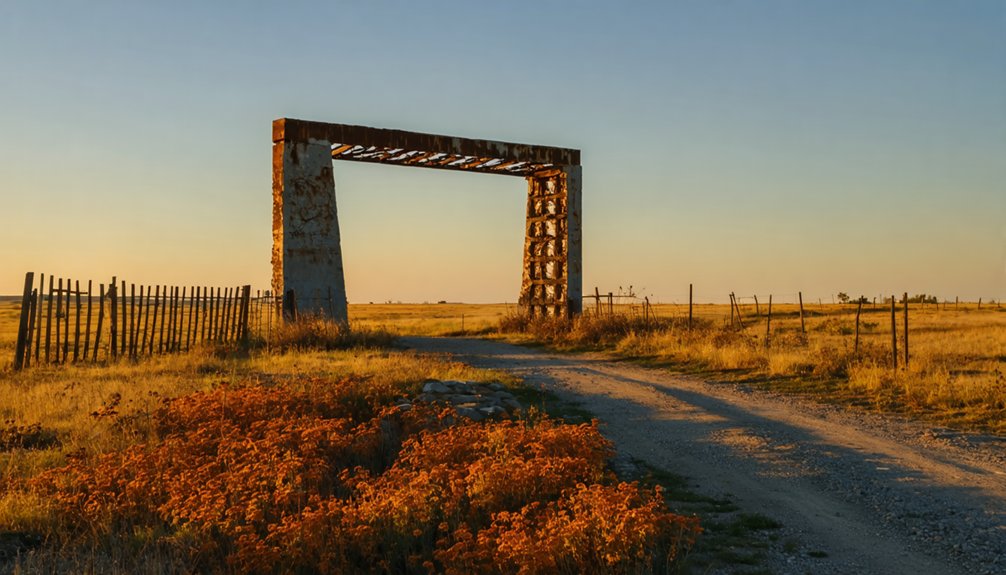
You’ll search in vain for the wrought iron arch that once marked Midian’s cemetery entrance—it was removed around 1995 when Highway 254 cut through the area.
What you’ll find instead is empty farmland under a wide Kansas sky, where the only monuments are fence posts and the occasional cattle gate. Bring a good county map and low expectations; sometimes the most powerful ghost town artifacts exist only in historical photographs and fading memories.
Locating the Monument Today
Finding Midian’s iron arch monument requires equal parts determination and luck, since nature has reclaimed much of what the prairie winds didn’t scatter decades ago. You’ll need to start by locating historical records at county offices or local historical societies, though documentation remains sparse.
When conducting on site investigation, bring a GPS unit loaded with old survey maps—cellular service disappears out here. The monument’s exact coordinates shift depending on which source you trust, so plan for some wandering through tall grass and weathered foundations. Early morning light works best for spotting metal fragments among the prairie vegetation.
Photographing Historical Remnants
Once you’ve tracked down the general location where Midian’s iron arch once stood, you’ll face a sobering reality—the monument itself vanished around 1995 when Highway 254 construction crews removed it. Your camera will find only overgrown rural Butler County landscapes where that wrought iron craftsmanship once marked the cemetery entrance.
This is where documenting details becomes indispensable. Photograph the empty fields, the county roads, the horizon line. Capture what absence looks like. I’ve learned that preserving memories of ghost towns means photographing not just remnants, but the spaces where history evaporated.
Study old images of the arch online before your visit—they’ll help you visualize what stood there. Your photos will document how completely an oil boomtown can disappear, leaving only cyberspace traces behind.
Getting There: Butler County Back Roads
Before you can explore the remnants of Midian, you’ll need to navigate Butler County’s impressive network of back roads—a 406-mile spiderweb of county-maintained routes that crisscross 1,472 square miles of Kansas prairie.
Your adventure starts with understanding the terrain:
- 357 miles of paved county roads form your primary arteries
- 49 miles of aggregate surfaced routes require careful driving
- Nearly 2,000 township-maintained miles offer authentic exploration
- Interstate 35 and Highway 54 provide quick regional access
Check aggregate road conditions before departure—spring rains transform these surfaces into challenging terrain. Download the County Road Map showing maintenance jurisdictions (solid blue lines mark county routes). Township roads appear as dashed blue, indicating different back road maintenance standards.
Contact Assistant County Engineer Bronson Webb at (316) 322-4101 for current road status. Real freedom means respecting these rural routes.
Nearby Ghost Towns Worth Exploring

While Midian serves as your primary destination, Butler County‘s position at the crossroads of Kansas oil country puts you within striking distance of dozens of vanished prairie settlements. Head northwest 1.5 miles from El Dorado to Oil Hill, where derricks once dotted the landscape. Thirteen miles east, Rosalia‘s weathered remnants tell their own story. Extinct Minneha and Midland mark historic land routes to explore along your journey.
Beyond Butler County, nearby pioneer era settlements await your discovery. South Haven—originally the colorful “Shoefly City”—retains a small population and frontier character. Perth joins the Sumner County ghost town circuit south of Wichita, where railroad booms turned to agricultural busts. Drury’s abandoned buildings and Corbin’s surviving Main Street structures offer tangible connections to Kansas’s restless past, each stop revealing another chapter of prairie resilience and decline.
Why Midian Disappeared: From Boom to Bust
Like countless Kansas prairie settlements, Midian’s fate was sealed the moment oil companies sank their first wells into Butler County soil. You’ll find these ghost town origins follow a predictable pattern—quick riches, quicker collapse.
The regional oil economy gave Midian life around 1916, then strangled it by 1920 when wells ran dry.
Midian burned bright for four years before the oil vanished, taking the town’s future with it.
Four Forces That Killed Midian:
- Single-resource dependency – No farms, no industry, just black gold
- Wells depleted faster than anyone predicted
- Bigger operations in El Dorado pulled workers and capital away
- Zero economic diversification meant no Plan B
Best Time to Visit and What to Bring
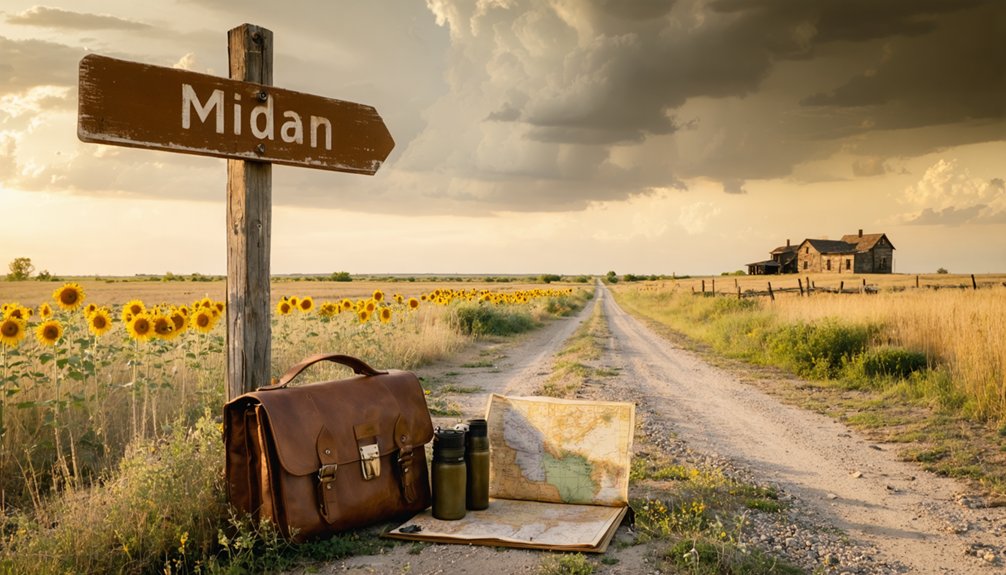
Planning your trek to Midian means preparing for Butler County’s temperamental prairie climate and unpredictable dirt roads that turn to mud soup after spring rains.
You’ll want to visit during fall’s crisp October days when temperatures hover in the 60s and the ground’s firm beneath your boots. Sunrise hours offer the best light for photography and solitude before Kansas winds pick up. Pack water—there aren’t local amenities for miles. Bring sturdy hiking boots, a GPS device since cell service is spotty, and layers for sudden temperature swings.
Spring’s second-best despite mud risks, offering wildflowers among the ruins. Summer’s brutal heat and winter’s ice make exploration miserable. Always carry emergency supplies; you’re genuinely on your own out here.
Frequently Asked Questions
Are There Any Safety Concerns When Visiting Abandoned Town Sites in Kansas?
Yes, you’ll face real dangers exploring these ghost towns. Watch for structural hazards like crumbling buildings and contaminated mining debris. Be mindful of local trespassing laws—freedom doesn’t mean immunity from prosecution. Pack water, sturdy boots, and your adventurous spirit responsibly.
Can I Camp Overnight Near the Midian Monument Site?
You’ll need to check availability of camping facilities near Midian, as most ghost town sites lack designated areas. Potential restrictions on overnight stays often apply on private property, so scout nearby state parks or public lands for legal camping spots first.
Is Gloria Tucker’s Property Open to Visitors or Off-Limits?
Gloria Tucker’s property remains off-limits to visitors. You’ll encounter strict visitor restrictions and clearly marked property boundaries. Respect these limits—trespassing carries hefty fines. Instead, explore nearby public roads for glimpses of Midian’s haunting beauty while staying legal.
What Photography Equipment Works Best for Documenting Ghost Town Remnants?
You’ll want wide-angle lenses to capture crumbling facades and eerie interiors in their full glory. Tripod stability becomes essential for those moody long exposures when natural light fades—I’ve saved countless shots this way in abandoned places.
Are There Guided Tours Available for Butler County Ghost Towns?
No guided tours exist for Butler County ghost towns, so you’ll commence self-guided tours instead. Connect with local historians before departing—they’ll share hidden gems and stories that maps won’t reveal, enriching your independent exploration.