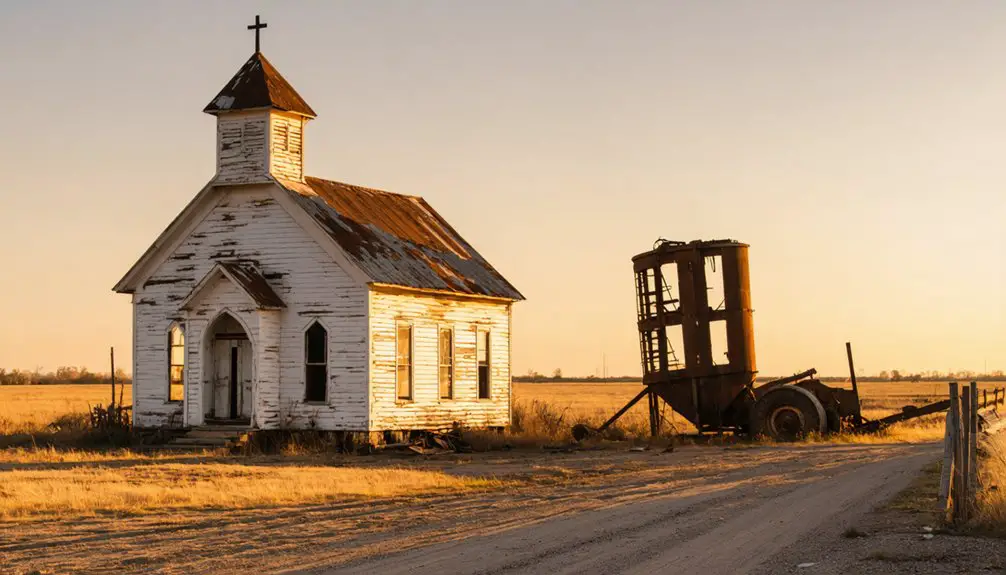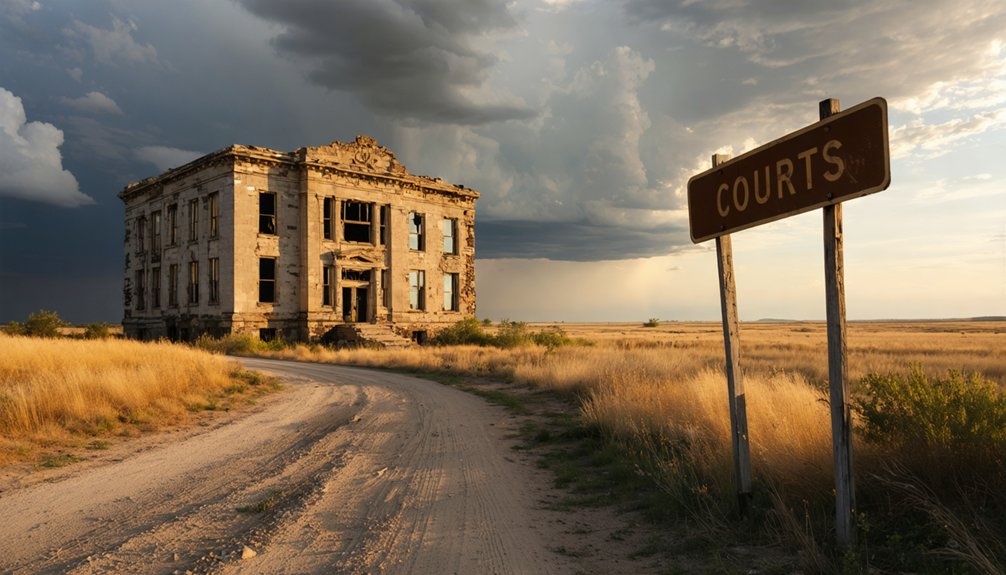
You’ll find Miller Court House’s ghost town site near Idabel by heading north on US-259 through McCurtain County, though virtually nothing remains of this 1821 Arkansas Territory settlement. The original courthouse and community have vanished completely, reclaimed by fields and vegetation, making it one of Oklahoma’s most elusive historical locations. Fuel up in Idabel before your search, as sparse signage and lost records make pinpointing exact coordinates challenging. Combine your expedition with nearby attractions like Beavers Bend State Park to discover why this vanished settlement holds fascinating secrets.
Key Takeaways
- Miller Court House, established in 1821 as Arkansas Territory’s county seat, ceased to exist in 1828 with no structures remaining.
- From Idabel, take US-259 north through McCurtain County and watch for highway historical markers near the site.
- The exact location is difficult to pinpoint due to sparse signage, lost records, and overgrown vegetation reclaiming the land.
- Nearby attractions include Beavers Bend State Park, Tiner Historical Schoolhouse, and Spaulding-Olive House in Idabel for territorial history.
- Fuel up in Idabel beforehand, check weather for fog or flooding, and no permits are required for visiting.
The Historical Significance of Miller Court House
When you stumble upon the forgotten site of Miller Court House today, you’re standing where Oklahoma’s first courthouse once dispensed justice—though technically, it wasn’t in Oklahoma at all. Established in 1821, this Arkansas Territory outpost fulfilled the role as county seat for Miller County, governing a wild frontier where three future states would eventually converge.
Sheriff Claiborne Wright and postmaster J.H. Fowler maintained order in this remote settlement until treaties redrew the map. The trail of tears connection runs deep here—Choctaw families registered at this very spot before their forced removal, and corn supplies stockpiled nearby sustained them during relocation. Like the Jesse Chisholm Trading Post, this location served as a crucial waypoint in the region’s frontier commerce and settlement patterns.
The county’s jurisdiction ended in 1828, when territorial boundaries shifted and Miller County ceased to exist as an administrative unit.
Getting to the Abandoned Town Site Near Idabel
The vanished community that witnessed Oklahoma’s earliest legal proceedings isn’t easy to find, but that’s exactly what makes the journey worthwhile. You’ll discover Miller Court House by embracing the challenge of abandoned access roads and limited site markers along US-259 near Idabel.
Finding Miller Court House demands perseverance through unmarked roads and fading history, rewarding those who seek Oklahoma’s hidden territorial past.
Your route requires:
- Start from Idabel and follow US-259 north through McCurtain County’s forested terrain
- Watch for the historical marker positioned along the highway—your only modern landmark
- Navigate rural county roads connecting to the former Miller County Arkansas Territory site
- Prepare for unmarked territory near the Red River cession area where the Choctaw registration station once stood
The lack of GPS coordinates and developed infrastructure means you’re genuinely exploring Oklahoma’s forgotten frontier, tracing paths once traveled during the Trail of Tears. This remote location once served as Oklahoma’s first post office, operating from September 5, 1824 until its closure in December 1839. The site lies within McCurtain County, Oklahoma’s southeastern corner bordering the Red River.
What You’ll Find at the Ghost Town Location Today
Upon reaching Miller Court House’s location, you’ll confront a sobering reality: absolutely nothing remains of Oklahoma’s first post office or the courthouse that served the Arkansas Territory in the 1820s. The site lies somewhere within McCurtain County’s boundaries, though pinpointing its exact coordinates remains challenging due to sparse signage and lost historical records—ironically burned by departing settlers in 1828.
The wooded terrain offers no structures, foundations, or interpretive markers commemorating this significant crossroads where Native and non-Native histories collided. You’re fundamentally standing where history happened, using imagination to reconstruct scenes from nearly two centuries ago. It’s raw, unfiltered exploration—perfect for those who prefer authentic discovery over curated experiences.
What greets you instead is likely overgrown vegetation reclaiming land once bustling with Choctaw Trail of Tears registration activity and supply distribution. The land has returned to fields and pastures, with only the faintest traces suggesting a community once existed here. Miller Court House represents just one of an estimated 2,000 ghost towns scattered throughout Oklahoma.
Many of these ghost towns of Oklahoma history are steeped in tales of ambition and disappointment, where dreams of prosperity faded into silence. As the echoes of the past linger, some towns have become a canvas for artists and historians, eager to capture their essence before time erases all memory. Visitors often find themselves drawn to the stories that lie within the crumbling walls, each one a testament to a vibrant community that once thrived.
Combining Your Visit With Nearby Attractions
Since Miller Court House leaves virtually no physical trace to explore, you’ll want to anchor your ghost town pilgrimage with destinations offering tangible historical experiences.
Without standing structures to photograph, successful ghost town exploration requires pairing the site with nearby destinations where history remains physically accessible.
Essential stops within McCurtain County and beyond:
- Beavers Bend State Park – Combine history hunting with outdoor freedom through hiking trails, canoe rentals, and year-round rainbow trout fishing just minutes from the marker.
- Tiner Historical Schoolhouse – Experience preservation efforts firsthand at this authentic one-room schoolhouse east of Broken Bow, showcasing early education artifacts.
- Spaulding-Olive House – Idabel’s heritage centerpiece at 601 Southeast Adams Street offers visitor services and detailed insights into territorial life.
- Garland Cemetery – Pioneer-era gravesites on East County Road 1170 in Stigler reveal frontier stories through weathered markers and family plots. The Lincoln County Museum of Pioneer History in Chandler provides additional context for understanding Oklahoma’s settlement era through preserved artifacts and educational exhibits.
- Miller Historic District – This beautifully preserved Territorial Architecture destination features Victorian styles and guided tours that bring local history to life for just $5 entry.
Best Routes and Travel Tips for Your Road Trip
Reaching Miller Court House’s historical marker requires traversing southeastern Oklahoma’s network of well-maintained highways that slice through pine forests and rolling hills before delivering you to Idabel’s western edge. Navigate U.S. 70 Bypass westbound from its U.S. 259 intersection, watching for the marker just 0.2 miles ahead on your right. There’s no formal parking lot—you’ll pull onto the shoulder roadside-style, so keep your flashers ready.
Before departing Idabel, fuel up and grab supplies; local amenities thin out quickly beyond town limits. The Red River region’s weather shifts unpredictably, bringing sudden fog or seasonal flooding, so check forecasts beforehand. This isn’t a journey requiring permits or fees—just open roads, flexible timing, and curiosity about Oklahoma’s forgotten courthouse territory waiting southwest of civilization. The site marks where Claiborne Wright’s place hosted the first court proceedings in Old Miller County before a permanent courthouse was constructed nearby. For genealogists researching the region, note that Custer County’s marriage records are available from 1895, making it one of Oklahoma’s valuable early record repositories.
Frequently Asked Questions
Can I Camp Overnight Near the Miller Court House Historical Marker Site?
You can’t camp at the marker itself, but you’ll find freedom exploring nearby options. Check for permitted camping areas at Beavers Bend State Park, or consider alternative overnight accommodations like cabins and lodges throughout McCurtain County’s scenic wilderness.
Are Guided Tours Available for the Abandoned Miller Court House Location?
No guided tours exist for the abandoned Miller Court House site—it’s a remote historical marker, not a preserved structure. You’ll find complete location accessibility for self-exploration, offering the freedom to discover this ghost town remnant independently.
What Safety Precautions Should I Take When Visiting the Ghost Town?
You’ll want to bring a first aid kit for emergencies and avoid trespassing on private property surrounding the marker. Watch for traffic on the bypass, wear sturdy footwear for uneven terrain, and carry insect repellent for Oklahoma’s wildlife.
Is the Miller Court House Site Wheelchair Accessible for All Visitors?
Traversing this forgotten frontier poses challenges—wheelchair accessibility features are virtually nonexistent at this abandoned site. You’ll find no nearby accessible parking or maintained pathways. Consider the rough, uneven terrain carefully before venturing into this crumbling piece of history.
What’s the Best Season to Visit Miller Court House Ghost Town?
Spring offers ideal weather conditions with comfortable 75°F highs perfect for exploring freely. You’ll capture the best time of day during golden hour—sunrise or sunset—when dramatic lighting transforms the historic courthouse into an unforgettable photographic masterpiece.
References
- https://kids.kiddle.co/List_of_ghost_towns_in_Oklahoma
- https://www.okhistory.org/about/markers.php?pageno=1&name=%%&county=%%&topic=%%%&action=Search
- https://en.wikipedia.org/wiki/List_of_ghost_towns_in_Oklahoma
- https://oklahomaroute66.com/highlights
- https://beaversbendcabincountry.com/directory/miller-court-house/
- https://www.hmdb.org/m.asp?m=147470
- http://sites.rootsweb.com/~oktttp/ghost_towns/ghost_towns.htm
- https://kids.kiddle.co/Miller_Court_House
- https://www.okhistory.org/about/markers.php?pageno=3&name=%%&county=%%&topic=%%%&action=Search
- https://www.okhistory.org/publications/enc/entry?entry=IN018