You’ll find Miller ghost town in Lyon County where Road W7 intersects with Highway 56, accessible via a stable 5.5-mile drive east from Admire or 8 miles west from Osage City. The functioning Methodist Church anchors this windswept site, where a weathered grain elevator, brick school monument, and abandoned structures tell stories of Thomas Condell’s 1868 cattle empire turned railroad community. Bring weather-appropriate gear and respect for Kansas’s unpredictable conditions, as this remote prairie location reveals deeper layers of tragedy and resilience beneath its quiet decay.
Key Takeaways
- Access Miller via Road W7, traveling 5.5 miles east from Admire or 8 miles west from Osage City with stable road conditions.
- Visit the functioning Methodist Church, operating grain elevator, cemetery, monument built from school bricks, and weathered abandoned structures.
- Highway 56 provides alternate access near the grain elevator, located one mile north of the abandoned townsite’s main area.
- Plan around weather conditions, as Kansas winters bring ice and summers produce storms that impact prairie travel safety.
- Explore the brick memorial monument marking the demolished 1920 school, representing Miller’s educational legacy and community preservation efforts.
The Story Behind Miller’s Founding and Railroad Era
The windswept plains of Cherokee County witnessed an ambitious gamble in 1868 when Thomas Condell, an Irishman who’d settled in Illinois, acquired over 5,000 acres of raw Kansas grassland. He dispatched his sons to manage the cattle operation, building what would become the legendary Miller Ranch through hands-on family operations.
Though Condell died in 1880, his mortgage was cleared by 1881, setting the stage for transformative ranch acquisitions.
The Miller brothers—William and Hiram—purchased the spread in 1882, with Hiram’s political and banking connections proving invaluable. They doubled the holdings to nearly 10,000 acres. When the Missouri Pacific Railroad cut through in 1886, everything changed. The new station and stock pens transformed isolated rangeland into a shipping powerhouse, breathing life into what you’ll discover as Miller’s ghost town remnants. The town of Miller was officially platted north of the tracks in 1887, establishing the community’s formal boundaries. Like many Kansas settlements, Miller’s fate would eventually be influenced by unpredictable local politics and economic shifts that determined which towns survived.
What Remains at the Miller Ghost Town Site Today
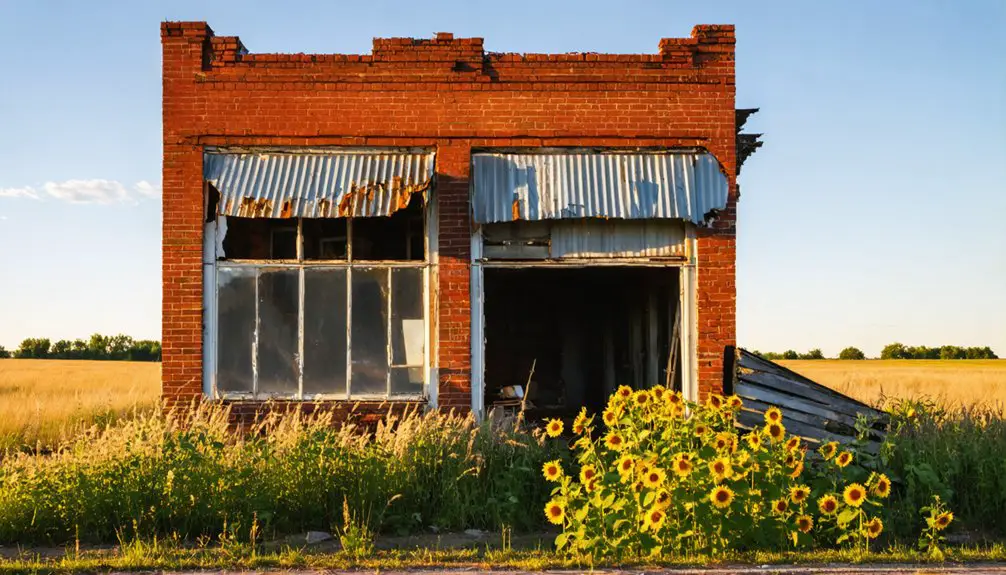
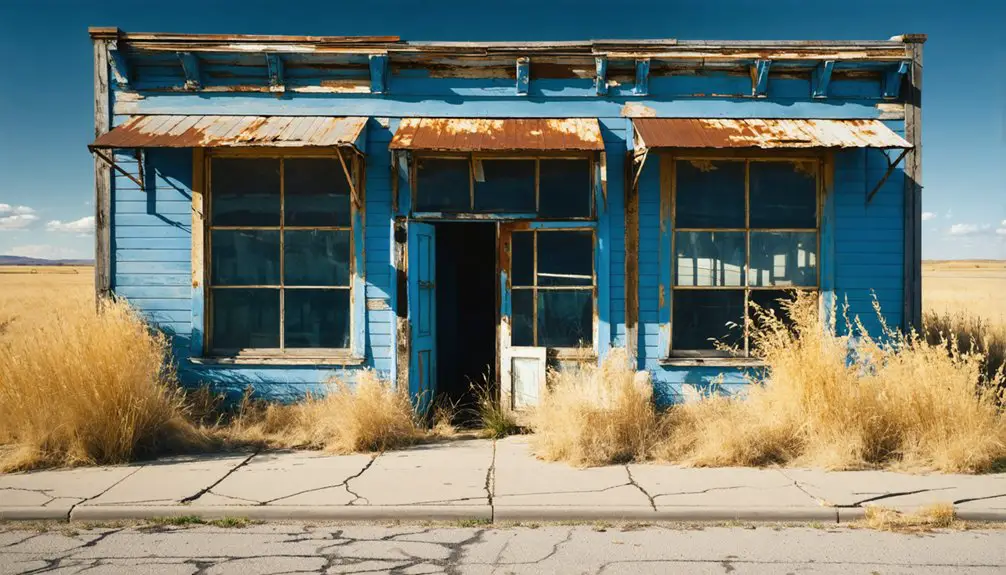
What greets visitors to Miller today stands in stark contrast to the bustling railroad town that once processed thousands of head of cattle through its shipping pens. You’ll find scattered remnants across the former town layout—a functioning Methodist Church, weathered abandoned homes, and old business buildings slowly surrendering to time. The remaining community structures tell stories through their absence: a monument built from school bricks marks where students once learned, while the cemetery preserves generations of Miller families.
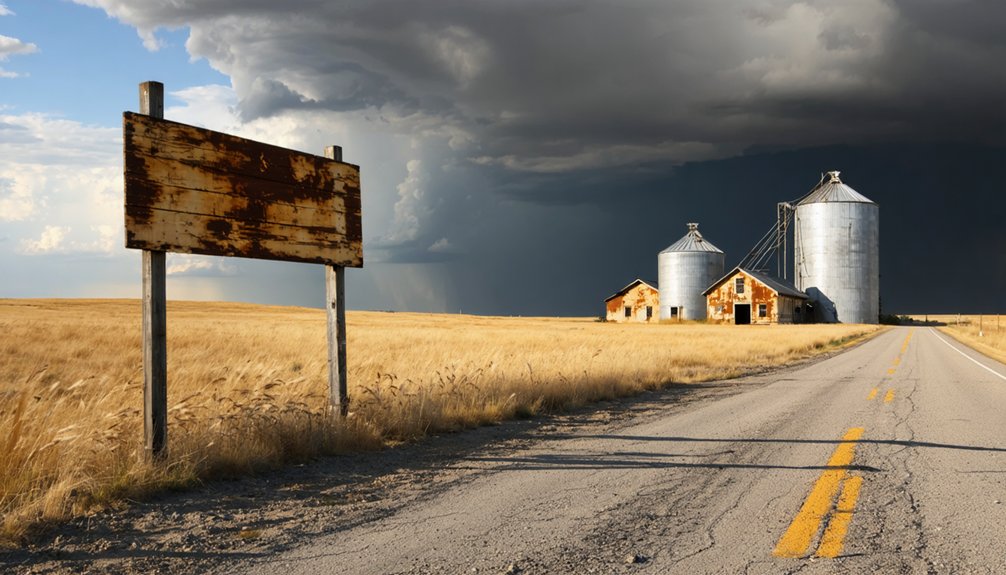
One mile north on Highway 56, the Miller Grain Elevator still operates, its silos rising against the horizon like sentinels. A handful of occupied homes dot the landscape, but decay dominates. Like many Kansas settlements, Miller’s decline reflects technological advancements in agriculture that dramatically reduced the need for rural manpower. Similar to ghost towns along historic Route 66, Miller offers visitors a glimpse into America’s past through its abandoned structures and fading Main Street. There’s freedom in exploring this ghost town’s authenticity—no commercialization, just raw history waiting for those willing to wander off Kansas’s beaten path.
Getting to Miller: Directions and Road Conditions
Finding Miller requires traversing the rural heart of Lyon County, where county roads stretch across windswept prairie like threads connecting Kansas’s forgotten places. You’ll navigate Road W7 east from Admire for 5.5 miles, or venture west from Osage City for eight miles of uninterrupted horizon. Highway 56 provides access near the grain elevator, one mile north of the abandoned townsite.
Unlike some ghost towns haunted by collapsed mining activity, Miller’s roads remain stable—no sinkholes threaten your journey. However, weather impacts demand respect. The humid subtropical climate brings occasional winter ice to these county roads, while summer storms can transform gravel stretches momentarily. Check KDOT updates before departing. The Methodist Church marks your destination, standing sentinel over what remains of this prairie community’s past.
The grain elevator itself represents a connection to the milling traditions that once formed the economic backbone of prairie settlements like Miller. Mills counted among some of the oldest factories in human history, and their operators—the millers—often held positions of greater wealth and influence than ordinary peasants in traditional rural societies.
The School Monument: A Brick Memorial to Education
Standing at the former high school site, you’ll find a monument crafted from the very bricks that once housed Miller’s students—a weathered sentinel marking where generations learned their lessons.
The memorial rose from the rubble after the brick high school’s demolition in 1970, built across from where the grade school stood until that January morning in 1956 when smoke and flames consumed it.
These salvaged bricks now tell a quieter story, preserving the legacy of the four-room school that opened in 1920 and the determined community that valued education enough to build it twice. Like Miller Park School in Omaha, which began as a four-room wooden schoolhouse in 1910, small rural schools formed the bedrock of prairie education. While Miller chose brick, many Kansas schools were built of native Kansas limestone, such as the Old Albany Schoolhouse Museum Building in Sabetha, reflecting the state’s rich tradition of stone construction.
Monument Construction and Design
The School Monument rises from Miller’s prairie grass as a memorial to frontier education, its weathered bricks still bearing the patina of decades spent facing Kansas winds. You’ll find yourself standing before a structure that speaks through its simplicity—each brick laid as [testament] evidence of a community’s commitment to learning on the untamed prairie.
The material choices reflect practical pioneer wisdom: sturdy red brick that could withstand harsh seasons and isolation. While the exact construction timeline remains shrouded in Miller’s fading records, the monument’s craftsmanship reveals deliberate care. You can trace your fingers along mortar joints that’ve held firm through countless storms, connecting you to the hands that built this enduring tribute to education’s role in settling the frontier. Like the meticulous leveling process employed by skilled masons when setting memorial pavers, each brick required precision and patience to ensure the monument would stand as a lasting testament to those who valued learning. The monument stands unlighted but accessible, inviting visitors to explore this piece of Kansas heritage at any hour of the day.
Historical Significance Today
Beyond its physical presence, this brick memorial carries the weight of Miller’s complete educational arc—from hopeful beginning to inevitable end. You’re witnessing community values manifested in salvaged materials—bricks that once echoed with children’s voices now standing silent guard over empty ground. This monument represents more than historical preservation; it’s Miller’s refusal to let consolidation erase what mattered most.
The story runs deep: from that optimistic 1920 opening with thirty-six students, through desperate fire rescue attempts in 1956, to the final 1970 closure when North Lyon County USD 251 absorbed what remained. Those repurposed bricks bridge 1920’s electrified promise and today’s quiet acceptance. Miller’s fate mirrored the broader pattern across Lincoln County, where over 80 school districts once operated before smaller schools unified or closed, leaving just two districts by 1966-67. You’ll find no glossy interpretation here—just honest testimony that small-town education once thrived before economics dictated otherwise.
Historic Disasters That Shaped Miller’s Fate
Few forces shape a town’s destiny more decisively than disaster, and Miller, Kansas experienced its share of catastrophic blows that hastened its transformation from thriving community to near-ghost town.
You’ll discover how a 1931 train derailment destroyed the Missouri-Pacific depot when thirteen refrigerated cars broke loose and plowed through the building. The 1956 grade school fire forced elementary students into the brick high school until 1970 consolidation finally shuttered education entirely.
When Hoglund Lumber yard burned in the mid-1960s, Miller lost irreplaceable town records. These disasters, compounded by economic factors during the Depression, proved devastating without fire protection. Today’s local preservation efforts include a monument built from original school bricks, marking where community resilience couldn’t overcome successive catastrophes.
Best Times to Visit This Remote Lyon County Location
Timing your journey to Miller requires balancing Kansas’s notoriously fickle weather against your tolerance for dusty backroads and exposed ruins. Your ideal windows are:
Plan your Miller expedition around Kansas weather patterns and your willingness to navigate rough terrain and desolate ghost town conditions.
- Spring (April-June): Moderate temperatures and calmer seasonal winds create perfect conditions for photographing crumbling structures and traversing Lyon County’s remote routes.
- Fall (September-November): Second-best season offering comfortable exploration temperatures with bonus fall foliage enhancing your road trip aesthetics and fewer crowds.
- Summer (July-August): Budget season if you’ll endure scorching heat on exposed dirt roads near active railroad tracks.
- Winter (December-February): Avoid unless you’re experienced—bitter cold and snow jeopardize access entirely.
March offers shoulder-season compromise: lighter crowds, unpredictable conditions, and that liberating sense of having Miller’s haunting remains practically to yourself.
Nearby Ghost Towns to Include on Your Route
Miller’s haunting landscape becomes exponentially more rewarding when you thread together a constellation of Lyon County’s vanished settlements into one ambitious ghost town circuit. Arvonia’s Welsh colonial settlement diversity offers a standing church and scattered structures worth exploring, while Silkville’s French utopian experiment demands research despite its complete disappearance.
Venture further to Peterton, accessed via a dusty mile-long dirt road where active railroad tracks still slice through agricultural emptiness. Dunlap’s twenty-seven remaining souls inhabit a slowly collapsing landscape of overgrown houses and an abandoned high school along Highway 56.
Down in Sumner County, Hunnewell preserves memories of 1,500 cattle loads shipped in 1889, when its bawdy cowtown reputation and gunfights defined rural town economy prosperity. Each stop reveals Kansas’s untamed settlement patterns and liberation from modern constraints.
What to Bring for Your Rural Kansas Exploration
Your Kansas ghost town adventure demands preparation that matches the unforgiving nature of these remote landscapes. Rural driving checklists become your lifeline when exploring abandoned settlements where cell service vanishes and help sits miles away.
Pack roadside emergency essentials that transform potential disasters into minor inconveniences:
- Emergency vehicle kit – jumper cables, spare tire, car jack, flashlight with batteries, and tow strap for mechanical failures
- Navigation and communication – paper maps, GPS device, fully-charged phone, and car charger since you can’t rely on signals
- Sustenance and protection – gallon of water, high-protein snacks, sunscreen, first-aid supplies, and emergency blanket
- Documentation – driver’s license, insurance proof, medical cards, and emergency contacts
These windswept plains don’t forgive unpreparedness.
Frequently Asked Questions
Were There Any Businesses or Commercial Buildings in Miller During Its Peak?
You’ll discover Miller’s notable commercial establishments thrived during its peak—a general store, lumberyard, hardware shop, and blacksmith supported primary economic activities. These businesses served ranchers and railroad workers, creating a self-sufficient frontier community before abandonment.
What Was the Population of Miller at Its Highest Point?
Like a candle’s brief flare, Miller’s population peaked at just 24 souls in 1910. Former residents built their dreams around agricultural development and railroad prosperity, creating a tight-knit frontier community before time scattered them across Kansas’s endless prairie.
Are There Any Known Photographs or Historical Images of Miller Available?
You’ll find limited photographs of historic buildings documenting Miller’s past, though visual documentation of town layout remains scarce in public archives. Local historical societies might hold unpublished images, but online resources won’t satisfy your curiosity completely.
Did the Condell Family Continue Ranching After the Town Declined?
No, the Condell family’s ranching operations ended before the town’s economic decline even began. After Thomas’s death and their 1882 land sale to the Miller brothers, you’ll find no evidence they continued ranching there.
Is the Land Where Miller Stood Privately Owned or Public Property?
Every single inch of Miller’s ghost town landscape belongs to private landowners—you’ll need permission before exploring. Bob Miller owns the historic 162-acre site, while historical records show the remaining ranch land passed through various private hands since 1958.
References
- https://legendsofkansas.com/miller-kansas/
- https://www.youtube.com/watch?v=PfThSLZOtqg
- https://www.hhhistory.com/2019/05/ghost-towns-of-kansas.html
- https://www.youtube.com/watch?v=KBXINX0xqnU
- https://freepages.rootsweb.com/~gtusa/history/usa/ks.htm
- https://www.ksgenweb.org/KSTrego/ghost.html
- https://legendsofkansas.com/lyon-county-extinct-towns/
- https://www.youtube.com/watch?v=dF7vGl5xasI
- https://octa-trails.org/wp-content/uploads/2023/05/Ellis-Uniontown-and-Plowboy–-Potawatomi-Ghost-Towns.pdf
- https://legendsofkansas.com/kansas-ghost-town-list/