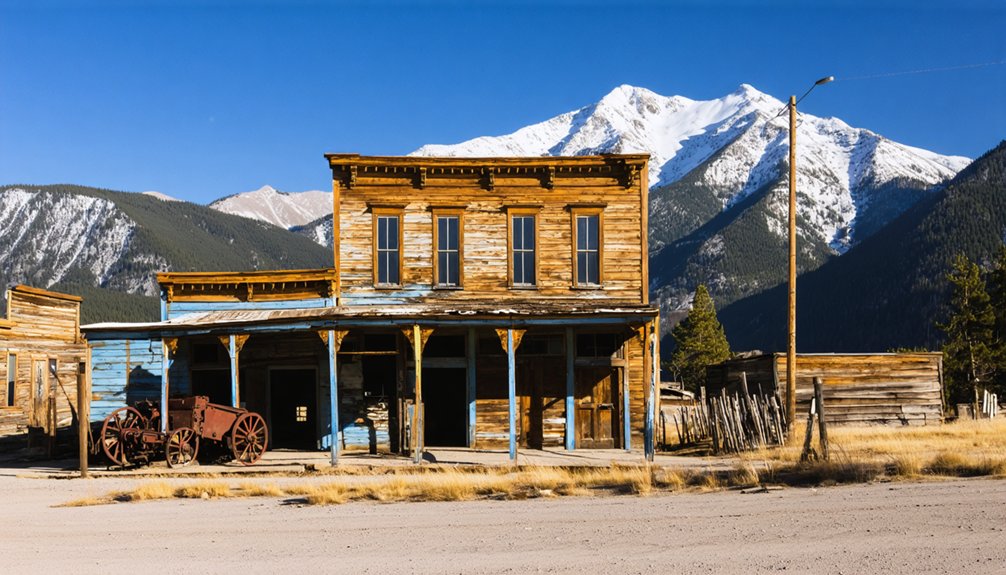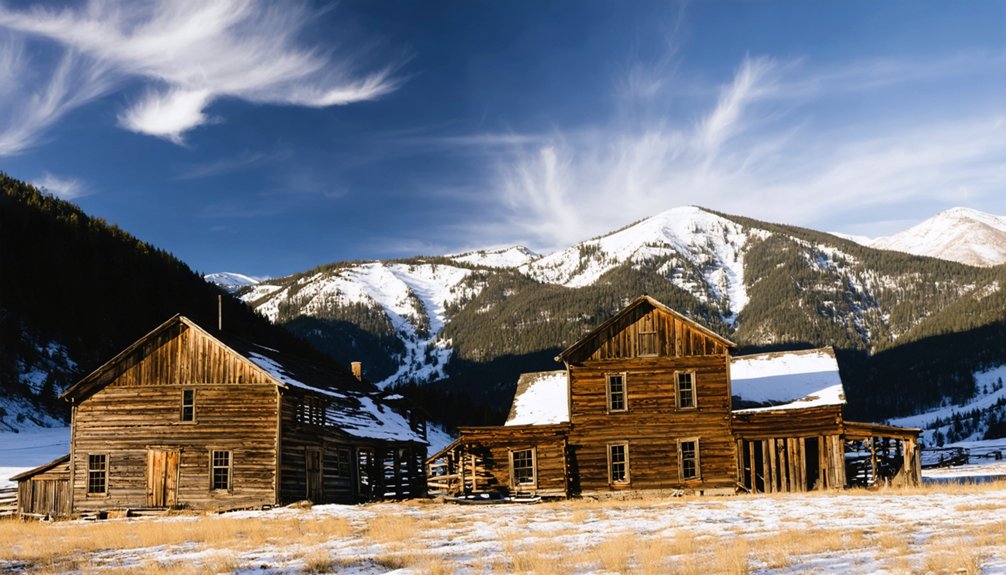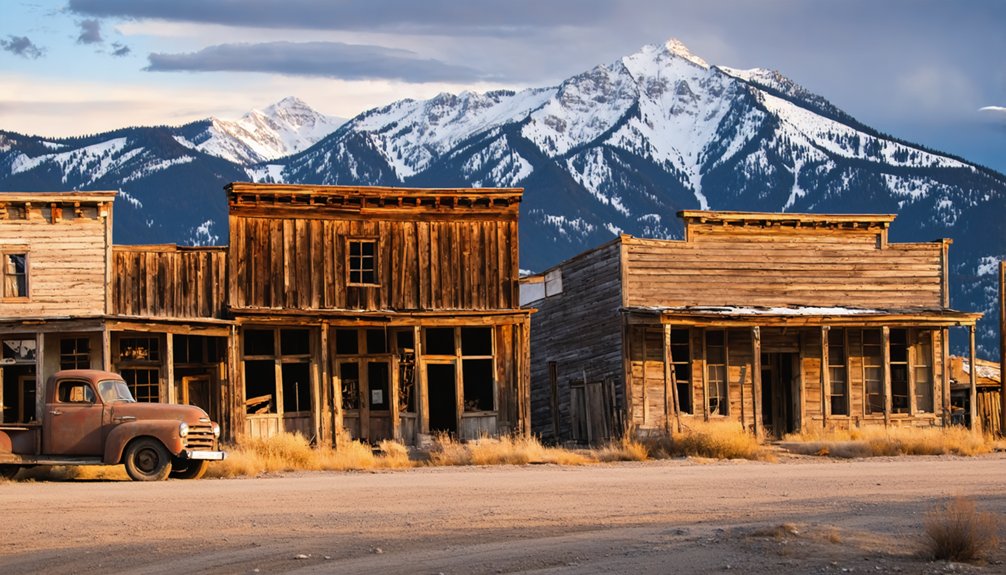
You’ll find Montana City’s ghost town remnants at Grant-Frontier Park, just off South Platte River Drive in southwest Denver at 2300 S Platte River Drive. This accessible site preserves Colorado’s first gold rush settlement from 1858, featuring reconstructed log cabins, vintage mining equipment, and the actual riverbank where prospectors worked their claims. Visit between late spring and mid-fall for ideal conditions, with September through November offering stunning foliage and fewer crowds. The park’s trails, artifacts, and gold-panning opportunities reveal the stories behind Denver’s frontier origins.
Key Takeaways
- Montana City’s historic site is preserved at Grant-Frontier Park, 2300 S Platte River Drive, Denver, open daily 5AM-11PM with free admission.
- Visit between late spring and mid-fall for best access, with September-November offering ideal weather, vibrant foliage, and fewer crowds.
- Explore reconstructed log cabins, Conestoga wagons, mining equipment, and excavation sites revealing Denver’s first chartered town from 1858.
- Try gold panning in the South Platte River’s shallow gravel deposits where prospectors sparked the legendary Pikes Peak Gold Rush.
- Access hiking trails along the riverbank connecting to placer mining remnants, with parking, wildlife viewing, and ADA-compliant pathways available.
The Rise and Fall of Montana City’s Gold Rush Dreams
In July 1858, William Greeneberry “Green” Russell led a ragtag band of prospectors to the banks of the South Platte River, where Cherry Creek‘s waters merged with the muddy current. They christened their settlement Montana City, driven by whispers of gold at Dry Creek. You’d have found these “Fifty-Eighters” feverishly working placer diggings, their rustic charm masking desperate hope.
But the promised riches never materialized. While word spread and populations swelled at nearby Auraria and St. Charles, Montana City’s faded ambiance told a different story. Disappointed prospectors became “Go-Backers,” abandoning the site as quickly as they’d arrived.
Yet this ghost town’s brief existence sparked the legendary Pikes Peak Gold Rush, ultimately birthing Denver and drawing thousands westward to strike it rich.
Where to Find the Montana City Historical Site Today
You’ll find Montana City’s remains at Grant-Frontier Park, nestled along the South Platte River at Evans Avenue in southwest Denver. The site sits on the river’s east bank, positioned southwest of where Santa Fe Drive meets W. Evans Avenue, marking the spot where Colorado’s first chartered town took root in 1858.
Today’s park preserves authentic mining equipment and a replica log cabin, transforming this once-abandoned settlement into an accessible window into Denver’s pioneer origins.
Grant-Frontier Park Location
Grant-Frontier Park spreads across 10 acres of riverside land at 2300 S Platte River Drive in southwest Denver, where the South Platte’s waters still flow over the same gravel bars that sparked Colorado’s 1858 gold rush. You’ll find this historical site positioned just south of Evans Avenue on the river’s east bank, with GPS coordinates 39.6740°N, 104.9966°W guiding modern explorers to Colorado’s birthplace.
Park accessibility features include:
- Daily operating hours from 5AM to 11PM, seven days a week
- Dedicated parking areas on the west side of the river
- Concrete jetty with steps providing direct water access for gold panning
Seasonal changes bring different wildlife visitors—ducks paddle year-round while Canada geese winter along these historic banks, adding natural beauty to your ghost town exploration.
Accessing the Historic Site
Finding Montana City‘s remnants means traversing to Grant-Frontier Park, where log cabin replicas and authentic mining equipment mark the spot where prospectors first struck gold along the South Platte. You’ll discover this forgotten settlement at coordinates 39°40′35.40″N 104°59′49.20″W on the river’s east bank, accessible via South Platte River Drive.
No entrance fees restrict your exploration of this outdoor museum, where you’re free to wander excavation sites revealing original miner campsites. The location map pinpoints where 1858 fortune-seekers established Colorado’s first significant gold rush settlement.
Visitor access remains unrestricted across ground-level exhibits, allowing you to examine pioneer-era artifacts and mining tools up close. Whether you’re traveling solo or bringing fellow history enthusiasts, this reclaimed ghost town welcomes independent exploration of Denver’s foundational chapter.
Nearby Landmarks and Directions
The historical site sits at the intersection of Denver’s past and present, where South Platte River Drive curves along the waterway that once lured thousands of gold-seekers westward. You’ll discover Grant-Frontier Park‘s waterfront setting just southwest of where Santa Fe Drive meets W. Evans Avenue, marking Colorado’s first settlement from 1858.
The park’s landscape reveals nearby convergences that shaped frontier history:
- Little Dry Creek merges with the South Platte River at this precise location where Montana City pioneers staked their claims
- Auraria’s original townsite lies just downstream, where disappointed prospectors relocated their cabins
- Modern hiking trails connect you to remnants of placer mining operations along the riverbank
Today’s commemorative park preserves mining equipment displays and a faithful log cabin replica at coordinates 39°40′35.40″N 104°59′49.20″W.
What Remains at Grant-Frontier Park
Nestled along the South Platte River‘s east bank at Evans Avenue, this reconstructed settlement brings Montana City’s 1858 gold rush origins back to life through carefully preserved artifacts and period structures. You’ll discover a log cabin with sod roof, Conestoga wagon, and placer mining equipment including sluice boxes and rocker displays. A two-hundred-year-old cottonwood anchors the formal plaza, where an arching staircase descends past rock gardens toward the river.
The remaining historical structures tell stories of Denver’s first chartered town, while accessibility of prospecting areas upstream invites you to pan for gold yourself. Boulder terraces mark historic flood levels, and ADA-compliant pathways lead to an island built for exploration. The shallow gravel deposits still yield quality gold—freedom to prospect awaits where fortune-seekers first struck pay dirt.
Best Routes and Driving Directions to the Site
Whether you’re arriving from Denver International Airport or starting downtown, reaching Grant-Frontier Park requires traversing southwest Denver’s arterial network to the South Platte River corridor.
Primary Transportation Options:
- From DIA: Take I-70 west to I-25 south, exit at Santa Fe Drive, then head west toward South Platte River Drive—45 minutes covering 35 miles
- Downtown Denver: Navigate 8 miles southwest via Santa Fe Drive to the park entrance in just 15-20 minutes
- Colorado Springs: Head north 75 miles on I-25, merging onto Santa Fe Drive southbound for a 1.5-hour journey
RTD buses serve the Santa Fe corridor, while light rail connects Union Station to Evans Station. Cyclists can access the site via South Platte River Trail. Parking availability is excellent, with complimentary spaces awaiting your exploration of this 1858 gold rush settlement.
Peak Seasons and Ideal Times to Visit
Planning your arrival at Montana City’s ghost town remnants requires strategic timing to maximize your experience. Summer delivers full trail access and longer days for exploration, though you’ll navigate seasonal crowds at nearby attractions.
Fall emerges as your sweet spot—September and October bring golden aspens framing weathered structures, with fewer visitors after elk rut season ends. Winter transforms the landscape into isolated beauty, but snow buries access roads and high-elevation passes close completely.
Spring offers locals’ favorite conditions: blossoming wildflowers against abandoned buildings without tourist congestion. Your ideal visiting windows stretch from late spring through mid-fall, when roads remain passable and temperatures cooperate. Mid-October into November provides the ultimate freedom—brilliant foliage, accessible ruins, and minimal crowds competing for that perfect photograph.
Mining Artifacts and Historic Exhibits to Explore
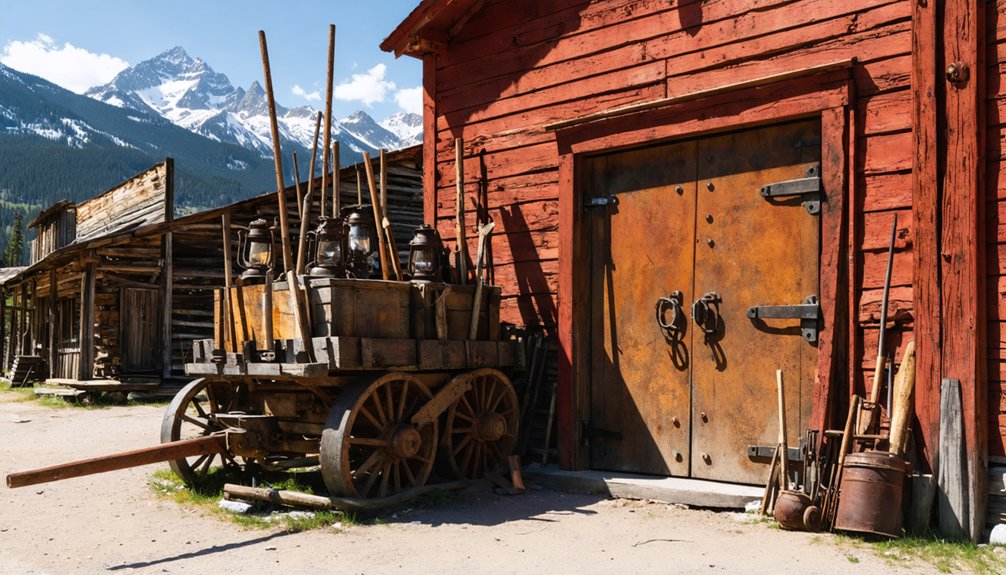
Scattered across Grant-Frontier Park’s grounds, authentic mining equipment from Montana City’s 1859 placer operations tells the story of desperate fortune-seekers who clawed through South Platte River sediments for gold that barely existed. You’ll find real pioneer-era implements positioned where prospectors once worked the riverbanks, offering placer gold panning experiences that reveal why settlers quickly abandoned their claims.
Authentic 1859 mining tools scattered across the park reveal the brutal truth behind Montana City’s failed gold dreams.
Historic centers house original artifacts in weathered trunks, while hands on mining reenactments demonstrate the backbreaking techniques of 1858-1859.
The displays capture three distinct phases of extraction:
- Gold panning tools from initial prospecting attempts
- Sluicing equipment that followed disappointing yields
- Ore cars, picks, and miner’s candles representing later technological advances
These relics connect you to Montana City’s brief, brutal reality—a settlement built on hope, destroyed by geology.
The Replica Log Cabin Experience
You’ll find yourself face-to-face with hand-hewn logs bearing the authentic axe marks of 1858 pioneers, each hatch scar telling stories of the Denver area’s first permanent structures.
Step inside to discover weathered floorboards cracked with age, their gaps revealing the original elements beneath wall coverings that overlay those hand-cut timbers.
The cabin’s single off-center door and iron stove create perfect frames for capturing atmospheric photographs that transport you straight back to the Pikes Peak Gold Rush era.
Authentic 1858 Construction Details
When you examine the replica log cabin at Grant Frontier Park, you’re observing construction methods that John Easter and his fellow pioneers employed in 1858 along the South Platte River. These period construction techniques reveal the ingenuity required to survive Montana City‘s harsh frontier conditions.
The log cabin dimensions and authentic details include:
- Rough-hewn logs chinked with clay and stones to seal gaps against bitter Colorado winters
- Off-centered front door with a gabled roof extending forward to create essential workspace
- Iron stove placement along the gable wall, replacing traditional fireplaces for efficient heating
You’ll notice how these structures prioritized function over comfort—exactly what gold seekers needed when establishing the Denver area’s first permanent settlement. Every detail reflects the self-reliance that defined frontier living during the Pikes Peak Gold Rush.
Interactive Historical Photography Opportunities
The weathered log cabin replica at Grant-Frontier Park transforms casual visitors into time travelers, offering an unparalleled backdrop for capturing Montana City’s 1858 gold rush atmosphere. You’ll find scattered mining equipment surrounding the structure, creating immersive reenactment opportunities that bring pioneer life into sharp focus. Position yourself beside rusted pans and picks for authentic prospector portraits, or frame wide-angle shots incorporating the South Platte River‘s flowing waters behind the cabin’s rough-hewn logs.
The park’s open layout enables dynamic action shots—imagine swinging a pickaxe or kneeling by vintage sluice boxes while the Denver skyline rises incongruously beyond. Educational signage anchors your photos with historical context, documenting the Lawrence Party’s brief 1858 settlement and subsequent abandonment. You’re free to explore every angle, crafting visual stories that bridge Colorado’s rough-and-tumble past with present-day exploration.
Photography Opportunities at the Abandoned Settlement
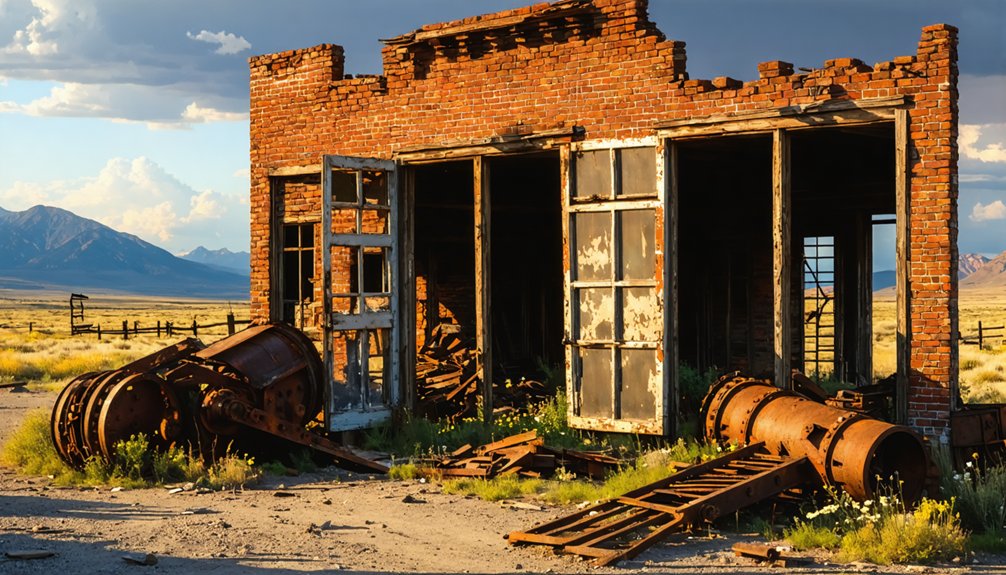
Grant-Frontier Park transforms into an evocative canvas where Denver’s abandoned mining past meets modern urban landscapes along the South Platte River. You’ll find remarkable photographic opportunities at this accessible 5,210-foot elevation site, where the contrast between preservation and decay tells Montana City’s brief 1858 story.
Where Denver’s forgotten mining heritage collides with contemporary cityscape, Grant-Frontier Park offers photographers an evocative journey through Montana City’s fleeting 1858 existence.
Capture these compelling elements:
- Replica log cabin textures against photogenic river reflections during golden hour
- Preserved mining equipment creating dramatic foreground interest with urban Denver backdrop
- Wide-angle riverbank compositions showcasing the flat terrain where Lawrence Party prospectors once searched for gold
Your wide lenses will excel here, documenting where Leavenworth Row and Kansas Row cabins once stood before their 1859 relocation to Auraria. Morning light illuminates the east bank perfectly, while year-round access means you’re never restricted by schedules or admission fees.
Nearby Denver Attractions to Combine With Your Visit
After photographing Montana City’s historic remnants, you’ll discover Denver’s vibrant attractions await just minutes from Grant-Frontier Park. City Park’s 314 acres offer nearby nature preserves with mountain-view hiking trails and free weekend concerts.
You’ll find unique city experiences at the Denver Botanic Gardens, where 24 acres showcase global plant collections worth exploring for hours. Red Rocks Amphitheater delivers world-class acoustics carved into natural rock formations—perfect for catching live performances under open skies. Elitch Gardens provides adrenaline-pumping roller coasters and water slides when you’re ready for modern thrills. The Downtown Aquarium lets you snorkel alongside sharks or observe 500+ species.
These attractions transform your ghost town expedition into a complete Colorado adventure, blending historical exploration with contemporary entertainment options you won’t find anywhere else.
Other Colorado Ghost Towns Worth Adding to Your Itinerary
While Montana City offers a compelling glimpse into Colorado’s mining past, you’ll find the state harbors dozens of remarkably preserved ghost towns that transform a single-destination trip into an unforgettable high-country expedition.
St. Elmo’s weathered storefronts stand sentinel near Buena Vista, while Animas Forks clings to the mountainside above Silverton at a breathtaking 11,185 feet.
Independence Pass reveals another abandoned gold camp where crumbling cabins and rusted equipment tell stories of fortune-seekers who braved Colorado’s unforgiving alpine wilderness.
St. Elmo Alpine Settlement
The alpine air grows thinner as you climb toward St. Elmo, perched at 10,000 feet in the Sawatch Range. This remarkably preserved settlement once thrived with nearly 2,000 souls after railroad transportation connected it to civilization in 1881. You’ll discover authentic Main Street buildings from the 1880s, untouched by modern restoration.
What Made St. Elmo Legendary:
- Alpine tunnel construction in 1882 created the 1,845-foot engineering marvel that pushed tracks through the mountains to remote mining camps
- The Mary Murphy Mine alone extracted over $60 million in gold from the mountainside above town
- Five hotels and saloons served prospectors chasing 150+ patented claims
Today’s National Register listing guarantees you’ll experience Colorado’s ghost town heritage as it actually existed—raw, authentic, and magnificently isolated.
Animas Forks Mining Camp
At 11,200 feet above sea level, Animas Forks ranks among North America’s highest mining camps—a windswept cluster of weathered cabins clinging to an alpine basin where three tributaries converge. You’ll find this Bureau of Land Management site twelve miles northeast of Silverton, accessible only by high-clearance 4WD along County Road 2’s rugged summer-only route.
The historic mining operations peaked in 1883 with 450 residents, thirty cabins, and the thundering Gold Prince Mill processing ore until 1910. But extreme weather challenges ultimately defeated human ambition—an 1877 avalanche obliterated the smelter, while 1884’s legendary blizzard buried everything under twenty-five feet of snow.
Today you’re free to explore the Duncan House, jail ruins, and mill foundations without crowds or restrictions, experiencing Colorado’s high-altitude frontier as it truly was: unforgiving and magnificent.
Independence Pass Gold Town
Gold fever struck on Independence Day 1879 when prospectors discovered the Independence Gold Lode, transforming this brutal 10,900-foot alpine shelf into Colorado’s most audacious high-altitude gamble. By 1882, 1,500 fortune-seekers weathered oxygen-thin air and subzero nights while Farwell Mining Company‘s stamping mill processed $190,000 in gold.
The boom died faster than it ignited—shallow veins depleted within three years.
What awaits your exploration:
- Historic mining technology remnants at Farwell Mill, where stamping equipment once crushed ore dreams
- Preserved miner’s cabin housing artifacts from the brutal 1880s high-altitude existence
- Easy half-mile trails connecting townsite ruins along the original stagecoach route
Seasonal considerations matter here—Highway 82 closes October through May. You’ll find this ghost town 16 miles east of Aspen, where interpretive kiosks reveal stories of forty businesses that couldn’t outlast economics.
Frequently Asked Questions
Are There Any Admission Fees to Visit Grant-Frontier Park?
No admission fees exist for Grant-Frontier Park—you’ll enjoy free access to this historic riverfront site. As a city-managed park, you’re welcome to explore the trails, fitness zones, and nearby amenities without paying state park passes.
Can Visitors Camp Overnight Near the Montana City Historical Site?
You won’t find camping facilities or overnight accommodations at Grant-Frontier Park itself. The historical site doesn’t offer lodging, but you’ll discover nearby Colorado campgrounds where you can pitch your tent and embrace adventure freely.
Are Guided Tours Available at the Montana City Ghost Town Location?
You’ll find self-guided tours rather than formal guided experiences here. Wander freely through weathered structures, read interpretive signage at your own pace, and explore Montana City’s haunting remnants independently—embracing the solitary adventure that ghost town exploration authentically offers.
Is the Grant-Frontier Park Site Accessible for Visitors With Mobility Challenges?
Yes, you’ll find excellent wheelchair accessibility throughout Grant-Frontier Park, with ADA-compliant paved trails, accessible river routes, and parking accommodations. The universally designed space enables you to freely explore the riverfront, historical areas, and recreational features independently.
What Safety Precautions Should Visitors Take When Exploring the Park?
Like a cautious explorer charting unknown territory, you’ll need to watch for hazards including unstable structures and rough terrain. Avoid trespassing on posted areas, inform others of your itinerary, and pack emergency supplies for remote conditions.