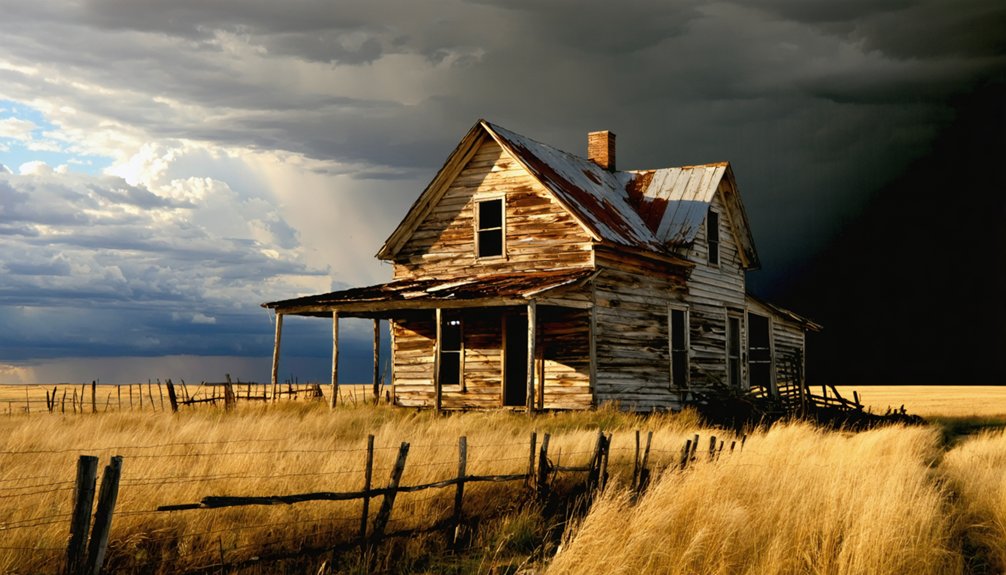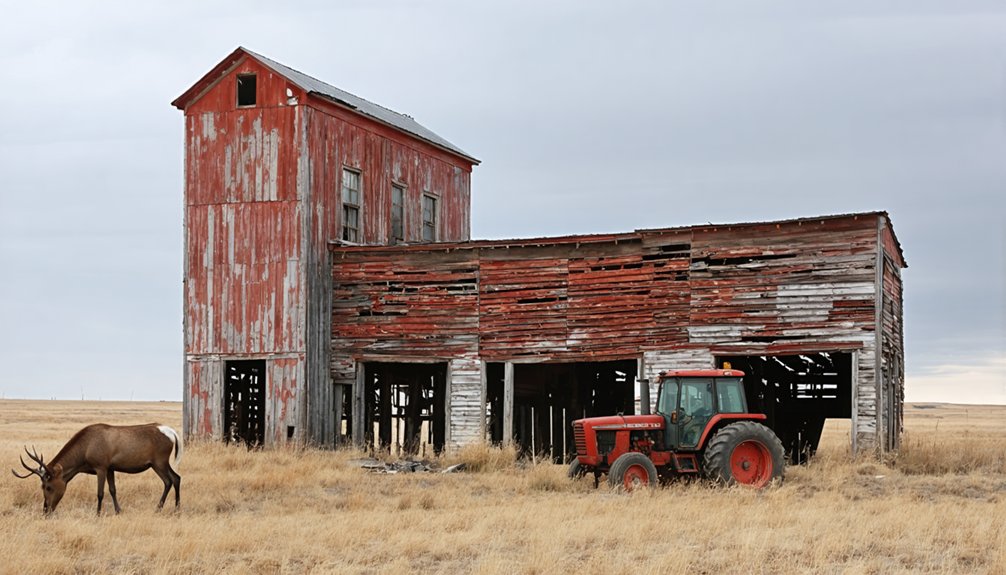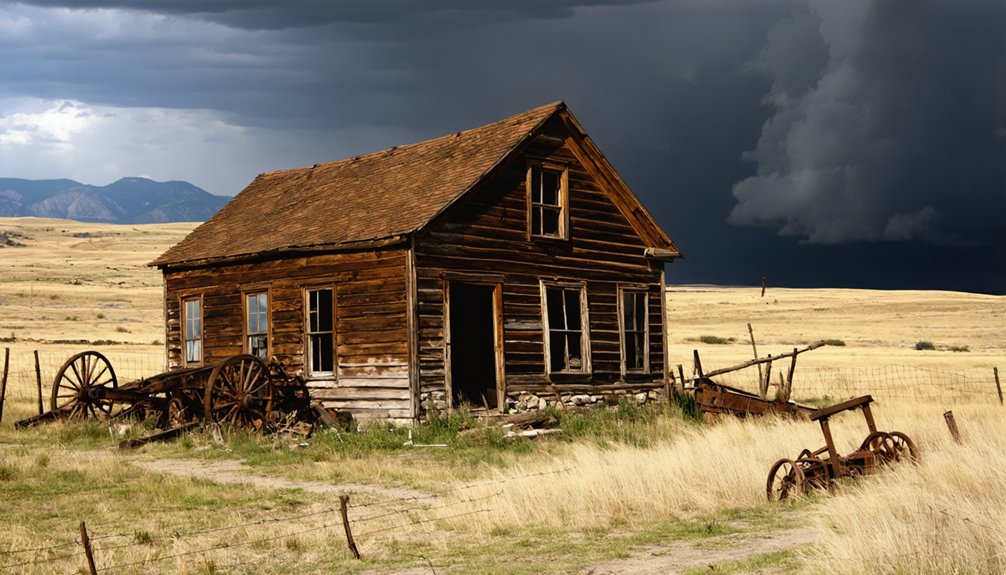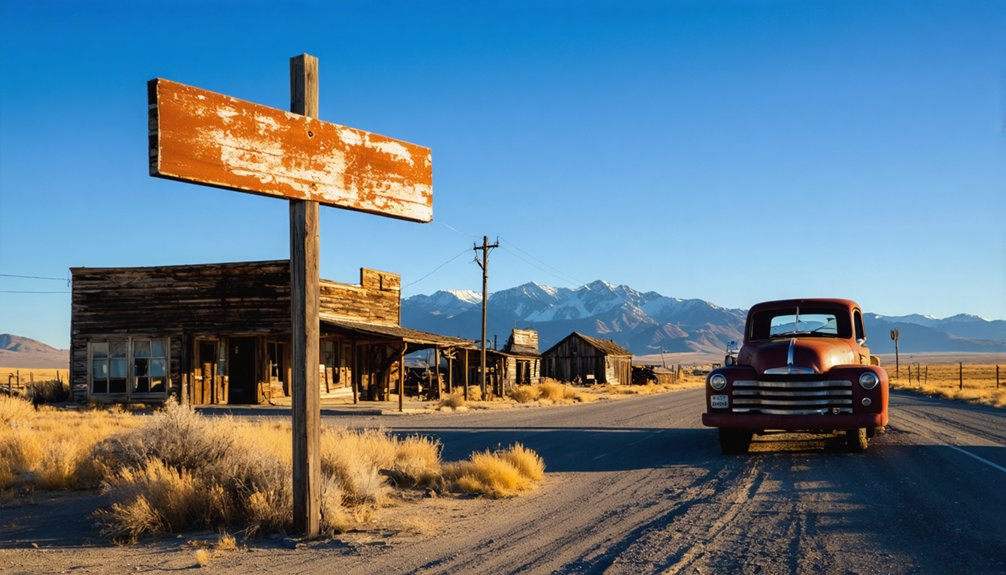
You’ll find Montana City at 5,741 feet in South Dakota’s Rochford Mining District, where rusted machinery and gaping mine shafts tell stories of the 1876 gold rush. When planning your visit, always obtain landowner permission and never enter mine portals due to poisonous gases and unstable structures. Check historical records, watch for subsidence zones near weathered ore bins, and explore nearby ghost towns like Hornblend and Galena along your route. The surrounding landscape reveals rust-colored tailings and crumbling mill foundations that reveal the region’s fascinating mining legacy.
Key Takeaways
- Montana City sits at 5,741 feet elevation in South Dakota’s Rochford Mining District near historic gold and silver operations.
- Explore remnants including gaping shafts, weathered ore bins, rusted machinery, and a twenty-ton mill foundation along Rapid Creek.
- Visit nearby ghost town sites like Hornblend, Blue Lead, and Galena along Galena Road in the Black Hills.
- Never enter mine shafts or portals due to poisonous gases, unstable structures, and hidden openings with steep walls.
- Obtain landowner permission before exploring and consult historical records to locate safe, accessible abandoned mining sites.
The Rich Mining Heritage of Montana City and Its Many Names
Perched at 5,741 feet in South Dakota’s Rochford Mining District, the Montana Mine sits within Lawrence County’s rugged terrain, where prospectors once scoured Rapid Creek’s banks for the telltale signs of fortune. You’ll find this 193.82-acre complex of eleven patented claims where underground replacement mining techniques employed by notable mining personalities like Dr. R. A. Vallier and Francis C. Lincoln once extracted gold and silver from the earth.
The Gregory Mining Company operated here in 1906, when miners read the landscape like a treasure map—rusty brown hematite stains promised gold, while green and blue copper traces revealed silver deposits. Just half a mile south of Nahant, the twenty-ton mill on Rapid Creek processed ore during Montana City’s brief but spirited contribution to the Black Hills gold rush. Miners accessed the ore through a 495-foot adit that ran north-northwest to the base of the main shaft, with drifting operations extending 444 feet on the 100-foot level. The region’s mining legacy connects to the Homestake Mining Company, which began when the Manuel brothers started prospecting for gold near Deadwood in 1876, eventually growing into America’s largest gold mine.
Exploring the Abandoned Mines and Remnants of the Black Hills Gold Rush
The Black Hills gold rush of 1874-1877 scattered remnants across this landscape—gaping shafts, weathered ore bins, and rusted machinery that tell stories of fortunes won and lost. You’ll find these haunting relics at sites like Hornblend, Blue Lead, and Galena, where enormous cyanide vats and crumbling mill foundations stand as monuments to an industry that once produced 10% of the world’s gold supply. Among these sites, you may encounter mines that stand ready with affable and watchful caretakers, eager to resume production of silver, lead, zinc, and arsenic at the throw of a switch.
Before you explore these historic sites, remember that unstable structures and hidden shaft openings demand careful attention—admire these preserved pieces of history from a safe distance, never climbing on buildings or venturing into mine tunnels. Walk along Galena Road to discover remnants of the 1876 mining community now paralleled with modern homes.
Historic Mining Operations Overview
When Lieutenant Colonel George Armstrong Custer led his thousand-man expedition into the Black Hills in 1874, he shattered the terms of the 1868 Treaty of Fort Laramie and ignited one of the West’s most frenzied gold rushes. The economic impact of mining transformed this wilderness into a powerhouse of wealth extraction.
Major Operations That Defined the Rush:
- Homestake Mine – Burrowed 1.5 miles deep near Lead, employing thousands through ore processing innovations like chlorination and smelting
- Deadwood Gulch – Generated $1-1.5 million during 1876 alone from placer deposits
- Wheeler Brothers Claim – Yielded $140,000 in just four months
- Montana Mine – Extracted gold and silver at 5,741 feet elevation in Lawrence County
These operations required armed guards to transport gold to Cheyenne and Bismarck, underlining the fortunes at stake. The treasure coaches became such lucrative targets for road agents that the last recorded hold-up at Canyon Springs station in 1878 left one guard dead and two wounded. The Homestake mine continued its operations until 2002, making it one of the longest-running gold mines in American history.
Visible Mine Waste Today
Scattered across the Black Hills landscape, rust-colored tailings piles and collapsed timber frames mark where fortune-seekers once carved into mountainsides with picks and dynamite. You’ll find these abandoned tailings piles throughout Montana City’s remnants, though reaching them requires careful navigation of unmarked trails and private property boundaries.
The environmental legacy remains visible—orange-stained creek beds hint at toxic mine drainage seeping from forgotten shafts, while weathered wood structures lean precariously against time’s relentless march. Modern reclamation efforts haven’t touched many sites, leaving you free to witness authentic Gold Rush-era decay. The State of South Dakota lacks abandoned mine reclamation funds to restore these historical sites, meaning the deteriorating conditions persist indefinitely. Remember, these aren’t sanitized tourist attractions; you’re exploring genuine industrial archaeology where miners risked everything chasing veins of precious metal through unforgiving rock.
In contrast to these historical remnants, contemporary mining operations like Dakota Gold Corp.’s Richmond Hill project employ environmental baseline data collection through monitor wells to prevent the drainage problems that plague abandoned sites.
Safety Precautions When Exploring
Nobody who enters abandoned mines expects to become a statistic, yet 381 deaths and 152 injuries occurred at U.S. abandoned mine sites between 2000 and 2013 alone. Before exploring Montana City’s remnants, you’ll need proper preparation.
Consulting historical records and checking official inventories through Montana Bureau of Mines databases reveals specific hazards at mapped locations.
Essential precautions include:
- Obtain landowner permission to avoid trespassing charges on private property
- Never enter mine shafts or portals—poisonous gases accumulate without airflow, signaled by stale air
- Watch for subsidence zones where sinkholes form above shallow workings
- Stay clear of flooded pits with steep, slippery walls that prevent escape
- Be aware that abandoned coal mines can pose fire hazards if coal seams ignite, as prairie fires or other sources can trigger underground burning
Thousands of Montana’s dangerous openings remain unaddressed. Nationwide, abandoned mines far outnumber active mines, with as many as 500,000 scattered across the United States. Your freedom to explore comes with accepting responsibility for these real dangers.
Nearby Ghost Towns Worth Adding to Your South Dakota Itinerary
The Black Hills region transforms into a living museum when you venture beyond Montana City, with ghost towns dotting the landscape like forgotten chapters in South Dakota’s mining saga.
You’ll find Spokane just 17 minutes from Keystone, where gold-rush dreams collapsed by 1940, leaving abandoned homesteads scattered across silent hills. Drive five minutes to Etta’s cassiterite mill ruins, where tin mining evolved into lithium extraction before operations ceased.
Mystic beckons from 12 miles north of Hill City via gravel roads, its paranormal reputation drawing freedom-seekers to atmospheric mining remnants. Near the Wyoming border, Welcome’s Mineral Hill Mine occasionally rumbles to life amid Little Myersville’s deserted streets, while Ardmore represents shifting regional demographics—transitioning from Depression-era agricultural stability to complete abandonment by 2004.
What Led to the Decline of Montana City and Surrounding Settlements
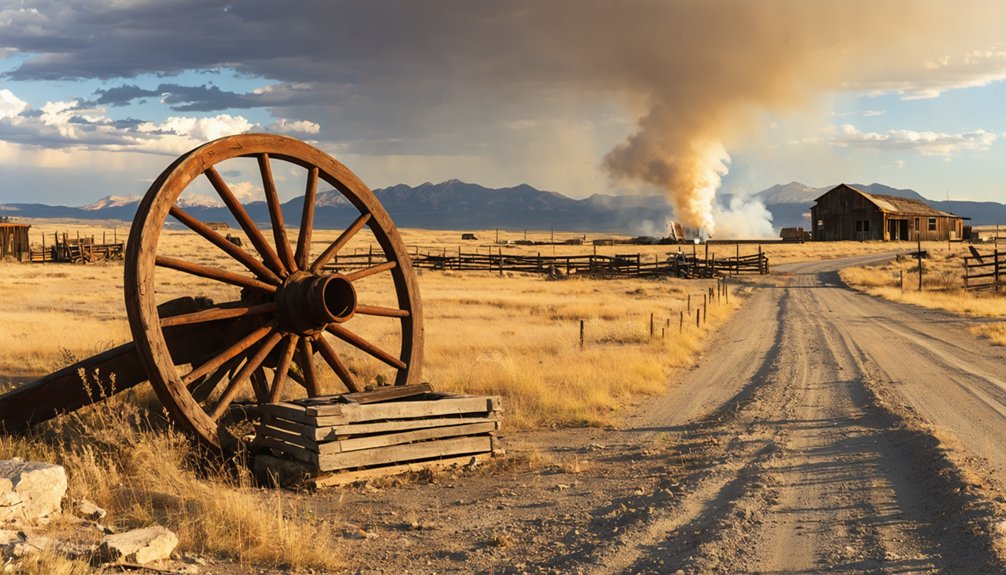
Gold fever burned through Montana City like wildfire in the 1870s, but economic reality doused those flames within a generation. You’ll find the settlement’s story mirrors countless frontier boomtowns that rose with mining prospects and vanished just as quickly.
The economic decline followed predictable patterns:
- Ore deposits depleted faster than anticipated, leaving miners empty-handed and desperate for new strikes
- Railroad routes bypassed the settlement, cutting off crucial supply lines and market access
- Competing camps with richer claims drew fortune-seekers away from Montana City’s dwindling opportunities
- Harsh winters and isolation made sustaining businesses impossible once profits dried up
The population exodus transformed bustling streets into abandoned corridors, leaving behind weathered structures that now beckon adventurous travelers.
What to Expect When Visiting Montana City Today
You’ll find Montana City’s weathered foundations and log cabin remnants scattered across a high-desert landscape where 1870s miners once extracted gold from the surrounding hills. The ghost town sits along maintained gravel roads 30 miles northwest of Rapid City, accessible by personal vehicle though four-wheel drive becomes essential during wet conditions or winter months.
Interpretive signs mark key locations throughout the site, helping you identify original mining camp layouts and assay office debris while you explore this authentic slice of Black Hills history.
Remnants of Mining Operations
What remains of Montana City’s mining legacy? You’ll discover subtle clues scattered across the landscape where fortune-seekers once toiled. The Montana Mine’s 193.82 acres of patented claims reveal nature’s slow reclamation efforts, though evidence of past extraction persists.
Look for these telltale signs of historic operations:
- Quartz fragments and bright-colored rocks indicating mineralization zones
- Green or blue mineral stains from copper chlorides marking silver deposits
- Rusty brown hematite deposits signaling gold-bearing areas
- Mine tailings dotting the terrain near former shaft locations
The 20-ton mill that once processed ore near Rapid Creek has vanished, but elevation markers at 5,741 feet guide you through this ghost town’s industrial past. You’re witnessing freedom’s double-edged sword—unbridled ambition followed by nature’s patient restoration.
Accessing the Ghost Town
The journey to Montana City’s weathered structures demands careful timing and preparation. You’ll navigate a gravel mountain road that’s passable in your Honda Civic during fair weather, but challenging winter access makes visits impossible from October through April when snow blankets the high elevation passes.
Plan your expedition between May and September, with gates closing around September 30th annually. As a managed historic site overseen by the Bureau of Land Management, you’ll encounter entry fees and posted restrictions near former mine entrances.
The reward? Thirty preserved buildings stand as unrestored monuments to Montana’s mining past, complete with period artifacts visible inside. Staff and volunteers provide historical handouts, while placards outside each structure guide your self-directed exploration through this 2010 National Register landmark.
Essential Tips for Planning Your Black Hills Ghost Town Adventure
Before you set out across Montana’s high desert in search of weathered saloons and abandoned mine shafts, proper preparation separates an unforgettable adventure from a disappointing detour. These ghost towns demand respect and readiness.
Respect Montana’s ghost towns with thorough preparation—the difference between adventure and disaster lies in your readiness.
Your Essential Checklist:
- Summer timing delivers access – Garnet’s 30 preserved structures become available during warm months, while Nevada City’s living history weekends bring the 1860s to life.
- Pack exploration gear – Sturdy boots handle creaky floors in Bannack’s church and courthouse, flashlights illuminate Comet’s shadowy remnants, and sun protection shields you from exposed terrain.
- Research entrance requirements – Bannack State Park charges fees; Garnet requires payment plus a brief walk to reach historic landmarks.
- Navigate cautiously – Gaping shafts at Hornblend and cyanide vats at Trojan pose real dangers around these preserved structures.
Frequently Asked Questions
Are Pets Allowed When Exploring Montana City and Nearby Ghost Towns?
Yes, you’ll find welcome freedom exploring these dusty streets with your four-legged companion. Pet friendly policies embrace leashed dogs throughout Montana’s ghost towns, while dog walking guidelines require waste cleanup—your adventure awaits together.
What Is the Best Time of Year to Visit Montana City?
You’ll find the best conditions during shoulder season visits in late May through early June or September through October. Off-peak season tours offer fewer crowds, lower prices, and perfect weather for exploring Montana City’s abandoned buildings and dusty trails freely.
Is Camping Available Near Montana City or Surrounding Ghost Town Sites?
Like pioneers staking claims in untamed territory, you’ll discover primitive campsites throughout Black Hills National Forest near Montana City’s ghost towns. These rugged spots honor the area’s historical significance while offering you authentic backcountry freedom and unforgettable starlit adventures.
Do I Need Special Permits to Photograph the Abandoned Mines?
You’ll need permits for commercial shoots on federal lands and permission from landowners for private property. Personal photography’s typically allowed, though you should verify ownership first. Camera equipment rental companies often provide current regulation guidance for specific locations.
Are Guided Tours Available for Montana City and Black Hills Ghost Towns?
Like forgotten frontier outposts, Montana City has no guided tours available—you’ll explore independently. However, nearby Black Hills ghost towns like Scenic and Spokane offer private tours, though accessibility challenges for visitors require four-wheel-drive vehicles on rugged terrain.
In addition to the private tours available in the Black Hills, other ghost town attractions in South Dakota reveal the haunting remnants of the Wild West. Visitors can immerse themselves in the rich history while navigating the unique landscapes that define this area. Each site offers a glimpse into the past, making it a memorable adventure for those seeking to uncover the stories behind these abandoned communities.
References
- https://www.historynet.com/ghost-town-mondak-montana-north-dakota/
- https://www.roadunraveled.com/blog/garnet-ghost-town-montana/
- https://www.legendsofamerica.com/castle-town-montana/
- https://www.youtube.com/watch?v=BNDINIXiOqw
- https://www.gonomad.com/232995-ghost-towns-of-montana
- https://www.sdpb.org/rural-life-and-history/2023-08-21/some-black-hills-ghost-towns-and-their-origins
- https://blackhillsvisitor.com/learn/maitland/
- https://www.sdhspress.com/journal/south-dakota-history-2-2/some-black-hills-ghost-towns-and-their-origins/vol-02-no-2-some-black-hills-ghost-towns-and-their-origins.pdf
- https://en.wikipedia.org/wiki/List_of_ghost_towns_in_South_Dakota
- https://history.sd.gov/museum/docs/Mining.pdf