Planning a ghost town road trip to Monticello, Kansas means stepping into a place where Wild West legends, Civil War tensions, and frontier hardship all collide. You’ll find historic cemeteries, the Virginia School House, and artifacts preserved by the Monticello Community Historical Society. Spring and fall offer the best conditions for exploring. Pair your visit with nearby ghost towns like Wilder, Clare, and Holliday for a full road trip experience. There’s far more to this story than you’d expect.
Key Takeaways
- Monticello, Kansas, now part of Shawnee, sits at the historic crossroads of the Midland Trail and a military road in Johnson County.
- Key sites include the Bullock, King/Wilder, and Boles cemeteries, the Virginia School House, and the Monticello Community Historical Society.
- Monticello’s rich history includes connections to Wild Bill Hickok, Bleeding Kansas tensions, Quantrill’s guerrillas, and Civil War-era Union barracks.
- Visit in spring or fall for the best experience; bring sturdy boots, water, and a detailed map for exploration.
- Extend your road trip by visiting nearby ghost towns including Wilder, Clare, Holliday, Chouteau Station, and Zarah.
Where Exactly Is Monticello, Kansas?
Tucked into the northern reaches of Johnson County, Kansas, Monticello once stood at the crossroads of the Midland Trail and a military road—a strategic position that made it a natural hub for travelers heading between Westport and Lawrence.
Its Monticello Geography placed it squarely where commerce, conflict, and culture collided during America’s most turbulent westward expansion era.
When you trace the town’s Historical Significance, you’ll find it wasn’t accidental. Founders established it on June 19, 1857, on 160 acres that previously served as a stagecoach stop—land once belonging to the Shawnee Indians before their reservation dissolved in 1844.
Today, the area sits within modern Shawnee, Kansas. You won’t find a thriving downtown, but you’ll discover a layered American story waiting beneath the surface.
What’s Left of Monticello, Kansas Today
Although Monticello itself has long since faded from the map, remnants of its story survive in ways that reward a curious traveler. This ghost town‘s historical significance lives on through several tangible touchstones you can actually visit.
Seek out the Bullock, King/Wilder, and Boles cemeteries near Clare Road and West 54th Street, where weathered headstones anchor you to the people who built this place. The Virginia School House still stands as a quiet relic of the community’s educational ambitions.
You’ll also find the Monticello Community Historical Society in nearby Shawnee preserving documents, photographs, and artifacts. These surviving pieces don’t just mark where people lived — they tell you how they lived, fought, and ultimately scattered when fortune moved elsewhere.
The Wild History That Makes Monticello Worth the Drive
Few ghost towns pack this much drama into a single ZIP code. Monticello’s history reads like a frontier novel — Wild Bill Hickok staked a claim here, horse thieves got lynched, and pro-slavery settlers made it a flashpoint during Bleeding Kansas.
Wild Bill Hickok staked a claim here. Horse thieves got lynched. Bleeding Kansas made it a battleground.
Quantrill’s guerrillas passed through, buildings served as Union barracks, and a tornado, fire, and grasshopper plague all took their shots at the town. Then the railroad bypassed it entirely, sealing its fate.
For travelers chasing ghost towns with real historical significance, Monticello delivers something rare — layers of American conflict compressed into one abandoned crossroads.
You won’t find a museum or a gift shop. What you’ll find is raw, unfiltered history sitting quietly at the edge of northern Johnson County, waiting for you to show up.
Did Bill Hickok Really Live in Monticello?
If you’re a fan of Wild West legends, you’ll want to know that Bill Hickok once staked a 160-acre claim right at 83rd and Clare Road, putting him squarely in Monticello’s story.
He left Kansas in late 1859, but not before writing his mother a letter that painted a raw picture of frontier life, noting that no common law existed and a man could do as he pleased without fear.
That letter alone makes Monticello feel less like a forgotten dot on a map and more like a living chapter of American frontier history.
Hickok’s Monticello Land Claim
One of Monticello’s most intriguing historical footnotes is that Wild Bill Hickok once staked a 160-acre land claim at what’s now 83rd and Clare Road.
He arrived during the lawless Bleeding Kansas era, when men truly lived by their own rules. In a letter to his mother, Hickok himself described the territory as a place with no common law, where a man does what he pleases without fear.
That kind of raw freedom defined both the man and the region.
Hickok’s Legacy lives in ghost towns like Monticello, places where legendary figures briefly passed through, leaving behind only whispers in the wind.
He departed late 1859, but his brief presence adds a compelling layer to Monticello’s already fascinating story.
His Departure From Kansas
Hickok’s departure carries real historical significance. His letter home painted a stark picture of a lawless frontier where men acted without consequence or fear.
That raw freedom defined Monticello’s character during its most turbulent years.
You can stand at 83rd and Clare Road today and imagine what he experienced — wide open land, no rules, and a town teetering on the edge of collapse.
Whether he stayed briefly or longer, Hickok’s connection to Monticello remains one of its most compelling stories.
Hickok’s Letter Home
Among the most intriguing pieces of evidence tying Bill Hickok to Monticello is a letter he wrote to his mother before leaving Kansas in late 1859.
In it, Hickok’s impressions of frontier life paint a vivid picture of a place where civilization hadn’t yet tamed human nature. He told her there was no common law — that a man did whatever he pleased without fear of consequences.
For someone who valued personal freedom, that raw, unregulated existence held real appeal. Reading those words today, you get a genuine sense of what drew restless, independent spirits to places like Monticello.
It wasn’t just land — it was the absence of rules, the wide-open possibility of defining yourself entirely on your own terms.
What’s Still Standing in Monticello Township
If you make the trip out to Monticello Township today, you’ll find a handful of quiet but meaningful remnants still holding their ground.
Three historic cemeteries — Bullock, King/Wilder, and Boles — sit near Clare Road and West 54th Street, marking the lives of early settlers who built and lost this community.
The old Virginia School House still stands as a relic of the township’s former life, and the Monticello Community Historical Society in nearby Shawnee keeps the full story alive for anyone hungry for more.
Historic Cemeteries Still Standing
While most of Monticello has vanished beneath time and overgrowth, three historic cemeteries still anchor the township’s past to the present: Bullock, King/Wilder, and Boles, all located near Clare Road and West 54th Street.
These quiet burial grounds hold the remains of early settlers who lived through Bleeding Kansas, the Civil War, and the town’s slow disappearance.
You’ll find weathered headstones, forgotten names, and the kind of stillness that fuels cemetery legends and ghostly encounters.
Local history enthusiasts treat these sites as outdoor museums — free, accessible, and deeply personal.
Walk the grounds and you’re walking among people who carved a community out of raw prairie.
Respect the grounds, bring a camera, and let the silence tell you what the history books barely mention.
Virginia School House Relic
Tucked within Monticello Township, the Virginia School House stands as one of the last surviving relics of a community that time erased.
You’re looking at a structure that reflects the Virginia history settlers carried westward, embedding their architectural traditions into Kansas soil. The schoolhouse architecture speaks quietly but powerfully — modest, practical, and built to last longer than the town it served.
While Monticello’s hotels, saloons, and storefronts crumbled or burned away, this building endured. When you visit, you’re standing where children once learned, where a frontier community asserted its identity amid chaos and conflict.
It’s more than weathered wood and old walls — it’s physical proof that people built something here, believed in something here, and left behind more than just ghost stories.
Monticello Historical Society
Though Monticello itself is gone, the Monticello Community Historical Society in Shawnee keeps its memory from disappearing entirely. If you’re passionate about uncovering forgotten history, this organization deserves your attention.
Their Monticello preservation efforts have rescued stories, documents, and records that would otherwise vanish alongside the town itself.
Stop in and explore their historical artifacts display, where tangible pieces of frontier life connect you directly to the settlers, conflicts, and ambitions that shaped this corner of Johnson County.
You’ll encounter evidence of a community that survived Bleeding Kansas tensions, Civil War upheaval, and natural disasters before quietly fading from the map.
The Society transforms an extinct town into a living story, giving independent-minded travelers like you genuine insight into what once thrived here.
Monticello’s Three Cemeteries and How to Find Them
Three quiet cemeteries are all that remain of Monticello’s once-bustling community, and tracking them down makes for one of the more rewarding stops on any ghost town road trip. Their cemetery significance goes beyond simple grave markers — they’re tangible proof that real lives unfolded here long before Monticello faded into one of Kansas’s forgotten ghost towns.
You’ll find three distinct burial grounds to explore: Bullock Cemetery, King/Wilder Cemetery, and Boles Cemetery. All three sit near Clare Road and West 54th Street in northern Johnson County.
Bring a map, because signage is minimal. Walk the grounds slowly — worn headstones and weathered inscriptions reveal names tied directly to Monticello’s founding families.
These cemeteries don’t just mark death; they mark a community that once stood proud on the Kansas frontier.
What the Monticello Historical Society Knows That You Don’t
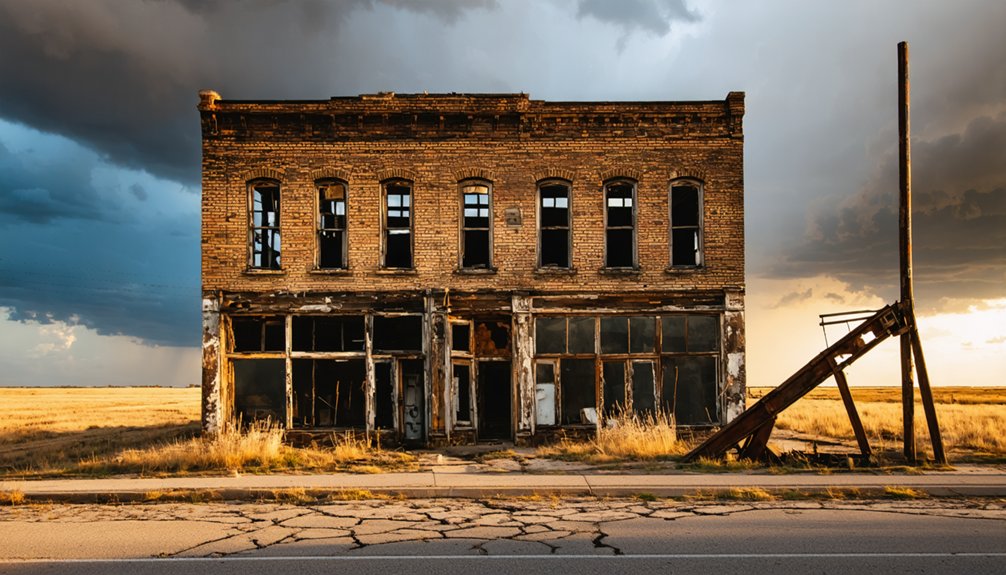
The Monticello Community Historical Society in Shawnee holds records, photographs, and oral histories that never made it into mainstream archives, and they’re your best shot at uncovering the town’s most overlooked stories.
You’ll find forgotten accounts of the families who built Monticello, survived its boom, and watched it quietly vanish — details no roadside marker will ever tell you.
If you’re serious about understanding what this ghost town really was, their collection bridges the gap between the landscape you’re standing on and the lives once lived there.
Hidden Historical Records Preserved
Buried within the archives of the Monticello Community Historical Society in Shawnee, Kansas, lies a trove of records that most ghost town enthusiasts never get to see.
These hidden archives hold firsthand accounts of Bleeding Kansas skirmishes, early settler land claims, and the town’s controversial pro-slavery politics.
You’ll find historical artifacts that connect you directly to figures like Bill Hickok, who once staked a 160-acre claim nearby.
The Society preserves documents tracing Shawnee Indian land treaties, the town’s 1857 founding charter, and records of communities like Clare, Wilder, and Holliday.
If you contact them before your visit, you gain access to context that transforms a simple road trip into a genuinely immersive journey through one of Kansas’s most turbulent and forgotten chapters.
Forgotten Stories Uncovered
What the Monticello Community Historical Society knows could genuinely rewrite your understanding of this forgotten Kansas crossroads.
They’ve catalogued forgotten legends surrounding figures like Bill Hickok, who staked his claim here before disappearing into frontier mythology.
They’ve tracked hidden artifacts connected to Shawnee settlements, Bleeding Kansas violence, and Quantrill’s raiders cutting through the township.
You’ll discover that Monticello wasn’t just a sleepy pro-slavery outpost — it was a raw, lawless proving ground where men operated without consequence.
The Society preserves documents, cemetery records, and community stories that never made mainstream history books.
If you’re serious about understanding authentic frontier freedom — unfiltered and unvarnished — these keepers of local memory hand you something no roadside marker ever could.
Best Time of Year to Visit Monticello, Kansas
Timing your visit to Monticello, Kansas, can make all the difference between a rewarding ghost town experience and a frustrating one.
Spring and fall offer the best season for exploration, delivering ideal weather with mild temperatures and manageable humidity. You’ll move freely through cemetery grounds and historical sites without summer’s oppressive heat slowing you down.
Spring and fall deliver ideal weather for exploration — mild temperatures, manageable humidity, and freedom to roam historic grounds.
April through May brings wildflowers that soften the eeriness of forgotten landscapes, while September through October bathes everything in golden light perfect for photography.
Avoid winter’s unpredictable ice storms and summer’s brutal heat index. Weekdays give you solitude that weekends can’t guarantee.
Pack sturdy boots, water, and a detailed map regardless of when you go — Monticello rewards the prepared traveler who respects its untamed, independent spirit.
Nearby Ghost Towns Worth Pairing With This Trip
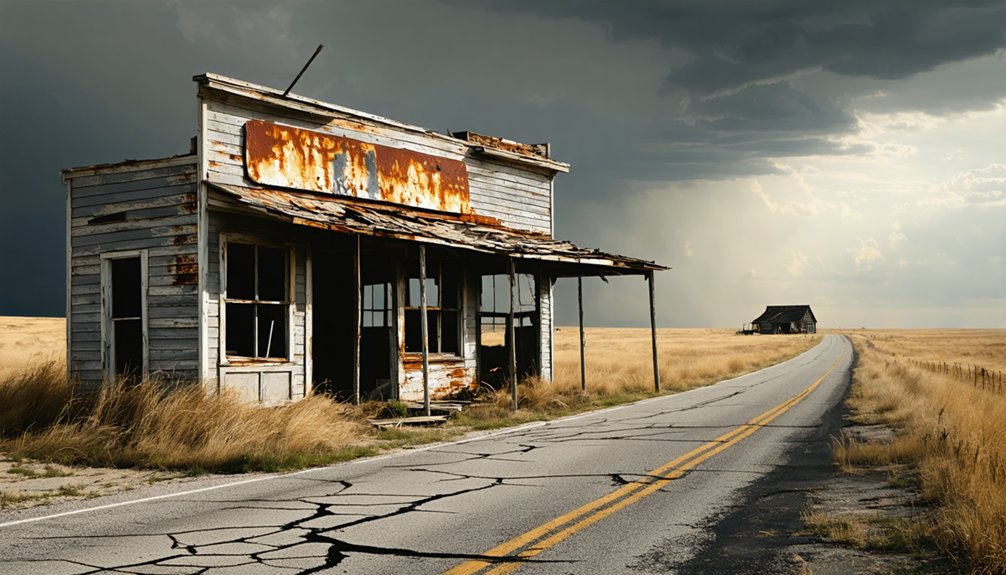
Monticello doesn’t stand alone in its haunted history — the knowledge tells us it represents a cluster of vanished communities worth tracking down together.
Wilder, Clare, Holliday, Chouteau Station, and Zarah all share this forgotten northern Johnson County landscape, each carrying its own story of boom and abandonment.
Chouteau Station once buzzed with steamboat activity along the Kansas River, while Clare and Holliday faded when railroad deals bypassed them entirely.
Look for historical markers and ghost town attractions scattered across the region that connect these communities into one compelling narrative.
Mapping out this cluster turns a single stop into a full-day expedition.
You’re not just visiting ruins — you’re tracing the raw, restless energy of a frontier that refused to stay settled.
What to Know Before You Walk the Monticello Grounds
Before you set foot on the Monticello grounds, knowing what’s left — and what isn’t — will shape how you experience the site.
No reconstructed buildings greet you here. What remains are echoes — in the land, the cemeteries, and local legends passed down through generations.
Come prepared:
- Respect the cemeteries — Bullock, King/Wilder, and Boles hold real history, not historical artifacts for souvenirs
- Bring a map — GPS struggles with rural Johnson County back roads near Clare Road
- Walk slowly — the Virginia School House and surrounding land reward careful attention
- Talk to locals — the Monticello Community Historical Society in Shawnee holds knowledge no sign can capture
You’re walking ground where Bill Hickok once claimed land. Treat it accordingly.
Frequently Asked Questions
Was Monticello, Kansas Named After Thomas Jefferson’s Virginia Estate?
Yes, you’ll find that Monticello history directly connects to Jefferson legacy — the town was named after Thomas Jefferson’s iconic Virginia estate when founders established it on June 19, 1857, honoring America’s enduring spirit of freedom.
Why Did the Railroad Bypass Monticello in 1878?
Like a rigged card game, insider land dealings steered railroad expansion away from Monticello in 1878, favoring other areas instead. You’d feel the economic impact as the town’s once-thriving businesses crumbled without that essential connection.
Did William Quantrill’s Raiders Ever Attack Monticello Directly?
Quantrill’s raiders didn’t directly attack Monticello during the Civil War. You’ll find they merely passed through the township, using guerrilla warfare tactics en route to sack nearby Shawnee in 1862 and Olathe in 1864.
When Was the Shawnee Indian Reservation in This Area Dissolved?
Settlers swept in swiftly after the Shawnee Indian reservation dissolved in 1844, a moment of immense historical significance. You’ll feel the cultural impact as unclaimed land opened, forever reshaping this freedom-filled frontier you’re exploring today.
What Natural Disasters Struck Monticello During Its Early Years?
You’ll discover that Monticello faced brutal tornado impact in 1859, which you can imagine tearing through the frontier settlement. Following that devastation, you’d also encounter fire destruction and a grasshopper plague compounding the flood damage settlers already endured.
References
- https://monticelloks.org/history.htm
- https://legendsofkansas.com/monticello-kansas/
- https://jocohistory.wordpress.com/2019/01/13/monticello-area-history/
- https://www.kcur.org/arts-life/2022-04-09/ghost-towns-are-all-around-kansas-city-if-you-know-where-to-look
- https://www.legendsofamerica.com/nm-placita/
- https://thewanderingpigeon.com/2015/10/03/day-of-kansas-ghost-towns/
- https://johnsoncoks.cottonhills.net/historic-records/old-towns.html
- https://monticelloks.org/sites.htm