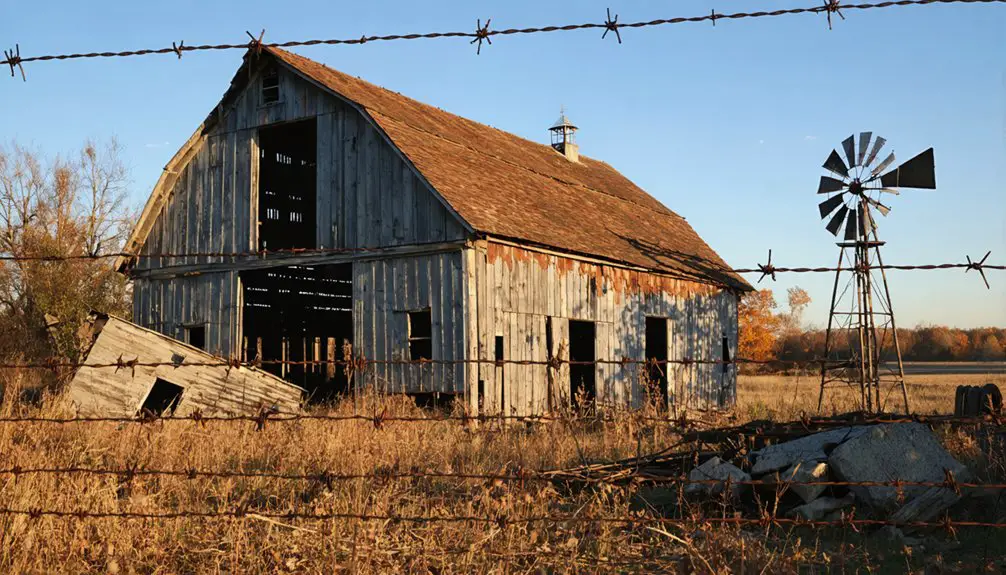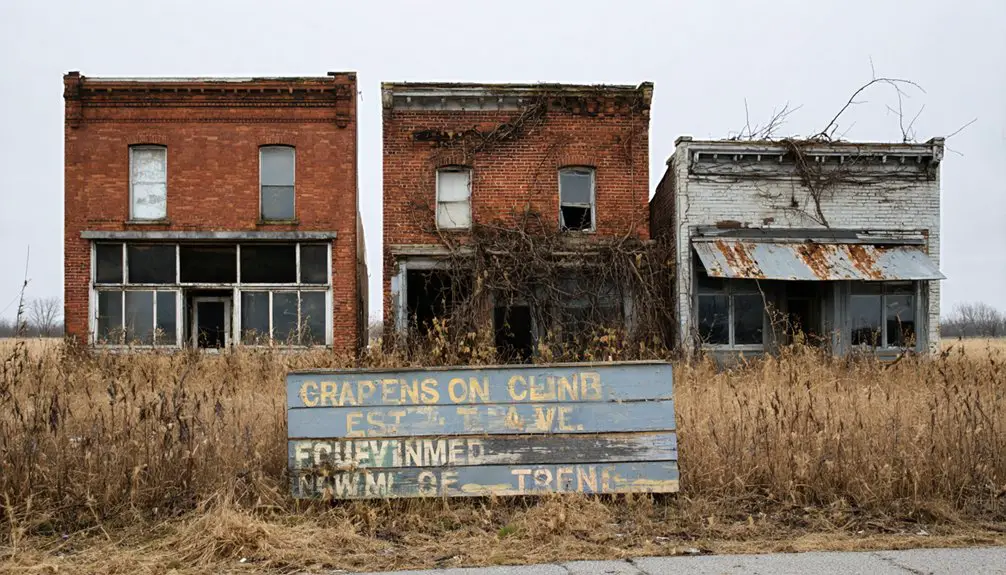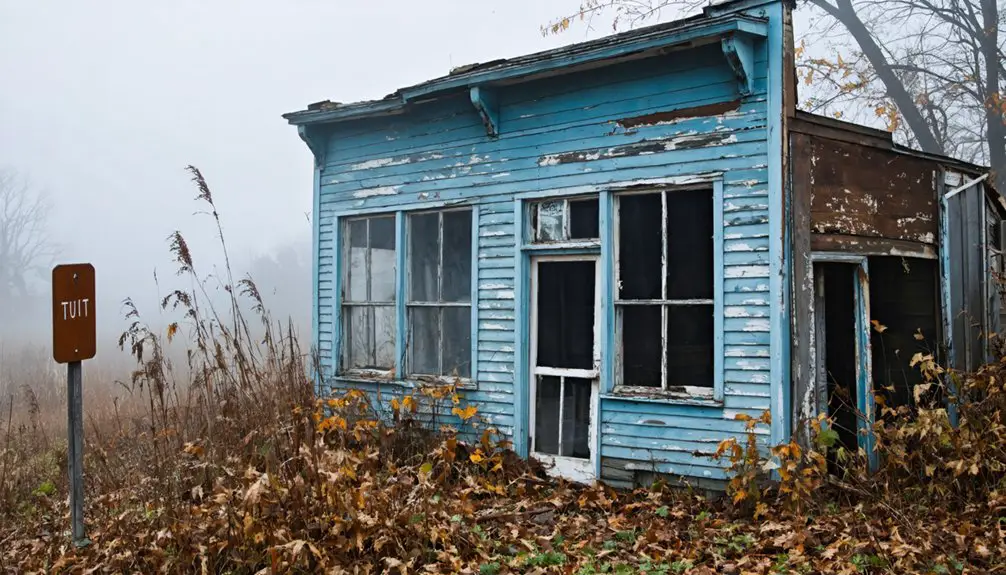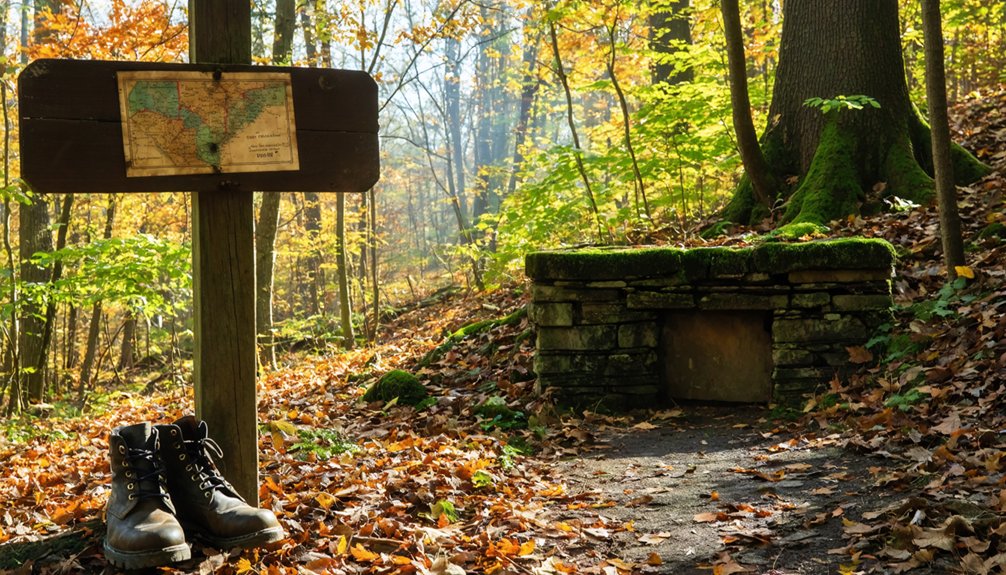
Your Moonville ghost town adventure starts 75 miles southeast of Columbus in Vinton County’s remote wilderness. Navigate to Lake Hope State Park, turn onto Wheelabout Road, and cross the one-lane bridge over Raccoon Creek to reach the trailhead. You’ll find the infamous 1856 tunnel just 100 yards down the gravel path, where 27 documented deaths created Ohio’s most concentrated paranormal hotspot. The railroad’s ghostly brakemen, lantern-carrying spirits, and vanishing Lavender Lady await those who venture beyond the tunnel’s dark mouth into Moonville’s haunted remnants.
Key Takeaways
- Access Moonville via OH-278 south to Lake Hope State Park, then Wheelabout Road to the one-lane bridge over Raccoon Creek.
- The Moonville Tunnel sits 100 yards from the trailhead at GPS coordinates 39° 18′ 24.12″ N, 82° 19′ 16.68″ W.
- Prepare for dense woodland and uneven backcountry terrain near Athens, Ohio in Vinton County.
- Visit the 1856 concrete tunnel where paranormal activity centers, including multiple ghost sightings and lantern-carrying apparitions.
- Explore the abandoned town site where 27 deaths occurred between 1859-1986, attracting ghost hunters for over a century.
The Rise and Fall of Moonville: A Brief History
When Samuel Coe purchased 350 acres of Brown Township land during the 1850s railroad boom, he couldn’t have imagined his property would birth a community destined to vanish within a century. The Marietta and Cincinnati Railroad carved through his holdings around 1856, creating a depot that attracted miners, farmers, and railway workers.
During its initial development stages, Moonville thrived with 100 residents by the 1870s, supporting a schoolhouse, gristmill, sawmill, and cemetery. The surrounding mines fed Hope Furnace, casting iron for stoves and Civil War weaponry.
However, economic decline factors emerged swiftly—depleted ore deposits and exhausted timber forced the furnace’s closure by the 1880s. Mining operations relocated, railroad ownership changed hands, and Vinton County’s remote economy weakened. The last family abandoned Moonville in 1947.
Getting to Moonville: Location and Directions
You’ll find Moonville tucked away in southeastern Brown Township, Vinton County—Ohio’s least populated county—where the ghost town sits quietly along Raccoon Creek within Zaleski State Forest.
Your journey begins on OH-278, turning left onto Wheelabout Road before winding through gravel roads (Shea Road, then Hope-Moonville Road) for roughly 2.5 miles until you spot the metal bridge crossing Raccoon Creek.
Park in the gravel pulloffs just before this bridge, where a trail marked by a large boulder hugs the creek’s edge and leads you through the town’s remnants toward the historic railroad bed and tunnel perched on the hillside above.
Finding Moonville’s Remote Location
- Primary GPS location: 39° 18′ 24.12″ N, 82° 19′ 16.68″ W
- Nearest regional hub: Athens, Ohio
- Access point: Lake Hope State Park in Vinton County
- Historical reference: Former crossing between Buck Lane and Shea Road
Expect dense woodland, uneven ground, and genuine backcountry conditions throughout your exploration.
Accessing the Rail Trail
From Nelsonville, the journey to Moonville begins where civilization starts to fray at its edges. You’ll turn south on OH-278 toward Lake Hope State Park, watching pavement surrender to gravel as Wheelabout Road narrows. The one-lane bridge over Raccoon Creek marks your arrival—park near the old rail bed where the trailhead location awaits.
From Athens, OH-50 splits from OH-32 before you turn right onto OH-278 toward Zaleski, then right again on Wheelabout Road to reach the same crossing.
The multi use trail access welcomes hikers, equestrians, and muscle-powered adventurers along this flat, natural-surface corridor. Once you’ve crossed Raccoon Creek on foot, Moonville Tunnel stands just 100 yards away—a brick-lined portal into another era.
Nearby Landmarks and Parking
Beyond the tunnel’s shadowed mouth, Moonville’s scattered remnants tell stories through absence—crumbling foundation stones half-swallowed by forest loam, the weathered cemetery where iron fences guard names worn smooth by a century of rain.
Your exploration extends beyond the tunnel itself:
- Old trestles spanning Raccoon Creek offer dramatic vantage points
- Foundation remains of the mining town scatter through undergrowth
- Schoolhouse ruins mark where children once gathered
- Cemetery plots preserve the community’s final residents
Visitor parking considerations remain informal—you’ll find limited roadside pulloffs near trailheads rather than developed lots. The Vinton County Park District manages access points, though specific facilities aren’t marked. For nearby lodging options, Lake Hope State Park provides cabins and camping, while Zaleski offers modest accommodations for multi-day ghost hunting expeditions.
The Moonville Tunnel: Engineering Marvel Turned Haunted Landmark
You’ll spot the concrete tunnel emerging from dense forest like a relic from another era, its dark mouth framed by weathered stone where trains once thundered through Vinton County’s hills. Built in 1856 on Samuel Coe’s donated land, this sturdy passage was engineered to carry coal and clay shipments along the Marietta-Cincinnati Railroad‘s shortest route.
What began as an unremarkable engineering solution has transformed into Ohio’s most notorious haunted landmark, where decades of fatal accidents—brakemen crushed, engineers killed in collisions, at least 26 deaths on these tracks—left behind more than rusted rails and crumbling abutments.
Construction and Structural Features
When railroad surveyors first mapped the route through southeastern Ohio’s wilderness in 1856, they faced dense forests and challenging terrain along Raccoon Creek. Samuel Coe’s strategic land donation solved their routing dilemma, shortening the distance to Cincinnati while enabling efficient coal and clay transport from his property.
The tunnel construction techniques employed concrete as the primary material, creating a structure that would endure over 130 years of service. Material sourcing challenges in this isolated location required innovative engineering solutions.
Today, you’ll find the tunnel’s key features at GPS coordinates 39.31006, -82.32434:
- Single-track concrete design accommodating 19th-century freight trains
- Railroad abutments over Raccoon Creek supporting original infrastructure
- Accessible gravel paths connecting to parking areas
- Structural stability maintained despite 1980s rail abandonment
From Active Rail to Ghost Magnet
The Marietta and Cincinnati Railroad‘s completion through Moonville in 1866 transformed Samuel Coe’s strategic land donation into a pivotal commercial artery stretching from Wheeling to Cincinnati. Trains roared through at 50 miles per hour, bypassing Appalachian ridges while serving a mining community that peaked at 100 residents.
When Baltimore & Ohio absorbed the line in the 1880s, traffic surged—but Moonville withered anyway.
Rail service eventually ceased, leaving the tunnel stranded in Zaleski State Forest, where Vinton County’s dense woodlands reclaimed what civilization abandoned. Today’s paranormal investigations draw thrill-seekers to this Historic Site #15, where lantern-swinging phantoms allegedly caused emergency braking decades ago. Community resurgence efforts now balance preservation with ghost-hunting tourism, offering you unregulated access to explore where tragedy bred legend.
Tragic Tales: The Deadly Accidents That Shaped Moonville’s Legend
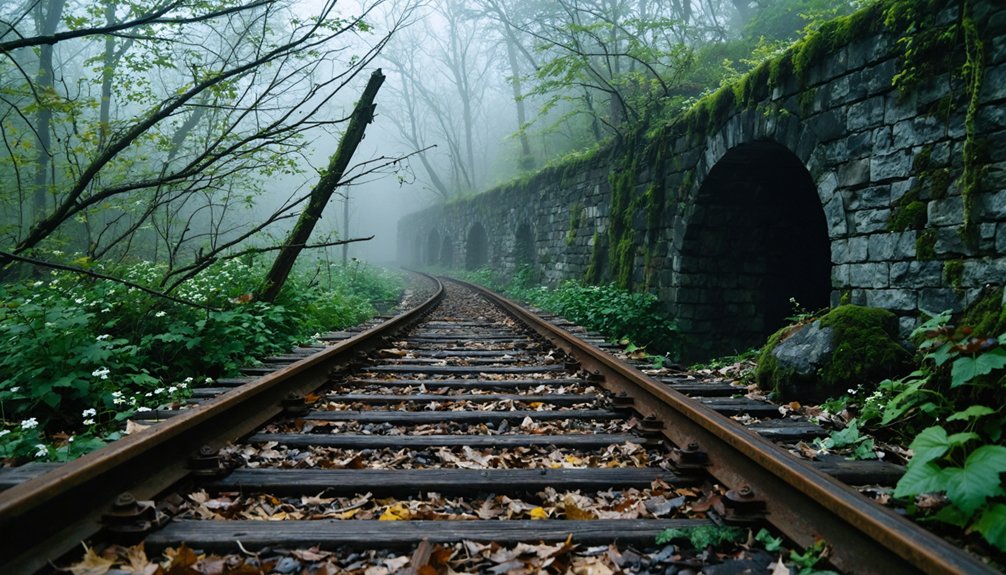
Blood and iron forged Moonville’s dark reputation along these treacherous rails. Between 1859 and 1986, these tracks claimed upwards of 27 lives through locomotive disasters and worker casualties that still echo through the abandoned infrastructure.
The deadliest incidents you’ll discover include:
- The 1880 head-on collision near Moonville that killed engineer Frank Lawhead and fireman Charles Krick when a dispatcher’s error sent two freight trains into catastrophic impact
- Five brakemen crushed between 1859-1884, one decapitated when his brake band slipped near the tunnel
- Pedestrian deaths from drunken track-walking and bridge crossings through dense woods that muffled train sounds
- The 1938 rockslide collision that killed an engineer west of the tunnel
These tragedies birthed the ghost stories drawing you here today.
Meet the Spirits: Ghostly Residents of Moonville
From these documented tragedies emerged the spectral residents you might encounter during your visit. Theodore Lawhead’s ghost appears holding a lantern, his eyes gleaming like fire with a halo of stars as he walks the tracks where his 1880s collision occurred.
You’ll find paranormal activity centered around the drunken brakeman who lost his leg in 1859—his spirit manifests as both a lantern-carrying figure and hovering light orb. The Lavender Lady, believed to be Mary Shea, vanishes suddenly near the tunnel’s far end, leaving only her signature scent.
Baldie, the murdered town bully, adds another presence to these cemetery legends. Local historians estimate up to 27 deaths along these tracks, creating a concentration of spectral energy that’s drawn ghost hunters for over a century.
Hiking the Moonville Tunnel Rail Trail
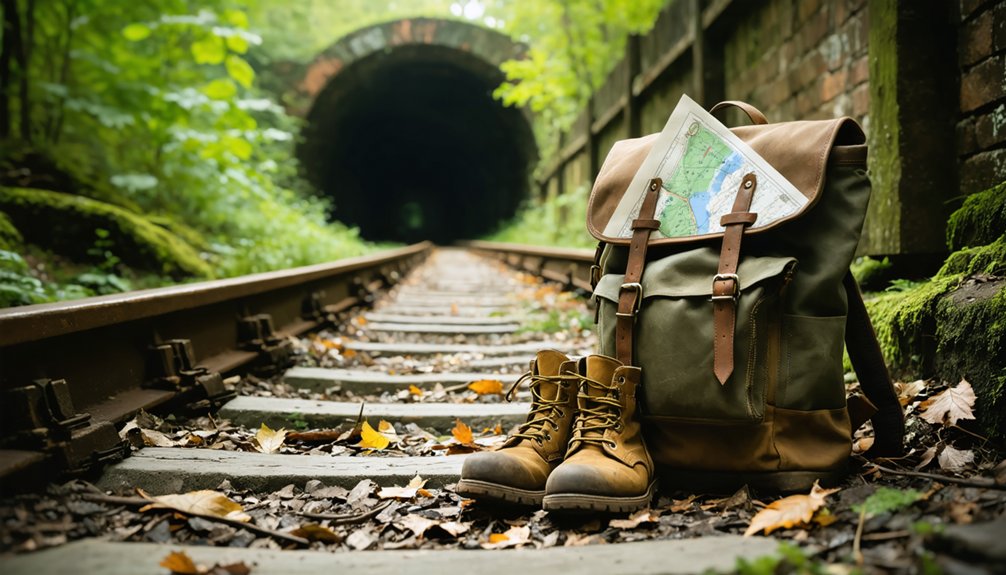
Beyond the ghostly legends, you’ll discover a 10-mile adventure through southeast Ohio’s Zaleski State Forest, where the Moonville Tunnel Rail Trail winds through Vinton and Athens Counties along an abandoned railroad corridor. This primitive path challenges you with terrain variations from gravel to natural surfaces, descending 40 feet through Raccoon Creek valley.
Your Trail Essentials:
- Navigate multiple stream crossings where railroad bridges once stood
- Explore both Moonville’s masonry tunnel and King Switch’s 120-foot timber-lined passage
- Access trailheads at Zaleski (Mill Street) or Mineral (Biddyville Road)
- Embrace wildlife viewing opportunities in this year-round backcountry
The hard-rated difficulty rewards your adventurous spirit with untamed landscape and historic infrastructure. Park at Moonville’s gravel lot and forge your own experience through Ohio’s forgotten railroad past.
What to See: Exploring the Cemetery and Town Remnants
Just past the iron bridge, a weathered hilltop cemetery emerges from the forest canopy—your most tangible connection to Moonville’s vanished community. Thirteen known graves rest here, including tombstones of the Coe family who donated land for the railroad in 1856. You’ll find the weathered headstones tell fragmented stories—many names eroded beyond recognition, others unmarked entirely. Local custom saw some markers repurposed as walkway stones decades ago.
The gravestones composition speaks to mid-19th century settlers who watched their town peak at 100 residents before coal and iron resources depleted. By 1947, the last family left. Now thick woods reclaim the hilltop, with only faint building foundations scattered nearby. Tread carefully across uneven terrain, respecting these silent witnesses to a community that thrived, struggled, and ultimately surrendered to time.
Best Time to Visit Moonville for Ghost Hunting
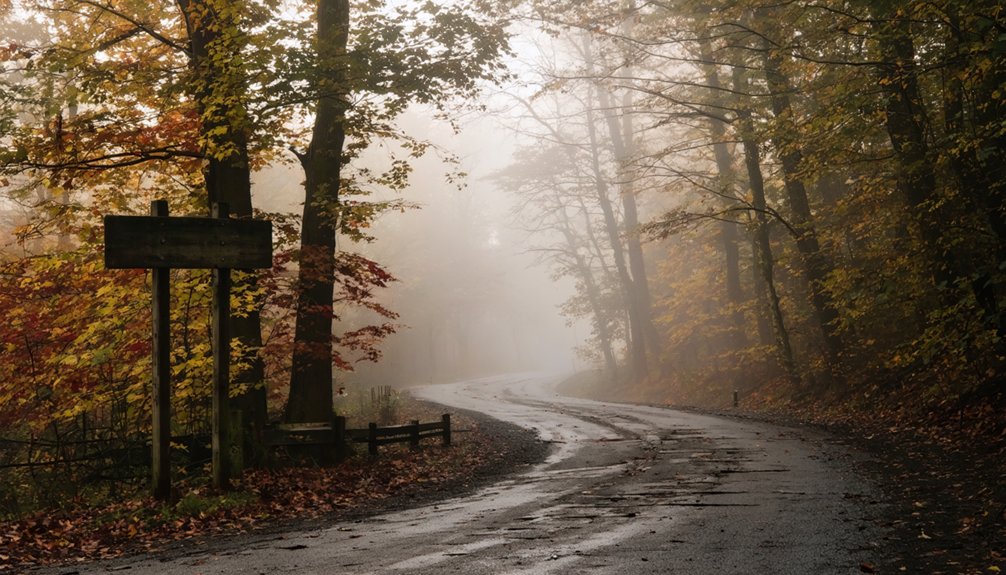
While Moonville’s haunted tunnel stands accessible year-round with no posted hours, your ghost hunting experience depends heavily on timing.
Moonville tunnel welcomes visitors 24/7, but strategic timing transforms casual visits into genuine paranormal encounters with restless spirits.
Prime paranormal windows include:
- Fall evenings (September-October) – Peak foliage frames the gravel road while cooler temperatures bring spirits out. Halloween week offers ideal conditions for encountering apparitions.
- Dark, stormy nights – Heavy weather through southeast Ohio’s dense forests creates mystical breakthroughs. Witnesses report greenish-yellow lights and chilling sounds.
- Weeknight ghost tours – Jannette Quackenbush’s exclusive night hikes reveal authentic encounters without weekend crowds. Off season paranormal activity intensifies during quieter periods.
- Full moon excursions – The lantern-carrying ghost appears in varying conditions, though moonlit nights amplify strange voices and shadowy figures.
Events like “Midnight at Moonville” (October 13th, 3pm-11pm) combine professional guidance with peak haunting hours.
Nearby Attractions: Lake Hope State Park and Ravenwood Castle
After your ghost hunting adventure in Moonville, you’ll find Lake Hope State Park just a short drive away, where 120 acres of shimmering water cut through rugged Appalachian gorges and dense hardwood forests.
The park’s 17 miles of hiking trails lead past historic Hope Furnace—a Civil War-era iron smelter—while the lake itself invites you to paddle rental kayaks through quiet coves where beavers build their lodges.
For overnight stays that match Moonville’s otherworldly atmosphere, Ravenwood Castle in nearby New Plymouth offers medieval-themed rooms and cottages, complete with birding trails hosting over 120 species and guided owl walks through the shadowy woods.
Lake Hope State Park
The rugged wilderness of Lake Hope State Park sprawls across 2,983 acres of Zaleski State Forest, five miles northeast of Zaleski in Vinton County. You’ll discover natural scenery shaped by abandoned iron mines and steep forested gorges surrounding the 120-acre lake.
The park offers year round activities from swimming at the beach where the ghost town of Hope once stood to exploring 15 miles of trails through oak-hickory forests.
Your adventures include:
- Hiking and mountain biking through narrow ridges and wildflower-dotted valleys
- Boating and fishing on Big Sandy Run’s impoundment
- Camping in wooded sites with full-kitchen cottages available
- Connecting to the nearby Moonville Rail-Trail and 21-mile backpack trail
Free admission welcomes you dawn to dusk at 27331 State Route 278.
Ravenwood Castle Accommodation
Stepping from Lake Hope’s wilderness trails into a medieval fantasy, you’ll find Ravenwood Castle rising from the Hocking Hills forests like something from another century. This 12th-century English-Welsh border castle replica offers unique accommodations that’ll transport you beyond typical lodging—choose from castle rooms like Queen Victoria ($199/night) or rustic medieval village cottages including Tanner’s Cabin ($179/night) and Woodcutter’s Cottage ($239/night).
The castle amenities embrace your unplugged vacation: explore hiking trails, gather in the Great Hall, or challenge fellow travelers with 100+ board games in the Library. Raven’s Roost Pub serves as your evening retreat. Cell service? Limited. TV? Forget it. Instead, you’ll discover scavenger hunts, murder mysteries, and a community that values real connection over digital distractions—exactly what your ghost town adventure needs.
Essential Tips for Your Moonville Ghost Town Adventure

Gravel crunches beneath your boots as you approach southeastern Ohio’s most haunted railroad remnant, where proper preparation separates memorable exploration from dangerous misadventure. While local folklore draws thrill-seekers to Moonville’s shadowy tunnel, these visitor safety tips guarantee you’ll leave with stories instead of scars:
- Choose guided tours over solo expeditions—experts navigate the rail trail safely while sharing authenticated history
- Pack essentials: sturdy footwear, flashlights, first-aid supplies, and water for the thirty-minute drive from McArthur
- Avoid trestles and active rail areas where 26 deaths have occurred since the 1850s
- Respect the cemetery—many headstones vanished decades ago, making ground unstable
Dawn and dusk offer ideal lighting for photography while reducing hazards around Raccoon Creek’s trestles and the tunnel’s crumbling masonry.
Frequently Asked Questions
Is Camping Allowed Near the Moonville Tunnel or on the Rail Trail?
Camping isn’t allowed on the rail trail itself, but you’ll find overnight accommodations at nearby Lake Hope State Park. You can explore hiking trail conditions during daylight hours, then retreat to your campsite under star-filled skies.
Are There Restrooms or Facilities Available at the Moonville Site?
No, you won’t find restrooms at this remote ghost town—just wilderness and ruins. Seasonal portable restrooms aren’t provided. You’ll need nearby public facilities at Lake Hope State Park or Hope Furnace before exploring Moonville’s haunting tunnel.
Is the Moonville Tunnel Safe to Walk Through Today?
Yes, you’ll find the tunnel’s structural integrity remains solid inside, though you should note accessibility considerations with its uneven surface. The interior’s completely safe to explore, while entrance areas show weathering that adds authentic character to your adventure.
Do I Need Permission to Access Private Property Around Moonville?
You’ll need local landowner permissions if venturing beyond the designated rail trail, as private property access restrictions apply outside state forest boundaries. Stick to public paths—the tunnel and foundations offer plenty of ghostly exploration without trespassing concerns.
What Ghost Hunting Equipment Should I Bring to Moonville?
Bring paranormal cameras with night vision to capture ghostly manifestations, electromagnetic field meters to detect spirit energy spikes, audio recorders for EVP documentation, and reliable flashlights. You’ll need backup batteries since Moonville’s remote wilderness offers no power sources.