You’ll find Moretown Common along Vermont’s Route 100B, where stone walls and cellar holes mark the boundaries of a settlement that thrived from 1792 to 1832. The site preserves extensive remnants of early frontier life, including farm foundations and the Moretown Common Cemetery with 266 memorial records. Forest Service trails provide documented access to these historical structures, while ten cemeteries throughout the township offer additional exploration opportunities. The Vermont Cemetery Registry and local historical societies maintain detailed coordinates and archival materials to guide your investigation of this preserved settlement.
Key Takeaways
- Moretown Common, Vermont’s historic governance center from 1792-1832, features abandoned homesteads, stone walls, and extensive farm ruins to explore.
- Access the site via Forest Service trails from Route 9 to discover cellar holes and remnants of early 1800s settlements.
- Visit Moretown Common Cemetery, containing 266 memorial records from the 1800s, one of ten documented cemeteries in the area.
- Obtain the town’s official brochure for cemetery coordinates and consult Vermont Cemetery Registry for detailed location data before visiting.
- Explore nearby Mad River Valley for additional abandoned hill farms and logging camps marked by stone walls and family burial plots.
The Historical Significance of Moretown Common
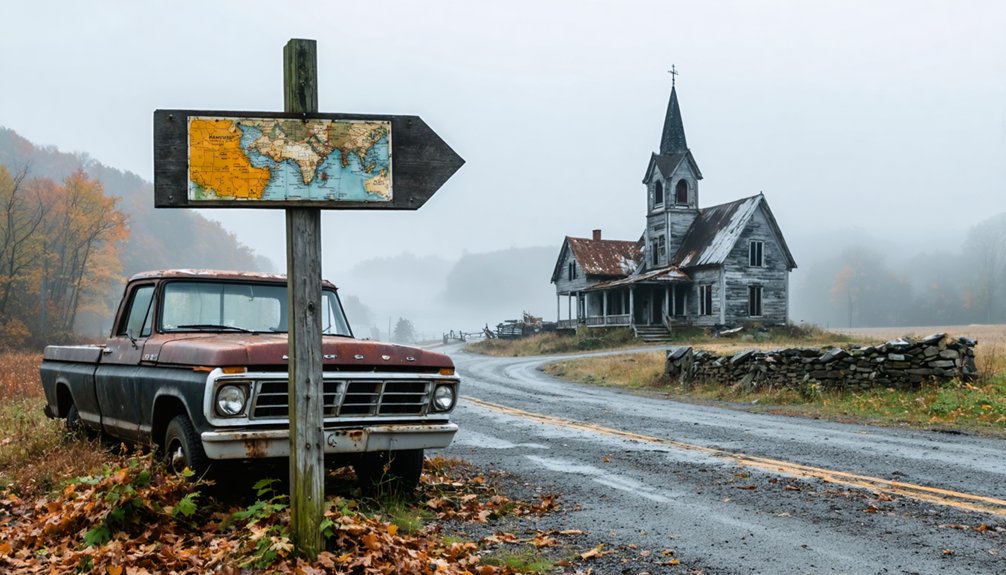
When Governor Benning Wentworth signed Moretown’s charter on June 7, 1763, he set in motion a land grant that would outlast empires and reshape Vermont’s Mad River Valley.
You’ll find that Moretown Common served as the beating heart of town governance origins from the first meeting at Joseph Haseltine’s house in 1792 until 1832. Frontier families gathered here for forty years, making decisions that shaped their independent community without outside interference. The Common represented self-determination in its purest form—neighbors convening freely to manage their affairs.
When residents voted to relocate meetings to the Hollow in 1832, they didn’t abandon these principles. They simply followed opportunity down the valley, leaving behind this remarkable site where Vermont’s democratic traditions took root.
Understanding the 1927 Flood That Changed Everything
The democratic traditions that flourished at Moretown Common for four decades met their ultimate test on November 3, 1927, when nature delivered Vermont’s deadliest natural disaster. You’ll find that 84 lives were lost when moisture-laden air dumped up to 9.86 inches of rain across the state.
The Winooski Valley suffered catastrophically—1,285 bridges destroyed, entire communities swept away. The economic impact equaled half of Vermont’s total assessed property value at $30-35 million. Congress’s $2.7 million reconstruction grant couldn’t restore what was lost.
The long term societal changes proved irreversible: traditional gathering places like Moretown Common disappeared as the Army Corps built flood retention reservoirs, fundamentally altering Vermont’s landscape and its citizens’ relationship with their rivers forever.
What Remains: Structures and Landmarks You Can Visit Today
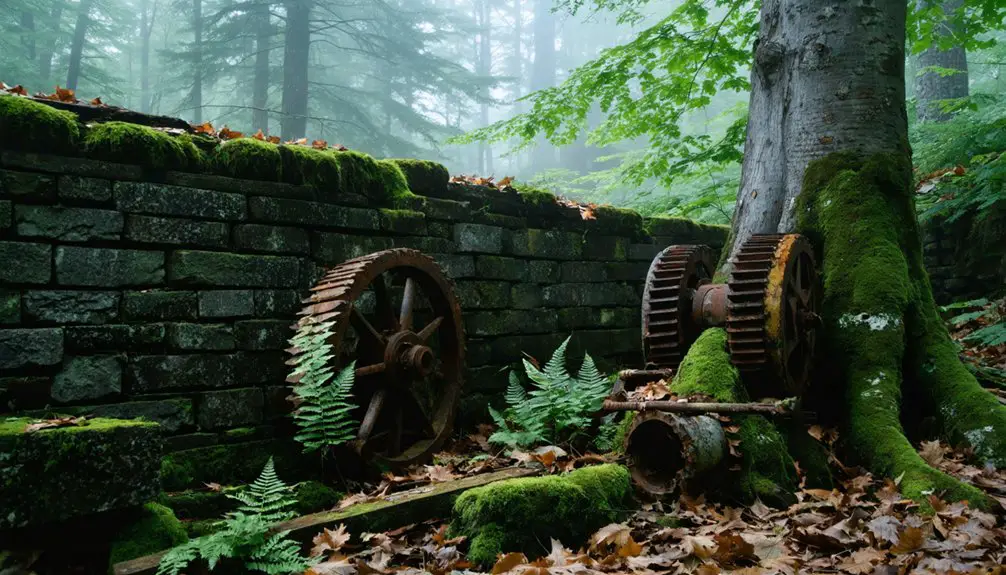
Though decades of forest growth have reclaimed much of Moretown Common, you’ll discover tangible evidence of the settlement scattered across the landscape. Extensive stone walls outline former farm fields cleared in the early 1800s, creating compelling stone wall hikes through what’s now dense forest. These walls were constructed during the sheep farming era, marking a short-lived but intensive period of agricultural activity.
You’ll find cellar holes marking abandoned homesteads along mountainside trails, silent testimonials to families who once worked this land. The farm ruins stand as unguarded archives accessible to those willing to explore beyond maintained paths. Forest Service trails from Route 9 provide access to these sites within Green Mountain National Forest, where you’re free to document and photograph remnants of Vermont’s vanished settlements.
Exploring Other Abandoned Settlements Near Moretown
Beyond Moretown Common’s boundaries, Vermont’s Mad River Valley harbors several lesser-known abandoned settlements that share similar patterns of settlement and decline. You’ll discover these sites require dedicated research through county records and cemetery registries, as standardized documentation remains limited.
Local folklore preserves stories of hill farms and logging camps that vanished when residents relocated to valley towns with railroad access. The dark history of economic hardship drove families from marginal highland properties between 1880-1920. You can trace old settlement locations through stone walls threading forest growth, cellar holes marking former homesteads, and family burial plots maintained by descendants.
Historical societies in Warren and Waitsfield preserve photographs and land deeds documenting these vanished communities, offering pivotal context for understanding settlement patterns across this rugged landscape.
Finding the Hidden Cemeteries and Burial Grounds
Ten documented cemeteries scatter across Moretown’s landscape, divided between four actively maintained sites and six non-active burial grounds that require careful navigation to locate. You’ll find Mountain View, Village, Common, and Fairmont cemeteries under town stewardship, while lesser-known sites like Belding, Cobb, Hawks-Eaton, and Jones Brook demand independent exploration.
Moretown Common Cemetery holds 266 memorial records spanning the 1800s, making it invaluable for family history research. You can access detailed location data through Vermont Cemetery Registry and FamilySearch databases before venturing out. Contact commissioners John Fulton (802-279-2096), Mark Austin (802-249-3724), or Mary Murphy-Blake (802-496-2901) for specific site directions.
Expect unmarked gravestones in non-active locations. The town’s official brochure documents all ten cemeteries, providing coordinates that preserve your autonomy while protecting these fragile historical sites from further deterioration.
Route Details and Trail Access for Your Journey
While Moretown Common lacks designated hiking trails, you’ll access the historic settlement area via Route 100B, which branches northwest from Vermont Route 100 approximately 4.5 miles south of Waterbury. You won’t find formal visitor parking or trail signage marking this abandoned community, so you’ll need to identify safe roadside pulloffs that don’t block private property or forest service access.
The settlement remains scattered across steep terrain requiring bushwhacking skills and topographic map reading. You’re responsible for traversing unmarked paths while respecting conservation easements and posted boundaries. Document your entry points with GPS coordinates, as cellular service proves unreliable in this mountain hollow.
Winter snowshoe access offers clearer views of foundation stones, though you’ll face avalanche risks on steeper slopes.
Frequently Asked Questions
Are There Any Guided Tours Available for Moretown Common Ghost Town?
No formal guided tours exist, but you’ll discover freedom in self-guided walking tours through time-weathered ruins. Wandering independently, you’ll uncover haunting historical narratives preserved in crumbling foundations and forgotten pathways—each stone whispering stories of Vermont’s vanished community.
What Is the Best Time of Year to Visit These Abandoned Settlements?
Visit late summer through fall foliage season for ideal exploration. You’ll find accessible trails, minimal vegetation obscuring historic features, and stable weather. Avoid spring’s mud season and winter’s impassable conditions that threaten both safety and preservation efforts.
Do I Need Special Permits to Explore the Old Structures?
You don’t need special permits for passive exploration, but you’ll want to follow local regulations and prioritize explore site safety. Respect property boundaries, avoid disturbing structures, and practice conservation-minded principles when visiting these historic locations.
Are the Trails Suitable for Families With Young Children?
Start small and you’ll go far—yes, several trails suit families. You’ll find kid-friendly activities on Blueberry Lake’s beginner paths and Kingsbury’s Greenway. However, assess trail difficulty levels carefully; Moretown Forest’s technical features challenge little ones immensely.
Where Can I Find Overnight Accommodations Near Moretown Common?
You’ll discover several overnight options including bed and breakfasts nearby like Maplecroft and Mad River Inn, plus local rental properties throughout the area. Chain hotels and historic inns preserve traditional Vermont hospitality while respecting the region’s natural character.