Start your ghost town expedition by traversing to Four Mile (43°43′58″N 103°40′31″W) west of Custer, where Moss City’s 1890s structures mix with sagging trailers across windswept grassland. You’ll pay $7.50 for self-guided tours through original buildings, then venture to Spokane’s skeletal mine ruins with their rusted machinery and glory holes scarring the landscape. Pack navigation tools, cut-resistant gloves, a high-lumen flashlight, and weatherproof boots for exploring crumbling foundations and root cellars frozen in time. The complete circuit through South Dakota’s mining past reveals essential preparation strategies and hidden stops.
Key Takeaways
- Moss City is now called Four Mile, located at 43°43′58″N 103°40′31″W in South Dakota’s Black Hills region.
- Four Mile Historic Preservation offers self-guided tours for $7.50, featuring original 1890s structures and audio-guided exploration.
- Visit Spokane’s stone mine ruins to see crumbling foundations, rusted machinery, and abandoned automobiles from its 1927 peak.
- Bring navigation tools, weather-appropriate clothing, cut-resistant gloves, high-lumen flashlight, dust mask, and waterproof hiking boots.
- Expect unvarnished High Plains decline with sagging trailers, crumbling infrastructure, and no active preservation beyond Four Mile Historic site.
Discovering the Mystery of Moss City’s Location
When you punch “Moss City, South Dakota” into your GPS, you’ll likely get a blank stare from your navigation system—and that’s because this ghost town exists in a historical twilight zone between memory and mapmaking.
Your destination actually sits at 43°43′58″N 103°40′31″W—what locals still call Four Mile. This unincorporated community earned its “Moss City” moniker around 1890 during early population growth that swelled the settlement to about 100 residents. The temporary name didn’t stick, and by the early 20th century, maps reverted to Four Mile.
You’ll find it four miles west of Custer, South Dakota, where U.S. Route 16 meets Pleasant Valley Road. The geographic coordinates mark a junction where Western mythology meets blacktop reality—a place that changed names but never truly disappeared. If you encounter references to Fourmile in historical records, note that this spelling variation appears in various disambiguation contexts throughout regional documentation. The standoff between communities over land ownership and sovereignty has echoes in other forgotten corners of American history, where questions of territorial control remain unresolved.
The Gold Rush Era That Sparked Moss City’s Birth
The windswept junction where Moss City once stood owes its very existence to a rumor that rippled across America in 1874—gold in the Black Hills. When Custer’s expedition discovered gold at French Creek, you’d have witnessed prospectors defying treaties and soldiers alike, pushing northward through Hill City and Pactola, chasing whispers of wealth.
By November 1875, they’d struck pay dirt at Deadwood Gulch—real bonanza country where each shovelful glittered with promise.
This wasn’t slow-burn settlement. Rapid population growth exploded across these hills as resource extraction industries carved camps from wilderness overnight. The Manuel brothers’ Homestake discovery in 1876 cemented the region’s destiny, eventually producing 10 percent of the world’s gold. Within a year, George Hearst and fellow investors purchased the operation for $70,000, transforming it into the most legendary mine in American history. The discovery violated the Fort Laramie Treaty of 1868, intensifying the Indian Wars that would culminate in Custer’s death at the Battle of the Little Bighorn.
Moss City emerged during this frenzy, another name on surveyors’ maps drawn by men chasing freedom and fortune.
What Remains of Moss City Today
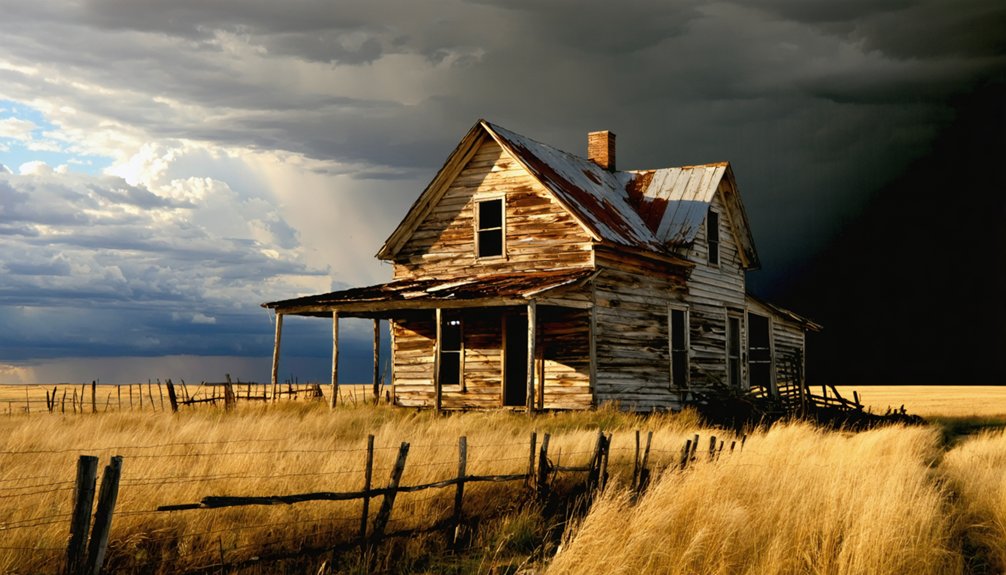
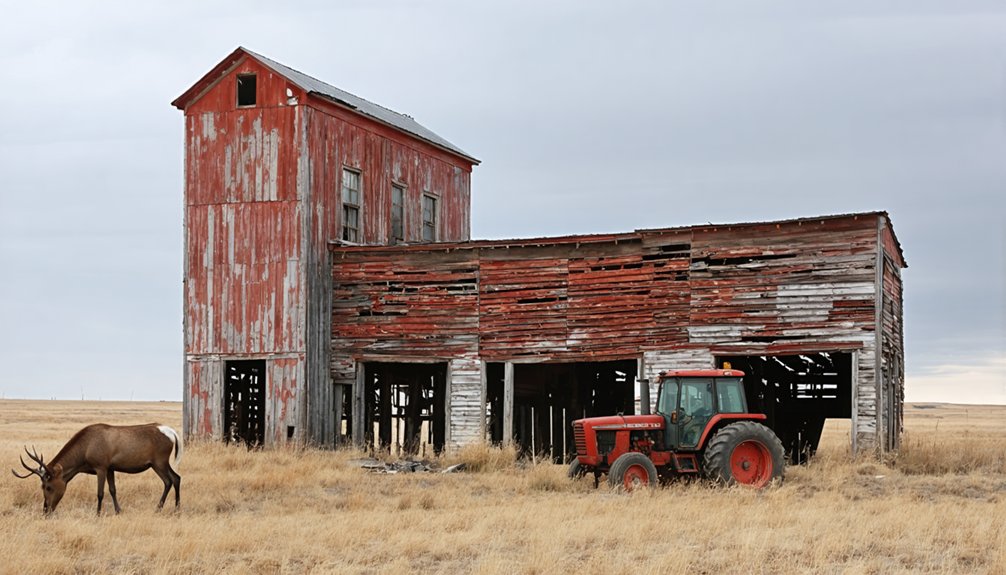
What greets you at Moss City today bears little resemblance to its gold rush origins—instead of bustling miners’ tents, you’ll find sagging trailer houses and rust-eaten trucks frozen mid-decay across windswept grassland. The crumbling infrastructure tells stories of families who left everything behind—clothes still hanging in closets, dishes on counters—creating an atmosphere that’ll make you want to roll up your windows despite your curiosity.
You’ll stop for photos anyway. The dilapidated buildings won’t stand forever, making this one of those fleeting opportunities to witness rural abandonment firsthand. With uncertain restoration prospects and no preservation efforts underway, Moss City exists in a strange limbo between past and present. The surrounding South Dakota grasslands represent the kind of precious remnants that conservation partnerships work to protect from further development. It’s earned its 4.5-star rating from travelers who appreciate the unvarnished reality of High Plains decline. Many visitors report an unsettling feeling of being watched that cuts exploration short, even for the most adventurous road-trippers.
Essential Stops Along Your Black Hills Ghost Town Circuit
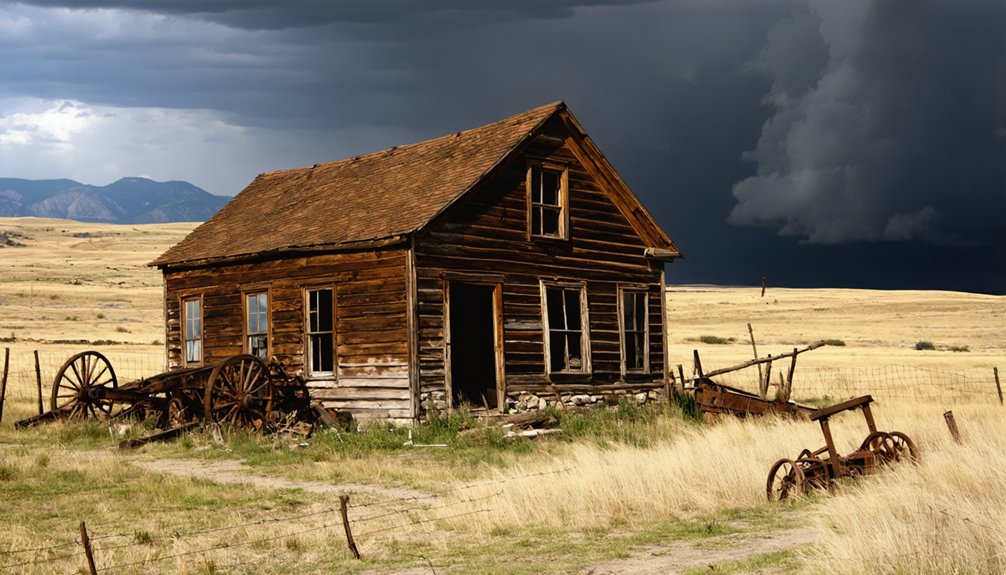
Your ghost town circuit isn’t complete without veering off to Four Mile Historic Preservation, where weathered log cabins and rusted equipment sit frozen in time among wildflower meadows.
Just down the trail, Spokane’s stone mine ruins rise from the forest floor like ancient monuments—crumbling walls and gaping shaft entrances that once echoed with miners’ pickaxes now harbor only wind and bird calls. Located 16 miles from Custer, this abandoned mining town was still booming in 1927 before its last resident left in the 1970s.
These sites offer the raw, unrestored authenticity that makes you feel like you’ve stumbled upon history by accident rather than design. For a stark contrast, visit Barren where no remaining structures exist—the site has completely reverted to empty fields, leaving only imagination to fill in what once stood there.
Four Mile Historic Preservation
Stepping through the open doors of Four Mile Old West Town Museum feels like wandering onto an abandoned movie set where the cameras just stopped rolling. Between 40 and 50 buildings line dusty boardwalks, mixing original structures from the 1890s boom with careful recreations. The historical significance runs deeper than surface nostalgia—this spot housed Custer’s army stockade before transforming into Moss City, a precious metals hub expecting 200 residents.
Today’s evolving preservation efforts balance authenticity with accessibility. You’ll navigate self-guided tours with audio recorders explaining artifacts, while unexpected touches like a talking outhouse keep things loose. The $7.50 admission gets you unrestricted exploration after the owner’s introduction. The knowledgeable owner provides historical context about the area’s past, drawing from deep familiarity with the site’s frontier legacy.
Mid-May through early October, this living museum operates daily, preserving both frontier hardship and the irreverent spirit that defined these forgotten settlements. Located just four miles west of Custer, the site offers convenient access for travelers exploring the Black Hills region.
Spokane’s Stone Mine Ruins
The skeletal remains of Spokane ghost town cling to hillsides roughly 14 miles northeast of Custer, where rusted machinery parts and crumbling foundations tell stories the Forest Service tried erasing decades ago. You’ll find the manager’s house standing sentinel over collapsed shaft-houses and mill ruins—tangible evidence of $150,000 annual peak production in 1927.
Glory holes and prospect pits scar the landscape where miners extracted silver, gold, and lead before abandoning everything in 1940. These stone mine ruins parallel moss city mining operations that shaped the Black Hills’ industrial heritage.
Walk among root cellars and rusted automobiles frozen in time, physical remnants of moss city’s historic legacy. Jim Shepard’s 1908 murder over disputed claims adds darker undertones to your exploration of this unregulated, unrestored memoir to frontier ambition.
Four Mile: Your First Destination West of Custer
Just four miles west of Custer on Highway 16, you’ll discover where the Black Hills gold rush comes alive through weathered wood and authentic relics. Four Mile’s western ambiance hits you immediately—40 to 50 authentic pioneer buildings with open doors beckoning exploration. Named for the old stagecoach numbering system, this settlement once housed the Moss Family and 100 miners chasing precious metals.
You’re free to wander boardwalks at your own pace, peering into structures filled with genuine artifacts from South Dakota’s frontier days. The talking outhouse adds unexpected humor to your journey through history. At $7.50 admission, you’ll access self-guided tours or grab audio guides for deeper stories. General Custer himself rode this terrain. Your ghost town adventure begins here, where independence and gold fever once ruled.
Exploring Spokane’s Stone Ruins and Mine Shafts
Sixteen miles northeast of Custer, Spokane’s stone skeletons rise from the pines like monuments to vanished ambition. You’ll spot the headframe first, towering above the stamp mill’s hulking remains.
Stone remnants pierce the forest canopy, silent witnesses to century-old dreams that crumbled with the silver market.
Two-story stone walls frame the sky where roofs once sheltered 1890s miners chasing silver veins.
The moderate hike from Forest Service Road 330 reveals homes, root cellars, and rusted Fords frozen in time. Gaping shafts pierce the earth where cables once hauled ore and men between underground tunnels and surface—130 years of mine exploration ending in 1940 when profits couldn’t justify the risk.
Warning: Spokane’s permanently closed now. The Forest Service demolished unsafe structures, leaving these ruins as historical markers of what freedom-seeking prospectors built and ultimately abandoned.
Mapping Your Complete Ghost Town Route
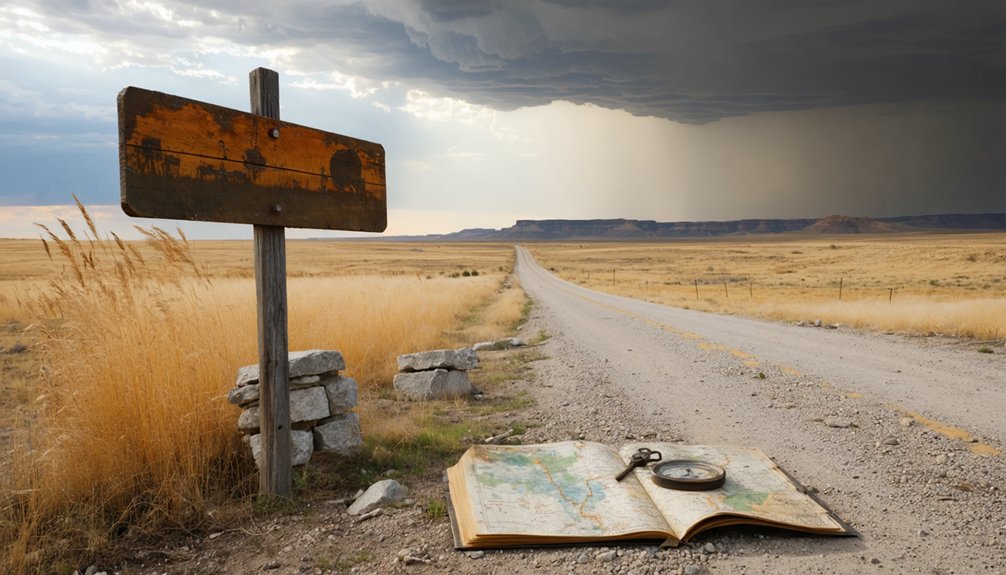
Your windshield frames a different landscape now as you leave Spokane’s stone ghosts behind and aim your compass toward Four Mile, better known by its fleeting alias, Moss City. Highway 16 west from Custer delivers you straight to these ruins—just four miles of asphalt between civilization and abandonment.
Plot your course using these coordinates for historical preservation sites:
- 43°43′58″N 103°40′31″W marks the epicenter where Custer’s soldiers once camped
- Pleasant Valley Road junction splits toward County Highway 715’s scenic drives
- Four Mile Creek traces the path where gold dredges failed twice
- 1994 museum grounds blend authentic structures with faithful reconstructions
- Multiple county roads offer alternative approaches for the wanderer’s soul
Secondary routes branch everywhere. You’re free to improvise your path through America’s oldest Black Hills settlement.
What to Bring for Your Backcountry Exploration
Your success in exploring Moss City’s crumbling foundations and weathered structures depends entirely on what you pack into your vehicle before leaving paved roads behind. I learned this lesson the hard way during my first ghost town expedition when a sudden thunderstorm rolled across the prairie, soaking my cotton layers and rendering my cheap disposable camera useless while I still had a mile to hike back.
Pack navigation tools that won’t fail when you’re surrounded by identical-looking grasslands, clothing that adapts to South Dakota’s unpredictable weather swings, and quality camera equipment that captures the haunting beauty of collapsed homesteads without breaking down in dust and wind.
Before you venture into the crumbling structures of Moss City, you’ll need to arm yourself with gear that bridges the gap between adventure and recklessness. Your headlamp becomes your eyes in collapsed basements where daylight never reaches.
Compass usage matters when GPS signals vanish between decaying buildings, and terrain navigation skills prove essential as overgrown paths disappear into prairie grassland.
Pack these non-negotiables:
- Cut-resistant gloves for exploring rusty metal fragments and splintered wood
- High-lumen tactical flashlight as your headlamp backup
- Dust mask or respirator against decades of accumulated mold
- Small mirror for checking unstable corners before entering
- Multi-tool and duct tape for emergency repairs
These items transform risky impulses into calculated exploration, letting you push boundaries without surrendering common sense.
Weather-Appropriate Clothing and Footwear
South Dakota’s prairie weather operates on its own brutal timeline, and Moss City’s exposed location amplifies every temperature swing, windstorm, and sudden cloud burst the Great Plains can deliver. You’ll need waterproof hiking boots with aggressive tread year-round—the ghost town’s uneven ground doesn’t forgive poor footwear choices.
Master layering techniques: thermal base layers beneath insulated jackets for winter’s sub-20°F nights, moisture-wicking shirts with light fleece for summer’s dramatic temperature drops. Spring demands waterproof shells and quick-dry pants when thunderstorms roll across the grasslands.
Seasonal accessorizing matters—sun buffs and wide-brim hats combat 275 sunny days, while winter gloves and beanies become survival tools when November winds howl through abandoned buildings. Pack merino wool socks regardless of season; they’ll manage moisture when you’re miles from civilization.
Photography and Documentation Equipment
While abandoned structures photograph beautifully in golden hour light, Moss City’s backcountry location demands equipment that’ll survive dusty interiors, temperature extremes, and miles of hiking before you capture a single frame.
Your camera settings matter less than having backup power and protection. Pack weatherproof bodies like the OM-1 Mark II that won’t quit when prairie dust infiltrates every crevice.
Essential gear includes:
- Canon 24-70mm f/2.8 for interior documentation and architectural details
- Neutral density filters (5-stop through 15-stop) for shooting techniques in harsh midday sun
- Spare batteries and SD cards organized in accessible pouches
- Lens cleaning kit with blower and brushes for constant dust removal
- Peak Design tripod balancing portability with stability for low-light interiors
Lightweight beats ample when you’re miles from civilization.
Respecting Historic Sites and Pioneer Cemeteries
Reverence settles over you like prairie dust when you first encounter the weathered headstones of a Black Hills pioneer cemetery. Speak softly near these gravesites—freedom includes respecting those who came before. Never step on markers or disturb flowers left by others.
Preserving historic structures means resisting the urge to touch crumbling walls or lean against century-old timber frames. Your photographs capture memories without flash on sensitive artifacts.
Honoring children’s graves deserves special attention at places like Mystic’s cemetery, where tiny headstones reflect brutal pioneer hardships. Stay on marked paths around fragile ruins. Carry out every scrap of trash. Don’t pocket “souvenirs”—federal laws mean serious fines. Report vandalism immediately. These 600+ ghost towns across the Black Hills aren’t museums; they’re sacred ground where past communities still whisper through weathered wood and stone.
Frequently Asked Questions
Are There Guided Tours Available for Moss City Ghost Town Exploration?
No tour guides available at Four Mile Old West—you’ll explore Moss City’s weathered boardwalks independently. Self-guided walking tours let you wander freely through forty authentic buildings, discovering hidden artifacts at your own pace without schedules constraining your adventure.
What Accommodations Are Closest to the Black Hills Ghost Town Route?
You’ll find State Game Lodge and Legion Lake Lodge inside Custer State Park closest to the route. For quaint bed and breakfasts, Dakota Dream sits 8.9 miles away, while historic hotel accommodations dot downtown Custer’s charming streets nearby.
Is Metal Detecting Permitted at Abandoned Mining Sites Near Custer?
You’ll need written authorization from site managers before detecting, as metal detecting regulations protect 90% of abandoned mines. Historical artifacts preservation laws like ARPA restrict removal, though you can explore with handheld detectors following strict depth limits.
Which Ghost Towns Are Accessible During Winter Months in Black Hills?
You’ll find excellent winter accessibility at Etta, Mystic, and Rochford via plowed roads, while snowmobile trails provide access to Soldier Creek’s prairie sites. Winter weather conditions keep trails smooth and uncrowded, letting you explore freely across 13,000 wilderness acres.
Do I Need Permits to Explore Ghost Town Ruins on Federal Land?
You don’t need permits for casual viewing without surface disturbance, but respect private property access rules around ruins. Watch for abandoned structure safety concerns—rotting floors and unstable walls threaten your freedom to explore safely.
References
- https://www.sdhspress.com/journal/south-dakota-history-2-2/some-black-hills-ghost-towns-and-their-origins/vol-02-no-2-some-black-hills-ghost-towns-and-their-origins.pdf
- https://www.fourmileoldwest.com
- https://www.sdpb.org/rural-life-and-history/2023-08-21/some-black-hills-ghost-towns-and-their-origins
- https://coratravels.com/blog/ghost-towns-in-south-dakota
- https://en.wikipedia.org/wiki/List_of_ghost_towns_in_South_Dakota
- https://www.youtube.com/watch?v=Glucs_Rq8Xs
- https://www.southdakotamagazine.com/ardmore
- https://en.wikipedia.org/wiki/Four_Mile
- https://www.adirondacklife.com/2022/09/27/what-really-happened-at-moss-lake/
- https://history.sd.gov/archaeology/FAQ.aspx