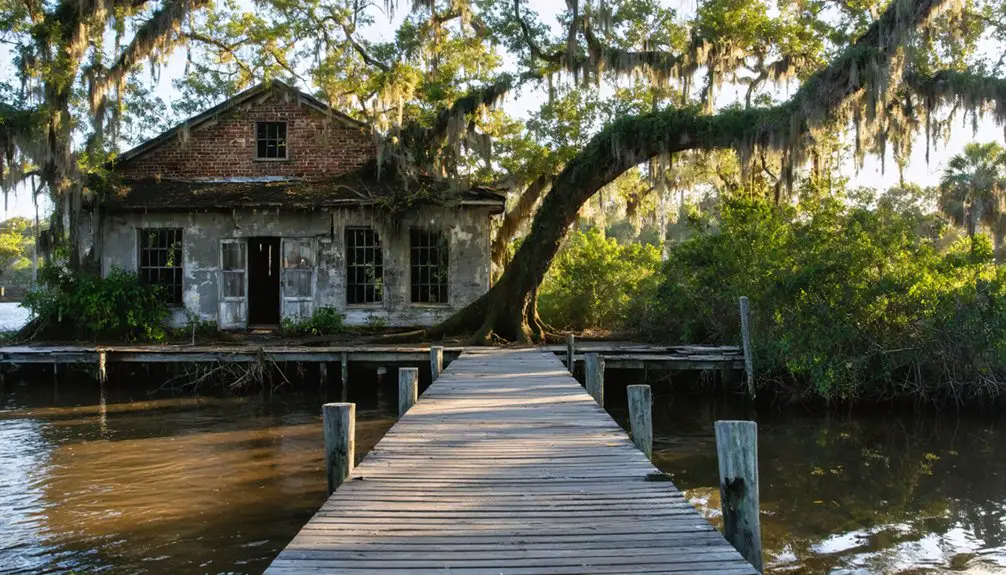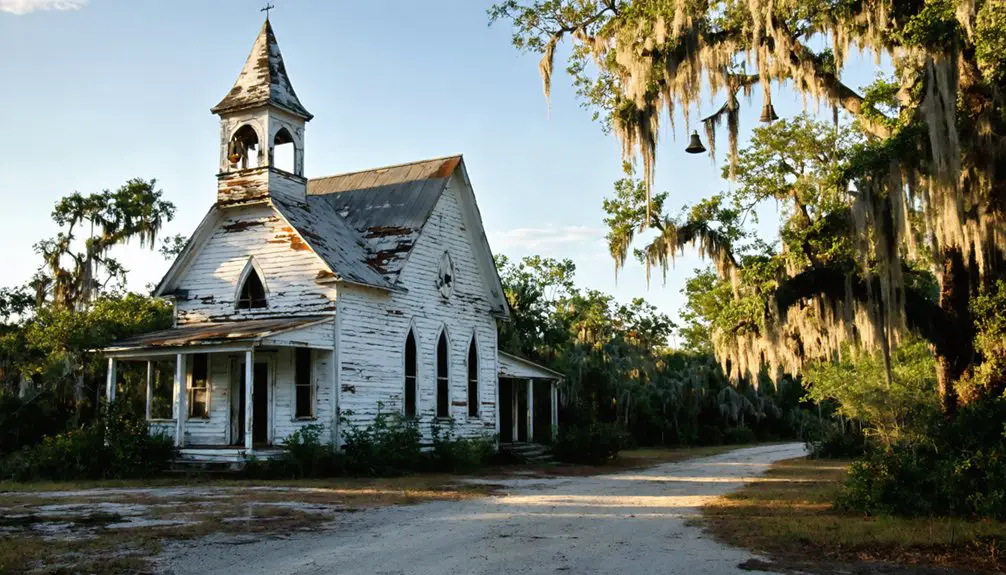
You’ll find Muscogee ghost town 20 miles northwest of Pensacola along the Perdido River, accessible through private property with limited infrastructure. The Old Muscogee Cemetery crowns a hilltop overlooking the river, featuring weathered headstones from the 1870s through 1998, while foundation pilings and a brick locomotive well mark the vanished Southern States Lumber Company. Visit during cooler months with sturdy boots for overgrown terrain, and bring water since facilities don’t exist. The guide below reveals essential access points, preservation guidelines, and nearby attractions for your northwest Florida ghost town exploration.
Key Takeaways
- Muscogee is located 20 miles northwest of Pensacola in Escambia County along the Perdido River corridor.
- Access is challenging due to private property and lack of visitor infrastructure; plan accordingly before visiting.
- The Old Muscogee Cemetery is the primary landmark, featuring graves from the 1870s through 1998 atop a hill.
- Historic remnants include a brick town well, lumber mill foundation pilings, and segregated burial sections reflecting the era.
- The town thrived as a lumber hub until 1917-1918 hurricanes destroyed timber, leading to rapid abandonment.
Getting to Muscogee: Directions and Access Points
Nestled along the winding Perdido River corridor, Muscogee sits approximately 20 miles northwest of Pensacola in Escambia County—a ghost town that once thrived as a critical lumber transport hub where river, oxcart, and rail converged. You’ll travel state and county roads through Florida’s panhandle, following the river’s path for a 25-35 minute drive from downtown Pensacola.
A forgotten lumber hub where river, oxcart, and rail once met along the Perdido River corridor northwest of Pensacola.
The journey takes you through timber country straddling the Florida-Alabama border, where historical logging railways once covered 50 miles of tracks.
Land ownership challenges complicate access, as RMS now controls the property, and no maintained visitor infrastructure exists. Seasonal accessibility concerns include dense vegetation obscuring cemetery grounds and ongoing vandalism.
Pine Barren Road provides historical orientation, though you’ll find this destination requires determination and respect for private property boundaries.
What Remains: Landmarks You Can Still Visit Today
When you arrive at Muscogee’s overgrown coordinates, three tangible remnants anchor this vanished lumber town to its industrial past.
The Old Muscogee Cemetery stands as the primary surviving landmark, its weathered headstones and ornate monuments marking families who called this place home in the late 1800s. Beyond the graveyard, you’ll find the brick town well that once supplied water to steam locomotives and the foundation pilings of Southern States Lumber Company’s mill rising from the forest floor like skeletal fingers.
The Old Muscogee Cemetery
Perched atop a hill overlooking the Perdido River in west Cantonment, the Old Muscogee Cemetery stands as one of the few tangible remnants of the vanished lumber town. Dating to the late 1870s, this historic burial ground reflects the post-Civil War era with its segregated burial sections—the white section crowning the hilltop while the Black section slopes downhill, now heavily overgrown.
You’ll find graves marked by distinctive iron rock mounds and weathered headstones, though vandalism has left many missing headstones and sunken depressions where pine box burials have deteriorated. The oldest known grave belongs to E.Z. Nellums, an infant who died in June 1889. Despite decades of neglect and vandals tossing stones into the river, restoration efforts continue, making this solemn site accessible to descendants seeking their ancestors.
Historic Town Well
Beyond the cemetery’s weathered stones, another relic anchors Muscogee’s fading memory—a brick well that once sustained the thundering pulse of industrial ambition. Built in the late 1800s, this towering structure served critical water supply functionality for Southern States Lumber Company’s five steam locomotives hauling timber across 50 miles of track to Pensacola’s wharves.
You’ll find it off River Annex Road near Cantonment—one of few landmarks still standing in this ghost town. Though the water’s long stopped flowing, recent archaeological assessment recommended it for National Register protection alongside nearby mill foundations.
During Muscogee’s peak, when 1,000 men worked these woods and 60 million board feet shipped annually, this well powered an empire. Now it stands silent, watching over vanished rails and forgotten dreams.
Mill Foundation Pilings
Deep in the overgrown woods near the Perdido River, concrete pilings thrust upward through palmetto and pine needles—skeletal fingers of Muscogee’s industrial past. These foundation remnants mark where Southern States Lumber Co.’s planing and finishing mills once thundered with activity, processing timber hauled in via rail connections to Pensacola.
These structures tell a darker story than mere industry:
- Over 1,000 workers toiled here, paid in scrip token economy that trapped them
- Four massive mills consolidated in 1905, controlling livelihoods completely
- 1918 strike erupted when workers demanded real currency
- Hurricanes obliterated 80 percent of timber in 1917-1918
- Abandonment transformed prosperity into desolation overnight
You’ll find these potentially National Register-eligible pilings documented by preservationists—testament to freedom lost and regained when workers finally walked away.
Exploring the Old Muscogee Cemetery
When you climb the hill above the Perdido River in west Cantonment, you’ll find yourself standing among the weathered remnants of Old Muscogee Cemetery—a burial ground where time and neglect have waged a relentless battle against memory. The racial diversity of burials tells a story of integrated rest: black, white, and Creole communities share this hillside, their graves dating from the 1870s through 1998.
Vines choke the notable gravestones and monuments, many broken or vandalized since the 1980s. You’ll spot sunken depressions marking pine box burials and north-south rows indicating Indigenous graves. The Owens family plot, Henrietta Williams’s marker, and infant E.Z. Nellums’s 1889 stone stand as memorials to lives once lived.
Recent cleanup efforts have reclaimed portions from oblivion, but wilderness still claims much territory.
The Rise and Fall of a Lumber Boom Town
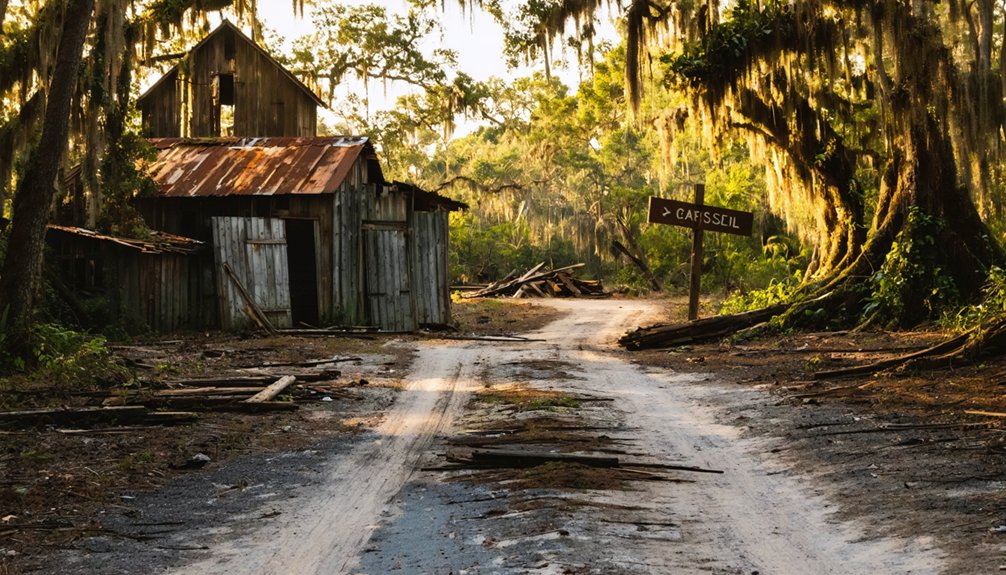
Standing among the cemetery’s weathered stones, you can almost hear the echoes of Muscogee’s glory days when over 1,000 men worked its mills and logging camps, shipping 60 million board feet of lumber across the globe in a single year.
But the town’s prosperity was built on borrowed time—clearcutting the surrounding pine forests with no thought to replanting. When back-to-back hurricanes in 1917 and 1918 destroyed 80% of what little timber remained standing, Muscogee’s fate was sealed.
Timber Industry Prosperity Peak
By 1889, Muscogee had transformed from a modest timber operation into an industrial powerhouse that would dominate northwest Florida’s lumber trade for decades.
Southern States Land and Lumber Company’s acquisition triggered unprecedented expansion across 340,000 acres spanning Florida and Alabama. You’d witness an empire built on ambition and extraction:
- Over 1,000 men labored in camps and mills, their labor force demographics reflecting the era’s working-class struggles
- Five locomotives and 70 train cars thundered through forests, hauling tomorrow’s profits
- 60 million feet of lumber exported annually to distant shores across four continents
- 50 miles of railroad carved pathways through wilderness
- Environmental impacts of clearcutting left stripped landscapes where ancient pines once towered
This was prosperity’s peak—raw, unregulated, and unsustainable.
Hurricane Devastation and Exodus
On September 27, 1906, nature shattered Muscogee’s lumber empire in a single catastrophic blow. The Category 2 hurricane transformed Tarragona Street into a tangled graveyard of debris stretching to Muscogee wharf, burying the town’s economic lifeline.
Ships lay driven inland, businesses paralyzed, and agriculture decimated across northwest Florida’s coast. Martial law gripped Pensacola as damages climbed into the millions. You’ll find that Muscogee never recovered from this devastation. The wharf blockage strangled lumber commerce, triggering immediate economic decline.
Families who’d built fortunes on timber watched their world crumble into Gulf waters. Within months, the dwindling population abandoned what remained, choosing escape over rebuilding. The hurricane didn’t just destroy infrastructure—it obliterated Muscogee’s reason for existence, leaving behind only memories and ruins.
Best Time to Visit and What to Bring
When winter’s chill grips much of the country, Muscogee’s ghost town emerges as an ideal destination, offering mild temperatures that hover comfortably between 60-72°F from November through March. You’ll experience the ideal visitor experience during these months, though you should prepare for 4-5 inches of rainfall and 71-75% humidity.
Your packing recommendations for exploring this abandoned settlement:
- Waterproof jacket to shield you from sudden downpours while wandering forgotten streets
- Lightweight layers for moving between cool mornings and warm afternoons
- Sturdy hiking boots for traversing overgrown cemetery paths
- Insect repellent to combat humidity-loving mosquitoes near the Perdido River
- Sun protection despite frequent cloud cover
November offers the best conditions—lower precipitation, calmer winds, and excellent visibility for photographing crumbling structures before they fade completely.
Nearby Attractions in Cantonment and Pensacola Area
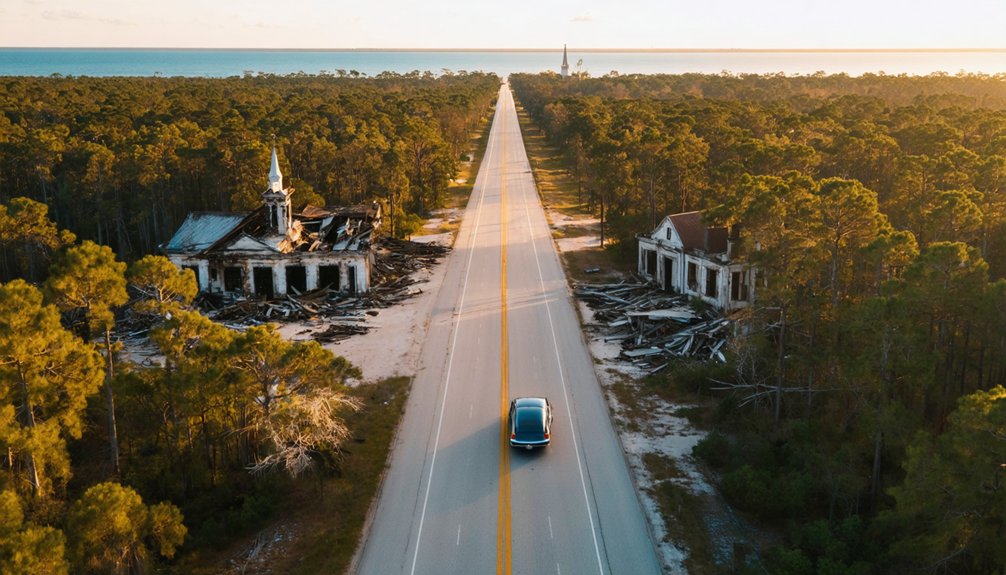
Your exploration of Muscogee’s abandoned remnants needn’t end among crumbling foundations and weathered tombstones. The Cantonment and Pensacola area offers compelling diversions beyond ghost town hunting. You’ll find nearby Gulf Coast wildlife experiences at Gulf Breeze Zoo and ZooWorld Zoological Park, where you can hold kangaroos and pet sloths. Gulfarium Marine Adventure Park has delivered marine encounters for over six decades.
Regional outdoor recreation options include Becks Lake Fish Camp for fishing expeditions and Beulah Regional Park for trail exploration. The National Naval Aviation Museum chronicles flight history, while Historic Pensacola Village preserves centuries-old architecture. Evening entertainment awaits at Five Flags Speedway or Escape LOL’s haunted challenges. Pensacola Beach Boardwalk and Perdido Key State Park provide coastal escapes when you’re ready to trade desolate ruins for sun-bleached shores.
Respecting the Site: Visitor Guidelines and Preservation Efforts
While crumbling tombstones and deteriorating foundations might appear abandoned to time’s indifference, Muscogee’s cemetery demands your conscious stewardship. Family descendants still honor these grounds where their ancestors built Florida’s frontier timber community. Your visit carries responsibility beyond curiosity.
Essential visitor conduct:
- Document tombstones photographically to preserve fading inscriptions before vandalism erases them forever
- Walk only established paths—disturbing unmarked graves dishonors those resting beneath your feet
- Report damage immediately to local authorities; silence enables destruction
- Leave everything untouched; removing artifacts steals irreplaceable heritage from future generations
- Maintain cemetery silence out of respect for the dead and living descendants
Cultural memory preservation depends on visitors who understand that exploration and exploitation aren’t synonymous. Your respectful presence protects what remains.
Frequently Asked Questions
Are There Any Restroom Facilities Available at the Muscogee Ghost Town Site?
No restrooms exist amid the overgrown tombstones and crumbling history. You’ll find no wheelchair accessibility or on-site parking availability either—just wild, abandoned terrain. Plan your pit stops along Highway 29 before venturing into this forgotten wilderness.
Is Overnight Camping Permitted Near the Cemetery or Former Mill Areas?
No, overnight camping isn’t permitted near cemetery or former mill areas. You’ll need to use designated permitted campsites away from these sensitive historic sites, following local camping regulations that protect Muscogee’s archaeological remnants and cultural structures.
Can Visitors Access the Perdido River for Fishing or Kayaking Nearby?
You’ll find excellent Perdido River access at Fillingim Landing, just 2.6 miles from Muscogee. It offers public boat launches for kayaking and fishing, plus picnic areas nearby with grills and trails—your perfect basecamp for waterborne adventures.
Are Guided Tours of Muscogee Offered by Local Historical Societies?
No guided tours exist for Muscogee—you’ll explore independently. Local tour guide contacts aren’t available, and visitor parking options remain informal along roadside areas. You’re free to wander the cemetery and ruins at your own pace, unescorted.
What Cell Phone Reception Can Visitors Expect at the Remote Location?
You’ll find virtually zero reliable coverage in Muscogee’s wilderness—expect spotty connectivity at best. All major carriers struggle here. Download maps offline beforehand, enable Wi-Fi calling, and embrace the digital detox this ghost town adventure demands.