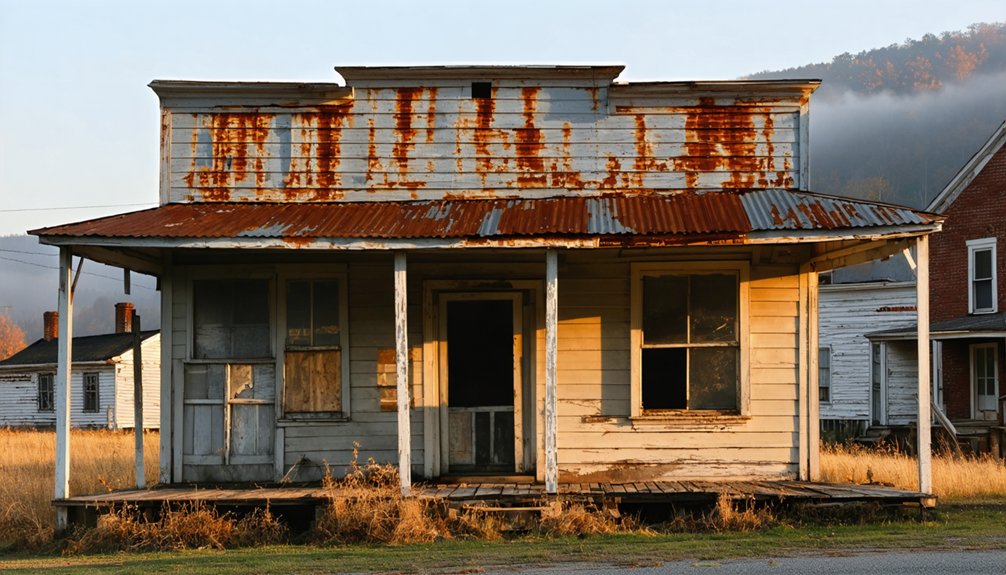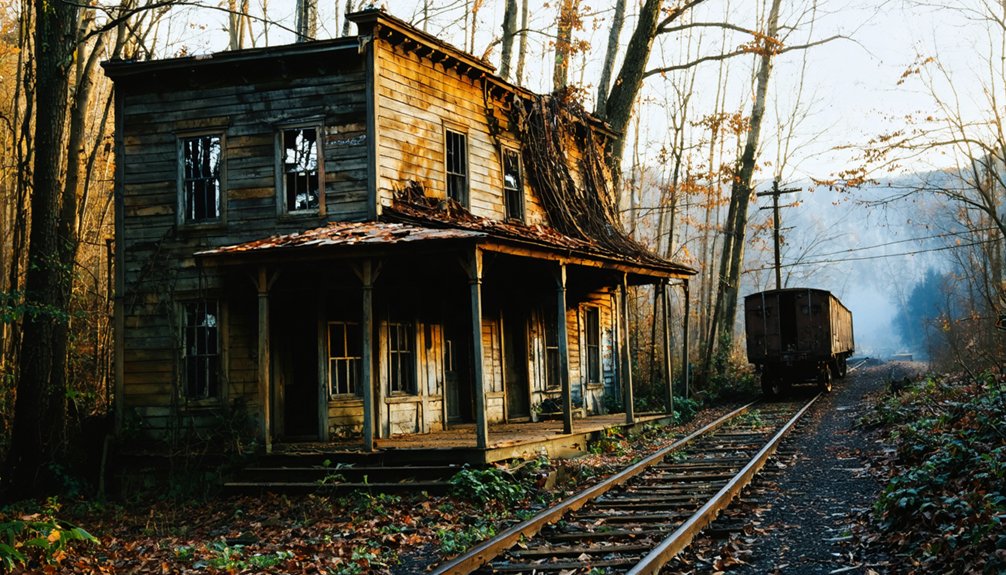
You’ll find Neal’s ghost town remnants on private refinery land seven miles southeast of Williamsburg in Whitley County, making roadside observation your only option. This former coal mining camp employed 250 workers before closing in 1946, and today rusted structures peek through industrial fencing where Patricia Neal’s birthplace once thrived. Navigate remote Cumberland Mountain valleys using coordinates rather than addresses, and bring binoculars for distant viewing. The full story reveals alternative Kentucky mining towns offering unrestricted access to similar histories.
Key Takeaways
- Neal is located seven miles southeast of Williamsburg in Whitley County, accessible via remote mountain routes requiring careful navigation.
- The former coal mining camp closed in 1946 and now sits on private refinery property with strict no-trespassing restrictions.
- Only roadside viewing is permitted; unauthorized entry onto private land can result in police reports and trespassing charges.
- Coordinates are more reliable than addresses since no structures mark the former mining camp’s exact location today.
- Consider visiting accessible alternatives like Portal 31, Blue Heron, or Barthell Coal Camp for unrestricted ghost town exploration.
Understanding Neal’s Ghost Town Status and Refinery History
Deep in the rugged hollows of Whitley County, Kentucky, the ghost town of Packard stands as a haunting record to the boom-and-bust cycles that defined Appalachian coal country. You’ll find this abandoned settlement seven miles southeast of Williamsburg, where crumbling foundations on private property mark what once thrived as a vibrant mining camp history.
Founded around 1900 by the Thomas B. Mahan family, Packard swelled to nearly 400 residents at its peak. The impact of coal company town dynamics shaped every aspect of life here—from the monopolistic company store to the script wages that trapped miners in economic dependency. At its height, the coal companies employed up to 250 workers who labored in the mines.
When coal resources exhausted by the mid-1940s, the Mahan-Jellico Coal Company shuttered operations in 1946, and Packard faded into memory. This abandoned coal town also holds distinction as the birthplace of acclaimed actress Patricia O’Neal.
What Remains of Neal Today: A Landscape Transformed by Industry
The environmental impact remains visible in the overgrown, stripped landscape. Only two houses survived into recent memory, one occupied by Neal family descendants within the Packard area.
Today’s remnants blend into reclaimed earth, accessible only through faded photographs and distant memories. Private ownership blocks exploration, leaving you to imagine what thrived here. The land keeps its secrets, guarded by time and no-trespassing signs. Like other Kentucky communities with unusual town names, the story of Neal attracts those seeking to uncover its forgotten past.
Similar to nearby Fleming-Neon, Neal’s coal industry decline left behind vacant buildings and economic hardship that transformed the landscape. The absence of economic activity mirrors the quiet emptiness found in former company towns like Wheelwright and Benham, where nature slowly reclaims what industry once dominated.
Getting to Neal: Location and Access Considerations

Tucked away in Whitley County’s southeastern corner, Neal sits at coordinates 36°40′03″N 84°03′21″W, roughly seven miles southeast of Williamsburg and a mere nine miles from the Tennessee border. You’ll navigate remote terrain challenges through Cumberland Mountain valleys where coal once ruled.
Deep in Whitley County’s wilderness, Neal’s abandoned coal camp awaits explorers willing to brave Cumberland Mountain’s unforgiving backcountry terrain.
Local access routes wind through mountainous landscape demanding careful attention—ensure your vehicle handles rough conditions before venturing out. Kentucky’s industrial past includes about 80 iron furnaces that operated in the early 1800s, many now standing as ghost town remnants throughout the state.
The ghost town’s isolation means you’re traveling back roads without modern amenities. You’ll find coordinates more reliable than addresses here, as no structures mark this former mining camp’s location. The AA Highway near Grayson offers similar exploration opportunities if you’re chasing Kentucky’s forgotten coal heritage. Consider visiting deserted mining communities like Wheelwright or Lynch to experience more of Kentucky’s coal town history.
Exploring ghost towns in Kentucky can be a hauntingly beautiful experience, revealing remnants of a bygone era. As you wander through these abandoned places, you’ll uncover stories etched in crumbling walls and forgotten landscapes. Each site offers a unique glimpse into the lives of those who once called these towns home, inviting you to reflect on the passage of time.
Pack supplies, download offline maps, and embrace the solitude of authentic ghost town exploration.
You’ll find Neal’s remnants nestled within private refinery land, where rusted structures peek through industrial fencing and “No Trespassing” signs mark clear boundaries. The coal company that birthed this settlement still controls access, transforming your ghost town exploration into a roadside observation rather than an up-close encounter.
As you wander the outskirts, the stories of Neal, Kentucky’s abandoned structures linger in the air, echoes of a once-thriving community that was intertwined with the coal industry’s rise and fall. Each dilapidated building stands as a testament to the passage of time, inviting curiosity yet demanding respect for the untold narratives they hold. Despite the barriers, a sense of intrigue and history persists, compelling explorers to imagine what life was like before the silence settled in.
Your best vantage points exist from public roads skirting the property’s edges, where telephoto lenses and patient watching reveal Neal’s skeletal buildings without crossing into restricted territory. Property owners can file police reports at the first sign of unauthorized entry to establish a record of trespassing. Unlike Poplar Hills, which was gradually reduced through annexation wars with neighboring suburban cities, Neal simply faded as its industrial purpose disappeared.
Understanding Refinery Land Ownership
Visiting Neal’s industrial remnants means confronting a landscape shaped by bankruptcy, broken promises, and barbed wire. The Seven States Oil Company’s collapse transformed accessible territory into legally contested ground—$1 million in capital vanished through questionable well trades and lawsuits.
Today’s refinery operations continue this tradition of restricted access, with Marathon’s propane cavern demanding permits under Title V regulations while technically avoiding petroleum refinery classification.
What you’ll encounter traversing these historical sites:
- Court-ordered land sales from 1922-1923 erased public pathways, converting 10-acre refinery plots into privately controlled zones
- Company solvency failures left behind legal barriers more impenetrable than physical fences, with personal liability claims haunting former officers
- Modern operational permits restrict even odor emissions at public locations, extending corporate control beyond property lines
- The original 20-acre Hollywood site at the Belt Line Railway, purchased by the Memphis Chamber of Commerce for $15,000, became the epicenter of failed industrial ambitions
The freedom to explore ends where bankruptcy courts redrew the maps. Seven States planned construction of a 2,000-barrel-a-day refinery in Memphis, Tennessee, before litigation consumed the company through 1927.
Safe Viewing Alternative Locations
When Neal’s refinery barriers shut you out, Kentucky’s mining ghost towns throw open their gates. Portal 31’s underground passages welcome you where Neal’s access restrictions hold firm. You’ll descend into Harlan County’s authentic tunnels, experiencing what refinery property boundary considerations deny elsewhere.
Blue Heron’s hillside structures await your camera from designated viewpoints, while Barthell Coal Camp’s roadside ruins offer unrestricted photography. Creelsboro’s abandoned streets stretch before you from public roads—no locked gates blocking your exploration.
These alternatives respect safety without crushing your wanderlust. Bells Mines’ overgrown cemetery and Civil War remnants invite discovery through marked trails. Each location balances preservation with genuine access, letting you experience Kentucky’s ghostly past without confronting the industrial barriers that define Neal’s modern reality.
Nearby Ghost Towns to Add to Your Itinerary

While you’re exploring Neal’s abandoned streets, consider extending your journey to nearby Packard, just miles away in Whitley County, where coal dust still seems to hang in the air of this 1908 mining town that birthed Hollywood actress Patricia O’Neal.
Head north to Barthell in McCreary County, where you’ll find something extraordinary among Kentucky’s ghost towns—restored company houses available for overnight stays since 1984, letting you sleep where miners once rested after long shifts underground.
Further west, the legendary Paradise in Muhlenberg County offers a haunting reminder of towns erased entirely, its former streets now buried beneath a massive TVA power plant that inspired John Prine’s mournful ballad.
Packard’s Coal Mining Legacy
The echoes of labor strife and economic exploitation resonate powerfully through Packard’s abandoned coal camp, where the Mahan Jellico Coal Company once maintained an iron grip over nearly 400 souls. You’ll discover a haunting record to workers who challenged corporate tyranny during the volatile 1922 strike, when Kentucky guardsmen arrived with machine guns to suppress their uprising.
The economic factors and community impacts tell a chilling story:
- Coal scrip payments trapped 250 workers in perpetual servitude, forcing them to purchase overpriced goods at the company’s monopolistic store
- Machine-gun wielding soldiers crushed workers’ desperate revolt after miners torched the coal tipple
- Complete unionization arrived decades before the mines closed in 1946, leaving only crumbling foundations
Located seven miles southeast of Williamsburg, Packard’s ruins whisper tales of exploitation and hard-won liberation.
Barthell’s Historic Overnight Accommodations
Unlike Packard’s desolate ruins, Barthell Coal Camp offers you a rare chance to sleep within preserved history—twelve restored company houses that once sheltered miners now welcome overnight guests seeking an authentic Appalachian coal town experience.
You’ll choose between nine two-bedroom houses or three one-bedroom units with hide-a-bed sofas accommodating four people. Each rental unit features air conditioning, heating, full kitchen with modern appliances, private bath, and living space—all wrapped in original hemlock and poplar lumber construction.
The rental unit amenities blend 1900s authenticity with contemporary comfort, letting you experience coal camp life without sacrificing convenience.
While accommodations pricing details require contacting 888-550-5748 or visiting barthellcoalcamp.com, you’re investing in more than lodging—you’re claiming temporary residence in Kentucky’s mining heritage, seven miles west of Stearns along Highway 742.
Paradise and Regional Routes
Just thirty miles from Owensboro, Paradise stands as Kentucky’s most haunting reminder of progress’s price—a once-thriving Muhlenberg County farming community that literally vanished beneath industrial appetite. TVA’s coal-hungry power plant consumed everything except the hilltop cemetery, where surnames carved in stone provide the only documentation to generations who farmed this land.
Kentucky tourism initiatives now embrace these forgotten places as powerful historical narratives.
Beyond Paradise, your ghost town itinerary expands dramatically:
- Blue Heron (Mine 18) along Big South Fork River showcases reconstructed mining structures from its 1937-1962 operational period
- Creelsboro’s Cumberland River ruins blend natural arch formations with abandoned settlement remnants
- Golden Pond’s prohibition-era legacy offers moonshiner history within accessible parkland
Cemetery preservation across these sites transforms roadside stops into profound explorations of Kentucky’s vanished communities.
Best Times and Routes for Exploring Southeast Kentucky Abandoned Sites

When planning your ghost town expedition through southeast Kentucky’s abandoned coal camps and iron furnace communities, timing transforms an ordinary drive into an unforgettable journey through Appalachian history. April and October offer ideal conditions—wildflowers or fall foliage frame your explorations of Barthell’s 1902 structures and Packard’s overgrown ruins.
You’ll navigate KY-92’s Cumberland Mountain curves from Williamsburg, reaching Whitley County’s ghost settlements where seasonal lodging options in nearby Stearns provide base camps for multi-day adventures. US-27 south connects you to Blue Heron’s moderate trails and restored Mine 18, while KY-119 winds toward Lynch’s partially occupied streets.
Pack high-clearance vehicles for gravel backroads, and embrace recreational activities in the area—hiking mud-free trails after May’s lighter rains or photographing solitary winter landscapes when snow blankets Packard’s forgotten foundations.
What to Bring and Safety Precautions for Industrial Ghost Town Visits
Before you step onto the crumbling foundations of Neal’s forgotten coal camp or peer into Barthell’s rusted industrial shells, your preparation determines whether you’ll return home with compelling photographs or hospital bills. Personal protective equipment best practices aren’t suggestions—they’re survival essentials for Kentucky’s deteriorating industrial sites.
Your preparation at abandoned industrial sites determines whether you document history or become a cautionary tale requiring emergency extraction.
Pack these non-negotiables:
- Respiratory defense: N95 respirators guard against coal dust and asbestos fibers lurking in collapsed structures
- Illumination arsenal: Headlamp plus backup flashlight with fresh batteries for maneuvering lightless tipples and processing facilities
- Recovery kit: Tire repair gear and earth anchors for self-extraction on abandoned haul roads
Share your route plan with someone trustworthy. Even refinery restoration project planning professionals scout exits before entering. Trust your instincts—if Neal’s structures feel unstable, they are. Your freedom to explore tomorrow depends on caution today.
Documenting Your Visit: Photography Tips and Historical Context

As you frame Neal’s vanishing remnants through your viewfinder, you’re capturing more than architectural decay—you’re preserving testimony to corporate expansion devouring American communities. Focus on architectural elements where refinery towers loom behind abandoned foundations, telling stories of Marathon Petroleum’s territorial advance. Shoot at dawn when soft light reveals textures in crumbling structures along the now-privatized KY 757. Your telephoto lens becomes instrumental for documenting the security gate that severed Neal from public roads in 1999.
Ephemera preservation matters here—photograph fading highway signage marking the 1987 bypass that began Neal’s isolation. Black-and-white compositions emphasize the stark shift from residential life to industrial zone. Frame shots against Big Sandy River’s banks, contextualizing how refinery growth physically erased this southeastern Boyd County settlement from Kentucky’s accessible landscape.
Frequently Asked Questions
Are There Any Guided Tours Available for Neal’s Refinery Area?
No formal guided tours exist for Neal’s abandoned refinery area. You’ll explore through self-guided tours instead, discovering remnants independently. Check nearby tourist information centers in Ashland for historical context before venturing into this forgotten industrial landscape.
Can I Find Old Cemetery Plots or Burial Sites Near Neal?
You’ll discover Neal Cemetery in McCreary County with 95 memorial records waiting to be explored. Old gravestones stand among abandoned burial plots, offering glimpses into frontier lives. Nearby Cat Hill and Davis cemeteries provide additional historical treasures for your independent journey.
What Happened to Neal’s Original Residents After the Refinery Acquisition?
Records don’t reveal Neal’s original residents’ fates after the 1924 refinery acquisition. You’ll find no documented economic impacts or social displacement connecting this ghost town to Ashland’s operations—the community’s disappearance remains mysteriously untold.
Is Drone Photography Permitted Over the Refinery Property at Neal?
Ironically, while Neal’s abandoned streets welcome explorers, aerial photography restrictions prohibit drone flights over the refinery without owner consent—trespassing carries misdemeanor charges. You’ll face on-site exploration risks, but ground-level photography captures this haunting industrial relic’s essence perfectly.
Were There Any Notable Historical Buildings in Neal Before Abandonment?
Neal’s refinery structures held historical significance for the local community before abandonment. You’ll discover remnants of industrial buildings that once powered the region’s economy, though the closure left behind haunting architecture that now attracts freedom-seeking explorers.
References
- https://www.onlyinyourstate.com/experiences/kentucky/12-ghost-towns-in-ky
- https://www.novanumismatics.com/the-elusive-story-of-packard-kentucky-and-its-tokens/
- https://kids.kiddle.co/Neal
- https://en.wikipedia.org/wiki/Packard
- https://www.youtube.com/watch?v=dMYY-gEGkEM
- https://wbkr.com/have-you-ever-visited-these-ghost-towns-in-kentucky-video/
- https://pantheon.world/profile/place/packard-kentucky
- https://www.townofcumberlandgap.com/meet-mayor-neal-pucciarelli/
- https://www.herkentucky.com/blog1/rkentucky.com/2013/03/herkentucky-womens-history-month.html
- https://www.youtube.com/watch?v=CdlhDpJbpvQ