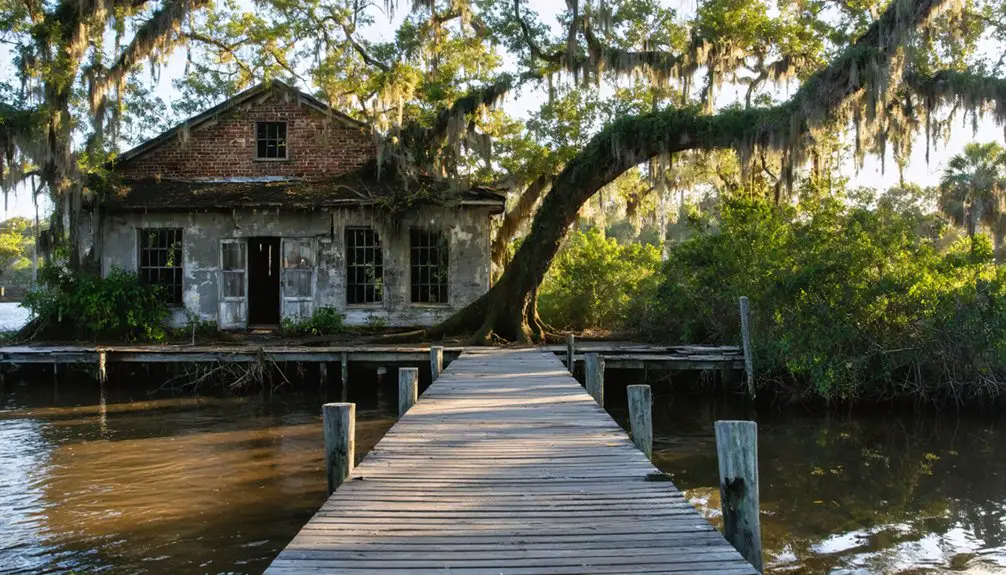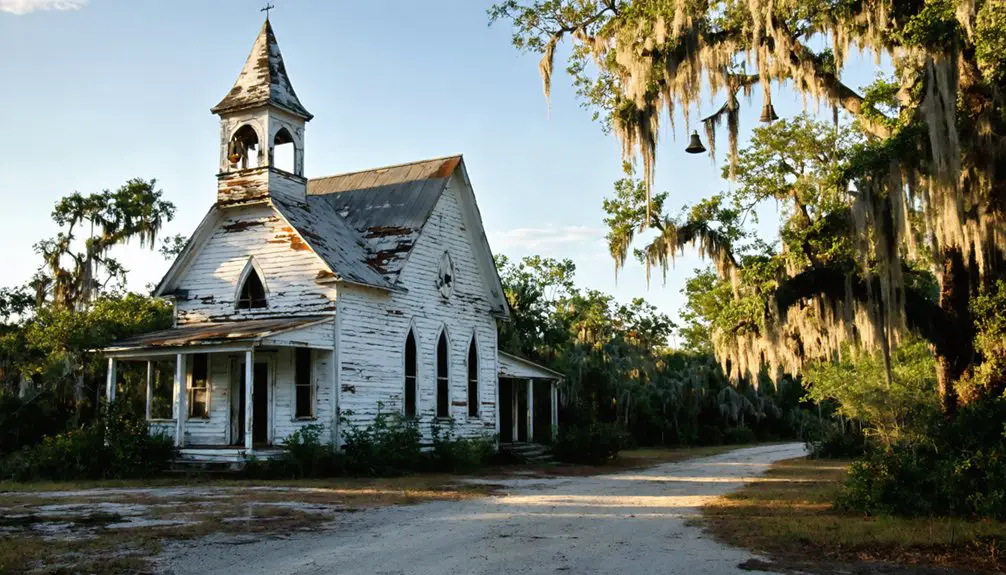
You’ll reach New Troy via US Highway 27 to Mayo, where pavement surrenders to dirt roads threading through Lafayette County’s hardwood forests. This Suwannee River settlement vanished twice—first as Old Troy after Civil War flames, then as New Troy following the suspicious 1892 courthouse fire. Troy Spring State Park now sprawls across the townsite where 500 souls once traded cotton and turpentine. Plan your visit between late fall and early spring, checking river levels before venturing into the floodplain where weathered cemetery headstones mark the community’s tangible memorial.
Key Takeaways
- New Troy thrived from 1860 to 1917 along the Suwannee River before vanishing after the 1892 courthouse fire.
- Troy Spring State Park now occupies the former settlement site at river miles 82-83 near Mayo, Lafayette County.
- Access requires driving US Highway 27 to Mayo, then following county roads where pavement transitions to dirt paths.
- Visit between late fall and early spring to avoid humidity, floodwaters, and challenging river conditions.
- Troy Cemetery remains the only tangible memorial, with weathered headstones accessible via remote trails through hardwood forest.
The Rise and Fall of a Suwannee River Settlement
Deep in the piney woods along the Suwannee River‘s east bank, New Troy sprang to life in August 1860 when the postal service opened its doors. You’ll discover this settlement rose from Old Troy’s ashes, becoming Lafayette County’s seat after fire devastated its predecessor.
By 1870, five hundred souls called this place home, their economic dynamics revolving around steamboats hauling turpentine, cotton, and citrus downriver. You’d have found a cotton gin, sawmill, general stores, and a two-story courthouse anchoring community governance. Like the ancient tell of Hisarlık, settlements often rebuild upon the ruins of their predecessors, creating layers of history in a single location.
But social transformations came swiftly. When flames consumed the courthouse on New Year’s Eve 1892, residents voted to relocate the county seat to Mayo. The original Troy had been located approximately 8-9 miles up the Suwannee River from Branford before its own courthouse burned, possibly in 1865. Businesses vanished, steamboats stopped running by 1899, and the ferry closed in 1917. Hardwoods reclaimed the fields where commerce once thrived.
From Old Troy to New Troy: A Town Reborn
The chaos that followed the Civil War brought flames that devoured Old Troy, reducing the riverside settlement to ash and forcing survivors to salvage what remained of their lives. You can almost hear the crackling timbers and see the glow reflected in the dark Suwannee waters as families watched their courthouse and homes burn.
From those embers, the determined settlers moved just a quarter mile inland, carrying their hidden county records and their resolve to rebuild what they’d christened New Troy.
Old Troy’s Fiery End
On May 3, 1901, flames erupted from the Cleveland Fiber Factory’s Spanish moss drying racks in northwest Old Troy, igniting what would become the largest fire in Southern U.S. history. You’d have watched helplessly as high winds transformed burning moss into airborne embers, each one a death sentence for the wooden-shingled roofs below.
The inferno consumed 150 blocks, reducing 2,368 buildings to ash—including the courthouse holding every pre-1901 property record. Two souls perished in the St. Johns River seeking escape. Ten thousand residents lost everything. This moss industry disaster exposed the deadly combination of wooden construction and volatile materials, prompting fire prevention measures that would reshape American towns. Similar devastation would strike Florida nearly a century later when the 1998 Florida Firestorm consumed roughly 500,000 acres across east central Florida. The drought index reaching 700 matched conditions typically found in Western states, creating unprecedented wildfire susceptibility in a region historically protected by high humidity and rainfall.
Old Troy’s complete annihilation forced survivors to abandon their riverfront home forever.
Building the New Settlement
Rising from Old Troy’s ashes, survivors didn’t rebuild where catastrophe had struck—they moved a quarter mile inland from the Suwannee River’s treacherous floodplain, choosing elevation over nostalgia. Between 1860 and 1862, you’d have witnessed Lafayette County’s new seat taking shape with pragmatic determination.
The architectural styles reflected frontier practicality—a log courthouse anchoring the settlement, simple log houses spreading outward, and boarding facilities for travelers.
This wasn’t mere survival; it was transformation. Community services emerged rapidly: a post office connecting New Troy to civilization, a jail maintaining order, and both Baptist and Methodist churches providing spiritual refuge. You’d have found two general stores stocking provisions, a cotton gin processing harvests, and a sawmill cutting timber. By 1870, five hundred souls called this phoenix town home.
Life at Its Peak: When 500 Souls Called New Troy Home
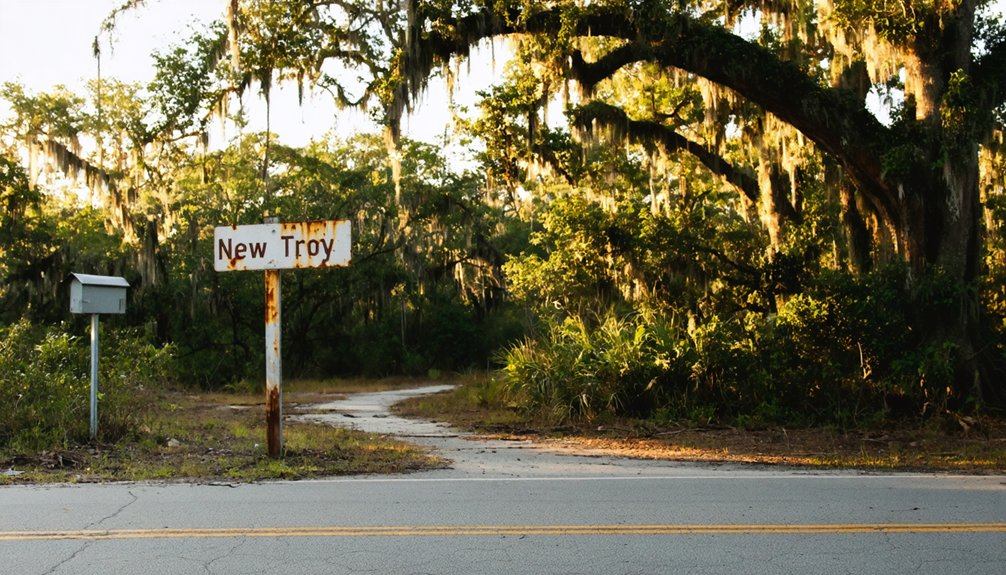
By the 1890s, New Troy pulsed with an energy that’d be unrecognizable to anyone standing amid its silence today. Five hundred souls carved lives from this frontier, creating vibrant community social life around:
- Two bustling general stores where neighbors bartered cotton and turpentine proceeds
- Rival newspapers—the Lafayette County Messenger and Enterprise—printing weekly gossip and political battles
- Churches hosting circuit riders who brought fire-and-brimstone sermons to Methodists and Baptists alike
- Steamboat landings where captains shouted orders while loading oranges and vegetables bound for distant markets
The sawmill’s screech punctuated mornings. Hotels welcomed traders. Your ancestors might’ve celebrated this economic boom in boarding houses, never imagining the coming bust that’d erase their thriving settlement from Florida’s map. This frontier town thrived during an era when Florida’s population center was still shifting steadily southeastward from the panhandle, as settlers gradually moved down the peninsula seeking new opportunities.
The Courthouse Fire That Changed Everything
As midnight approached on New Year’s Eve 1892, flames consumed the two-story wooden courthouse that’d anchored New Troy’s identity for decades. You can imagine the orange glow reflecting off the Suwannee River as residents watched their government seat burn to ash. The courthouse blaze wasn’t just another fire—investigators suspected arson, though they’d never prove it.
Within weeks, furious county residents voted to relocate the seat to Mayo, seven miles away. This pivotal county shift sealed New Troy’s fate. The very businesses that’d thrived around the courthouse square shuttered their doors. The building had served as a gathering place for local events, weddings, and public meetings before the flames destroyed it. Families dismantled their homes for salvageable timber and bricks. By 1894, Lafayette County had completed construction of a wooden replacement courthouse on the courthouse square in Mayo, marking the definitive end of New Troy’s status as county seat.
Finding New Troy Along the Suwannee River Floodplain
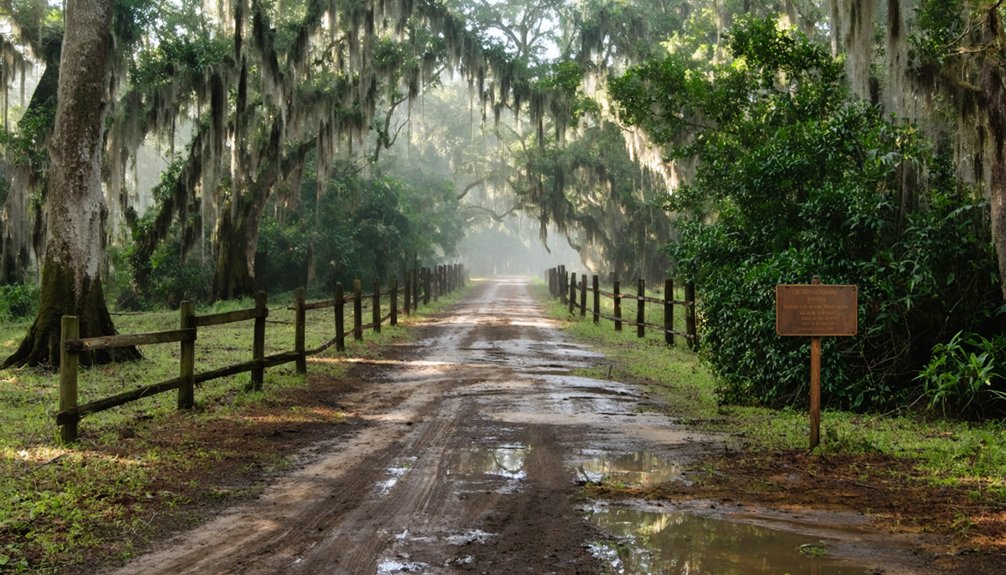
Today’s Troy Spring State Park sprawls across the very ground where New Troy’s residents once conducted commerce, raised families, and dreamed of permanence. You’ll discover their settlement flourished between 1856 and 1917 along the Suwannee’s edge, where karst landscape features shaped daily life and pre settlement land uses left minimal traces.
Where commerce once thrived and families built futures, floodwaters now reclaim the dreams settlers carved from unforgiving ground.
Navigate this 100-year floodplain carefully:
- Northern boundary – Lowest elevations meet river miles 82-83
- Spring-run corridor – 325-foot channel cuts through alluvial forest
- Southern uplands – Highest ground where families built homes
- Eastern parcels – Nearly 2,000 acres of floodplain forest
The river’s unobstructed flow still floods these lands during 10-year events, reclaiming territories settlers once believed they’d conquered. Understanding how flood risk changes over time through development and weather patterns helps explain why this community ultimately vanished beneath the waters. Modern visitors can check current river levels at monitoring stations that update every 1-2 hours to gauge the Suwannee’s ever-changing moods. Your journey traces their waterlogged ambitions.
What Remains: Troy Cemetery and Historical Traces
Deep within Lafayette County’s reclaimed wilderness, Troy Cemetery endures as the settlement’s most tangible memorial—a scatter of weathered headstones standing sentinel where forest has swallowed every other trace of human ambition. You’ll find forgotten gravestones marking brief lives—an 1882 infant, a teenager dead at fifteen in 1866—their stories compressed into crumbling marble.
The remote location challenges modern visitors: no paved roads lead here, only faint trails through hardwoods that replaced cotton fields. Where steamboats once carried turpentine and oranges, where five hundred souls built churches and businesses, nature has reclaimed everything except these burial plots. Like Alabama’s Mt. Pleasant Cemetery, founded before 1850, this burial ground united black and white parishioners in a shared resting place that outlasted the community it served. The courthouse burned, the ferry closed, the buildings were dismantled for salvage. What remains is this: stone markers standing defiant against time’s erasure.
Getting There: Routes to Lafayette County’s Hidden Past
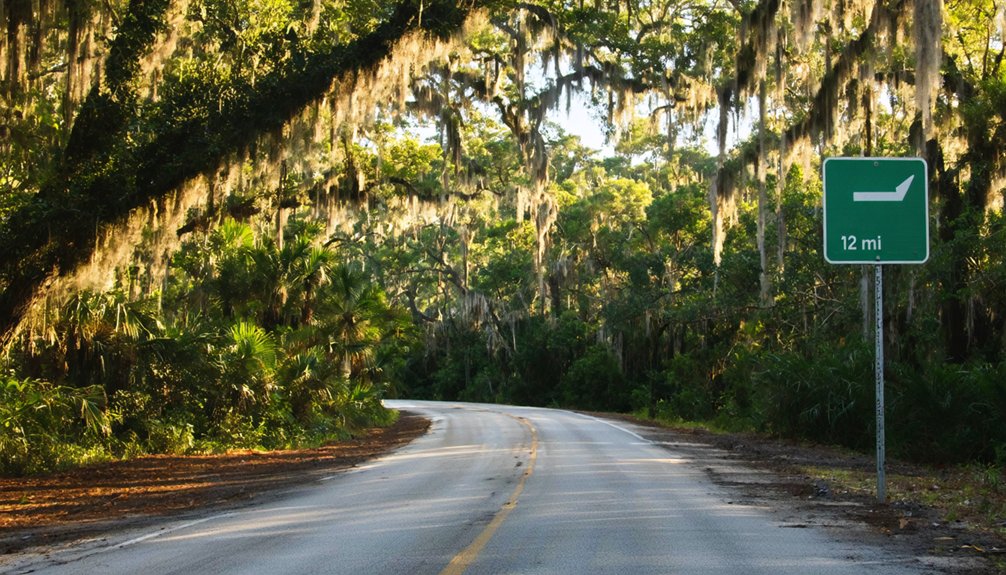
Reaching New Troy requires commitment—this isn’t a destination marked by highway signs or welcomed by paved access roads. You’ll navigate where road development patterns abandoned this settlement nearly a century ago, following routes that mock modern transportation innovations.
New Troy exists where pavement surrenders to memory, accessible only to those willing to trade convenience for discovery.
Your journey unfolds through:
- US Highway 27 to Mayo – Lafayette County’s gateway, where civilization makes its last stand before wilderness reclaims the narrative
- County roads toward the Suwannee – Pavement surrenders to dirt approximately one mile north of Highways 20 and 425’s intersection
- Remnant paths through hardwood forest – Where New Troy’s dismantled homes left barely discernible traces
- The river’s edge – Your final landmark, nine miles upriver from Branford, where steamboats once delivered dreams and departed with timber
Expect isolation. Embrace adventure.
Best Time to Visit This Wilderness Ghost Town
You’ll find New Troy most rewarding between late fall and early spring, when Florida’s wilderness sheds its oppressive humidity and the Suwannee River settles into predictable rhythms. During these cooler months, you can explore the abandoned townsite without battling swarms of mosquitoes or wading through floodwaters that often swallow the low-lying ruins.
The forest opens up as vegetation dies back, revealing crumbling foundations and forgotten pathways that summer’s dense growth conceals beneath impenetrable walls of palmetto and vine.
Seasonal Weather and Accessibility
New Troy’s wilderness setting demands careful timing, as North Florida’s temperamental climate swings between muggy summers with highs in the upper 70s and bone-chilling winter nights that plunge into the upper 20s. Temperature swings following cold fronts can drop readings 20°F overnight, transforming your exploration from comfortable to challenging.
Fog patterns blanket low-lying areas each morning, reducing visibility along unmarked trails.
Plan around these seasonal realities:
- Spring/Fall shoulder seasons offer preferable conditions—moderate temperatures without extreme mugginess
- Winter freezes create treacherous morning access through the 100-year floodplain
- Summer humidity persists day-to-night, with dew points making physical exploration taxing
- Post-front days deliver crisp northern breezes and clearing skies for ideal visibility
Monitor Suwannee River levels before venturing into this elevation-challenged ghost town, where nature reclaims civilization on her terms.
Wildlife and Vegetation Cycles
While New Troy’s historical remnants remain constant, the surrounding wilderness transforms dramatically with Florida’s ecological calendar, determining not just your comfort but what you’ll actually encounter among the ruins. Though specific animal migration patterns for this remote corner remain undocumented, you’ll navigate through sandhill and xeric hammock ecosystems where saw palmettos and scrub pines dominate the landscape year-round.
The floodplain swamps surrounding the ghost town shift between accessible and impassable as water levels rise and fall. Winter months offer drier conditions for exploring the upland pine forests, while vegetation bloom cycles peak in spring when wildflowers emerge across the sandhills. Without established trails or visitor data, you’re venturing into genuinely wild territory where nature—not tourism schedules—dictates what you’ll witness.
River Levels and Flooding
When might the remnants of New Troy disappear beneath murky floodwaters? Understanding seasonal flooding patterns proves essential for accessing this remote wilderness ghost town. The Suwannee River system—your gateway to New Troy—transforms dramatically throughout the year.
Your flood risk assessment should consider:
- Spring Peak Season: Historical data reveals March and April bring the highest water levels, with crests reaching 72 feet
- Post-Storm Surges: Tropical systems trigger major flooding events that can isolate the area for weeks
- Ideal Water Conditions: Target levels below 50 feet for safe exploration without portages
- Real-Time Monitoring: Check USGS WaterWatch stations every few hours before departure
November through early February typically offers the most accessible conditions, with water levels retreating to 30-foot ranges at historical monitoring points.
Combining Your Trip With Nearby Branford
Just fifteen minutes east along the winding Suwannee River corridor, Branford awaits as the perfect companion destination to your New Troy ghost town exploration. You’ll trace the same route ferries once navigated until 1917, connecting these historic settlements through dense floodplain forests and spring-fed tributaries.
Branford delivers what New Troy can’t—crystal-clear swimming holes at Branford Springs, riverside camping under towering cypress canopies, and kayak launches into the scenic Suwannee River’s dark tannin waters. Explore antique shops harboring regional treasures, then refuel at local eatery options serving Southern comfort fare. The town’s historic district reveals architectural remnants from the steamboat era, while nearby Suwannee River State Park offers trails threading through landscapes virtually unchanged since New Troy’s cotton-shipping heyday. It’s freedom distilled into twenty miles of old Florida.
What to Bring for Your Historical Exploration

Your journey into New Troy’s abandoned floodplain demands careful preparation—this isn’t a casual stroll but a genuine wilderness expedition where Spanish moss drapes over forgotten pathways and overgrown cemeteries hide beneath tangled palmetto. You’ll need sturdy boots to navigate the uneven ground where courthouse foundations once stood, reliable navigation tools to pinpoint scattered remnants along the Suwannee’s bends, and documentation supplies to record weathered tombstones that mark the town’s 1800s inhabitants.
The right gear transforms what could be a frustrating scramble through thick brush into a rewarding historical investigation where you’ll actually find—and preserve—the traces of Florida’s lost river settlement.
Essential Outdoor Gear
The crumbling facades and overgrown pathways of New Troy demand more than curiosity—they require serious preparation. Your freedom to explore hinges on proper outdoor gear that transforms risky wandering into calculated discovery.
Pack these essentials for true independence:
- Illumination arsenal: Flashlight and headlamp with spare batteries illuminate pitch-black interiors where sunlight fears to tread.
- Storage solutions: A durable backpack organizes your gear while keeping hands free for climbing through collapsed doorways.
- First aid preparedness: Extensive medical kit addresses cuts from rusted metal and broken glass.
- Hydration system: Water bottles and purification tablets sustain you through scorching Florida afternoons.
Don’t forget your multi-tool—it’s your skeleton key to unexpected obstacles. Heavy-duty gloves, sturdy boots, and respiratory protection complete your arsenal against New Troy’s beautiful decay.
When shadows swallow the broken windows of New Troy’s abandoned structures, navigation becomes survival, and documentation transforms into your time capsule back to civilization. You’ll need GPS devices that pinpoint precise coordinates in Florida’s dense scrubland, while artifact mapping tools like Surfer software convert your discoveries into tangible distribution patterns.
LIDAR terrain analysis reveals what your eyes can’t—hidden foundations, forgotten paths, structural remnants buried beneath decades of vegetation.
Pack historical maps measuring 18×24 inches for field reference, comparing 1800s layouts against today’s overgrown reality. Document everything: photograph artifacts in situ, record grid locations, capture the decay. Your smartphone becomes your archaeological notebook. These tools don’t just guide your exploration—they preserve New Troy’s fading memory, ensuring your adventure contributes to understanding what freedom-seeking pioneers left behind.
Cemetery Research Supplies
Beyond mapping New Troy’s skeletal structures lies its most profound archive—the cemetery where pioneers rest beneath weathered stones and tangled palmetto. Documenting the cemetery site demands specialized gear that transforms you from visitor to historical preservationist.
Essential cemetery research supplies include:
- Camera with extra batteries to capture weathered inscriptions before they vanish completely
- Large paper sheets and rubbing wax for transferring faded epitaphs that cameras can’t capture
- Soft bristle brushes and distilled water for proper cleaning techniques that won’t damage century-old marble
- Small empty bottles for soil samples and botanical specimens
Pack white rags, wooden craft sticks, and safety glasses alongside your standard exploration kit. These forgotten graveyards don’t maintain themselves—you’re their temporary custodian, extracting stories from stone before Florida’s humidity claims them forever.
Frequently Asked Questions
Are There Any Guided Tours Available for New Troy Ghost Town?
No guided tours exist for New Troy since it’s not a recognized ghost town. You’ll need to seek self-guided tours at established Florida locations like St. Augustine, where educational exhibits bring authentic haunted history alive through immersive, spine-tingling experiences.
Is Camping Allowed Near the New Troy Historical Site?
You’ll find overnight accommodations aren’t available directly at New Troy’s ruins, but you’re free to explore nearby camping options. Local amenities include state parks and national forest sites where you can pitch your tent under star-filled skies.
Do I Need Special Permits to Explore the Area?
You won’t need special permits for New Troy’s ghost town ruins, but you’ll navigate private property concerns at Troy Cemetery. Contact Lafayette County’s local government regulations office beforehand, respecting landowners while preserving your freedom to explore history’s abandoned corners.
Are There Any Safety Concerns With Wildlife in the Area?
You’ll encounter wild Florida out there—wildlife sightings include deer and hogs roaming freely. Watch for potential snake encounters in overgrown ruins and springs. Stay alert, respect their territory, and you’ll navigate this untamed landscape safely.
Can I Access Troy Cemetery Year-Round?
You can explore Troy Cemetery year-round, though you’ll encounter limited accessibility during severe weather like storms or high winds. Gates maintain seasonal hours—typically 8am to 7pm—so plan your ghost town adventure accordingly for unrestricted access.
References
- https://www.youtube.com/watch?v=SfNW9rjRUbQ
- https://www.ghosttowns.com/states/fl/troy.html
- https://en.wikipedia.org/wiki/Troy
- https://www.youtube.com/watch?v=aoel0MrTQ_k
- https://www.foxnews.com/travel/once-in-a-century-treasures-dating-back-4500-years-unearthed-legendary-city
- https://www.geotab.com/ghost-towns/
- http://files.usgwarchives.net/fl/lafayette/history/carltroy.txt
- http://www.friendsofthemahicantuck.org/uncategorized/city-council-to-squander-yet-another-piece-of-troy-history/
- https://anvio.org
- https://www.youtube.com/watch?v=OwCnzTxX5Nw