You’ll find North Walden’s haunting remains accessible via Route 15 to Hardwick, then forest roads leading to crumbling foundations, Freedley Quarry’s 1870s inscriptions, and cemetery stones marking lives cut short in the 1860s. The abandoned wool mill that once supplied Civil War uniforms stands among root cellars reclaimed by wilderness. While Benjamin Greenbank’s 1849 operation anchored this logging settlement, its collapse mirrors the broader Bennington Triangle’s unsettling history—where mysterious disappearances between 1945-1950 transformed Vermont’s ghost towns into something far more sinister than simple economic casualties.
Key Takeaways
- North Walden, abandoned since economic collapse in the 1800s, features crumbling foundations, cemetery stones, and Freedley Quarry ruins from 1874-1875.
- The ghost town lies near the Bennington Triangle, where five people mysteriously disappeared between 1945-1950, including Frieda Langer and Middie Rivers.
- Abenaki legends warned of cursed grounds at “Where Four Winds Meet” and a man-eating stone on nearby Glastonbury Mountain.
- Visitors report unexplained lights, phantom voices, strange figures in trees, and disorienting phenomena among the abandoned residential and industrial ruins.
- Key landmarks include Benjamin Greenbank’s 1849 wool mill ruins, stone walls, root cellars, and graves dating 1818-1887 reclaimed by wilderness.
The Rise and Fall of a Vermont Lumber Settlement
On a cold November day in 1780, Vermont’s legislature granted the wilderness tract that would become Walden to Moses Robinson and sixty-four others—men who’d never laid eyes on the dense forests they now owned.
Sixty-five men claimed Vermont’s wilderness without ever witnessing the forests that would define their legacy.
You’ll find North Walden’s story mirrors Vermont’s boom-and-bust timber saga. After Nathaniel Perkins arrived in 1789, carrying corn meal thirty miles on his shoulders, the settlement grew slowly until logging exploded statewide.
By 1889, Vermont produced 375 million board feet annually—but the Champlain Valley’s best timber was already gone by 1840. Clearcutting devastated the impact on local economy, forcing families from forest-dependent livelihoods.
The exhausted land eventually became state forest, sparking Vermont’s forest conservation efforts in 1904. North Walden couldn’t survive what progress demanded.
Understanding the Bennington Triangle Phenomenon
While North Walden’s abandonment stemmed from economic collapse, southwestern Vermont harbors a different kind of ghost story—one that refuses rational explanation. Author Joseph A. Citro coined the term “Bennington Triangle” to describe five disappearances between 1945-1950 across Glastenbury Mountain’s 100 square miles. You’ll find reported sightings of strange lights, bigfoot, and phantom hitchhikers throughout this rugged terrain where Native Americans once claimed the mountain was cursed.
The search efforts were chaotic—370 volunteers marking trails with confetti, state troops mobilizing, yet bodies rarely surfaced. Frieda Langer’s remains appeared seven months later, but others vanished completely. Some blame wilderness hazards; others point to rumored portal sites and interdimensional vortexes. The area’s ghost towns—unincorporated since 1937—add atmospheric weight to theories that defy conventional investigation.
Mysterious Disappearances That Shocked New England
You’ll find the Bennington Triangle‘s most haunting cases unfolded between 1945 and 1950, when five people vanished without explanation from the same mountain region.
The series began with 74-year-old Middie Rivers, an experienced hunting guide who disappeared on a familiar trail, followed by college student Paula Welden who stepped into the woods and was never seen again.
Then came James Tedford, who boarded a bus to Bennington but never arrived at his stop—fourteen passengers confirmed he’d been sitting in his seat just moments before the final destination.
The Vanishing Hikers Series
The forests of Vermont harbor stories that refuse to fade, and none grip the imagination quite like the Bennington Triangle disappearances. Between 1945 and 1950, five people vanished along familiar trails, creating a regional mystery pattern that still haunts these mountains.
You’ll find these unexplained vanishings centered around the Long Trail near Glastenbury Mountain. Experienced hunter Middie Rivers disappeared first in 1945, followed by college student Paula Welden in her red coat. Young Paul Jepson’s scent trail simply ended at a road intersection. Most disturbing was Frieda Langer‘s case—her remains surfaced six months later, too decomposed for answers.
These weren’t greenhorns lost in wilderness. They were locals, guides, experienced outdoorsmen who knew these woods. That’s what makes your journey here so unsettling.
Bus Passenger Without Trace
On December 1st, 1949, James E. Tetford boarded a bus in St. Albans, heading home to Bennington after visiting family. Fourteen passengers witnessed him sitting in the back, his luggage stowed overhead.
When the bus reached Bennington, Tetford had vanished—but his belongings remained untouched at his seat. Neither the driver nor fellow passengers saw him leave. Nobody heard anything unusual. He simply ceased to exist between stops.
This unexplained disappearance presents unique evidentiary challenges. Unlike the hikers who vanished on mountain trails, Tetford disappeared from a confined space with multiple witnesses. There’s no wilderness to blame, no opportunity to wander off-trail. The logistics make it seemingly impossible.
You’ll find no answers in Bennington today, just another thread in the Triangle’s unsettling tapestry.
Child Lost Near Dump
While Tetford’s disappearance defied explanation within the confines of a bus, another case stripped away even that sense of containment. In the 1950s, a child wearing a bright red coat vanished from a truck near a pig feeding area—gone within sixty minutes despite orders to stay put. This mysterious disappearance launched immediate searches that found nothing.
The investigation revealed:
- No clothing fragments or personal items discovered
- Zero tracks leading into surrounding wilderness
- Mother had left child unattended briefly for farm duties
- Authorities attributed loss to terrain despite evidence vacuum
While officials dismissed suspected foul play, the complete absence of traces defied natural explanation. The red coat—meant for visibility—became another Vermont enigma, swallowed by landscape that refuses surrender.
Native American Legends and Cursed Grounds
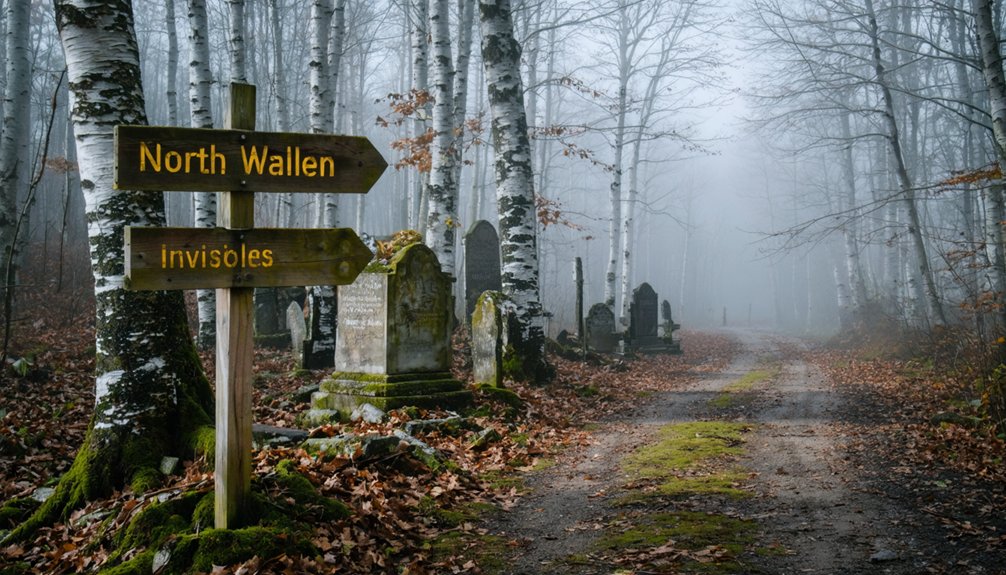
The Abenaki who once inhabited this region carried stories about places where spiritual forces converged—spots they approached with caution and respect.
At North Walden, you’re standing near what some called “Where Four Winds Meet,” a location tied to the Man-Eating Stone legend, where travelers supposedly vanished without explanation.
The Western Abenaki, who roamed these Connecticut River Valley territories until conflicts and colonial pressures pushed them north, understood certain grounds demanded mindful passage, not the careless footsteps of those who’d forgotten the old warnings.
Where Four Winds Meet
Long before colonial maps carved Vermont into tidy townships, the Abenaki understood this landscape through stories that breathed life into stone and water. You’ll find their traditional land uses etched into every river bend and hilltop—places where ancient practices shaped what colonists later mistook for wilderness.
The Northeast Kingdom’s old growth forests witnessed ceremonies and seasonal migrations that predated any European claim:
- Amus Falls gathered hundreds during spring fish runs, its name meaning “fishing place”
- Forest burning managed landscapes intentionally, documented into the 1770s
- Sacred springs like Brunswick’s held healing powers before exploitation triggered curses
- Rock Dunder in Lake Champlain marked where Oodzee-hozo transformed, becoming stone after shaping valleys
These weren’t superstitions—they were maps of belonging, teaching you to walk as if all things matter.
The Man-Eating Stone Legend
Among those sacred stones and springs, one rock carried warnings so urgent that generations refused to speak its precise location. The Algonquin people knew something existed on Glastonbury Mountain—a stone that could swallow anyone who stepped upon it. They’d avoided this cursed ground since 8500 BCE, passing down knowledge like a survival manual.
When five people vanished between 1945 and 1950, Joseph Citro’s research connected these disappearances to the legend. Bloodhounds traced victims to highways near the mountain’s Long Trail, where the stone allegedly waited. Skeptical interpretations suggest conventional explanations, though ongoing investigation hasn’t solved these cases.
You won’t find coordinates—nobody living claims to have seen it. The Algonquin’s silence protected wanderers then. Perhaps it still does now.
What Remains of the Abandoned Town Today
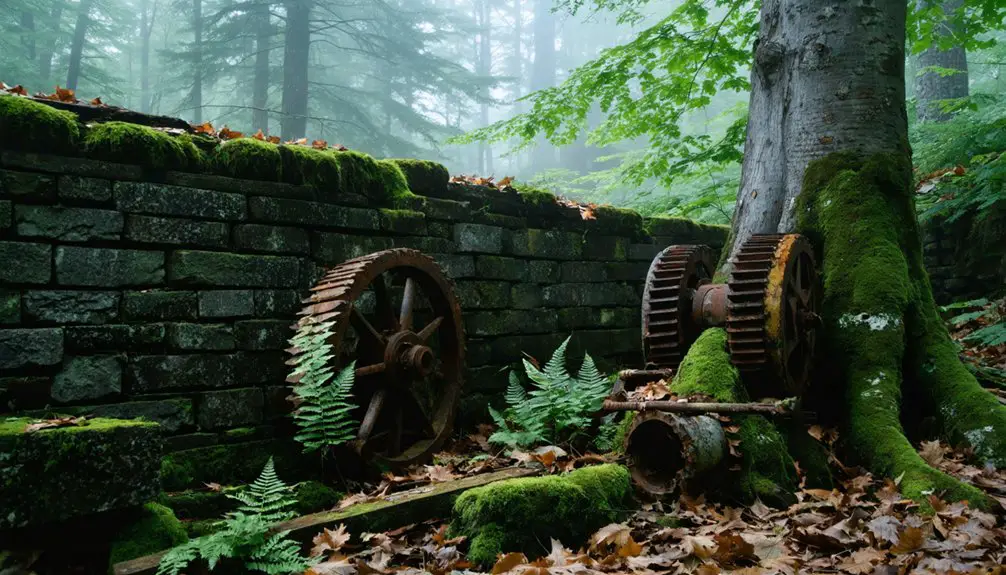
Scattered across the forested hillsides, North Walden’s remnants tell stories through crumbling stone and weathered markers. You’ll discover the remaining mill foundations from Benjamin Greenbank’s 1849 wool operation that once supplied Civil War uniforms before flames consumed it. The abandoned residential ruins include root cellars and stone walls where families once thrived, now reclaimed by wilderness.
Stone foundations whisper tales of Benjamin Greenbank’s 1849 mill, where wool looms once hummed before fire claimed everything.
As you explore, you’ll encounter:
- Cemetery stones dating 1818-1887, with 1862 graves marking young lives at 28
- Freedley Quarry’s massive excavations showing 1874-1875 inscriptions without recent footprints
- Late 1790s mill walls near Joe’s Creek where the structure collapsed
- Covered bridge replica standing sentinel over the original burn site
Each crumbling foundation and weathered headstone offers freedom to imagine lives lived beyond modern constraints.
Strange Encounters and Supernatural Reports
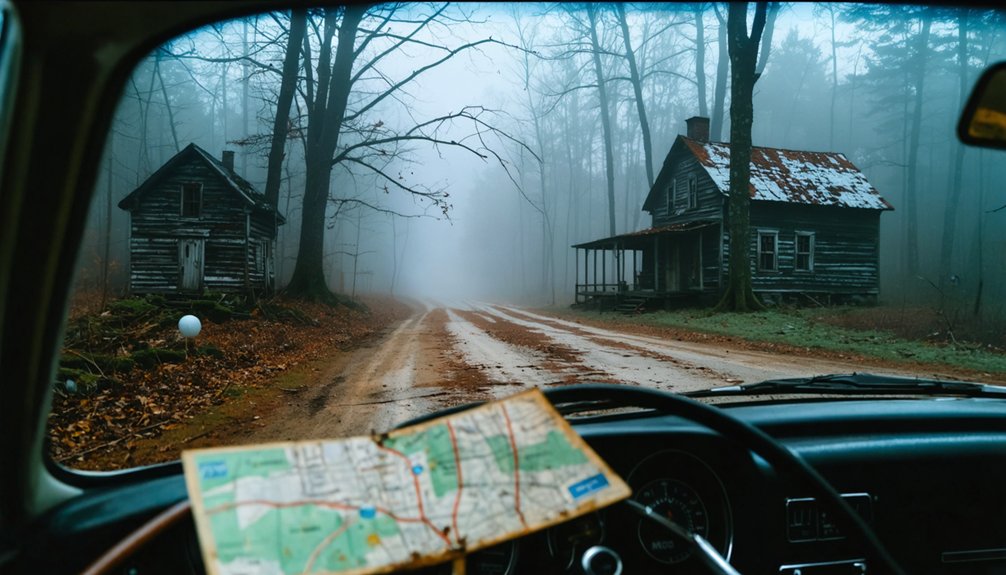
You’ll hear stories from locals about unexplained lights flickering between abandoned foundations after dark, accompanied by sounds that don’t match the empty landscape—footsteps on rotted floorboards, voices where no one stands.
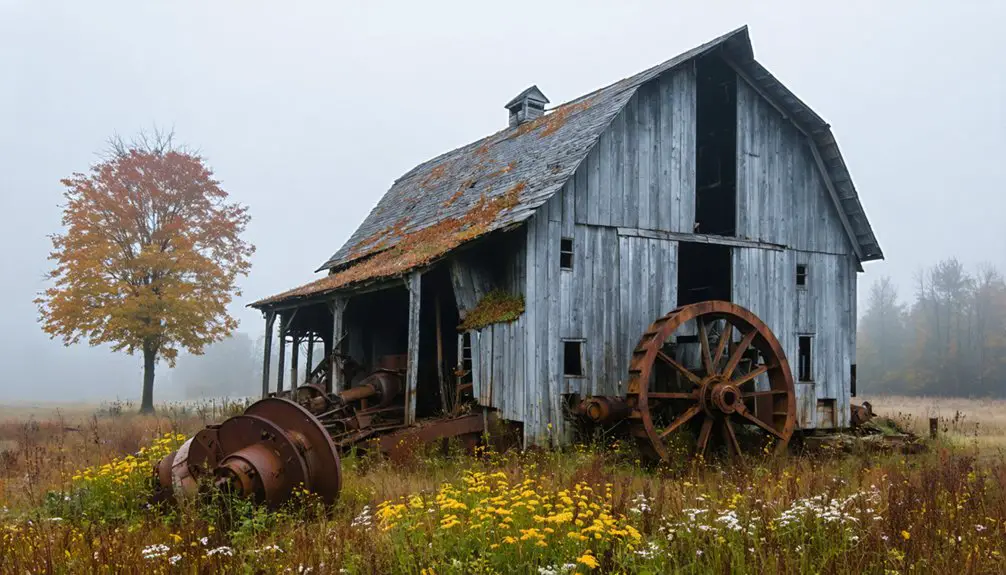
Over the decades, visitors have reported strange figures moving through the trees and unsettling presences that seem to watch from the shadows of collapsed barns. The indigenous Abenaki peoples warned that certain lands carried a heaviness, and some believe North Walden sits on ground that never wanted to be settled.
Eerie Lights and Sounds
Long before the Bennington Triangle earned its ominous reputation, settlers reported something fundamentally wrong with the forests around Glastenbury Mountain. You’ll find accounts spanning centuries describing identical phenomena: mysterious lights dancing above treetops, unnatural fog patterns rolling through valleys, and sounds that defy explanation echoing through dense woodland.
The unexplained happenings in woods include:
- Strange luminous orbs floating between trees, documented from colonial times through modern UFO reports
- Disorienting winds that shift direction constantly, creating eerie whistling through abandoned settlements
- Unidentifiable odors accompanying supernatural encounters, noted by both indigenous peoples and Civil War-era travelers
- Inexplicable roaring sounds that terrorized stagecoach passengers and continue unsettling hikers today
These persistent reports suggest you’re entering territory where nature itself seems fundamentally altered.
Creature Sightings Through History
Beyond the lights and phantom sounds lurking in Vermont’s forests, you’ll encounter reports of physical entities—creatures that witnesses claim walked, watched, and sometimes attacked. The Bennington Monster terrorized a coach full of travelers on Glastenbury Mountain during the 1800s, establishing a legacy of fear that continues today.
These ghastly beast encounters aren’t confined to one location. In 1971, a Northfield farmer investigating backyard noises discovered a man-sized figure with white hair covering its body and pig-like facial features lurking at the edge of his kitchen light. He’d expected a raccoon—instead, he found something humanoid.
Vermont’s wilderness holds countless unexplained creature sightings, reminding you that some mysteries resist rational explanation, demanding you venture beyond comfortable assumptions.
Indigenous Cursed Land Warnings
Centuries before settlers arrived in Vermont, Native American tribes regarded Glastenbury Mountain as profoundly dangerous—a place where the four winds met and the dead belonged. They shunned the area completely, prohibiting resource use and habitation through strict taboos. Only burial ceremonies brought them to this cursed ground.
Their warnings painted a terrifying picture of spiritual forces at work:
- Man-eating rock that swallowed anyone who stood upon it
- Strange lights and mysterious flying objects drifting above the treetops
- Eerie sounds and unidentifiable odors permeating the forest
- Wild men and beast attacks threatening intruders
These stories passed through generations, creating boundaries colonists initially respected. The indigenous peoples’ collective memory preserved tales emphasizing environmental and supernatural peril—warnings that gained chilling credibility during the 1945-1950 disappearances when hikers vanished without trace.
Getting There: Routes and Access Points
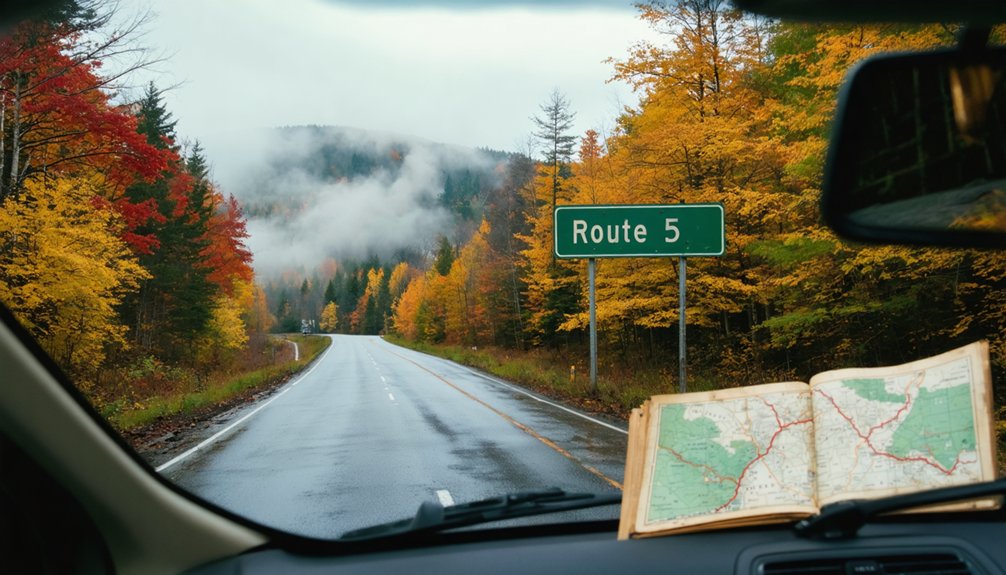
While you won’t find North Walden marked on most modern maps, reaching Glastenbury—Vermont’s most notorious ghost town—requires careful planning and a reliable vehicle. Your journey begins just outside Bennington, near where the Appalachian Trail cuts through the wilderness. Take Route 9 through Woodford, then navigate fire road 71 until you reach fire road 325. These rough tracks lead you into 36 square miles of unbroken forest where Fayeville’s unexplored ruins await.
The fire roads remain passable by vehicle, though conditions vary seasonally. You’ll encounter unmarked trails branching into deeper wilderness—some leading to forgotten settlements, others disappearing into dense growth. Bring detailed topographic maps and GPS coordinates; cell service vanishes quickly. The freedom to explore comes with responsibility: notify someone of your route before venturing into this isolated territory.
Must-See Locations and Historical Landmarks
Deep in the Green Mountains, these forgotten settlements tell Vermont’s darker frontier story through crumbling foundations and weathered gravestones.
Your journey begins at Woodford Ghost Settlement, where remote cabin sites cluster along mountainside trails. Stone walls mark homesteader land claims abandoned when sheep farming failed. Waters Hill Cemetery preserves 35 graves from 1794-1861, their surnames—Bickford, Cotton, Harris—echoing through forest silence.
Essential stops include:
- Greenbank’s Hollow: Vermont Valley Woolen Mill ruins where fire consumed everything, visible from Saint Johnsbury five miles distant
- Glastenbury Town Hall: Built circa 1830, surviving witness to Vermont’s wildest logging town
- Original covered bridge sites: Early 1800s architecture reclaimed by wilderness
- Abenaki ceremonial grounds: Man-eating stone legends near Glastenbury Mountain
These sites require sturdy boots and self-reliance—no park rangers manage these territories.
Hiking Glastenbury Mountain Trail
Rising through one of Vermont’s most enigmatic wilderness areas, Glastenbury Mountain’s 3,748-foot summit promises both spectacular views and unsettling history. You’ll find multiple routes ranging from a manageable 11.6-mile trek to extreme 19-mile expeditions gaining over 4,500 feet. The fire tower crowning Vermont’s 29th highest peak rewards your effort with panoramic vistas across Green Mountain National Forest.
Proper preparation for challenging hike means anticipating brutal conditions—summits run 20-40°F colder with icy surfaces threatening even experienced hikers. Start from the Long Trail Route 9 Trailhead, pack your headlamp, and turn back at least two hours before sunset. Water crossings might require barefoot wading, and trail markers vanish beneath snow.
Most routes demand 5-13 hours and good fitness levels. Consider overnight trips for longer sections through this legendary wilderness.
Nearby Ghost Towns and Haunted Sites to Explore
Beyond Glastenbury Mountain’s haunted trails, Vermont’s wilderness conceals entire communities swallowed by forest and time. You’ll discover forgotten burial grounds hidden among Somerset‘s slate ruins, where weathered headstones mark families who gambled everything on quarry work.
Architectural preservation challenges intensify as nature reclaims these settlements—Greenbank’s Hollow’s covered bridge collapsed into Joe’s Creek decades ago, leaving only foundation stones.
Essential stops for your ghost town expedition:
- Ricker Basin – Remote mountain settlement accessed through Little River State Park’s backcountry trails
- West Castleton – Mining ruins within Bomoseen State Park, where copper fever consumed an entire community
- Somerset – Windham County’s slate ghost town along designated history trails
- Greenbank’s Hollow – Caledonia County’s woolen mill catastrophe site
Each location offers unguarded exploration without tourist crowds controlling your experience.
Frequently Asked Questions
What Supplies and Safety Equipment Should I Bring for This Trip?
Better safe than sorry—you’ll need an emergency kit with water, first aid supplies, and road flares. Don’t forget appropriate footwear for exploring ruins, plus extra batteries, blankets, and that sense of adventure that brought you here.
Are Overnight Camping Permits Required in the Glastenbury Area?
Camping permit requirements vary in the Glastenbury area regulations. You’ll need landowner permission on private property, while state lands require no permits for small primitive groups. Commercial outfitters must obtain special permits before setting up camp.
Is Cell Phone Reception Available Throughout the Ghost Town Regions?
Cell phone reception isn’t reliable in ghost town regions. You’ll encounter potential signal dead zones throughout these remote areas due to limited cell tower coverage. Verizon offers your best chance, but don’t count on connectivity in Vermont’s backcountry.
What Are the Best Months to Visit for Optimal Weather Conditions?
You’ll hit the sweet spot visiting during September and early October, when mild temperatures and low precipitation create perfect exploring conditions. The stunning foliage backdrop makes your ghost town adventure even more memorable and accessible.
Are There Guided Tours Available for the Bennington Triangle Locations?
Guided walking tours focus primarily on Old Bennington’s historic sites rather than broader Triangle locations. You’ll find private ghost town tours aren’t explicitly offered, though you can arrange customized museum experiences and explore remote Triangle areas independently.