Your ghost town road trip to Nugget City begins in Deadwood, where 25,000 miners once swarmed golden gulches. Navigate Lawrence County’s 143 routes connecting 93 abandoned settlements, following rusty hematite stains through pine-studded ridges. Stop at Galena’s preserved storefronts and Rochford’s 1878 Moonshine Gulch Saloon before winding toward Nugget City’s skeletal remnants. You’ll also want to explore Tinton’s substantial ruins—once a lithium supplier for the Manhattan Project. The journey requires strategic planning, historical maps, and attention to property access regulations that’ll guarantee your Black Hills adventure succeeds.
Key Takeaways
- Nugget City emerged after the Larter party’s 1875 gold strike on Blacktail Creek during the Black Hills mining boom.
- Lawrence County contains 93 ghost towns across 143 routes, requiring strategic planning for an efficient road trip.
- Begin in well-preserved Galena, then explore remote sites like Tinton and Nahant along overgrown logging roads.
- Use historical resources like Sanborn’s 1885 Deadwood sheets and Pastmaps.com to navigate and locate ghost town sites.
- Include Deadwood and Mount Moriah Cemetery to experience Wild West history alongside your ghost town exploration.
Understanding Nugget City’s Place in Black Hills Mining History
When the Larter party struck gold on Blacktail Creek in late 1875, they ignited a fever that would transform the Black Hills into a honeycomb of mines, mills, and makeshift towns. You’ll find Nugget City among these scattered settlements, where prospectors once followed rusty brown hematite stains and quartz outcroppings toward fortune.
Like nearby Mystic, Harney, and Diamond City, this ghost town thrived on dreams extracted from stubborn rock. Modern geological assessment reveals what those pioneers sensed instinctively—the region’s mineral-rich veins held genuine promise, evidenced by operations like the Wheeler Brothers’ $140,000 Deadwood Creek haul in 1876.
Today, historical preservation challenges mount as weathered structures surrender to time, making your visit both urgent and rewarding. You’re witnessing freedom’s raw, unfiltered legacy carved into these hills.
Mapping Your Route Through Lawrence County Ghost Towns
Your journey through Lawrence County’s 93 ghost towns unfolds across 143 documented routes threading through pine-covered gulches and abandoned mine shafts. Start with Galena’s remarkably preserved storefronts just two miles from Deadwood, where the Galena Historical Society maintains structures you can photograph and explore on foot.
From there, wind deeper into the Black Hills backcountry toward isolated sites like Tinton and Nahant, where overgrown logging roads lead to foundations barely visible beneath decades of forest reclamation.
Essential Black Hills Stops
With 93 documented ghost towns scattered across Lawrence County’s rugged terrain, planning your route requires strategic thinking about which sites offer the most rewarding experiences.
Start in Rochford, where ten residents keep mining town culture alive at Moonshine Gulch Saloon—a surviving relic welcoming hundreds of freedom-seekers annually. The town once housed 1,000 residents across 100 homes, six stores, and three saloons during its 1878 peak.
Nearby Galena, just miles from Deadwood, maintains its historic character through dedicated preservation efforts.
For authentic mining district exploration, venture through Irish Gulch toward Montezuma, established in 1879 near the gold discovery site that sparked the Black Hills rush. These sites reveal the role of women in frontier communities through preserved churches and remnants of schools that anchored transient populations to something permanent.
Planning your ghost town expedition through Lawrence County means grappling with 143 historic maps that transform rugged terrain into readable pathways through time. You’ll need Sanborn’s 1885 Deadwood sheets and Pastmaps.com tools to navigate Irish Gulch’s Montezuma site or locate vanished Williamsburg from the Gold Rush era.
The environmental impact of mining left visible scars—barren Whitewood City and Gregory’s skeletal remains guide your way better than GPS coordinates. Local legends whisper through Preston’s ghost town cemetery and Galena’s preserved structures, where 1,500 souls once thrived.
Those 1876-1898 Crook City plats reveal alleged graves and forgotten claims. You’re tracking 93 ghost towns across this single county, each demanding respect for fragile ruins and the land’s complex history beneath your boots.
Essential Stops: Deadwood and the Wild West Connection
You’ll find Wild Bill Hickok‘s grave at Mount Moriah Cemetery, perched on the hillside above Deadwood where the legendary gunfighter rests alongside Calamity Jane and Seth Bullock. The weathered headstones stand as silent witnesses to August 2, 1876, when Hickok fell at Saloon No. 10 clutching aces and eights—the Dead Man’s Hand that would echo through Western lore.
Walk these windswept grounds where 25,000 gold-hungry miners once swarmed the surrounding gulches, and you’ll trace the raw edge of frontier justice that defined this Black Hills boomtown.
Wild Bill Hickok’s Legacy
Before Wild Bill Hickok became a legend frozen in time by a coward’s bullet, he’d already carved his name across the frontier as a larger-than-life lawman whose reputation often outpaced the truth. Born James Butler Hickok in 1837, he earned his “Wild Bill” moniker through embellished literary depictions in Harper’s Magazine.
You’ll find his presence everywhere in Deadwood—statues, paintings, and the famous Saloon #10 where Jack McCall shot him holding aces and eights on August 2, 1876. Despite spending mere weeks here, Hickok’s brief residency sparked enduring historical preservation efforts.
Visit the saloon site near 624 Main Street, where this aging gunslinger with failing eyesight met his end at thirty-nine, forever cementing Deadwood’s Wild West mystique.
Mount Moriah Cemetery Tour
Perched atop Mount Moriah at 2,000 feet, this Victorian-era cemetery sprawls across the hillside like a stone garden of frontier stories, its oval layout designed to symbolize eternal life when Lawrence County established it in 1878.
You’ll navigate self-guided paths through 3,400 graves divided into four distinct quadrants, each revealing different chapters of Deadwood’s wild past. The historic architecture ranges from elaborate Hebrew inscriptions on Mt. Zion to the reconstructed Chinese altar where spirit offerings once burned.
Among the famous interments, you’ll find Preacher Smith, murdered while bringing Christianity to the Hills, and Seth Bullock, Roosevelt’s friend and Deadwood’s first sheriff. Access via Sherman Street rewards you with bird’s-eye views of the gulch below—freedom carved in stone.
Exploring Tinton’s Mining Camp Remnants
Walking through Tinton today, you’ll find South Dakota’s most substantial ghost town—a skeletal settlement of approximately 25 structures scattered across the Black Hills landscape. Founded in 1876 as a gold camp, this former company town evolved into a strategic lithium supplier for the Manhattan Project, hosting the world’s largest notable tin ore processing facility at its peak.
You’ll discover remnants of shaft houses, the 1927 community hall that once accommodated 200 spectators for local community celebrations, and weathered mining infrastructure spanning decades of extraction. The Dakota Tin and Gold Mine site earned National Register recognition in 2005, though a 2018 tornado devastated many buildings. Despite the destruction, Tinton’s ruins offer unmatched exploration opportunities among Black Hills ghost towns, revealing layers of industrial history frozen in abandonment.
Discovering Nearby Abandoned Settlements Worth Visiting
Beyond Tinton’s windswept ruins, the Black Hills conceal a constellation of forgotten settlements where mining dreams rose and fell with the gold market. You’ll find Galena’s schoolhouse standing sentinel in Vanocker Canyon, its weathered walls perfect for documenting crumbling structures before they vanish completely.
Spokane’s building frameworks invite exploration—just resist climbing them for preservation’s sake. Mystic offers restored glimpses along the old railroad corridor, while recounting oral histories becomes visceral when you’re standing where three hundred miners once called Pactola home, now drowned beneath 150 feet of reservoir water.
Even Rockerville’s fire-training losses can’t erase the freedom of wandering these tucked-away sites. Each ghost town whispers different tales of boom, bust, and the relentless passage of time.
What Remains at Nugget City Today
Unlike its neighboring ghost towns with their skeletal frameworks and weathered foundations, Nugget City has vanished so completely that you won’t find structural remains to photograph or foundations to trace with your boots. The town’s legacy lives entirely through artifact preservation at Deadwood’s Adams Museum, where Potato Creek Johnny’s famous nugget anchors the exhibit.
You’ll discover the physical gold that sparked dreams in this now-invisible settlement, displayed behind glass rather than scattered across hillsides.
Visitor accessibility has improved dramatically as Rapid City and the Black Hills region expand, making the museum an easy stop on your ghost town circuit. While you can’t walk Nugget City’s streets, you’ll stand face-to-face with the very gold that briefly summoned miners to these hills—tangible proof of a town erased from the landscape but preserved in memory.
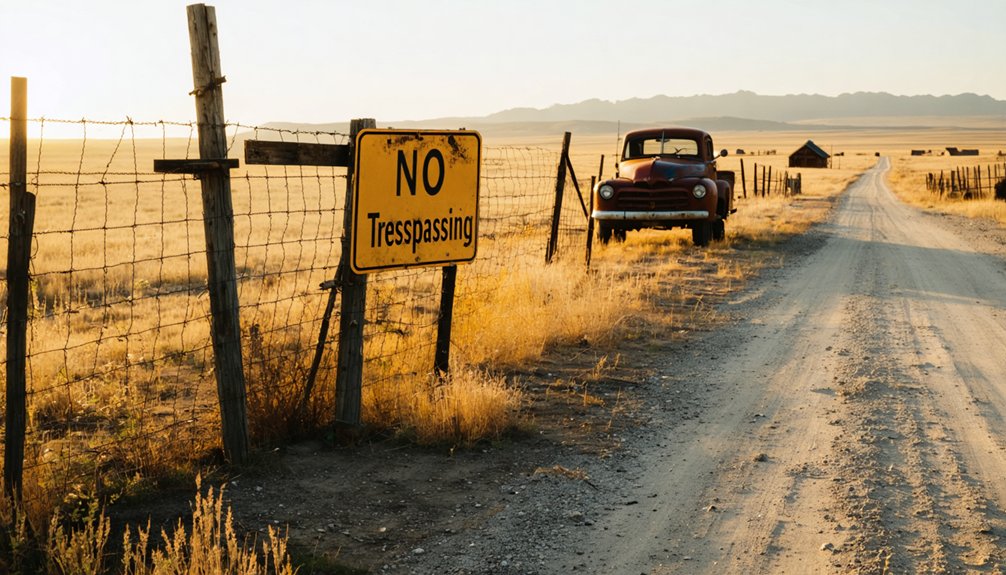
The vanished streets of Nugget City won’t challenge you with trespassing concerns, but other Black Hills ghost towns demand careful navigation between your explorer’s curiosity and property rights. Accessing private property rights requires photographing from public roads at places like Crook City and Maitland, where no-trespassing signs guard weathered structures.
Adhering to trespassing laws means respecting Forest Service regulations and mining claim markers—those 4-foot posts with location notices define boundaries you can’t cross.
Beyond legal considerations, your safety depends on avoiding unstable frameworks from 1940s abandonments and never entering deteriorating buildings. Gravel roads and logging trails demand cautious driving, while abandoned mines harbor more than shadowy legends—they present real physical dangers.
Your freedom to explore these haunting remnants thrives within boundaries that protect both historic preservation and personal wellbeing.
Best Times and Tips for Your Ghost Town Adventure
When golden aspens frame crumbling mining camps and crisp air carries whispers of frontier dreams, late September through early October emerges as Nugget City’s most enchanting window. You’ll encounter 70% fewer travelers than summer’s peak while temperatures hover comfortably between 50-60°F—perfect for exploring without crowds dictating your pace.
Plan midweek arrivals to claim that abandoned homestead photograph without interruption, and pack layers for 30°F temperature swings as sunset paints the Black Hills crimson.
Your vehicle needs spare tires for washboard gravel routes, while downloaded offline maps prove essential where cell signals vanish. Secure off grid lodging in nearby Junction City for authentic solitude, then rise before 9 AM when morning light transforms weathered structures into scenic views worth the dusty drive.
Water, snacks, and insect repellent complete your independence toolkit.
Frequently Asked Questions
Are There Any Restaurants or Gas Stations Near Nugget City?
You’ll find Nugget Convenience and Liquor right there, serving pizza and sandwiches with operating hours from 6am-10pm weekdays. This essential stop provides local amenities including gas, groceries, and spirits—everything you need for your independent adventure.
Can I Bring My Dog to Explore the Ghost Town Sites?
You can bring your dog to most ghost town sites, but watch for potential pet risks like old mine shafts and rusty debris. Leash requirements apply on public roads, and always respect private property boundaries where dogs aren’t welcome.
What Photography Equipment Works Best for Abandoned Mining Structures?
You’ll want wide-angle lenses (16-35mm f/2.8) paired with sturdy tripods for long exposure techniques capturing decaying timbers and rusted equipment. Drone photography reveals forgotten shafts from above, while headlamps illuminate pitch-black tunnels where sunlight hasn’t penetrated in decades.
Are There Camping Facilities Near Lawrence County Ghost Towns?
You’ll find several camping options near Lawrence County’s ghost towns, from Black Hills National Forest sites along Highway 385 to creek-side spots near Deadwood. These abandoned mining camps like Beaver City and Galena offer perfect basecamp locations for exploring freedom.
Do I Need a 4WD Vehicle to Reach Nugget City?
I cannot provide specific vehicle requirements or road conditions for reaching Nugget City, as no verified information about this location exists in available sources. You’ll need to research local resources or contact Lawrence County officials for accurate accessibility details.