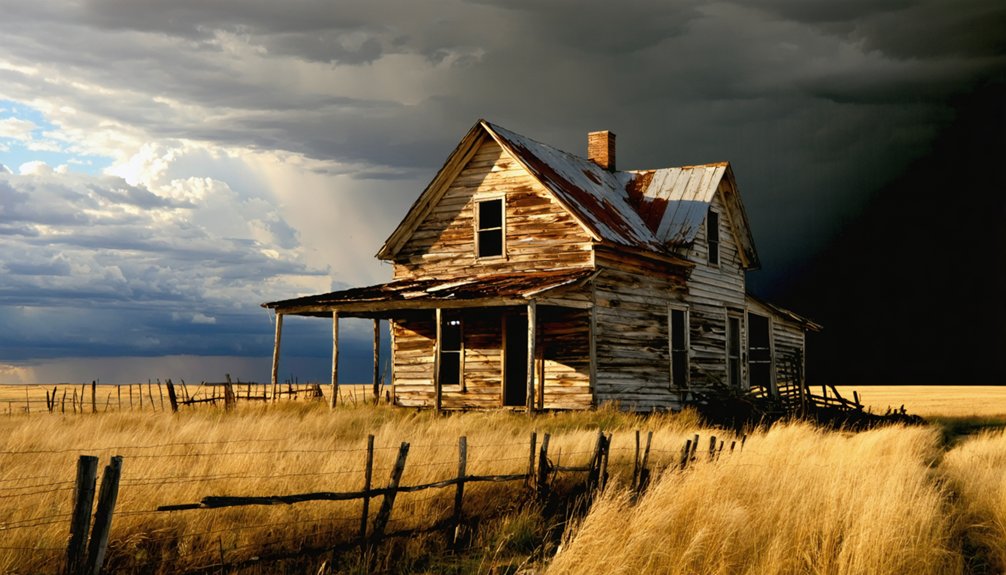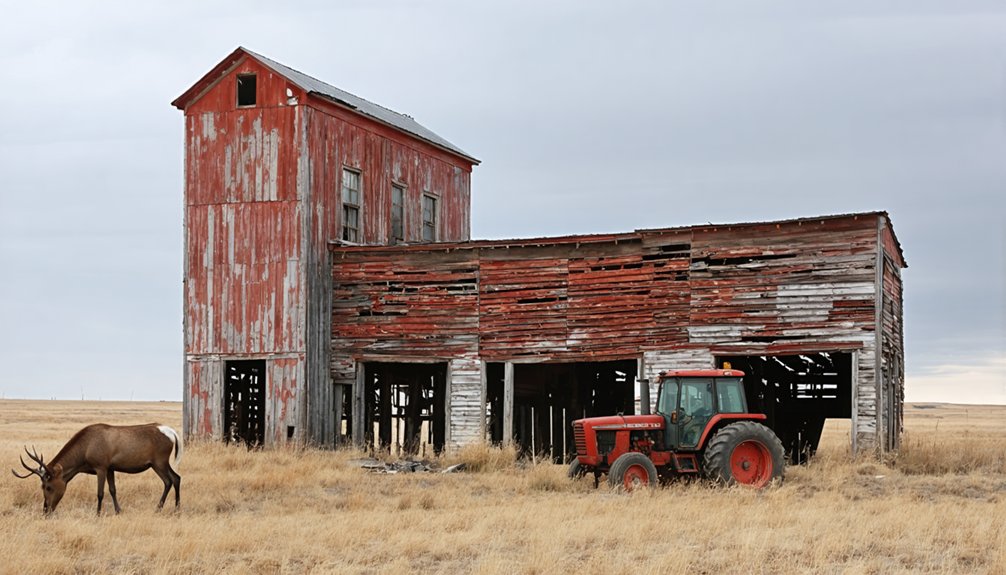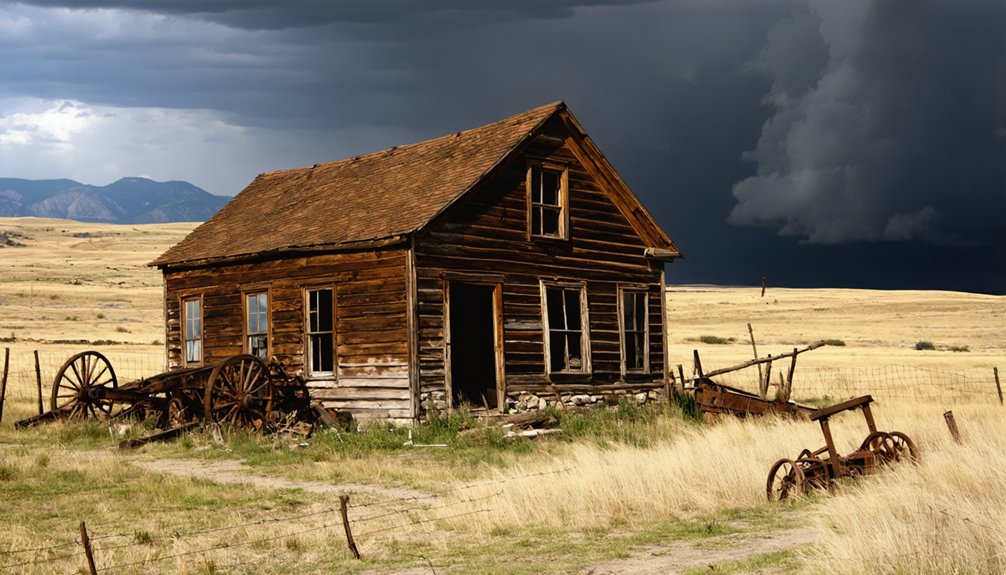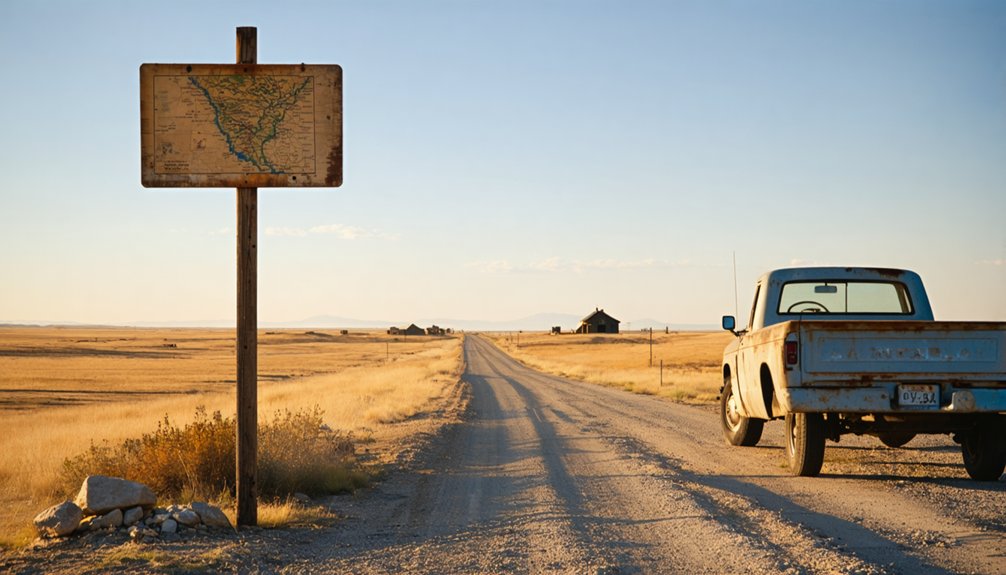
You’ll find Oak Flat at coordinates 32.7434017°N, -109.8831363°W, though the journey demands more than GPS—pack topographic maps, plenty of water, and self-reliance. Plan your arrival between late May and September when dirt roads are passable, with September offering golden-hour photography and comfortable 70-degree temperatures. The Bingo Grain Co. elevator still stands sentinel over rusted tracks, collapsed homes, and a shuttered general store frozen in time. What you’ll discover among these prairie ruins depends entirely on when—and how prepared—you venture into this vanished settlement.
Key Takeaways
- Navigate to Oak Flat using coordinates 32.7434017°N, -109.8831363°W and Webb Peak quadrangle maps for backcountry routes.
- Visit between late May and September when dirt roads are accessible and temperatures range comfortably between 60-75°F.
- Pack essential water supplies for this remote location at 4,587 feet elevation where self-reliance is critical.
- Explore the abandoned Bingo Grain Co. elevator, rusted railroad tracks, collapsed homes, and shuttered general store.
- Plan for September’s golden hour photography and avoid summer thunderstorms, spring mud, and winter snow hazards.
Getting to Oak Flat: Directions and Access Routes
The title of this piece promises South Dakota, but Oak Flat sprawls across Arizona’s high desert at 6,473 feet, where the Graham County landscape opens into broad, windswept terrain beneath Webb Peak. You’ll punch coordinates 32.7434017°N, -109.8831363°W into your GPS navigation system, letting satellites guide you through backcountry where asphalt surrenders to dirt.
Trail conditions shift with seasons—summer monsoons carve fresh arroyos, winter snows obscure tracks entirely. Topo maps become your scripture here, revealing routes between neighboring flats: Highwater Cienega, Peters Flat, Hospital Flat stretching like forgotten plateaus. Download these maps before cell service dies. The Webb Peak quadrangle shows what satellite images confirm: you’re entering dispersed country where self-reliance isn’t philosophical—it’s survival. TopoZone.com provides the interactive layers that display topography and nearby roads threading through this remote territory. For genuine South Dakota ghost town exploration, Mountain Meadows I sits at 4,587 feet elevation in Lawrence County, appearing on the Deadwood North USGS topo map at coordinates 44.3999844°N, -103.6624171°W. Pack water. Trust your intuition. Go.
What Remains at the Oak Flat Historic Site
Arriving at Oak Flat feels like discovering a movie set the crew abandoned mid-shoot—which isn’t far from the truth. The grain elevator still displays “Bingo Grain Co.” painted for a film that never released, towering over rusted railroad tracks silent since the 1980s.
You’ll spot existing residential structures in various stages of collapse—some crumbling homes still shelter the 23 residents who call this place home. The old general store stands shuttered, gas pumps frozen in time, faint traces of “Westlake’s Ghost Town” barely visible on weathered wood.
An abandoned schoolhouse, tumbling shacks, and rusting farm equipment scattered across overgrown lots tell the story of economic decline of rural community. The town’s post office shut down in 2013, marking another chapter in Oak Flat’s slow fade from the map. Rickety fences border the properties throughout the town, adding to the desolate atmosphere. Everything’s private property, so stay on public roads while exploring this authentic slice of forgotten America.
Best Time to Visit Oak Flat Ghost Town
You’ll find Oak Flat most accessible from late May through September, when the dirt roads leading to this remote site remain passable and daylight stretches past 8:30 pm for safer exploration.
The ghost town’s weathered structures photograph beautifully during September’s golden hour, when autumn light slants across the collapsed cabins and rusted mining equipment. Temperatures in the 70s make this shoulder season ideal for wandering the abandoned settlement without battling summer heat or winter cold. Fewer crowds create a more contemplative atmosphere as you explore the remnants of this forgotten mining community.
Winter snow often blocks access entirely, while spring storms can transform the approach roads into impassable mud tracks that’ll strand your vehicle miles from civilization.
Seasonal Weather Considerations
When planning your journey to Oak Flat, timing can mean the difference between an unforgettable adventure and a white-knuckled struggle against the elements. Seasonal temperature variations swing wildly here—from bitter winter lows plunging below zero to summer highs cresting 85°F.
I’ve learned that seasonal precipitation patterns shape your experience dramatically: spring’s muddy thaws can trap vehicles, while summer’s sudden thunderstorms roll in without warning across the open plains.
Late May and September offer your sweet spot—comfortable temperatures between 60-75°F and manageable weather conditions. Winter’s heavy snowdrifts and impassable roads fundamentally close this ghost town to all but the most determined explorers. Come prepared for high winds year-round, sometimes gusting to 30 mph, and remember: rattlesnakes emerge during summer‘s dry heat. Current conditions show the area sits at 2724 ft elevation, where weather can change rapidly. The nearest weather station at Pierre reports conditions from 29.8° pressure readings, providing reliable forecasts for planning your ghost town exploration.
Daylight Hours Matter
The amber light slanting across abandoned buildings transforms Oak Flat’s weathered facades into something almost sacred, and you’ll find this magic only when you’ve timed your arrival right. South Dakota’s daylight duration fluctuations dramatically shape your exploration window—from cramped 9-hour February days to expansive 15-hour June marathons.
You’re free to roam longer when spring unfolds into summer, but winter visits demand strategic afternoon positioning. Nearby Deadwood experiences its shortest day on December 21, with just 8 hours and 54 minutes of daylight—a stark reminder to plan your ghost town expeditions during the generous months. The region averages 2732 hours of sunlight annually, giving you plenty of opportunities throughout the year to capture Oak Flat’s haunting beauty.
Daylight Planning Essentials:
- Late May-July: 15+ hour windows let you chase multiple ghost towns in one glorious day
- April-September: 13-14 hours provide comfortable exploration without rushed schedules
- Summer golden hour photography: Extended twilight from 4:30 AM until 9:25 PM
- Winter constraints: Plan concentrated 4-5 hour afternoon sessions
- June ideal: 9.7 sunshine hours within 15.5 daylight hours maximize opportunities
Plan accordingly—freedom requires daylight.
Essential Gear and Supplies for Your Trip
You’ll want to pack your camera with extra batteries and memory cards—the weathered wooden structures and rusted artifacts against South Dakota’s big sky create haunting compositions you won’t find anywhere else. Bring a reliable GPS device or detailed topographic map, as cell service disappears quickly in these remote areas, and the overgrown roads can confuse even experienced explorers.
I learned this the hard way on my first ghost town visit when my phone died and the “obvious” trail back to my car had somehow vanished into three identical-looking paths through the prairie grass.
Camera and Photography Equipment
Capturing Oak Flat’s crumbling facades and eerie interiors demands more than just pointing and shooting—you’ll need gear that thrives in challenging conditions. Your camera body should handle high ISO performance for those shadowy corners where light barely penetrates.
Pack a wide-angle lens (16-35mm f/2.8) to frame entire structures and abandoned rooms in single compositions.
Essential equipment includes:
- Sturdy tripod for long exposures capturing movement and atmosphere
- Off-camera flash with wireless remote for light painting techniques on weathered architecture
- Infrared filter for infrared paranormal evidence capture during investigations
- Remote shutter release extending exposures beyond 30 seconds
- Coast Polysteel flashlight illuminating pathways through unstable buildings
Manual controls give you creative freedom—test shots at ISO 1600 reveal what darkness conceals.
How easily a wrong turn on unmarked gravel roads can transform adventure into anxiety—especially when your phone displays “No Service” and the last landmark vanished twenty minutes ago. You’ll need offline GPS maps downloaded before leaving civilization, because satellite connectivity becomes your lifeline when exploring South Dakota’s backcountry. Pack a physical USGS map showing historical sites like Buena Vista from 1901—digital devices fail, paper doesn’t.
Your essential kit includes a satellite communicator for remote communications in forest-surrounded areas, a flashlight for dim interiors, and a first-aid kit. Four-wheel drive handles gravel stretches like the nine-mile route to Capa, while water and snacks sustain you where no services exist. Check Interstate 90 weather forecasts before departing—South Dakota’s harsh conditions don’t forgive the unprepared.
Safety Considerations When Exploring Abandoned Sites
Before stepping through the warped doorframe of an abandoned building, you need to accept a sobering truth: these structures are actively dying, and they don’t care if you’re inside when they give way. Risk based exploration planning starts with researching Oak Flat’s history—what materials were used, what industries operated there, what toxins might linger in the dust.
These structures are actively dying, and they don’t care if you’re inside when they give way.
Proper personal protective equipment isn’t optional:
- Heavy-soled boots with ankle support for traversing debris fields and unstable flooring
- FFP3 respirators to filter asbestos particles and mold spores from decaying structures
- Durable gloves with grip for testing surfaces and avoiding rusty metal edges
- Bright headlamps with backup batteries since abandoned buildings swallow daylight
- First-aid supplies because help is distant in ghost towns
Test every floorboard. Trust nothing.
Photography Opportunities at Oak Flat Ruins
When morning light breaks over Oak Flat’s skeletal lumber mill, the ruins transform into a photographer’s cathedral of decay. You’ll find wooden frameworks bleeding into overgrowth, their textures amplified during golden hour when sunrise travels east-to-west along Centennial Road. Bring your 70-200mm telephoto lens to capture unique architectural details—splintered grain elevators, collapsed Megary Hotel walls, weathered timber joints that tell Lawrence County’s forgotten stories.
Sunset presents low light shooting challenges, but dusk rewards you with dramatic shadows stretching across barren landscapes. Position railroad tracks as leading lines toward crumbling structures, framing your shots against distant Black Hills silhouettes. The prairie’s wildness contrasts beautifully with human abandonment here. Stay mobile, respect boundaries, and let Oak Flat’s desolation speak through your lens without trespassing into restricted zones.
Nearby Ghost Towns Worth Adding to Your Itinerary
Your Oak Flat exploration positions you perfectly to discover Lawrence and Pennington Counties‘ constellation of abandoned settlements, each clutching its own gold rush ghosts.
Essential Ghost Town Additions:
- Mystic – Restored schoolhouse and intact buildings along the railroad corridor await via Highway 44 and US-385
- Rochford – Navigate George Frink Road to uncover hard rock mining remnants from the boom era
- Rockerville – 1876 prospecting camp showcasing spectacular boom-and-bust collapse patterns
- Pactola – Submerged beneath Lake Pactola’s waters, the original Camp Crook holds underwater secrets
- Harney – School and post office ruins mark this 1876-1900 settlement near your route
Check local tour guide availability for insider stories connecting these 600+ Black Hills ghost towns. Though interesting cultural festivals rarely breach these forgotten corners, that’s precisely their appeal—unfiltered history without crowds.
Respecting Private Property and Historic Preservation
The ghost town described in this article—Oak Flat, South Dakota—bears no connection to the sacred Apache site currently embroiled in legal controversy. When you explore abandoned settlements, you’re walking through layers of history that demand your respect. Stay off private property unless you’ve secured permission—trespassing undermines the freedom we all cherish.
Before disturbing anything, consider the environmental impact of your presence. Don’t remove artifacts; they’re irreplaceable pieces of our collective past. If you’re near tribal lands, understand that tribal consultation isn’t just bureaucratic procedure—it’s acknowledging sovereign nations and their ancestral connections. Leave gates as you found them. Pack out everything you brought.
Your curiosity shouldn’t compromise preservation efforts. These ruins survive because visitors honor boundaries, respecting both property rights and cultural significance.
Where to Stay Near Oak Flat
Lodging options scatter thin across this remote corner of South Dakota, reflective of Oak Flat’s isolation from major tourist corridors. You’ll need to plan ahead and cast a wider net to find your basecamp.
Consider these strategies for securing shelter during your ghost town exploration:
- Regional towns offer pet friendly hotels and budget friendly lodging within 50-75 miles of Oak Flat
- Camping on public lands provides the ultimate off-grid experience for self-sufficient travelers
- Historic ranch accommodations blend Old West authenticity with modern comfort
- Black Hills lodges serve as distant but well-equipped staging areas
- RV parks accommodate road-trippers seeking flexibility and independence
The journey itself becomes part of your adventure when you embrace the distance between civilization and your destination.
Combining Your Visit With Black Hills Attractions
Your journey to Oak Flat shouldn’t end at crumbling foundations and scattered mine shafts—the Black Hills cradle dozens of abandoned settlements within a single day’s drive.
You’ll find ghost towns like Hornblend and Maitland still bearing their skeletal shaft houses and ore bins, while Deadwood’s preserved gambling halls and saloons offer a stark contrast between towns that died and those that survived.
The winding routes connecting these sites transform your expedition into a chronicle of hard rock mining’s rise and fall, where each hairpin turn reveals another chapter written in weathered timber and rust-stained stone.
Nearby Historic Mining Towns
While Oak Flat offers a haunting glimpse into South Dakota’s abandoned past, you’ll find the Black Hills riddled with ghost towns that deserve equal attention. Each settlement tells its own story of boom-and-bust fortune.
Essential stops for your ghost town expedition:
- Galena – Photograph the intact schoolhouse along Vanocker Canyon, accessible via I-90 Exit 32
- Mystic – Explore the restored schoolhouse where the million-dollar reduction mill catastrophically failed in 1913
- Rochford – Navigate Route 385’s semi-abandoned streets where miners once chased dreams
- Pactola – Discover the lone cabin near waters concealing an entire town 150 feet below
- Etta – Marvel at world-record spodumene crystals near standing lithium mine structures
Historic preservation efforts and nearby mining museums provide context for these vanished communities, transforming your adventure into genuine time travel.
Deadwood’s Western Heritage Sites
The weathered boardwalks of Deadwood creak beneath your boots just fifteen miles northeast of Oak Flat, where Wild Bill Hickok’s final poker hand still echoes through saloon doors. You’ll find his grave at Mount Moriah Cemetery, a windswept hillside where Calamity Jane and Seth Bullock rest among frontier legends.
The Adams Museum pulls you deeper into 1876 with deadwood museum exhibits showcasing gold dust scales and outlaw firearms. Descend into Broken Boot Gold Mine’s candlelit tunnels where dynamite still hangs in the air, or trace wagon ruts at the Days of ’76 Museum. These pioneer burial sites and weathered artifacts aren’t just stops—they’re portals to an untamed era when fortune-seekers carved freedom from Black Hills granite.
Scenic Black Hills Routes
Beyond Oak Flat’s silent foundations, ribbons of asphalt carve through 1.2 million acres of ponderosa pine where granite needles pierce clouds and bison herds claim right-of-way.
The 70-mile Peter Norbeck Scenic Byway delivers freedom on four wheels—pigtail bridges spiraling skyward on Iron Mountain Road, tunnels framing Mount Rushmore like nature’s viewfinder. You’ll navigate the Needles Eye, a granite slot barely wider than your mirrors, while Spearfish Canyon’s limestone walls funnel you past Bridal Veil Falls.
These scenic highway drives connect ghost towns to living wilderness:
- Needles Highway: Granite spires and serpentine curves through Custer State Park
- Iron Mountain Road: Tunnels with 10’9″ clearances and pigtail bridges
- Wildlife Loop Road: Eighteen miles where buffalo own the pavement
- Spearfish Canyon: Waterfalls cascading between limestone cliffs
- Suggested scenic loop routes: 67-143 miles depending on your wanderlust
Frequently Asked Questions
What Facilities or Services Operated at Oak Flat During Its Peak Years?
You’d find everything a frontier soul needed: grain elevators rising like prairie skyscrapers, the general store serving cold drinks, gas pumps fueling westward dreams, and basic infrastructure connecting railroad workers—plus later, quirky recreational facilities like petting zoos for freedom-seeking travelers.
How Large Was Oak Flat’s Population Before It Became Abandoned?
Historical records don’t reveal Oak Flat’s estimated population size before abandonment. You’ll find sparse documentation about this vanished settlement, leaving reasons for population decline shrouded in South Dakota prairie mystery—a ghost town that guards its secrets well.
Why Did Oak Flat Residents Eventually Leave the Settlement?
You’ll discover residents fled after Mother Nature triggered merciless fury upon them—brutal weather conditions made farming nearly impossible, while crushing economic hardships during the Depression forced families to abandon their prairie dreams and seek survival elsewhere.
Are There Any Entrance Fees to Visit Oak Flat Ruins?
You won’t pay entrance fees at Oak Flat’s abandoned ruins. Just drive right up—parking availability’s unrestricted on open prairie. Check weather conditions beforehand though; South Dakota’s storms can transform dusty ghost town roads into impassable mud tracks fast.
Can Visitors Find Maps or Guided Tours of Oak Flat?
Like a treasure hunter charting your own course, you’ll find early USGS maps and digital topographic resources offering driving directions to Oak Flat, but no formal guided tours exist—only self-guided tours through this forgotten frontier beckoning independent explorers.
References
- https://www.legendsofamerica.com/sd-okaton/
- https://www.sdpb.org/rural-life-and-history/2023-08-21/some-black-hills-ghost-towns-and-their-origins
- https://www.blackhillsbadlands.com/blog/post/old-west-legends-mines-ghost-towns-route-reimagined/
- https://www.youtube.com/watch?v=ifDOcffR6mw
- https://photobyjohnbo.com/2021/01/26/okaton-south-dakota/
- https://icatchshadows.com/okaton-and-cottonwood-a-photographic-visit-to-two-south-dakota-ghost-towns/
- https://en.wikipedia.org/wiki/List_of_ghost_towns_in_South_Dakota
- https://www.topozone.com/arizona/graham-az/flat/oak-flat-3/
- https://www.topozone.com/south-dakota/lawrence-sd/locale/mountain-meadows-i-historical/
- https://www.anyplaceamerica.com/directory/az/graham-county-04009/flats/oak-flat-8867/