You’ll find Okaton’s weathered grain elevators and collapsing homesteads rising from the South Dakota prairie about 50 miles west of Mitchell—just take Exit 170 off Interstate 90. Park along the public roads and capture the rusted farm equipment, faded “Westlake’s Ghost Town” sign, and towering Bingo Grain Co. elevator through your camera lens. Remember that these crumbling structures sit on private property, so you’ll need to photograph from the roadside while respecting the boundaries. Below, you’ll discover the fascinating stories behind each abandoned building and exactly what awaits.
Key Takeaways
- Okaton is located along Interstate 90 in South Dakota, once a railroad town that declined after track abandonment in the mid-1980s.
- The Bingo Grain Co. elevator from 1906 is the main attraction, standing as a weathered wooden sentinel near remaining railroad tracks.
- View collapsed houses, rusting farm equipment, an old schoolhouse, and a jail building with striking marshal mural from public roads.
- The faded “Westlake’s Ghost Town” storefront marks the 1980s roadside attraction that featured façade buildings, rock shop, and petting zoo.
- Buildings are unsafe to enter; photograph the abandoned structures from public roads to safely capture Okaton’s haunting prairie landscape.
The Rise and Fall of a Railroad Town
When the Chicago, Milwaukee & St. Paul Railroad pushed westward in 1906, Okaton sprang to life as a gritty outpost for track-laying crews. You’d have witnessed an intriguing community spirit among railroad workers and homesteaders who carved out existence on these windswept plains.
The impact of rail network transformed empty grassland into a bustling hub where grain elevators rose skyward and telegraph wires connected settlers to civilization. Farming community members worked the surrounding land, shipping their harvests via the railroad that gave the town its purpose.
But Okaton’s glory proved fleeting. Construction crews moved on, leaving behind those brave enough to face South Dakota’s brutal winters. The Great Depression delivered devastating blows, forcing families cityward for survival.
When the Milwaukee Road finally abandoned these tracks in the mid-1980s, Okaton’s fate was sealed—a once-vibrant community reduced to weathered buildings and fading memories. The construction of Interstate 90 through the area brought a cruel irony, as the new highway bypassed the town entirely, cutting off what little traffic remained.
What Remains: Exploring the Abandoned Structures
As you step onto Okaton’s dusty streets, the towering Bingo Grain Co. elevator commands your attention—its misleading movie-prop name still emblazoned across weathered wood that creaks in the prairie wind.
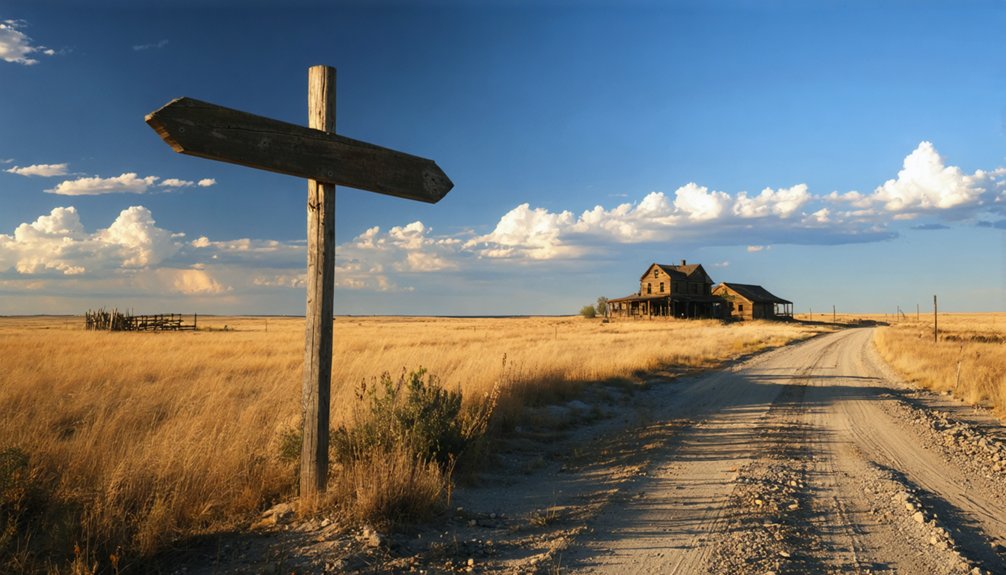
Across the way, the faded “Westlake’s Ghost Town” sign clings to a shuttered storefront where tourists once stopped for sandwiches and souvenirs, now silent behind keep-out warnings. The family also stocked a petting zoo and rock shop during their brief attempt to transform the abandoned railroad town into a roadside attraction.
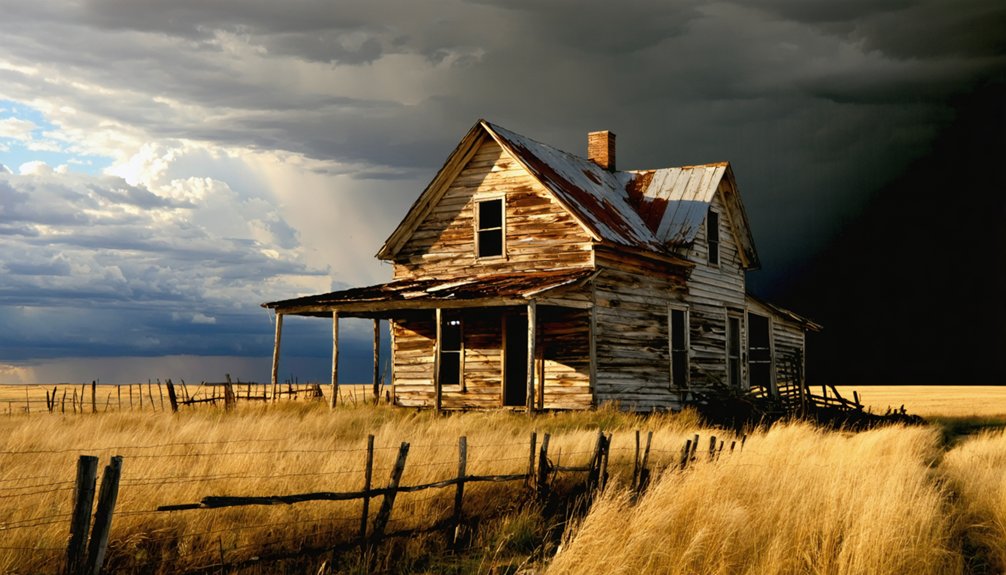
Rusted farm equipment lies scattered among collapsing houses like bones picked clean by time, each corroded wheel and splintered beam whispering stories of the families who once called this desolate place home. Railroad tracks still run in front of the grain elevator, a ghostly reminder of the workers who built this town in 1906.
Westlake’s Ghost Town Remnants
A weathered general store stands sentinel across the gravel road, its faded walls bearing ghost-white fragments of hand-painted letters that once proclaimed “Westlake’s Ghost Town” to passing motorists. You’ll spot the remnants of what was once a thriving tourist operation—gas pumps frozen in time, a shuttered rock shop, and the skeletal framework of attractions that drew families off Interstate 90 during the 1980s.
The Westlakes’ marketing strategies were brilliantly simple: highway billboards directing travelers to exit 183, cold drinks, sandwiches, and a petting zoo that transformed abandonment into adventure. Their commercial vision temporarily breathed life into dying structures. Since multiple real estate transactions followed their deaths, these buildings now stand empty, accessible only through your camera lens from public roads—freedom preserved in decay.
Bingo Grain Co. Elevator
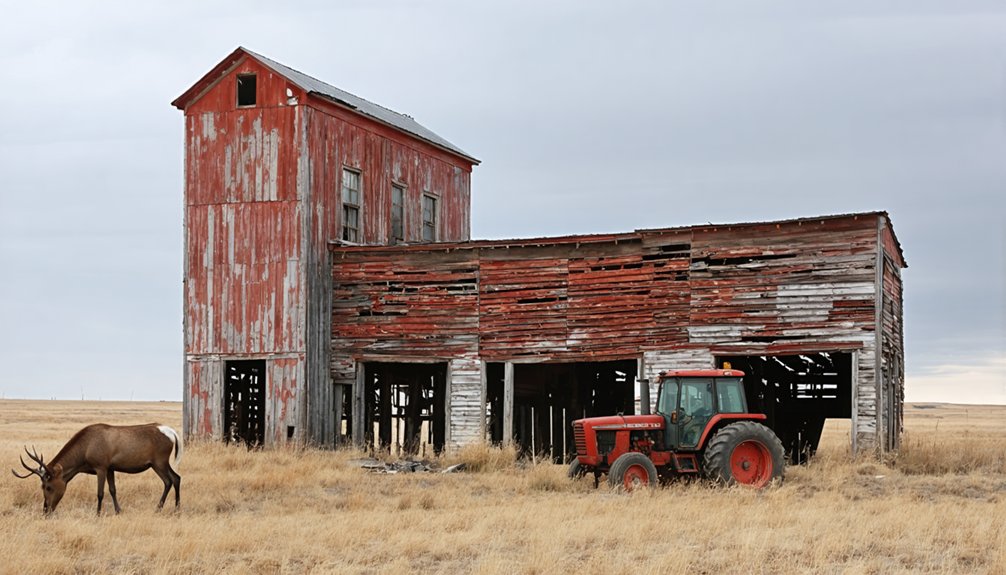
Rising from the prairie like a weathered monument to agricultural ambition, the Bingo Grain Co. elevator commands your attention the moment you roll into Okaton’s skeletal street grid. This wooden sentinel, founded in 1906 as “Okaton Grain Co.,” bears its current name from an unreleased 1980s film that repainted it for scenes never seen. The grain elevator significance extends beyond simple storage—it represents the railroad-farming symbiosis that birthed these plains communities.
Today, you’ll find its top section missing, claimed by relentless Dakota winds, while overgrown tracks snake past its weathered base. Despite severe deterioration eliminating any historical restoration potential, it remains standing when neighboring structures collapsed. That stubborn vertical profile, rust-streaked and decaying, creates an eerie daytime atmosphere that’ll grab your camera. Respect the private property boundaries while you shoot.
Rusting Equipment and Structures
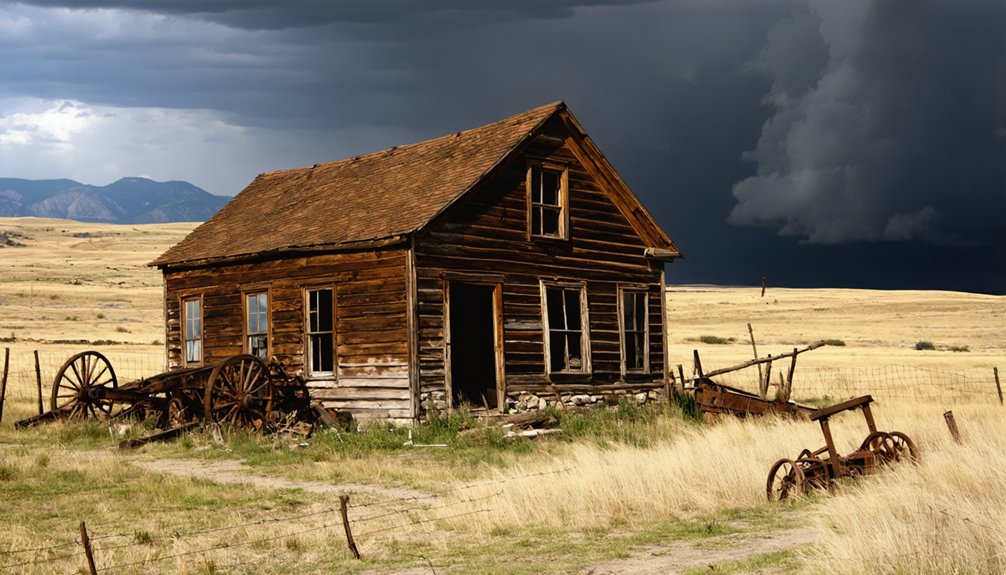
Scattered across Okaton’s five crumbling streets, rusting farm equipment bleeds orange into the prairie grass like frozen monuments to failed harvests. You’ll find tractors and plows from pre-1980s operations abandoned where they died, South Dakota’s harsh winters accelerating their transformation into photogenic decay.
Collapsed houses lean at impossible angles, their weathered boards exposing dark interiors to curious lenses. The old schoolhouse stands sentinel among tumbling shacks, evoking nostalgia for a bygone era when children’s voices echoed through these plains. The town jail building features a striking mural of a marshal and a prisoner’s shadow on its weathered facade.
Rickety fences barely contain the chaos—overgrown railroad tracks snake past the dilapidated general store, its faded “Westlake’s Ghost Town” sign a ghost itself. Everything’s privately owned, so respect the “Keep Out” warnings. But from the road, you’ll capture decay that speaks louder than preservation ever could.
The Westlake Legacy: From Tourist Stop to Forgotten Attraction
In the 1980s, Robert and Evelyn Westlake arrived from Illinois with an audacious vision—they’d breathe life into Okaton’s crumbling bones by creating “Westlake’s Ghost Town,” complete with façade storefronts, a rock shop, gas pumps, and a petting zoo that lured I-90 travelers off exit 183.
For a brief moment, their hand-painted highway signs worked magic, turning curious motorists into paying customers who’d stop for sandwiches, minerals, and snapshots beside weathered wood.
When the Westlakes passed away, their roadside empire died with them—the signs came down, the doors locked forever, and their painted legacy now fades on a shuttered storefront that nobody visits.
Building the Roadside Attraction
The abandoned storefronts and collapsing houses of Okaton caught Robert and Evelyn Westlake’s attention during the 1980s, when most would’ve seen only decay and failure. These Illinois transplants recognized opportunity where others saw desolation, launching aggressive property acquisition across the near-empty townsite. Their vision transformed authentic prairie ruins into “Westlake’s Ghost Town,” complete with calculated marketing strategies that lured Interstate 90 travelers off exit 183.
You’d have discovered their roadside empire featured:
- A rock shop stocked with souvenirs and Southwest geological specimens
- Functional gas pumps serving highway wanderers
- A family-friendly petting zoo alongside sandwich-serving general store
They even repainted the grain elevator as “Bingo Grain Co.” for film productions, blending commercial savvy with Okaton’s genuine dereliction into profitable roadside Americana.
Decline After Their Deaths
When Robert and Evelyn Westlake passed away, their carefully constructed roadside empire died with them. No successor emerged to maintain the attraction through the economic challenges of the 1980s-90s.
Highway signs vanished, gas pumps went silent, and the general store’s painted facade faded into memory. The petting zoo disappeared, rock shop closed, and fragmented property sales scattered what they’d built.
You’ll find census records tracking the community decline—36 souls in 2010, just 23 by 2023. Without roadside advertisements, travelers on I-90 lost their reason to exit. The post office shuttered in 2013, ending all public services.
Okaton completed its ironic transformation: the commercialized “ghost town” attraction became an authentic abandoned settlement once more.
Getting There: Directions and Access Information
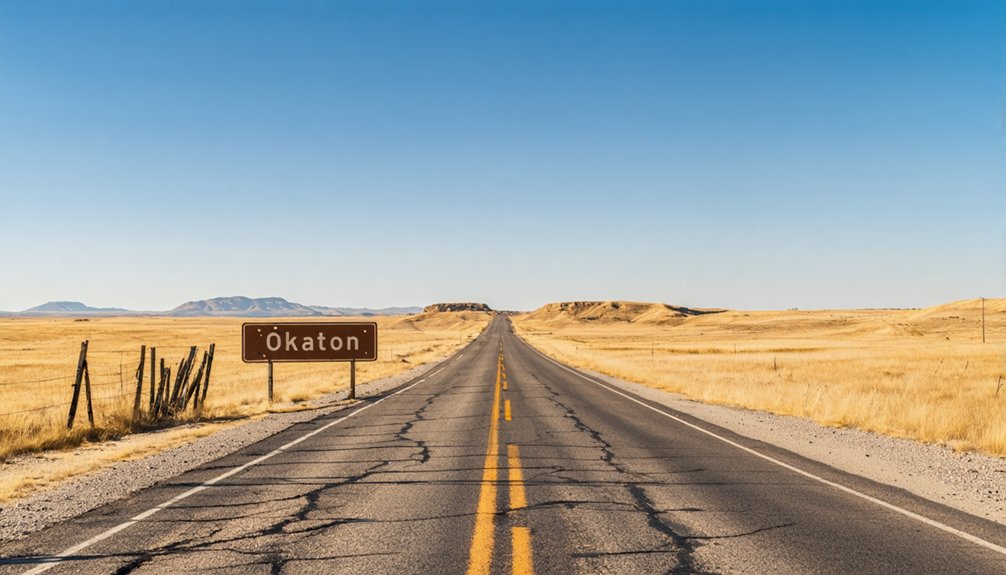
Finding your way to Okaton feels deceptively simple—after all, Exit 183 off Interstate 90 sits right there on every traveler’s GPS, a digital breadcrumb in the vast South Dakota prairie. You’ll spot it west of Murdo, where the rolling plains stretch endlessly toward the Black Hills.
Before you venture off the interstate, consider these realities:
- No services exist—fuel up in Murdo before your detour
- Seasonal weather impacts can transform these unmarked road conditions into treacherous passages during South Dakota’s brutal winters
- Private property dominates—those weathered buildings you’re photographing? Twenty-three residents still call this place home
Park along public roadways only, snap your photos from respectful distances, and remember: that “Keep Out” sign isn’t decoration. You’re exploring someone’s deliberately chosen solitude.
Photography Tips and What to Expect
How do you capture desolation without trespassing on it? You’ll shoot everything from public roads, staying in your vehicle while framing collapsed houses, rusting farm equipment, and that remarkable wooden grain elevator against endless prairie sky. Your smartphone’s 12000×9000 pixel capacity handles the vast landscape beautifully—moody lighting conditions during golden hour transform ordinary decay into haunting compositions.
The decorated jail building with its marshal mural becomes your anchor subject. Try minimalist framing techniques: place solitary structures against sprawling horizons to emphasize isolation. Modern fences will photobomb some shots—embrace them as temporal markers. From I-90 exit 183 viewpoints, you’ll find Westlake’s failed tourist attraction façade offering painterly backdrops.
Bring Adobe Lightroom or Luminar for post-processing. Even midday shoots work here—the creepy atmosphere persists regardless of sunshine. For inspiration on capturing abandoned buildings and ghost towns, consider Keith Dotson’s South Dakota Portfolio, a 24-page photography book resulting from his 2024 road trip through the state.
Visitor Guidelines: Respecting Private Property and the Community
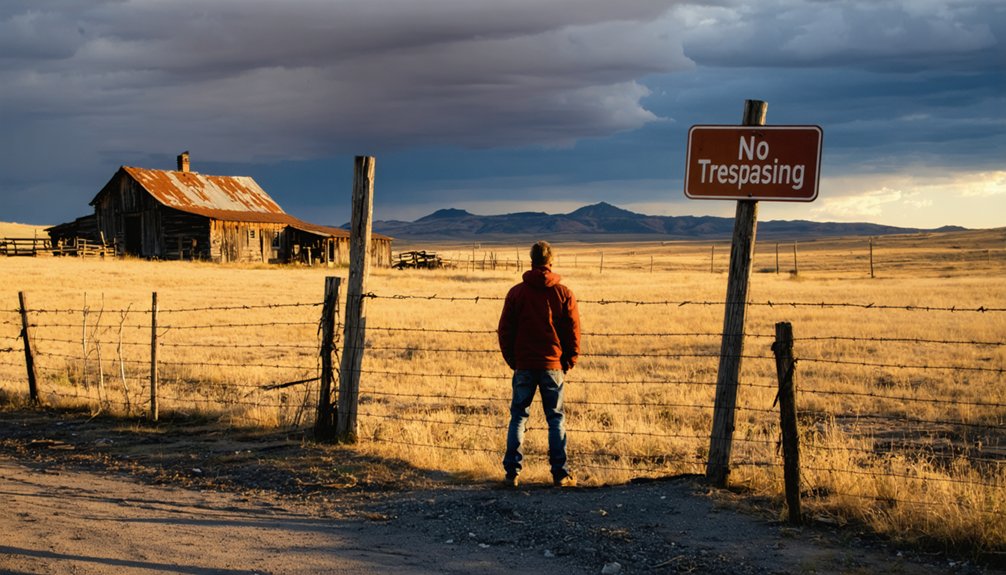
Every weathered building you’ll photograph from the roadside belongs to someone—a pivotal reality that distinguishes Okaton from true abandoned ghost towns. The 23-31 residents who call this place home navigate current residents’ daily life amid crumbling structures you’re enthusiastic to capture.
Okaton’s weathered structures aren’t abandoned—they’re owned property where 23-31 residents still live among the photogenic decay.
Tourism’s local impact ended when “Posted – Keep Out” signs replaced welcome billboards after the Westlakes departed.
Your roadside exploration demands three non-negotiable boundaries:
- Stay on public roads exclusively—no detours onto private property for better angles
- Keep distance from all structures, however photogenic their decay appears
- Respect working farms surrounding town perimeter where residents actively operate
Exit 183 off I-90 grants sufficient viewing access without trespassing. The dilapidated grain elevator and rusting equipment aren’t props—they’re part of someone’s property requiring your restraint. Okaton’s origins trace back to 1889 when it served as a former railroad town, before economic decline transformed it into the roadside attraction you see today.
Frequently Asked Questions
Are There Any Nearby Towns With Gas Stations or Restaurants?
Like an oasis in the prairie, Murdo beckons nine miles east with gas stations and restaurants. You’ll find accommodation options and reliable services year-round, though you should check seasonal road conditions before venturing to remote Okaton’s haunting ruins.
What Is the Best Time of Year to Visit Okaton?
Visit Okaton during late May through early June or September after Labor Day. You’ll enjoy comfortable temperatures perfect for exploring historic landmarks and capturing scenic vistas without crowds, while nearby towns’ services remain open for your adventure.
Can I Camp Overnight Near the Ghost Town?
You can’t camp at Okaton itself—camping regulations and local landowner policies prohibit it on private property. However, you’ll find freedom at nearby Badlands backcountry sites or Black Hills campgrounds, just miles from this haunting ghost town.
Are There Guided Tours Available for the Abandoned Structures?
No guided tours exist for Okaton’s abandoned structures. You’ll explore independently, capturing the architectural features of crumbling buildings from public roads while respecting private property. The historical significance reveals itself through weathered facades and your own discovery.
Is Cell Phone Service Available in the Area?
You’ll find cell phone signal strength surprisingly solid here! Verizon dominates with 96.6% network coverage options, while T-Mobile and AT&T trail behind. Don’t let Okaton’s ghost town status fool you—you’re connected enough to share your adventure.
References
- https://www.legendsofamerica.com/sd-okaton/
- https://www.atlasobscura.com/places/okaton-ghost-town
- https://www.abandonedspaces.com/towns/okaton-south-dakota.html
- https://www.youtube.com/watch?v=ifDOcffR6mw
- https://icatchshadows.com/okaton-and-cottonwood-a-photographic-visit-to-two-south-dakota-ghost-towns/
- https://photobyjohnbo.com/2021/01/26/okaton-south-dakota/
- https://www.youtube.com/watch?v=jmSADvq4Lek
- https://history.sd.gov/preservation/docs/SDRailroad.pdf
- https://www.powderhouselodge.com/black-hills-attractions/fun-attractions/ghost-towns-of-western-south-dakota/
- https://www.blackhillshikingbikingandmore.com/okaton