You’ll find Oketeyeconne’s submerged ruins beneath Walter F. George Lake along the Chattahoochee River, where this defiant Hitchiti-speaking settlement once thrived as the southernmost major Creek town. Access the site near Liberty County via Jerico Drive off I-95, about 30 miles south of Savannah. Visit during May or October for ideal weather conditions, and bring depth finders to trace the drowned village’s contours 90 feet below. The surrounding shoreline reveals archaeological clues to this vanished community’s agricultural prowess and unique cultural heritage.
Key Takeaways
- Oketeyeconne’s historic site lies near Midway in Liberty County, accessible via Jerico Drive off I-95, approximately 30 miles south of Savannah.
- The settlement now rests beneath Walter F. George Lake, where depth finders can reveal archaeological features 90 feet underwater.
- Visit during May, September, or October for optimal weather conditions and arrive at dawn or dusk for best photography opportunities.
- Explore nearby Fort Gaines Mound and historical markers to understand the broader Native American and frontier history of the region.
- The surrounding wetlands include Trophy Lake, Elbow Swamp, and Poplar Swamp, offering additional natural exploration opportunities near the ghost town.
Discovering the Hidden History of an 18th Century Creek Settlement
When Itsate refugees established Oketeyeconne in the mid-1700s along the Chattahoochee River’s eastern bank, they created more than just another settlement—they founded an independent enclave that would defy treaties and resist assimilation for over two centuries.
You’ll find this Hitchiti-speaking town stood apart from the Creek Confederacy, boldly rejecting the 1827 and 1832 treaties that bound others. The community thrived through unique agricultural practices, cultivating abundant corn and rice on fertile bottomlands while maintaining livestock herds. Benjamin Hawkins documented their prosperity in 1799, noting settlements stretching to the river forks. The region’s sandy loam soils proved particularly attractive to these Native American farmers, contributing to their agricultural success.
Today, preservation challenges obscure this defiant community’s legacy. As the southernmost major Chattahoochee town, Oketeyeconne bridged Muskogee-speaking Creeks northward and Hitchiti peoples southward, serving diverse Creek branches until 1960—a record of autonomous survival. Historical verification of the site’s exact boundaries and structures continues as researchers work to piece together this remarkable story.
Getting There: Directions to the Lake George Area
The journey to explore Oketeyeconne’s remnants begins in Liberty County, Georgia, where Upper Lake George now covers portions of the historic settlement site. You’ll find this 34-acre freshwater lake near Midway, accessible via Jerico Drive in the 31320 ZIP code. From Savannah, it’s a straightforward 30-mile drive south on I-95, while Brunswick sits 45 miles to your south.
Upper Lake George’s 34 acres near Midway conceal Oketeyeconne’s submerged past, just 30 miles south of Savannah off I-95.
Your route options include:
- Taking I-95 to Liberty County exits, then following local roads through Midway’s residential areas
- Connecting via US Highway 84 for scenic regional access through coastal Georgia plains
- Approaching from Hinesville, just 20 miles east of the lake
Natural preservation efforts maintain the lake water quality, protecting both the ecosystem and the submerged history beneath these serene waters. The surrounding region features numerous wetlands, including Trophy Lake, Elbow Swamp, and Poplar Swamp, creating a network of various swamps and lakes that characterize this coastal Georgia landscape.
For those exploring other Georgia waterways, consider visiting Walter F. George Lake, which offers 640 miles of shoreline along the Chattahoochee River at the Alabama-Georgia border.
What Remains: Exploring the Submerged Town Site
While you won’t find any buildings or streets rising from Walter F. George Lake‘s depths, Oketeyeconne’s legacy persists in the archaeological record beneath 90 feet of water. Your depth finder will reveal the contours of this drowned Creek settlement, where centuries of indigenous occupation left layers of pottery, mounds, and cultural artifacts now entombed in sediment.
The surrounding shoreline offers access to related historical sites that escaped flooding, providing tangible connections to the submerged town’s vanished world. Like the Coosawattee Valley now beneath Carters Lake, this site once served as an important center for indigenous communities before the waters rose. Archaeological investigations at comparable riverside sites have uncovered palisaded villages with domestic structures and defensive ditches that reveal how these communities organized their settlements.
Lake George’s Hidden History
Beneath Lake Lanier’s shimmering surface lies a landscape that tells two overlapping stories of loss. The 1950s flooding erased physical structures, but the racial oppression aftermath of 1912 had already destroyed Oscarville’s thriving community forty years earlier. You’re not just exploring a drowned town—you’re uncovering Oscarville’s heritage, a place where over 1,000 Black residents built successful farms before violent expulsion.
When you visit today, you’ll find traces of what’s hidden below:
- Submerged roadways including the abandoned stretch of Georgia Highway 53
- Cemetery relocations where 20 burial grounds were moved, though questions remain about completeness
- Looper Speedway remnants from Gainesville’s racing past
The water conceals more than buildings. It covers the forced erasure of an entire community’s achievements and their right to exist. Before the lake filled the valley, the area consisted of forest and farmland, with remnants like treetops and stumps that remained even as the water rose. The displacement began when three Black men were arrested for the alleged assault of Mae Crow, triggering a wave of racial terror that would empty the county of its Black population.
Archaeological Evidence Below Water
Ninety feet of water now separates you from Oketeyeconne’s physical remains, creating an archaeological site that exists in permanent twilight. You can still detect the town’s footprint with depth finders, but accessing what lies beneath requires underwater archaeological techniques most researchers can’t afford. The lake’s murky depths preserve Creek town foundations, pottery shards, and structural remnants that would’ve deteriorated on land—yet these same conditions make documentation nearly impossible without specialized equipment.
Site preservation challenges multiply in this submerged environment. You’re looking at artifacts from multiple eras: Mandeville Mounds’ burial sites, Fort Gaines’ ceremonial platforms, and eighteenth-century Creek dwellings—all locked beneath sediment and pressure. The Corps of Engineers’ salvage archaeology ended in 1962, leaving countless relics undocumented in their watery grave. Modern visitors can launch boats from the marina and boat ramp at nearby George T. Bagby State Park to position themselves directly above the submerged town site.
Nearby Preserved Historical Sites
Though Oketeyeconne itself rests beneath Lake Walter F. George’s waters, you’ll discover remarkable preserved sites that illuminate the region’s deep indigenous heritage. Fort Gaines Mound, established by Swift Creek Culture around 200 AD, stands as tangible evidence of continuous Native American presence since 1000 BC.
You can explore these significant locations:
- Cemochechobee Mounds – Three truncated pyramidal structures in the Chattahoochee Red Hills, occupied 1200-1300 AD, showcasing advanced architectural techniques
- Fort Gaines Mound – Active burial site until 600 AD, now surrounded by the town’s 19th-century cemetery
- Historical marker on Eufaula Street – Details Oketeyeconne’s connections to nearby creek villages and southern Hitchiti communities
These sites preserve indigenous ceramic styles and artifacts, offering you glimpses into centuries of autonomous communities that thrived along the Chattahoochee River. The Hitchiti-speaking Lower Creek town flourished near the east bank of the Chattahoochee River south of Sandy Creek during the late frontier period, forming part of a network of settlements that stretched down to the river’s forks.
Cultural Heritage: Understanding Creek Traditions and Customs
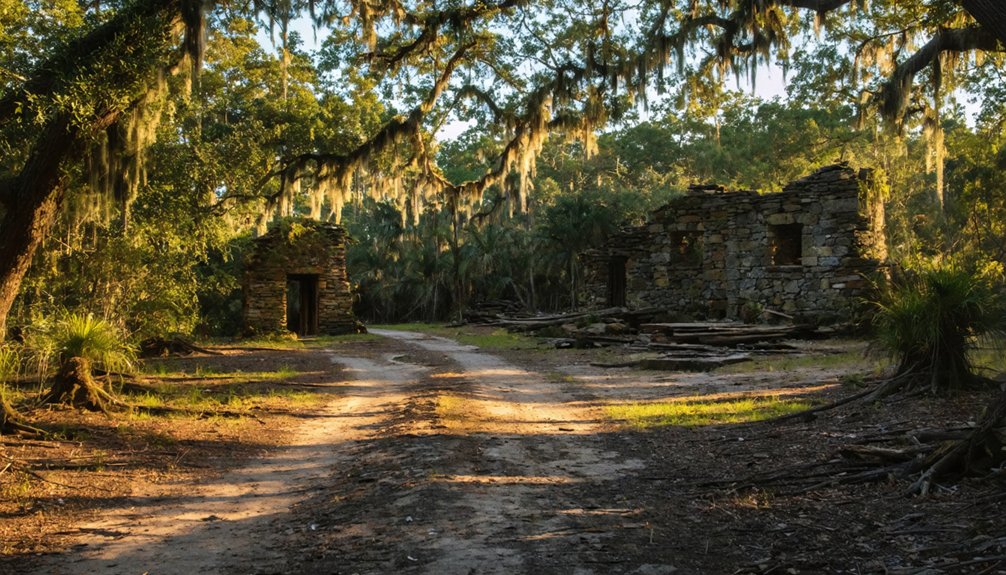
As you stand near Oketeyeconne’s submerged remains, you’re walking through lands where Creek micos once sent warriors carrying red war clubs and tobacco pipes between towns—a sophisticated communication system that transformed ceremonial grounds into networks of political alliance and conflict.
The waters below Lake Walter F. George now conceal not just buildings but also the resting places of Creek ancestors, whose burial traditions reflected their matrilineal clan system and spiritual beliefs about the journey beyond death.
Understanding these customs—from the deliberate messaging of war ceremonies to the careful rituals surrounding death—reveals how deeply the Creek wove social structure, spirituality, and kinship into every aspect of life in these now-vanished towns.
Ceremonial War Communication Systems
The Creek Nation’s communication systems blended practical military strategy with profound spiritual significance, creating networks that connected distant settlements through fire, smoke, and ceremonial protocol. You’ll discover how these tactical communication methods transformed Creek mounds into signal towers, where fires transmitted messages across Georgia’s landscape long before European contact.
The tastanegy (war chief) wielded authority through ceremonial protocols that mobilized confederated warriors:
- Smoke signals functioned simultaneously as battlefield coordination and spiritual practice
- Traditional war clubs symbolized the power to declare military action
- Confederate alliance networks required standardized communication spanning multiple settlements
This sophisticated system later proved invaluable during World War I, when Creek soldiers pioneered code talker programs. Their language contained concepts without English equivalents, creating unbreakable military transmissions that influenced twentieth-century warfare strategy.
Traditional Creek Burial Customs
Beyond their sophisticated networks of fire and smoke that unified the Creek Nation in times of war, another profound ritual bound communities together through generations: their reverence for the dead. Traditional burial rituals involved placing bodies in sitting postures within four-square-deep pits beneath cabin floors, legs bent and secured. Warriors received elaborate send-offs—graves lined with cypress bark, bodies painted, accompanied by weapons, pipes, and prized possessions. Families sacrificed horses, dogs, and livestock as tribute.
Mourning ceremonies shattered any stoic stereotypes you might’ve heard. Relations howled publicly for four days, their grief echoing through settlements. Prominent families abandoned burial sites entirely, believing ghosts and chimeras haunted these sacred grounds. They’d build anew rather than remain, while travelers avoided camping on roads’ left sides where spirits allegedly wandered.
Nearby Attractions: Fort Gaines Mound and Historical Markers
Layers of history converge at Fort Gaines, where a prehistoric Native American mound rises quietly within New Park Cemetery, bearing silent witness to millennia of human occupation. Dating to A.D. 200, this four-foot-high earthwork—one of Georgia’s ancient burial mounds—stands surrounded by scattered shells and stone chips from vanished villages.
You’ll discover historic military fortifications here, where General Edmund P. Gaines established his garrison in 1814. The strategic bluff above the Chattahoochee protected settlers during Creek conflicts and later served Confederate defenders.
Essential Sites:
- Original blockhouse foundations within the 100-foot stockade perimeter
- Historical markers erected by the Class of 1939
- Frontier Cemetery containing founders’ graves, including University of Georgia’s second president
These remnants speak to travelers seeking unfiltered connections with America’s complex past.
Best Times to Visit and Photography Tips
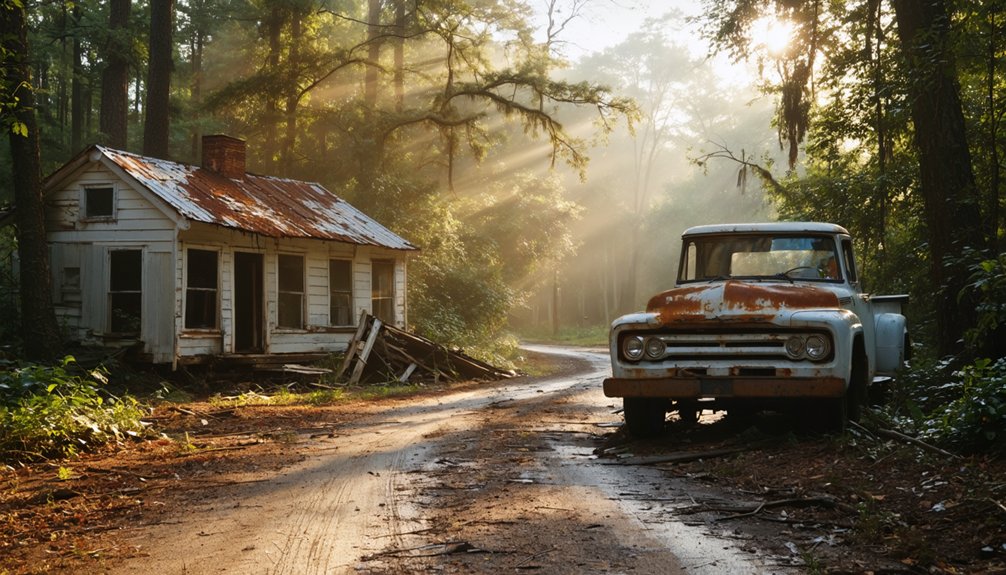
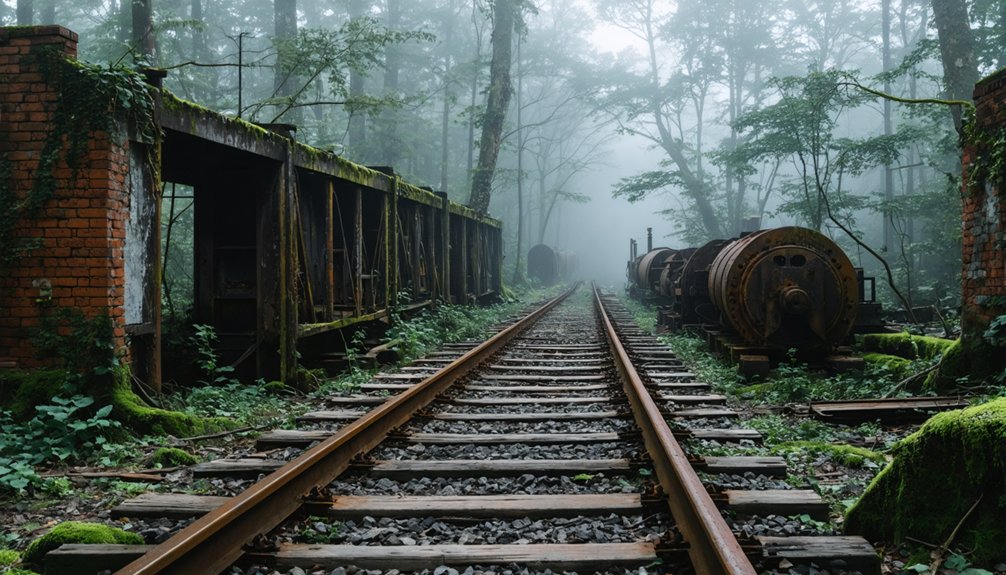
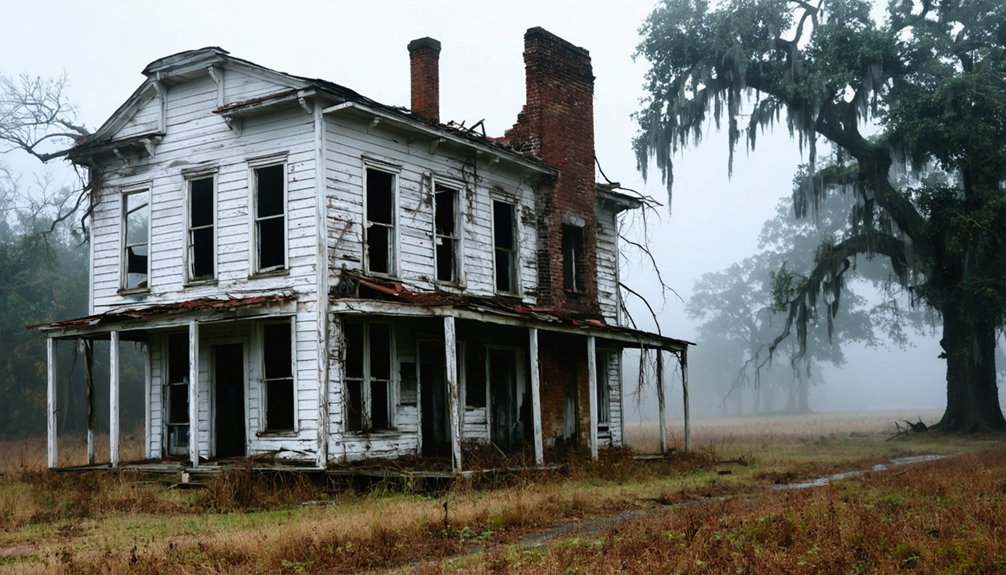
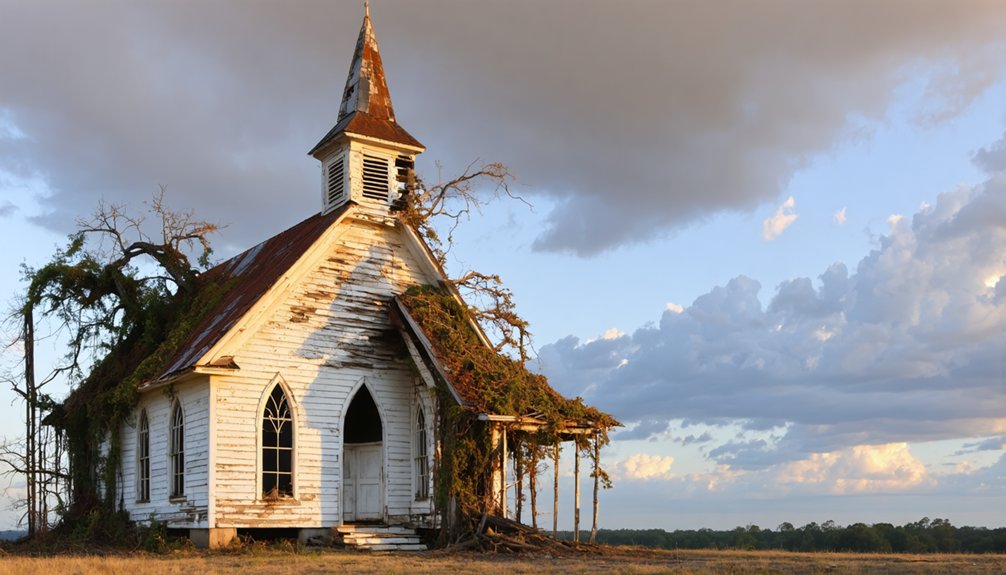
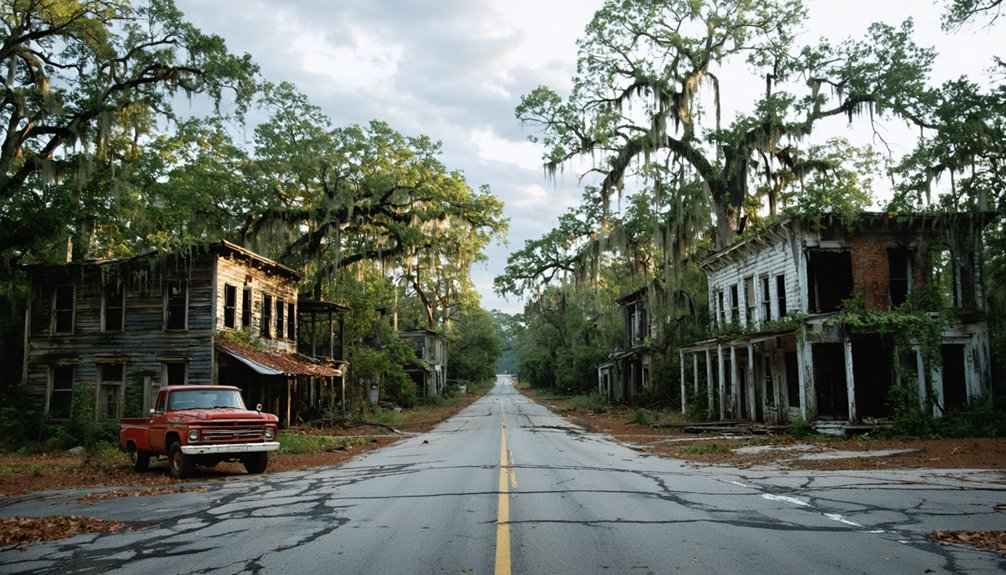
Two distinct windows frame your journey to Oketeyeconne’s abandoned structures: May’s moderate temperatures and September’s golden light transform crumbling foundations into photographer’s gold. You’ll dodge summer’s oppressive heat and mosquito swarms while capturing crisp reflections in swamp waters during these shoulder months.
Visitor trends thin dramatically between April and May, granting you solitary exploration through ghost town remnants. September delivers even greater advantages—minimal crowds, subdued insect activity, and early autumn hues bleeding into your frames.
For outdoor photography, arrive at dawn or dusk when angled sunlight carves dramatic shadows across weathered timber and stone. Wide-angle lenses capture expansive vistas where civilization surrendered to wilderness. October’s 55°F to 75°F range offers comfortable conditions for extended shoots, though September remains unmatched for combining ideal light, temperature, and isolation.
Frequently Asked Questions
Are There Any Guided Tours Available for the Oketeyeconne Site?
Unfortunately, no guided tours offered exist at Oketeyeconne currently—you’re free to explore independently. While private tours available aren’t an option here, you’ll discover authentic adventure roaming this forgotten ghost town at your own pace.
As you navigate through the remnants of Oketeyeconne, consider the historical significance of oketeyeconne, which once thrived during a pivotal era for the nearby communities. The dilapidated structures tell stories of resilience and change, leaving visitors with a poignant sense of connection to the past. Each corner you turn may unveil artifacts that provide insight into the lives of those who once called this place home.
Can I Access Underwater Archaeological Remains With Scuba Diving Equipment?
No, you can’t legally scuba dive Oketeyeconne’s underwater archaeological remains without permits. Legal scuba diving regulations prohibit disturbing submerged sites, and underwater artifact preservation requires professional authorization. You’ll need state permits for any archaeological diving access.
What Accommodations Are Available Near Lake George for Overnight Visitors?
You’ll discover freedom in Georgian Lakeside Resort’s 158 waterfront rooms, Inn on The Hill’s mountain vistas, and Holiday Inn’s family-friendly spaces. Nearby bed and breakfasts and historic inn accommodations offer intimate escapes along the shimmering lake’s edge.
Is There a Visitor Center With Exhibits About Oketeyeconne History?
There isn’t a dedicated visitor center with exhibits specifically about Oketeyeconne’s history. However, you’ll find historical documentation and related Native American exhibits at Fort Gaines’ museums and the Okefenokee Heritage Center, preserving this vanished community’s story.
Are There Any Annual Commemorative Events Honoring the Creek Settlement?
Unfortunately, there aren’t any annual festival celebrations or historical reenactments honoring Oketeyeconne’s Creek settlement. You’ll find this abandoned site remains largely uncommercialized, offering you authentic exploration freedom without organized events or modern interpretive programming constraining your discovery.
References
- https://www.thegagenweb.com/gaclay/oketeyeconneindianvillage.htm
- https://accessgenealogy.com/georgia/native-american-history-of-clay-county-georgia.htm
- https://www.youtube.com/watch?v=GbGwjlNtilk
- https://www.hmdb.org/m.asp?m=47227
- https://en.wikipedia.org/wiki/List_of_ghost_towns_in_Georgia_(U.S._state)
- https://jaybusbee.substack.com/p/convict-fish-and-land-cats-a-story
- https://digitalcommons.unf.edu/historical_architecture_main/7766/
- https://www.hcc-al-ga.org/tour_markers.cfm?GetPage=2
- https://dlg.usg.edu/record/dlg_ghm_chattahoochee-theater
- https://www.lake-link.com/georgia-lakes/liberty-county/upper-lake-george/311325/