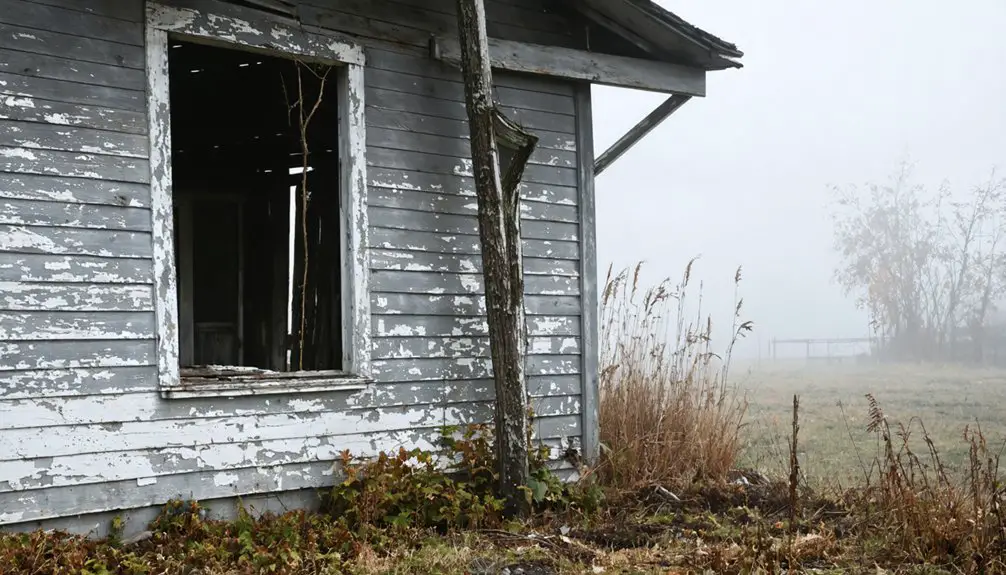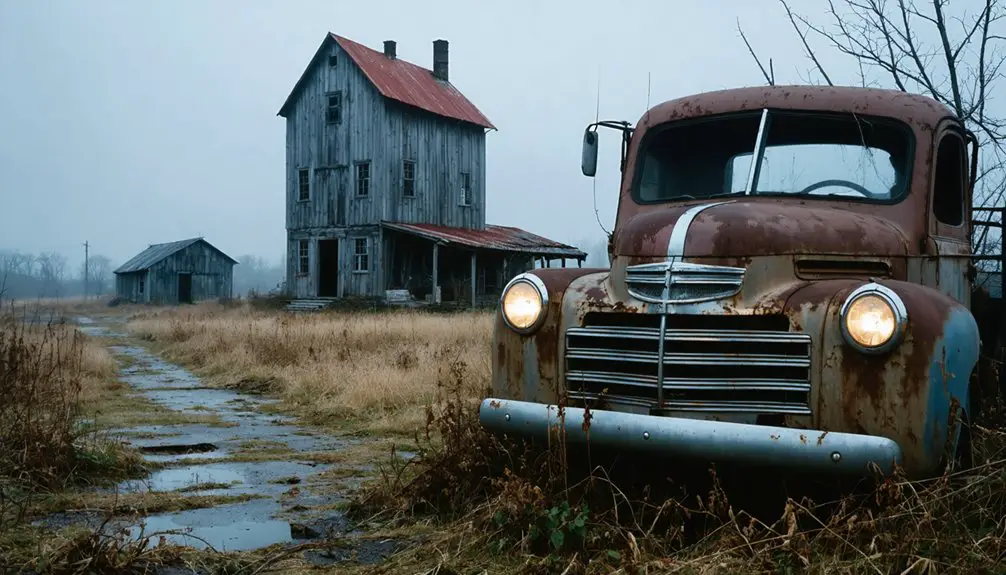
You’ll find Omard’s haunting remnants at the intersection of Peck Road and Isles Road (GPS: 43.257111°N, 82.903139°W), where three weathered structures—a tilting cemetery, skeletal church, and collapsed general store—emerge from Michigan’s dense forest like forgotten memories. Any standard vehicle handles the frost-heaved asphalt year-round, though spring mud patches the shoulders. Rusted mining equipment sinks into mossy earth alongside scattered iron relics and antique machinery fragments, creating an accessible portal into the state’s copper boom-and-bust era that rewards those who venture beyond the coordinates.
Key Takeaways
- Navigate to the intersection of Peck Road and Isles Road using GPS coordinates 43.257111°N, 82.903139°W, as no welcome markers exist.
- Access the site via M-53 to Peck Road, from Marlette northwest, or through county roads from Port Huron year-round.
- Explore three main structures: a cemetery with tilted headstones, a skeletal leaning church, and a collapsed general store.
- Discover scattered mining artifacts including rusted equipment, brick coke ovens, railroad ties, and pocket watches near collapsed shafts.
- Expect weathered roads with frost heaves and wilderness reclaiming former streets, now transformed into deer paths and root-covered mounds.
The History of Omard’s Copper Mining Legacy
Long before European settlers arrived with their industrial ambitions, something remarkable was happening on Michigan’s Keweenaw Peninsula—Indigenous Peoples were extracting pure copper from the earth using nothing but stone hammers and controlled fire. Between 5000 BCE and 1200 BCE, they pulled over 1.5 billion pounds from more than 5,000 pits, creating North America’s earliest metalworking industry.
When you explore Omard today, you’re walking grounds that witnessed influential mining magnates transform these ancient sites into industrial powerhouses. The 1840s mineral rush brought steam engines, compressed air drills, and nitroglycerin explosives. Michigan produced 11 billion pounds of native copper before Montana’s Anaconda mine overtook production in 1887. The decline of mining operations came swiftly after the 1913 strike, leaving ghost towns scattered across this copper-rich landscape.
What Remains at the Omard Ghost Town Site Today
When you arrive at Omard today, you’ll find just three weather-beaten witnesses to a once-thriving copper mining community: a lonely cemetery where miners and their families rest beneath simple markers, a skeletal church with walls still defying gravity, and the crumbling shell of the general store that once buzzed with Saturday commerce.
Scattered among the encroaching forest, you might spot rusted mining equipment—iron remnants of steam engines, ore carts, and hand tools—slowly sinking into the mossy earth. The wilderness has reclaimed most of what existed here, transforming former streets into deer paths and old foundations into root-covered mounds barely visible through the underbrush.
Visible Structural Remnants
Today, weathered wooden frames and crumbling stone foundations are all that interrupt the dense Michigan forest reclaiming Omard’s abandoned streets. You’ll discover three primary structures still standing against time’s relentless march.
What You Can Still Explore:
- The Cemetery – This overgrown burial ground offers the most intact remnant, with tilted headstones creating haunting cemetery landscapes that speak to Omard’s vanished community.
- The Skeletal Church – Leaning dramatically into the hillside, its exposed frame reveals church interiors stripped to bare timber, groaning in the wind like a living relic.
- The General Store – Collapsed walls and debris mark where daily commerce once thrived, now surrendered to invasive vegetation.
Between these landmarks, you’ll navigate ghostly foundations and scattered cabins—some preserving belongings from sudden abandonment, perfect for independent exploration.
Mining Equipment Artifacts
Beyond the skeletal buildings, Omard’s industrial past emerges through scattered iron relics and crumbling brick structures that once powered its coal mining operations. You’ll discover strange metallic artifacts embedded in the earth—unidentified pieces of antique mining machinery that hint at the site’s industrial complexity. Near collapsed air shafts, you might spot silverplated pocket watches within feet of miner’s tags, frozen moments from another era.
The dump sites reveal the most treasures. Waste rock extends from elevated mine mounds toward old water trapping dams, where pipe fragments and railroad-tied collectibles await discovery. Earth impressions mark where repurposed mining equipment once stood. Brick-fronted coke ovens, though bricked-up and weathered, still showcase their original masonry. These relics connect you directly to the miners who worked this unforgiving landscape.
Natural Reclamation Progress
Nature has staged a dramatic takeover at Omard’s former crossroads, where Peck Road meets Isles Road in Flynn Township. You’ll witness vegetation encroachment patterns that’ve accelerated since abandonment, transforming this mining settlement into wilderness.
Dense brush and mature trees now obscure foundation stones, demonstrating ecological restoration processes reclaiming what humans left behind.
What You’ll Encounter:
- Overgrown foundations – Trees push through crumbling stonework where buildings once stood
- Impenetrable thickets – Navigate carefully through brambles concealing the village’s original layout
- Photographic evidence – Compare historical images with today’s forest to track nature’s progression
The site remains accessible without barriers or restrictions. You’re free to explore these unmanaged lands, though bring boots and patience—Omard’s landscape reflects decades of unchecked growth since its 1940s decline.
Getting to Omard: Directions and Route Planning
Your journey to Omard begins on Peck Road, a straight ribbon of pavement cutting through Sanilac County‘s patchwork of cornfields and farmhouses where the horizon stretches endless under Michigan’s big sky. I remember my first trip here—turning off M-46 onto these rural roads felt like slipping back through time, with nothing but weathered barns and the occasional passing truck to remind me I was still in the 21st century.
The intersection of Peck Road and Isles Road marks your destination, easily accessible by any standard vehicle, though you’ll want to fuel up in Brown City since there’s nothing but open farmland once you head north.
Best Routes to Omard
The drive to Omard requires careful navigation through Michigan’s Thumb region, where county roads slice through flat farmland and the GPS signal occasionally wavers near towering silos. You’ll find cost effective routes converging at Brown City, five miles southwest of your destination.
From there, convenient transportation options include:
- M-53 to Peck Road northeast – Follow this primary route through Brown City, turning onto Peck Road for a straight shot to Omard’s intersection with Isles Road.
- Marlette approach from the northwest – Take state highways through open countryside, perfect for motorcycles and vintage cars seeking minimal traffic.
- County road network from Port Huron – Wind through authentic rural Michigan, passing century-old barns and roadside farm stands.
Pack detailed maps—cell service dies unexpectedly out here.
Road Conditions and Accessibility
When you roll into Omard’s crossroads, expect weathered asphalt pocked with frost heaves and patched cracks that tell decades of Michigan winters. Peck and Isles Roads handle standard vehicles fine, though spring thaw brings occasional muddy shoulders. You won’t find designated parking availability—just pull onto the grass near Omard Church or Cemetery, respecting any posted boundaries.
Signage challenges are real here. No welcome markers or historical plaques guide you; GPS coordinates (43.257111°N, 82.903139°W) prove essential. The intersection looks like any rural crossing until you spot the church steeple. County maintenance keeps roads passable year-round, but winter snow lingers longer on these secondary routes. Pack good tires, offline maps, and self-reliance—Omard rewards those who navigate without handholding.
Best Time to Visit Omard and What to Expect
Planning your ghost town exploration means weighing Michigan’s dramatic seasonal shifts against what little remains of Omard today. You’ll find crumbling foundations nestled in overgrown woods where lumberjacks once carved their fortunes.
The history of Omard, Michigan ghost town reveals a once-thriving community that succumbed to the passage of time. As you navigate the remnants, consider the stories each weathered beam holds and the lives that crossed paths in this now-forgotten place. Exploring such sites offers a glimpse into the resilience and hardships faced by those who sought to make their mark in the vast Michigan wilderness.
Seasonal extremes and vanishing traces make timing crucial when exploring Michigan’s forgotten lumber camps.
Late spring through early fall (May-October) offers your sweet spot—comfortable 50-80°F temperatures without winter’s brutal risks.
What awaits you at Omard:
- Spring-Summer (May-August): Dry trails perfect for exploring lumber-era trenches, though you’ll battle mosquitoes and ticks. Seasonal wildlife like deer emerge from thickets where sawmills stood.
- Fall (September-October): Peak visiting season delivers stunning foliage framing remnant structures—ideal for capturing historical photographs matching 1880s logging scenes.
- Winter (November-April): Only hardcore explorers brave 15°F temperatures and snowdrifts blocking access roads. Four-wheel-drive becomes essential, not optional.
Exploring Other Abandoned Mining Towns Near Omard
Beyond Omard’s lonely lumber-camp ruins, Michigan’s Upper Peninsula harbors dozens of abandoned mining settlements that tell richer stories—complete with standing buildings, preserved equipment, and underground tours you can actually walk through.
Central showcases its red sandstone Methodist Church and interpretive exhibits at a Visitor Center, where you’ll follow self-guided tours through streets once home to 1,200 copper miners. Delaware Mine drops you into actual shafts for $14, revealing underground workspaces your ancestors navigated by candlelight.
Fayette preserves an entire iron-smelting town—complete with hotel, meat market, and horse-racing track—frozen since 1891.
These aren’t roped-off museum pieces. You’ll walk dirt roads where Mandan’s 300 residents scattered buildings to new towns, touch rusting equipment at Freda’s abandoned mill, and choose your own adventure without tourist crowds controlling your pace.
Essential Gear and Supplies for Your Ghost Town Adventure

Three miles from Omard’s collapsed General Store, my boot sole peeled away after I’d stepped through rotted floorboards—a $180 lesson that proper gear isn’t optional when you’re exploring buildings that’ve weathered seventy winters without maintenance.
Proper footwear recommendations start with ankle-supporting boots featuring puncture-resistant soles. I’ve tested mine against rusty nails and broken glass scattered throughout Omard’s structures.
Pack these essentials:
- Heavy-duty gloves and dust mask protect against mold spores floating through abandoned homes
- Headlamp with backup batteries keeps your hands free while traversing pitch-black mine shafts
- First aid kit contents: gauze, antiseptic, tweezers for splinter removal, and wound closure strips
Your multi-tool handles emergency door prying. Paracord secures unstable entry points you’ll need for safe passage.
Photography Tips for Capturing Omard’s Historic Structures
When golden hour light streams through the church’s shattered stained glass, you’ve got maybe twenty minutes before those colors fade to flat gray—that’s when I learned timing matters more than expensive lenses.
For Omard’s weathered cemetery stones and crumbling general store, shoot during the soft morning light when shadows reveal texture without harsh contrast. Your camera settings should prioritize faster shutter speeds—these structures won’t stay standing forever, and neither will you in mosquito season.
Master basic lighting techniques like bracketing exposures; the church’s dark interior and bright doorways demand it. Pack a polarizing filter to cut glare off old windows. Most importantly, move quickly between locations—abandonment doesn’t wait for perfect conditions, and neither should you.
Combining Your Omard Visit With Upper Peninsula Attractions
After documenting Omard’s weathered church and cemetery markers, I pointed my truck northwest and realized Michigan’s ghost town network connects like abandoned railroad spurs—each site revealing another chapter of the lumber boom’s rise and collapse.
The 450-mile route to Keweenaw Peninsula’s mining camps passes Deward’s concrete sawmill foundations along Upper Manistee River, then crosses Mackinac Bridge into territory where Jennings’ relocated equipment powered Sault Ste. Marie mills.
This cross-peninsula journey traces lumber industry remnants from Deward’s riverside foundations northward through Mackinac straits to Sault Ste. Marie’s repurposed mill machinery.
Essential Upper Peninsula Extensions:
- Tahquamenon Falls (350 miles from Omard) pairs amber-tinted cascades with nearby natural attractions between ghost towns
- Deward ruins feature log-pulling blocks amid state forest roads—seasonal variations transform spring mud into fall’s hiking-friendly trails
- Central and Phoenix ghost towns echo Finnish settler heritage, mirroring Jennings’ transient lumberjack populations
You’ll chase vanished communities through elevation changes and cultural parallels.
Frequently Asked Questions
Are There Any Entrance Fees or Tour Costs to Visit Omard?
There aren’t established entrance fees since Omard faces private property restrictions limiting access. You’ll find no formal tourism development plans yet, leaving this forgotten place wild and unregulated—perfect for adventurers seeking off-grid exploration beyond commercialized attractions.
Is Overnight Camping Allowed at the Omard Ghost Town Site?
Overnight camping isn’t permitted at Omard itself, but you’ll find nearby recreation options with designated campsites in surrounding state forests. Seasonal accessibility varies, so check local regulations before planning your adventure into Michigan’s wild backcountry freedom.
Are the Structures at Omard Safe to Enter and Explore?
No, you shouldn’t enter Omard’s structures. With minimal remnants showing high decay, the structural integrity of buildings is severely compromised. Ground depressions and crumbling foundations create potential hazards for visitors seeking adventure in this forgotten landscape.
What Cell Phone Coverage Can I Expect in the Omard Area?
You’ll find limited cell phone signal strength around Omard since it’s remote rural territory. AT&T and Verizon offer your best shot at connectivity, though cellular data speeds may crawl. Download maps offline before venturing into this forgotten landscape.
Are There Restroom Facilities Available at or Near the Omard Site?
You won’t find restroom facilities at Omard’s abandoned site. Nearby public restroom options exist in Brown City, roughly ten minutes away. Restroom facility conditions vary, so plan ahead—pack supplies and embrace the freedom of rural exploration before visiting.