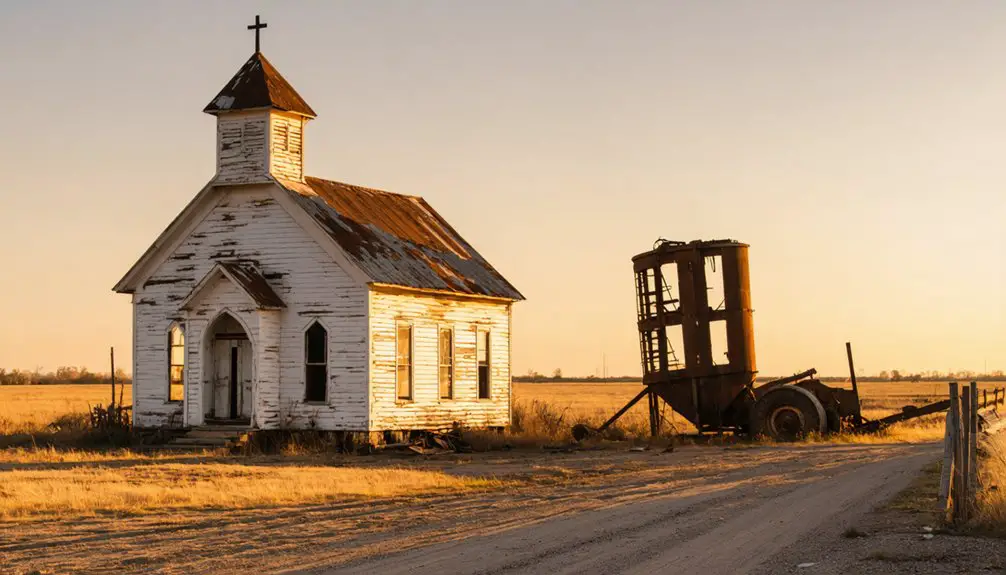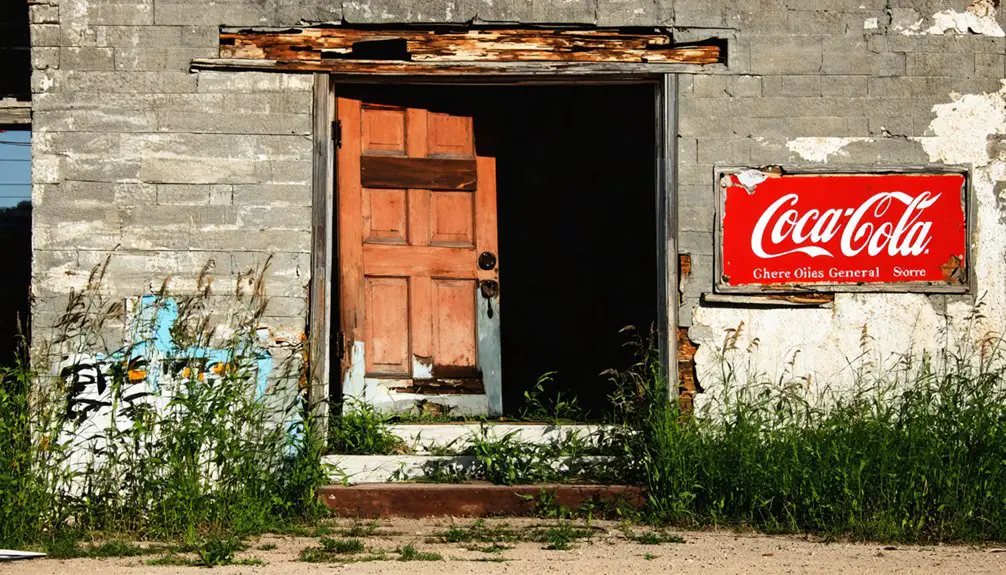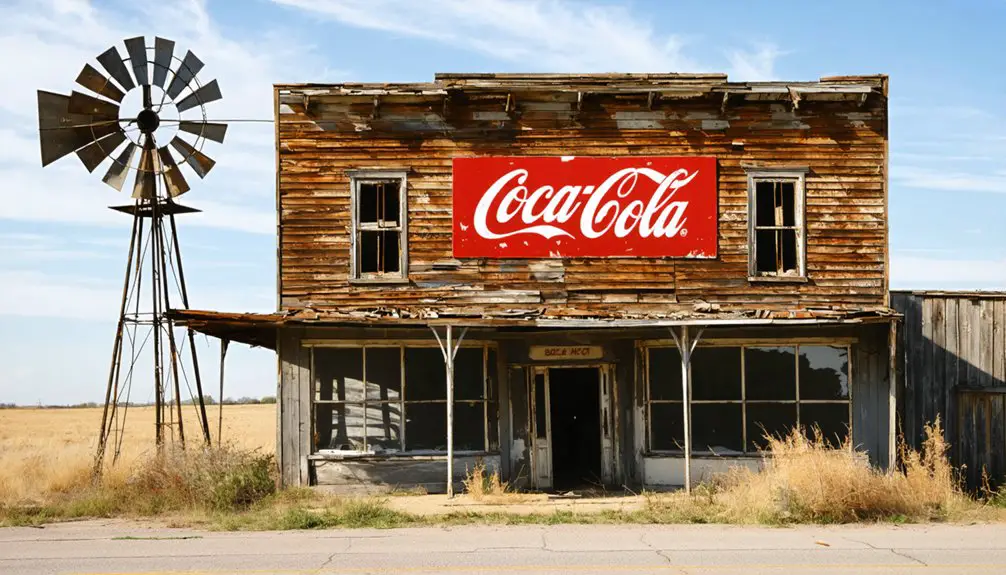
You’ll find Omega about 55 miles northwest of Oklahoma City along US-81, where pavement gives way to gravel roads leading to scattered ruins and weathered storefronts. Pack GPS coordinates, offline maps, sturdy boots, and plenty of water—this remote prairie location demands self-sufficiency. Spring and fall offer ideal 60-75°F temperatures for exploring the crumbling commercial buildings and foundation remnants. Consider extending your adventure to nearby Eagle City, Picher’s toxic mine sites, and Gray Horse to maximize your journey through Oklahoma’s forgotten frontier communities.
Key Takeaways
- Omega is located 55 miles northwest of Oklahoma City along US-81, accessible via gravel county roads requiring GPS coordinates.
- Spring and fall offer ideal visiting conditions with 60-75°F temperatures and moderate crowds for ghost town exploration.
- Explore nearby ghost towns including Eagle City, Picher’s toxic mining sites, and Gray Horse Osage settlements within driving distance.
- Bring proper supplies, GPS navigation tools, and personal protective equipment for remote conditions and structural hazards.
- Expect weathered commercial buildings, foundation remnants, and agricultural structures alongside scattered occupied farmsteads on the periphery.
The History Behind Omega’s Rise and Fall
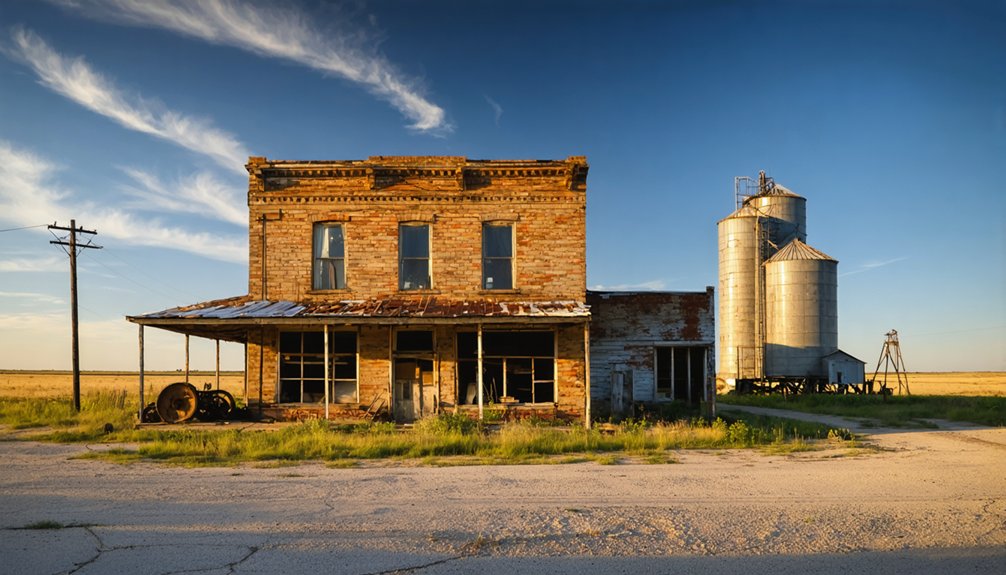
But freedom came with consequences. When railroads bypassed Omega for neighboring towns, your economic lifeline withered.
Agricultural crashes post-1920s emptied homes. By 2009, Omega joined Oklahoma’s 2,000 ghost towns—abandoned structures standing as monuments to dreams.
What Remains Standing in Omega Today
When you arrive in Omega, you’ll spot weathered structures scattered across the prairie, their wood siding bleached gray by decades of Oklahoma sun and wind. A few small community buildings still stand among the overgrown lots, their windows dark and doors hanging loose on rusted hinges.
The scene mirrors what you’d find at nearby Downs—farmland gradually reclaiming what the boomtown left behind, with just enough remnants to prove people once built lives here.
Abandoned Buildings and Structures
The skeletal remains of Omega rise from the Oklahoma prairie like monuments to a forgotten era, their weathered frames serving as evidence to over a century of boom and abandonment. You’ll encounter structures that demand respect—structural instability and environmental hazards make exploration risky without proper precautions.
What you’ll find among the ruins:
- Deteriorating commercial buildings with collapsed roofs and exposed timber framing
- Foundation remnants marking where homes once sheltered frontier families
- Agricultural outbuildings leaning precariously against Oklahoma’s relentless winds
- Scattered debris fields containing artifacts from territorial-era construction
Exercise caution when approaching these sites. Vandalism and decades of weather exposure have accelerated their decline. Document what you discover through photography—these remnants won’t stand forever, and your observations contribute to preserving Oklahoma’s vanishing frontier heritage.
Active Community Remnants
Contrary to its 2009 abandonment designation, Omega hasn’t completely surrendered to the prairie. You’ll discover scattered homes where resilient souls maintain their independence, refusing to let census classifications dictate their existence. These holdouts represent genuine community engagement—neighbors helping neighbors fix windmills, sharing well water, and keeping gravel roads passable.
While economic revitalization remains distant, a few weathered structures still serve practical purposes. You might spot occupied farmsteads on the town’s periphery, their satellite dishes and solar panels proving modern life persists here. The remaining residents embody that stubborn Oklahoma spirit, choosing isolation over conformity.
Don’t expect bustling activity, but recognize what you’re witnessing: freedom-seekers who’ve claimed this forgotten corner as their own, writing Omega’s unexpected final chapter.
Driving Directions and Route Options to Omega
You’ll find Omega tucked along US-81 about 55 miles northwest of Oklahoma City—an hour’s drive through flat Oklahoma farmland where grain elevators punctuate the horizon.
The route’s straightforward: take US-81 north through Kingfisher, then watch for the junction 15 miles beyond where a faded sign marks the turnoff. Your GPS might struggle with the exact location since Omega’s barely a dot on modern maps, so keep the Chisholm Trail Museum coordinates handy as a nearby reference point.
Primary Routes From Cities
Several major highways converge near Omega’s isolated coordinates, making this ghost town surprisingly accessible from urban centers across Oklahoma and neighboring states. You’ll find US-81 serves as your primary artery through Kingfisher County, cutting through prairie grasslands where abandoned homesteads dot the horizon.
Four Strategic Starting Points:
- Oklahoma City (50 miles) – Your quickest escape route follows US-81 north through wheat fields and forgotten settlements
- Tulsa (170 miles) – I-44 west delivers you through Stillwater’s college atmosphere before open country reclaims the landscape
- Wichita (200 miles) – US-81 south carries you across the Kansas border through Medford’s cattle country
- Dallas (200 miles) – I-35 north keeps travel costs reasonable while maximizing tourism potential through historic cattle-drive territory
Each route reveals Oklahoma’s untamed character.
Road Conditions to Expect
The pavement ends where Omega’s story begins. You’ll shift from maintained highways to gravel county roads that slice through Oklahoma’s backcountry.
Road conditions through remote areas vary dramatically—spring rains transform dry passages into muddy challenges, while summer bakes the earth hard as concrete. Winter ice can make these isolated routes treacherous without warning.
Expect washboard surfaces, loose stones, and sections where vegetation reclaims the roadbed. Your vehicle will earn its keep here. Potential seasonal route changes occur after severe weather; what existed last month might disappear beneath runoff or drifts.
No gas stations or services mark this final stretch—just open range and fading fence lines. Check local conditions before departing, carry supplies, and embrace the uncertainty. This remoteness isn’t obstacle; it’s invitation.
Finding Omega demands more than hope and intuition—modern GPS coordinates become your lifeline where road signs vanished decades ago. Route planning starts with downloading waypoints before you lose cell service on Kingfisher County’s gravel backroads. Load GPX files directly into your Garmin, marking township-range estimates refined through Google Earth.
Essential offline navigation tools:
- Pre-loaded coordinates from Ghost Towns of Oklahoma waypoints
- Downloaded maps covering northwest Oklahoma City radius (50+ miles)
- Township/range conversions pinpointing structures within mile sections
- Backup paper maps when technology fails mid-expedition
You’ll hunt around approximate locations—Omega won’t announce itself with billboards. Your GPS dot guides you to crumbling foundations and forgotten school yards. Expect gravel detours off Highway 152, where dual-sport bikes prove their worth beyond pavement’s end.
Essential Gear and Supplies for Your Visit

Before you point your vehicle toward the weathered remains of Omega, you’ll need to pack with the mindset of a pioneer crossing terrain that hasn’t changed much since the town’s abandonment. Throw a full first aid kit, flashlights, and multi-tool in your truck bed—proper storage techniques mean keeping water separate from electronics. You’ll want sturdy boots for traversing collapsed foundations and leather gloves for handling century-old debris without tetanus concerns.
Pack one gallon of water per person daily, high-energy trail mix, and cash—no ATMs haunt these plains. The navigational challenges extend beyond rutted roads; cell towers don’t reach Omega’s coordinates. Load offline maps, pack bear spray for coyote encounters, and toss in that rain jacket. Oklahoma’s weather shifts faster than tumbleweed.
Nearby Ghost Towns Worth Adding to Your Journey
While you’re tracing Omega’s dusty streets, you’ll find Alpha just minutes away—a settlement that flickered to life in 1893 and vanished within a decade, leaving nothing but prairie grass where homesteaders once staked their claims.
Head northeast to discover Centralia’s weathered structures perched on Craig County’s Blue Mound, where J.H. Hargrove’s 1898 vision crumbled by 1929, its skeletal remains still clinging to the windswept elevation.
For a deeper historical detour, Park Hill in Cherokee County offers more than abandonment—its cemeteries and preserved buildings tell stories of the Cherokee Nation dating back to 1836, making it a cultural anchor among Oklahoma’s forgotten settlements.
Eagle City’s Faded Remnants
Just seven miles west of Watonga on Highway 271, Eagle City waits in quiet obscurity, its faded street sign barely visible on the west side of the road. Continue another seven miles north on Highway 58 to reach this Blaine County settlement that never fulfilled its railroad dreams.
The eerie decay of the main street tells the story—four storefronts still standing as remnants of civic pride that couldn’t survive economic isolation.
What You’ll Find:
- Abandoned homes scattered across the west side, their empty windows watching the prairie
- Bare foundations where wildfires claimed buildings in 2000
- Friendly locals and wandering animals who’ve reclaimed these forgotten streets
- Accessible 2WD roads leading you deeper into Oklahoma’s vanished frontier
Visit during fall for ideal exploring conditions.
Picher’s Toxic Mining Legacy
The highway stretches northeast from Eagle City’s weathered storefronts toward a different kind of ghost town—one that didn’t fade from railroad rejection but died from poisoning itself. Picher produced $20 billion in ore and supplied half the metal for World War I, but left behind 70 million tons of toxic waste and 450 open mineshafts.
You’ll see rust-red water seeping from abandoned mines where 38 percent of children once tested for dangerous lead levels. The EPA evacuated everyone in 2009 after declaring the ground too unstable to inhabit. Despite $300 million spent on ongoing groundwater remediation, the long term health impacts remain sobering.
Chat piles still tower over demolished foundations—monuments to America’s most contaminated Superfund site.
Gray Horse Osage Abandonment
Forty miles southwest of Picher, Gray Horse tells a darker story than simple economic collapse—this is where oil wealth became a death sentence. Named after Osage medicine man Ka-wa-ko-dsa, this 1884 trading post transformed into a killing ground during the 1920s Reign of Terror.
What remains teaches hard lessons about power:
- Federal government failures created the “guardian” system that enabled systematic murder of over 60 Osage people
- Mansions built on $30 million in oil revenues now stand abandoned, monuments to stolen prosperity
- Oil company actions brought wealth that attracted predators—Rita Smith’s house exploded in 1923, killing three
- The ceremonial round house burned in 1963; only seasonal i’n-lon-schka dancers return each June
You’ll find overgrown schoolyards where children of the murdered once played.
Best Times of Year to Explore Oklahoma’s Abandoned Sites
When planning your ghost town adventure through Oklahoma’s dusty remnants, timing can transform a miserable slog into an unforgettable journey. Spring and fall reign supreme for exploring abandoned sites—mild 60-75°F temperatures let you wander Omega’s crumbling structures without melting or freezing. These seasons reveal prime seasonal visitation patterns, with moderate crowds granting you solitude among the ruins.
Weather impact on accessibility becomes critical when targeting remote locations. Summer’s thunderstorms wash out gravel roads, while winter ice blocks access to western ghost towns. Fall’s vegetation die-off exposes hidden foundations you’d miss during June’s suffocating overgrowth.
Skip October if you’re chasing solitude—Halloween seekers triple crowds at popular sites. Instead, aim for March through May or September through November, when you’ll navigate 10+ daylight hours with clear paths and minimal interference.
Safety Considerations When Exploring Abandoned Structures
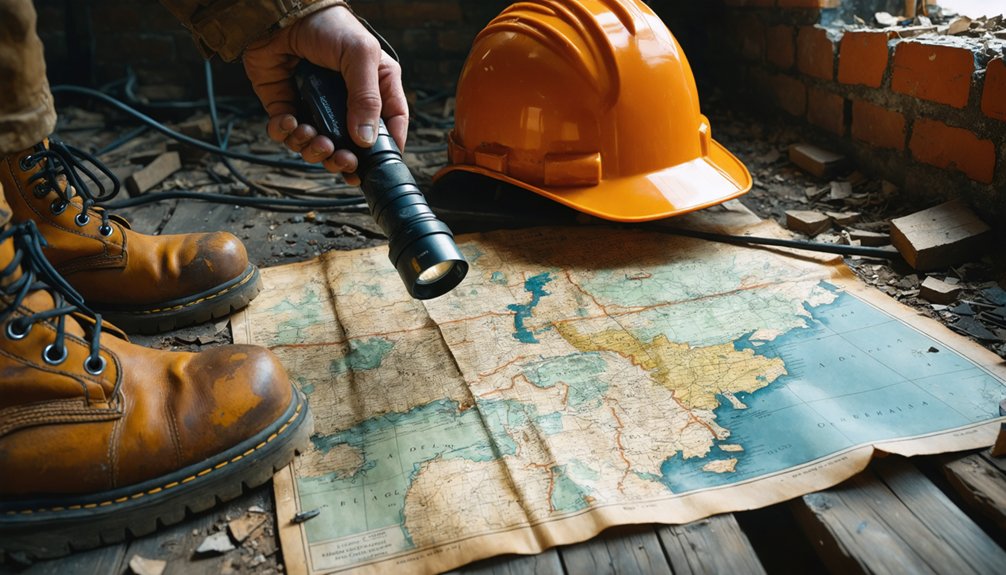
Picking the perfect weather window means nothing if you end up breaking through rotted floorboards in Omega’s abandoned general store. Before entering any structure, test every surface with a sturdy pole and scan for missing stairs or open shafts. Your personal protective equipment isn’t optional—steel-toed boots, heavy gloves, and respirators protect against hazards like asbestos and rusted metal.
Essential safety protocols:
- Never explore alone—inform someone of your exact location and expected return time
- Mark your path with chalk or ribbon to navigate back through darkened hallways
- Carry comprehensive, extensive first aid preparedness supplies including trauma dressings and tourniquets
- Identify exit routes immediately upon entry, noting alternative escapes if primary routes collapse
Watch for syringes, chemical barrels, and unexpected occupants in Omega’s forgotten spaces.
Photography Tips for Capturing Ghost Town Remnants
How do you capture the haunting beauty of Omega’s weathered facades before the midday sun washes out every shadow? You’ll need to arrive at dawn, positioning your tripod while stars still pierce the sky. That golden hour post-sunrise illuminates rust-streaked signs and crumbling doorframes with impossible warmth. Your wide-angle lens becomes essential for documenting the saloon’s collapse and the church’s skeletal remains.
Capturing ambient lighting transforms ordinary shots—long exposures render drifting clouds into ghostly streaks above abandoned structures. Work every angle around buildings; you’ll discover compositions others miss. Those broken bottles and scattered tools? They’re your emotional anchors.
Unique editing techniques like black-and-white conversion intensify the contrast between decay and permanence, while sepia tones whisper stories of exodus and forgotten dreams.
Five-Day Ghost Town Road Trip Itinerary

Your adventure begins in Kingfisher County, where Oklahoma’s forgotten settlements cluster like memories along dusty section roads. Omega, founded in 1892, offers small community involvement through local historians who’ll share stories abandoned structures can’t tell. Alpha whispers its decade-long existence from 1893 to 1903.
Your Five-Day Route:
- Day 1-2: Explore Kingfisher County’s Omega and Alpha, then push toward Logan County’s Orlando, where identical histories in two counties create mysterious duplication
- Day 3: Navigate Payne County’s Ingalls on established ghost town tours, experiencing natural preservation through minimal intervention
- Day 4: Discover Pawnee County’s Blackburn and Skedee, semi-abandoned since 1960
- Day 5: Journey to Boggy Depot State Park in Atoka County, where 1837 origins meet modern interpretation
Oklahoma’s 2000 ghost towns await your wheels and curiosity.
Where to Stay and Refuel During Your Adventure
Since ghost towns don’t exactly come with visitor centers and charging stations, you’ll base yourself in Oklahoma’s surviving communities that flank your exploration route.
Near Omega, you’ve got affordable hotel options like Watonga Motel and Western Inn, while the Lucky Star Casino Hotel & Convention Center delivers on site amenities including dining and entertainment.
If you’re pushing toward Oklahoma City, the Embassy Suites by Hilton near Will Rogers Airport puts rental cars within reach for quick exchanges.
Along I-35 between OKC and Dallas, Holiday Inn Ardmore at exit 33 serves as your strategic waypoint with restaurant access and easy parking.
Days Inn by Wyndham Henryetta works for eastern route explorers.
Most properties offer free cancellation—essential when chasing abandoned places that might demand unexpected detours.
Frequently Asked Questions
Is It Legal to Enter and Explore the Abandoned Buildings in Omega?
You’ll need permission before entering Omega’s crumbling structures. Explore legalities first—Oklahoma’s trespassing laws protect private property owners. Consider trespassing concerns seriously; those weathered buildings remain privately owned despite their abandonment, requiring written consent for your adventure.
Are There Any Guided Tours Available for Omega Ghost Town Visits?
No guided ghost tours operate at Omega—you’re on your own here. This forgotten townsite offers purely self-guided walking tours through overgrown ruins, where you’ll discover crumbling foundations and weathered memories at your own adventurous pace.
What Cell Phone Coverage Can I Expect in the Omega Area?
You’ll find excellent cell signal strength across Omega, with all major network provider availability covering 100%. Verizon delivers the strongest performance, though AT&T and T-Mobile work reliably too—keeping you connected while exploring this remote ghost town freely.
Are There Restroom Facilities Available Near Omega or Surrounding Ghost Towns?
You won’t find restrooms near Omega’s abandoned ruins. Restroom availability in nearby towns like Kingfisher becomes essential—plan ahead. The condition of restroom facilities there varies, but they’ll beat crouching behind crumbling foundations. Pack supplies and embrace your self-reliant spirit.
Can I Camp Overnight in Omega or Nearby Ghost Town Locations?
Like tumbleweeds drifting freely, you can’t officially camp at Omega’s historical markers. Instead, seek nearby public lands offering 14-day stays, where scenic overlooks become your campsite. Pack light, leave no trace, and embrace that wanderer’s spirit responsibly.