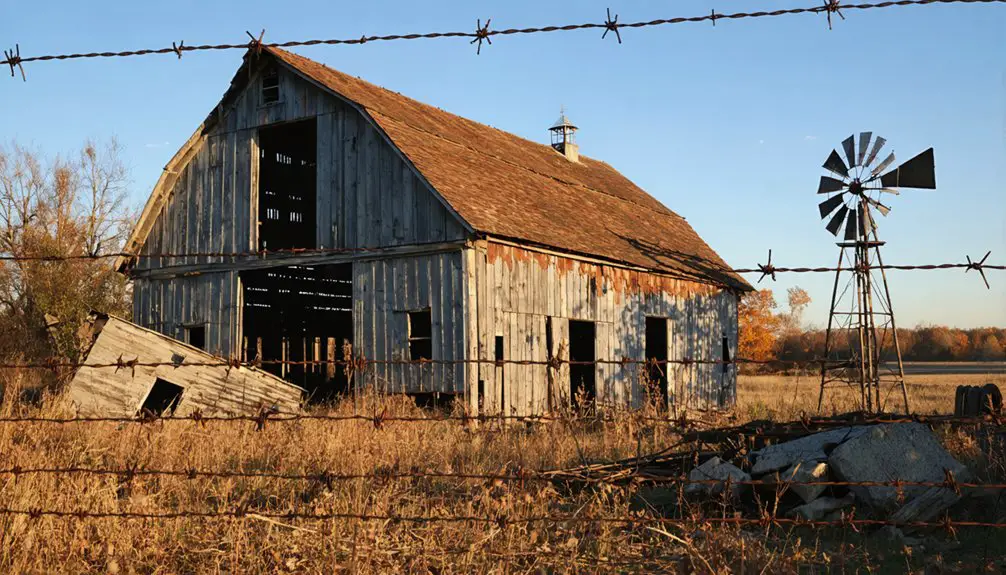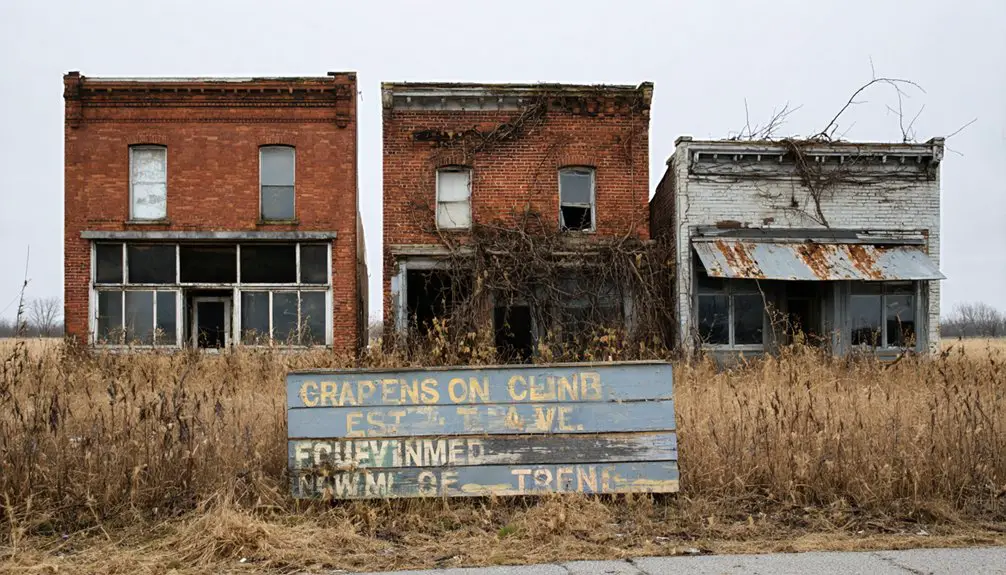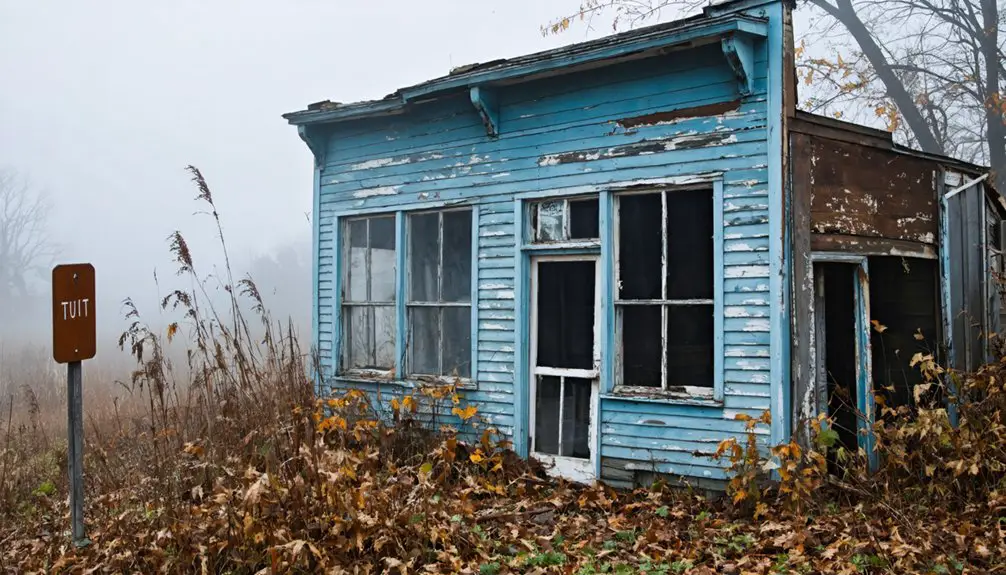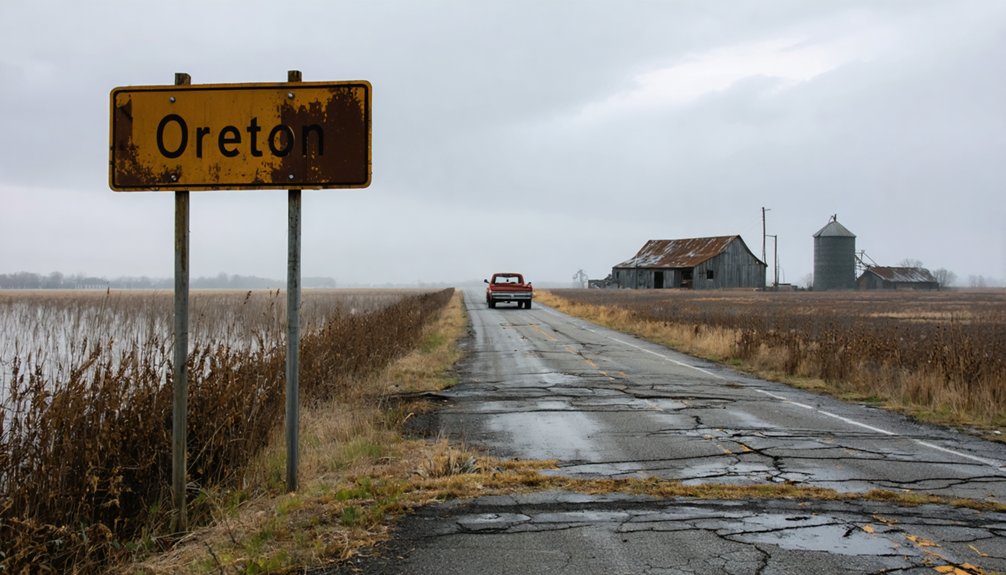
You’ll find Oreton at coordinates 39°09’50″N 82°24’46″W in Vinton County, accessible via State Route 160 near Zaleski State Forest at 692 feet elevation. Plan your visit for fall when October foliage frames the 40-foot Cincinnati Furnace ruins, first fired in 1854, or summer for dry trails leading to scattered foundations from the New York Coal Company‘s 70-house settlement. Bring a capable vehicle for gravel roads, and note there’s no cemetery—Oreton’s miners rest in neighboring communities. The full story of this 1920s abandonment awaits exploration.
Key Takeaways
- Access Oreton via State Route 160 through Vinton County near Zaleski State Forest at coordinates 39°09’50″N 82°24’46″W, elevation 692 feet.
- Visit during fall for peak foliage or summer for dry trails; avoid spring mud and winter conditions.
- Explore the 1854 Cincinnati Furnace ruins, Dave Ebert’s company store safe, and scattered foundations from 70 original houses.
- Plan for gravel roads and unpaved hiking paths that may challenge standard vehicles; consider 4WD for access.
- No cemetery exists on-site; miners were buried in neighboring towns, making Oreton uniquely haunting among ghost towns.
The Rise and Fall of a Mining Company Town
Deep in the hills of Vinton County, the New York Coal Company carved Oreton from the wilderness in the late 1800s, constructing a self-contained world where approximately 70 houses—many built by carpenter Bert Harder—rose to shelter miners and their families. The architectural styles of company built homes reflected functional necessity rather than aesthetic ambition, with modest structures clustered near Eagle’s Furnace and coal extraction sites.
You’ll find evidence of births recorded as early as 1853, when the evolution of mining technologies transformed southeastern Ohio’s landscape from farmland to industrial powerhouse. By the early 1900s, Oreton thrived with a post office, church, and general store. Then the mines closed in the 1920s, and families scattered, leaving behind empty shells along State Route 160.
What Remains of Oreton Today
Where seventy houses once crowded the hillsides, you’ll now discover only whispers of Oreton’s industrial past scattered across the wooded terrain along State Route 160. The crumbling iron furnace ruins, overseen by Civil War veteran Samuel T. Benner during the 1800s, stand as Oreton’s most prominent remnant.
You’ll find minimal residential remains—just scattered concrete and stone foundations marking where miners’ families once lived. Dave Ebert’s company store safe, a small brick structure, survives as the only known standing building.
Trek through these hills at 692 feet elevation, and you’ll notice something peculiar: no cemetery exists here. For over a century, Oreton’s deceased traveled miles to burial sites in neighboring towns, making this ghost town’s absence of final resting grounds uniquely haunting.
Discovering the Historic Richland Furnace
Just north of Richland Furnace State Forest along Vinton Township Road 6, you’ll encounter the stone remnants of what locals called Cincinnati Furnace when it first fired up in 1854. This 40-foot stack once produced 13 tons of iron daily, employing roughly 100 workers who earned a mere 65 cents for grueling 12-hour shifts.
The engaging furnace restoration in the 1860s included complete in-wall reconstruction and hot blast remodeling, pushing seasonal output to 3,500 tons. Intriguing workforce accounts reveal the operation’s massive scale—burning 2,500 tons of charcoal and processing 6,000 tons of ore annually. When Lake Superior’s richer deposits emerged, operations ceased in 1884, leaving these weathered stones as monuments to industrial ambition.
Getting to Oreton: Directions and Access Routes
Reaching Oreton requires traversing State Route 160 through the rugged hills of eastern Vinton County, where this ghost town’s scattered remnants lie approximately 692 feet above sea level at coordinates 39°09′50″N 82°24′46″W. You’ll navigate near Zaleski State Forest, where scenic state forest trails intersect with historical mining pathways. The route follows an east-west axis, with former streets like Oreton Boulevard and Smith Street marking where seventy mining families once lived.
From SR 160, you’ll need to hike unpaved paths to reach the iron furnace ruins and concrete foundations. Gravel roads may challenge standard vehicles, so plan accordingly. The location’s proximity to Zaleski offers seasonal wildlife viewing opportunities while you explore. No marked cemetery exists here; miners’ final resting places lie miles away in neighboring communities, legacy to Oreton’s complete abandonment.
Best Times to Visit the Ghost Town

Fall emerges as Oreton’s premier visiting season, when October’s foliage transforms eastern Vinton County’s dense forests into a tapestry of rust and gold that mirrors the iron furnace ruins themselves. You’ll navigate State Route 160 with clear sightlines to concrete foundations and brick safes, while seasonal variations bring comfortable 50-70°F temperatures perfect for outdoor pursuits among the coal mining remnants.
Summer offers dry trails and extended daylight for photographing the railroad tunnel, though you’ll encounter peak ghost town enthusiasts exploring the 1880-1950 post office site. Spring’s Raccoon Creek mud challenges even 4WD vehicles, while winter’s bite deters most wanderers—leaving you alone with Richland Furnace’s storied past. Skip stormy nights; this National Register site rewards daylight explorers.
Notable Landmarks and Points of Interest
When you arrive at Oreton, the iron furnace ruins anchor your exploration along State Route 160—towering brick stacks that processed Vinton County’s iron ore through the last half of the 1800s under superintendent Samuel T. Benner, a 12th Ohio Cavalry veteran.
You’ll discover the company store’s brick safe standing guard over scattered concrete foundations from approximately 70 miners’ homes built by Bert Harder. The post office site marks where community correspondence flowed from 1880 to 1950, while church and school remnants reveal gathering spaces once maintained by Azariah McManis.
Though preserved mining equipment has vanished, these foundations hold industrial archaeological significance—tangible evidence of families who carved autonomous lives from Appalachian coal seams before abandoning their remote settlement.
The Mysterious Night Watchman Legend

On stormy nights at Lake Hope Furnace, you might witness southern Ohio’s most enduring spectral tale—the ghost of George, the night watchman who perished in the 1800s while tending the ironworks. Witnesses report seeing a dark figure carrying a lantern along the furnace’s upper platforms, pacing back and forth in an eternal vigil until lightning flashes nearby and the apparition vanishes.
This phantom guardian continues his rounds more than a century after the fires went cold, appearing only when thunder rolls across the Appalachian foothills.
The Lantern Bearer Sightings
Since the 1920s, visitors to Oreton’s crumbling ore mine ruins have reported encounters with a spectral figure they’ve come to know as the Lantern Bearer—a tall, silent watchman who patrols the abandoned mining trails with a rhythmically swinging lantern. Standing 6 feet 5 inches tall in old miner’s attire, this apparition has sparked numerous paranormal investigations throughout Athens County.
Documented encounters reveal consistent patterns:
- Greenish lantern glow visible up to 200 yards without flame source
- Cold air drops preceding sightings on foggy evenings near mine entrances
- Faint whistling of mining-era tunes accompanying the figure’s 2-mph patrol pace
- Sudden disappearances near the old assay office foundation
Fifteen documented cases since the 1930s establish the legend’s historical significance, with October full moons producing peak activity along former watchman routes.
Stormy Night Apparitions
While the Lantern Bearer maintains his silent vigil along the mining trails, a different spectral guardian emerges at Richland Furnace when storm clouds gather over Vinton County. You’ll find the most compelling paranormal activity occurs during severe weather, when witnesses report a night watchman’s ghost making his rounds near the crumbling furnace remnants off SR 278.
These nighttime vigils mirror his original duties from the active mining era, when he died on these very premises. The apparition appears with lantern in hand, methodically inspecting the furnace area just as he did over a century ago.
Ghost town explorers document these manifestations concentrated at the northeast corner of the lake, where National Register site #1-82 marks the historic location. Storm-driven sightings continue drawing paranormal enthusiasts to Oreton’s abandoned landscape.
Furnace Guardian’s Eternal Watch
During Richland Furnace’s operational peak from 1854 to 1874, night watchmen bore the critical responsibility of maintaining the relentless fires that transformed raw ore into 15 tons of daily cast iron production. George’s story exemplifies their dedication—he refused to abandon his rounds despite an approaching storm, ultimately meeting his fate when lightning struck him on the wooden platform. His momentum carried him into the furnace below, stoking the furnace’s memories with tragedy.
You’ll find reports of George preserving the watchman’s legacy through eternal rounds:
- A dark figure carries a lantern across the furnace top on stormy nights
- The apparition paces the same platform path George walked in life
- Lightning strikes cause the figure to vanish momentarily
- He returns each subsequent storm, continuing his duty
Exploring Nearby Historic Sites in Vinton County
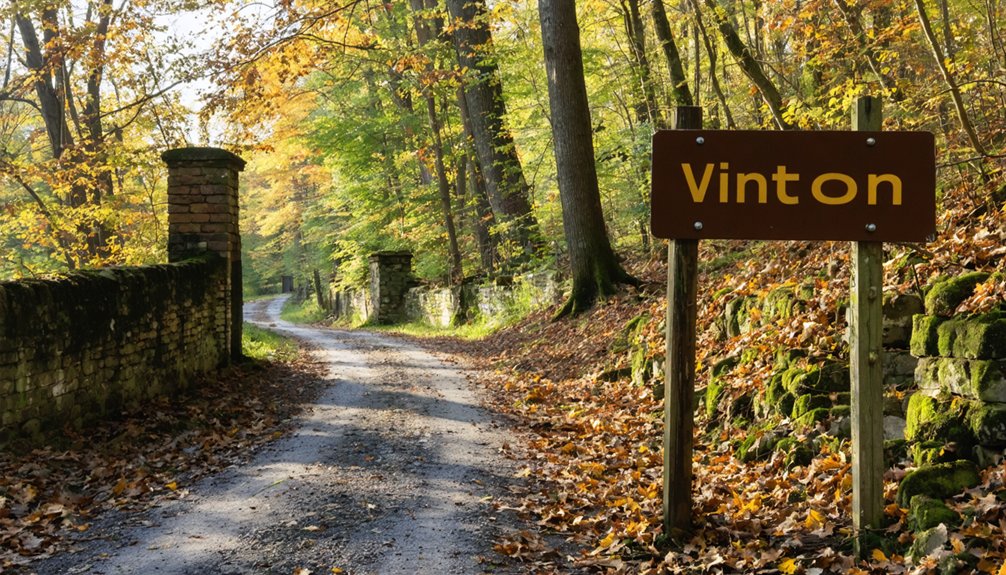
Beyond Oreton, you’ll find Vinton County scattered with iron furnace ruins that tell the story of Ohio’s 19th-century industrial boom. The skeletal remains of Hope Furnace, Richland Furnace, and Vinton Furnace mark where communities of hundreds once thrived on the coal and iron trade before disappearing into the forest.
Each abandoned site connects you to the county’s mining heritage—from company store tokens still surfacing near Vinton Station to sandstone structures that housed the roaring blast furnaces of the 1850s.
Other Vinton County Ruins
Before venturing to Oreton’s scattered remains, you’ll find Vinton County harbors dozens of lesser-known historic sites that reveal the region’s layered past.
Notable ruins across the county include:
- Hope Furnace – This rectangular sandstone blast furnace operated from 1854-1874, supporting 300-400 residents before abandonment left ornate architectural ruins standing sentinel in southeastern Ohio’s forests.
- Richland Furnace remnants – Explore the deteriorating furnace, tunnel, and primitive timber remnants scattered throughout Richland Furnace State Forest, marking another failed iron industry outpost.
- Old schoolhouses – Forgotten one-room education centers dot the countryside, offering glimpses into rural teaching traditions.
- Moonville Tunnel – This concrete rail tunnel survives from the 1800s ghost town, accessible via Moonville Rail Trail through dense woodland.
Each site rewards your curiosity with unguarded access to authentic frontier history.
Regional Mining Heritage Sites
Vinton County’s iron and coal industries transformed scattered forest settlements into thriving industrial centers between 1850 and 1890, leaving behind furnace ruins and abandoned mining camps that complement your Oreton exploration. Moonville Ghost Town anchors this heritage trail at coordinates 39.186533, -82.596500 in Brown Township, where coal mining and railroad operations sustained the community from 1856 until mines closed in 1947.
You’ll discover Richland Tunnel and deteriorating structures accessible via hiking trails off Richland Furnace Road. The region’s quarry history began in 1805 when Musselman discovered millstone deposits, dominating commerce before railroad resource transportation revolutionized the economy.
Frequently Asked Questions
Is It Legal to Explore and Take Photographs at Oreton?
You’ll need to verify current ownership before exploring, as private property considerations could restrict access. While no laws specifically prohibit photography, you’re responsible for respecting posted boundaries and addressing historical preservation concerns during your visit.
Are There Any Amenities or Facilities Available Near the Ghost Town?
You’ll find civilization’s comforts miles away from Oreton’s abandoned embrace. Nearby restaurants and local lodging options cluster around Lake Hope State Park and McArthur, where you’re free to resupply before venturing back into Vinton County’s forgotten wilderness.
What Safety Precautions Should Visitors Take When Exploring the Ruins?
Avoid entering unstable structures like Oreton’s crumbling blast furnace remains and brick safe. You’ll need proper equipment for exploration: sturdy boots, GPS navigation, and daylight hours. Travel in groups through this remote Vinton County terrain where mining-era foundations create hidden hazards.
Can I Camp Overnight Near Oreton or Richland Furnace?
You can’t camp at Richland Furnace itself—overnight stays are forbidden on these historic grounds. Instead, you’ll find freedom at private campgrounds like Lake Alma or public lands nearby including Pleasant Hill Lake’s 400+ sites awaiting adventurous spirits.
Are Guided Tours of Oreton and the Furnace Available?
No guided tours offered exist for Oreton’s furnace ruins—you’ll explore independently through thick Vinton County forest. Unlike nearby Moonville’s organized ghost hunts, group tours available aren’t listed here. You’re free to discover this abandoned iron town alone.