Exit Interstate 40 at Parkersburg Road, five miles west of Clinton, where Oklahoma’s forgotten settlement awaits your discovery. You’ll find weathered cemetery headstones breaking the horizon line north of historic Route 66, while abandoned buildings and the former school site cluster south of the alignment. Visit during spring’s mild April-May months, bringing sturdy boots, layered clothing, and plenty of water as you explore these windswept remnants where tallgrass prairie reclaims civilization’s retreat—and there’s much more to uncover about this haunting roadside memorial.
Key Takeaways
- Exit Interstate 40 at Parkersburg Road, five miles west of Clinton, to access the ghost town’s cemetery and remnants.
- Visit during April-May or October for ideal 65-75°F temperatures and comfortable exploration conditions without severe weather risks.
- Bring sturdy boots, water, sunscreen, layered clothing, navigation devices, and safety supplies for prairie exploration.
- Explore the weathered cemetery, abandoned building, former school site, and defunct gas station along historic Route 66’s alignment.
- Park along Route 66’s shoulder to access town remnants clustered south of the highway near visible railroad tracks.
The Rise and Fall of Parkersburg: A Brief History
The dusty ribbon of Route 66 once breathed life into Parkersburg, a modest settlement that materialized on the Oklahoma plains just west of Clinton during the highway’s golden age. You’ll find evidence of its crucial importance in school records spanning 1935 to 1943, when children filled classrooms from first through eighth grade.
The town’s organized municipal planning left tangible marks—a cemetery, multiple buildings flanking the highway, structures documented on 1944 Rand McNally maps.
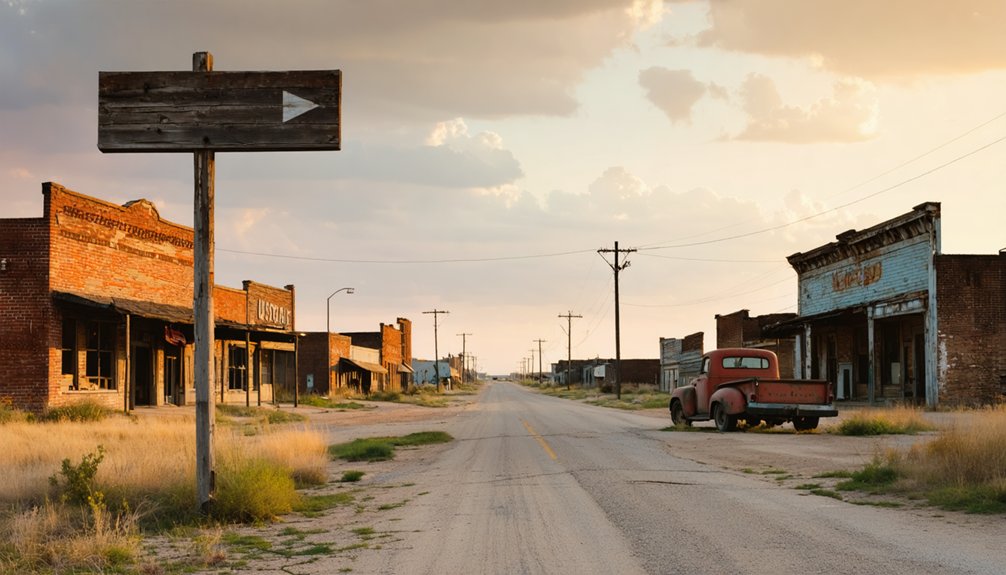
Then came the Interstate. Traffic diverted northward, commerce evaporated, and by 1957 the school stood abandoned. Buildings crumbled into the prairie wind. Today, you’ll discover little more than a cemetery and a single structure clinging to Route 66’s southern shoulder—silent monuments to a community that thrived briefly, then vanished.
What Remains Today: Cemetery and Route 66 Landmarks
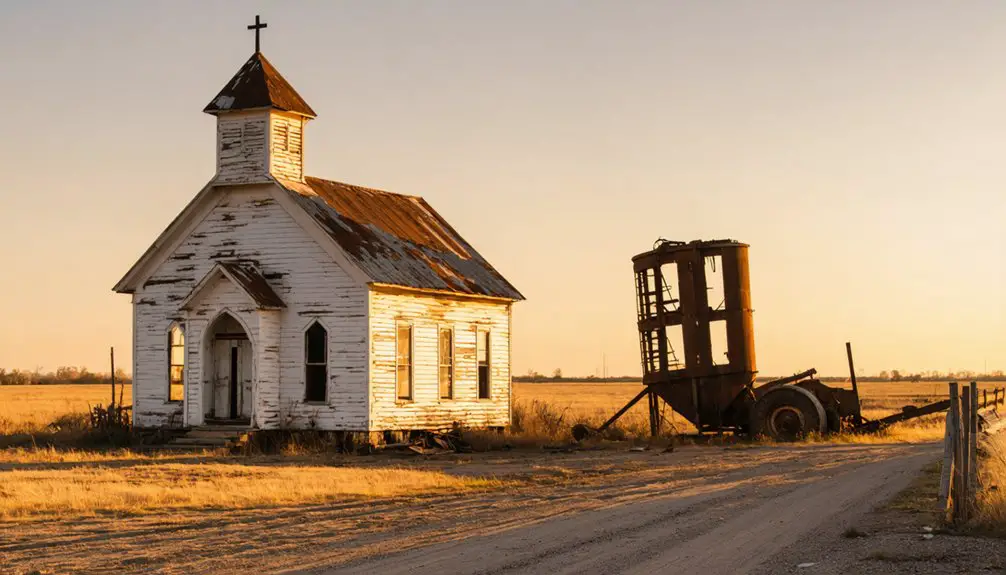
When you exit the interstate at the marked Parkersburg Road sign west of Clinton, you’ll spot the cemetery first—a weathered collection of headstones perched on a gentle rise north of the old highway, visible through the shimmering heat waves that dance across the Oklahoma plains. Unmarked gravestones lean at odd angles, guardians of stories lost to wind and time.
South of Route 66, three haunting remnants survive:
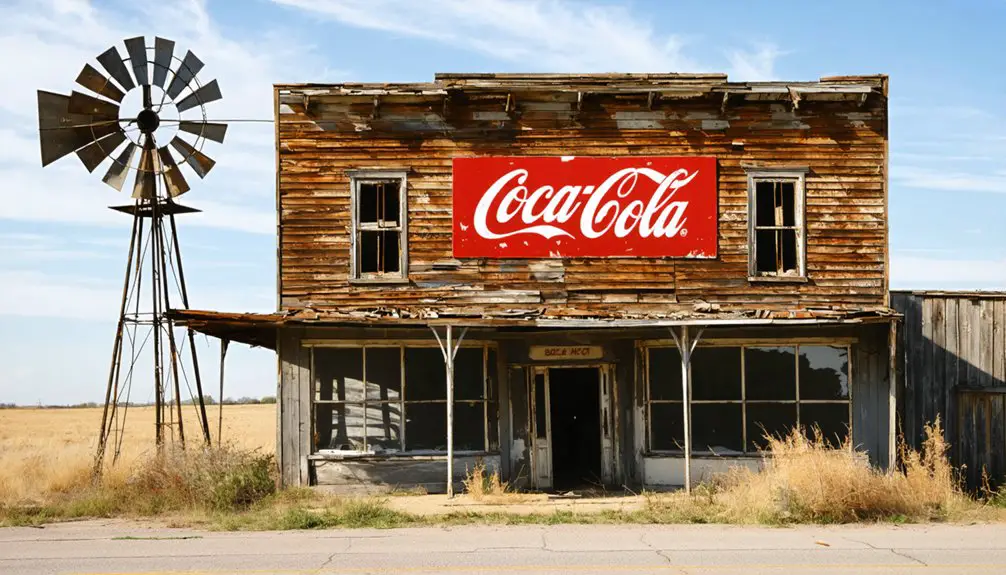
- A solitary abandoned building crumbling into red earth
- The former school site marked only on vintage maps
- A defunct gas station across the interstate, its rusted pumps frozen mid-transaction
The railroad tracks still gleam in the distance, carrying freight past a town that forgot to exist. You’re standing where America’s Main Street became a whisper.
Getting There: Directions and Access Points
Finding Parkersburg requires trusting old maps and newer signage to work in concert—Exit Interstate 40 at the marked Parkersburg Road approximately five miles west of Clinton, where the cemetery materializes first on your right, its weathered stones breaking the horizon line. The signage visibility proves adequate despite minimal development since 1983’s interstate integration.
Drop down to historic Route 66‘s alignment running parallel south of I-40, where the railroad tracks cut across the northern distance. Approaching from the west offers clearest orientation—town remnants cluster south of the roadbed, an abandoned building marking civilization’s retreat. Parking options exist along Route 66’s shoulder near the old school site. The interstate hums overhead while you stand where agricultural traders once gathered before Clinton’s rail hubs drew them eastward, building by building.
Best Time to Visit and What to Bring
Timing your Parkersburg expedition transforms the experience from survivalist ordeal to contemplative pilgrimage—spring’s shoulder months of April and May deliver that sweet convergence where wildflowers stipple the roadside prairies while temperatures hover in the 65-75°F range, perfect for tramping through knee-high grass without heat exhaustion shadowing your steps.
April and May transform Parkersburg visits into wildflower pilgrimages, with ideal 65-75°F temperatures replacing heat exhaustion with contemplative wandering through blooming prairies.
Your essential carry list for accommodating inclement weather:
- Layered clothing system spanning 40-80°F temperature swings, rain-ready poncho for Oklahoma’s sudden downpours
- Navigation essentials—GPS device with offline maps for pre trip route planning where cell towers vanish
- Safety cache—first-aid kit, flashlight for abandoned structures, weather radio during tornado season
Pack sturdy boots, water reserves, and sunscreen. October’s cooler alternative offers similar conditions without storm season’s edge.
Exploring the Site: Points of Interest
The cemetery stands as Parkersburg’s lone sentinel, its weathered headstones jutting from the tallgrass prairie like teeth in a giant’s skull—you’ll spot the entrance sign from Route 66 if you’re watching for it, though most drivers barrel past without registering this 19th-century burial ground that outlasted the town itself by decades.
Beyond the graveyard, you’ll find yourself wandering barren fields where 100 buildings once stood before their owners dragged them three miles east to Clinton. The historical significance reveals itself in absence—empty foundations swallowed by wheat grass, railroad tracks cutting through where merchants once haggled.
Natural scenery dominates now: wind-bent cottonwoods, red dirt roads disappearing into haze, the interstate humming in the distance. This desolation tells Parkersburg’s story better than any preserved structure could.
Nearby Attractions Along Historic Route 66
Your journey beyond Parkersburg’s weathered foundations leads you to Clinton’s Oklahoma Route 66 Museum, where 640 kilometers of Mother Road history unfolds through vintage passenger cars and steam engines. The museum stands as an essential pilgrimage site, documenting the iconic highway’s golden era with artifacts and photographs that capture the road’s transformation from dusty thoroughfare to American legend.
Between Parkersburg and Clinton, you’ll encounter other forgotten settlements—crumbling storefronts and abandoned homesteads that share similar tales of boom, decline, and the relentless passage of time.
Clinton’s Route 66 Museum
Just thirty miles southwest of Parkersburg, Clinton’s Route 66 Museum stands as Oklahoma’s official chronicle of America’s Mother Road. You’ll discover museum collections spanning from 1926 to 1985, where vintage vehicles and authentic artifacts tell stories of westward migration and open-road freedom.
Highway preservation comes alive through three unforgettable exhibits:
- A psychedelic hippie van with “Make Love Not War” painted across its doors
- Valentine Diner from 1938, showcasing factory-built roadside architecture
- Pop Hicks Restaurant display, recreating 1950s diner culture
The Oklahoma Historical Society’s chronological journey connects you with Dust Bowl refugees, World War II convoys, and post-war prosperity. For seven dollars, you’ll walk through Depression-era newspaper headlines and examine relics from when this legendary highway represented pure American possibility—before five Interstates erased its path forever.
Other Oklahoma Ghost Towns
Beyond Parkersburg’s windswept ruins, a constellation of forgotten towns punctuates Oklahoma’s Route 66 corridor, each one bearing scars from floods, economic collapse, or the Interstate’s cruel bypass.
You’ll find Texola straddling the 100th Meridian, where a 1910 territorial jail still stands sentinel. Foss remembers when floodwaters erased its original location, leaving only Kobel’s crumbling gas station as witness.
In Erick, old saloon buildings transformed into truck stops tell stories of reinvention, while the Curiosity Shop defies abandonment with roadside charm.
Northeast, seven ghost settlements—Ontario, Picher, Potter, Lincolnville, Narcissa, Oseuma, and White Oak—offer abandoned commercial structures and mining-town mysteries. Afton’s empty streets invite exploration, with motels available if you’re brave enough to spend the night among the ghosts.
Frequently Asked Questions
Are There Any Guided Tours Available for Parkersburg Ghost Town?
You won’t find guided tour offerings at Parkersburg’s windswept ruins—local preservation efforts remain minimal. Instead, you’ll explore independently along crumbling Route 66, discovering weathered cemetery stones and ghostly remnants through your own adventurous spirit.
Is Overnight Camping Permitted Near the Parkersburg Site?
Want to sleep under stars where whispers of the past echo? Unfortunately, overnight camping isn’t permitted near Parkersburg due to private property ownership. You’ll need to explore nearby public lands, though seasonal accessibility varies throughout the year.
What Safety Precautions Should Visitors Take When Exploring the Remaining Building?
Wear sturdy footwear to navigate crumbling debris and rusted metal scattered across forgotten streets. Avoid entering unstable structures—those skeletal buildings hide collapsing floors and toxic dust. Respect warning signs; they’re your lifeline in this haunting, poisoned landscape where freedom meets responsibility.
Are There Restroom Facilities or Services Available at the Site?
No restroom availability or on-site services exist at Parkersburg’s weathered remains. You’ll find only abandoned structures and prairie winds here. Head east to nearby Clinton for modern amenities—gas stations, restaurants, and facilities await along your freedom-seeking journey.
Can Visitors Access Historical Records or Photographs of Original Parkersburg Buildings?
You’ll discover absolutely treasure troves of historical archives through the Oklahoma Historical Society and National Archives, where photographic exhibits reveal Parkersburg’s vanished architecture. These collections let you freely explore the town’s forgotten past through vivid imagery and documentation.